This dissertation examines how intensional content, i.e., belief ascription, constrains antecedentgap chains. I defend the proposal that antecedent-gap chains are intensionally uniform: the antecedent and the gap must refer to the same... more
Author(s): Gluckman, John Daniel | Advisor(s): Sportiche, Dominique | Abstract: This dissertation examines how intensional content, i.e., belief ascription, constrains antecedent- gap chains. I defend the proposal that antecedent-gap... more
Still, we have a poor understanding of why some predicates participate in the alternation above (difficult, easy) but other things don’t (tall, quick). Here I address this issue by exploring what defines the natural class of... more
This paper focuses on Portuguese adjetival constructions akin to English contructions with tough movement – e.g., "este problema é difícil de resolver" ‘this problem is tough to solve’. In standard European and Brazilian Portuguese, the... more
In this paper', we will examine several different types of tough-and similar constructions. They have A -positon fillers and show unbounded dependency between filler and gap. Problems with the rule-based approach of GKPS arise when the... more
Although there is a lot of literature dealing with the classification and distribution of Korean adverbials, there does not seem to be any satisfactory work. This is partly due to the properties of the adverbials themselves, whose... more
Concord adverbial constructions in Korean show unbounded dependency relationships between two non-empty entities. There are two different types of unboundedness involved: one between a concord adverbial and a verbal ending and the other... more
Tough-constructions (henceforth TC, Rosenbaum 1967 a.o.) involve a subjective predicate (like tough, easy, impossible, important, annoying) embedding an infinitival clause, and taking an optionally overt EXPERIENCER argument, as shown in... more
Les adjectifs tough et le marquage de l'infinitif en néerlandais 1. Les marqueurs sans correspondant en français seront gardés tels quels. Il s'agit de : HET (pronom personnel neutre) ; ER (pronom clitique locatif correspondant à la fois... more
Le point de départ de cet article est la proposition soutenue dans Lagae & Van Peteghem (2020) de distinguer deux constructions tough en néerlandais, dont l'une n'est compatible qu'avec un nombre restreint d'adjectifs tough prototypiques... more
Looking back at the last 5 and a half years, I realize how tough and painful it has been. When my wife, my son and I came here, my son was only 11 months old. I don't remember how many nights I had to wake up at 3am in the morning to get... more
This linguistic textbook by Peter Culicover provides a broad introductory overview of various topics in the study of syntax. Its major objectives are to show how natural language makes use of various syntactic and morphosyntactic devices,... more
The dissertation offers an illustration of how pragmatically-aware investigation of longstanding linguistic problems can result in fresh progress. The approaches here could be extended or applied to other areas, other constructions, other... more
This article addresses the syntax of the notorious tough(-movement) construction (TC) in English. TCs exhibit a range of apparently contradictory empirical properties suggesting that their derivation involves the application of both... more
The 'multiple subject constructions' (=MSCs) in Korean and Japanese display peculiar language specific phenomena which can not be easily explained, either syntactically or semantically. These phenomena are syntacticaJIy interesting in... more
Although researches have been conducted on the polysemous nature of some Korean psych-adjectives, no consensus has been made on the criteria used for evaluating the polysemy. Furthermore, few formalizations (semantic structures) have been... more
This paper focuses on different behaviors of missing arguments and adjuncts. More specifically, this paper shows that interpretations of missing arguments can be freely recovered regardless of their environments while those of missing... more
Basic Data Given the common assumption that there is at most one subject per clause, the multiple occurrence of subject-like, nominative-marked NPs is puzzling. This puzzling phenomenon can be noticed in various constructions in Korean,... more
Yekan is typically used with a long-form negation, and the negation is interpreted like a metalinguistic negation. But I show that the negation associated with yekan is not metalinguistic but descriptive. The reason that descriptive... more
ion. Regarding Korean psych-adjectives and their -e hacounterparts, e.i., [psychadjective + -e ha-] constructions, what is at issue is how to capture the semantic difference and similarity between the two. Concerning this issue, one of... more
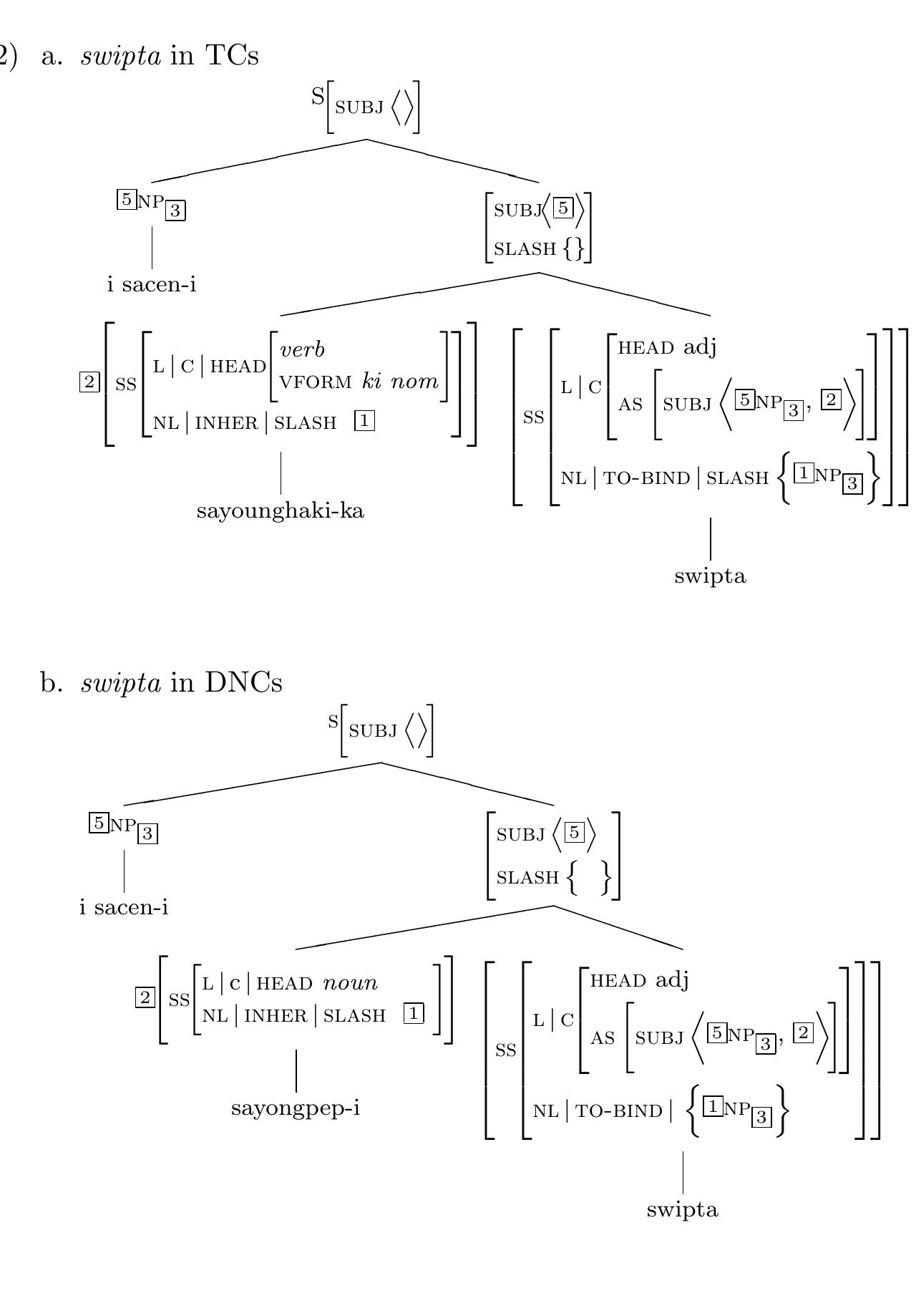
Some examples of non-object TCs are given as follows. i Lazarusj-ka [ j shyophingha-ki ]-ka/ey swipta (Locative) Lazarus-nom do shopping-nml-nom/for easy 'Lazarus is easy to do shopping (in)' ii yenphilj-i [ j kulssi-lul sseu-ki ]-ka/ey... more
What roles do syntax and semantics have in the grammar of a language? What are the consequences of these roles for syntactic structure, and why does it matter? We sketch the Simpler Syntax Hypothesis, which holds that much of the... more
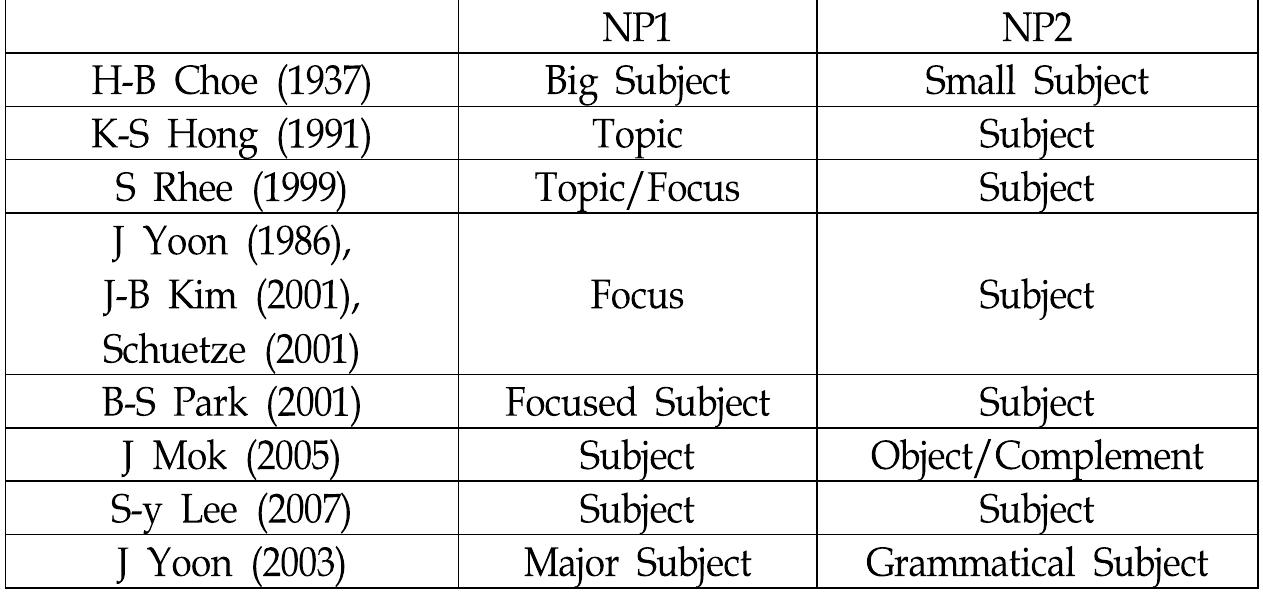
Previous Proposals and Problems Regarding the key question, two main streams of proposals are basically discernible. One stream maintained that both NP1 and NP2 are subject, trying to define various notions of subject: e.g., Yu (1909)... more
This paper presents a Vrst attempt to oUer a comprehensive typology of the pairs of identical-case marked NPs in Korean. On the basis of such semantic relations between two consecutive NPs like meronymic relation, inclusion relation,... more
Korean [… V-ko iss-] is ambiguous between progressive and resultative meanings. We assume that it is ambiguous in three ways: P(rogressive)-reading, R(esultative)-reading and p(seudo)-R-reading constructions. These constructions allow... more
I demonstrate instances where sentences that “should” be ungrammatical according to conventional syntax, are not. Their acceptability seems to hinge on something more than syntax alone. Problematic cases of this sort can be optimally... more
What roles do syntax and semantics have in the grammar of a language? What are the consequences of these roles for syntactic structure, and why does it matter? We sketch the Simpler Syntax Hypothesis, which holds that much of the... more
Historically, control in generative grammar has fallen within the province of syntactic theory. One primary reason for this is that Mainstream Generative Grammar (MGG) has imposed a strong uniformity criterion on analyses as a measure of... more
It has been claimed in the literature that Korean allows the relativization of another relative clause, deriving the so called 'double relative clause'. The presence of 'double relative clauses' has led some researchers to argue that... more
The central observation in our discussion of tough-constructions (TCs), such as John is easy to please, may be one according to which “the set of grammatical TCs is a ‘subset’ of that of other grammatical wh-movement constructions, such... more
Historically, control in generative grammar has fallen within the province of syntactic theory. One primary reason for this is that Mainstream Generative Grammar (MGG) has imposed a strong uniformity criterion on analyses as a measure of... more
very welcome 1 Gradience and categoricity in generative syntax
[A Clausal Predicate Analysis of Korean Multiple Nominative Constructions. Korean Journal of Linguistics , 33-4, 869-900] We will provide a clausal predicate analysis of Multiple Nominative Constructions (MNCs) in Korean, under the... more
Concord adverbial constructions in Korean show unbounded dependency relationships between two non-empty entities. There are two different types of unboundedness involved: one between a concord adverbial and a verbal ending and the other... more
In this paper, we will examine several different types of tough- and similar constructions. They have A -positon fillers and show unbounded dependency between filler and gap. Problems with the rule-based approach of GKPS arise when the... more
Two types of analysis are possible for Tough Movement constructions: Analyses with long distance movement of the matrix subject (such as Hicks 2005) or without it (such as Chomsky 1973). Here I present two pieces of evidence from child... more
• To provide a syntactic mechanism that permits a predicate to combine with a NP and become another (clausal) predicate • To show that the nominative NPs in MNCs are not different from one another regarding their grammatical functions
It is shown that in Korean, just as in English, relative clauses are built from two standalone structures linked to each other by coreference. A relative element in one clause must obligatorily refer to a non clausemate antecedent.... more
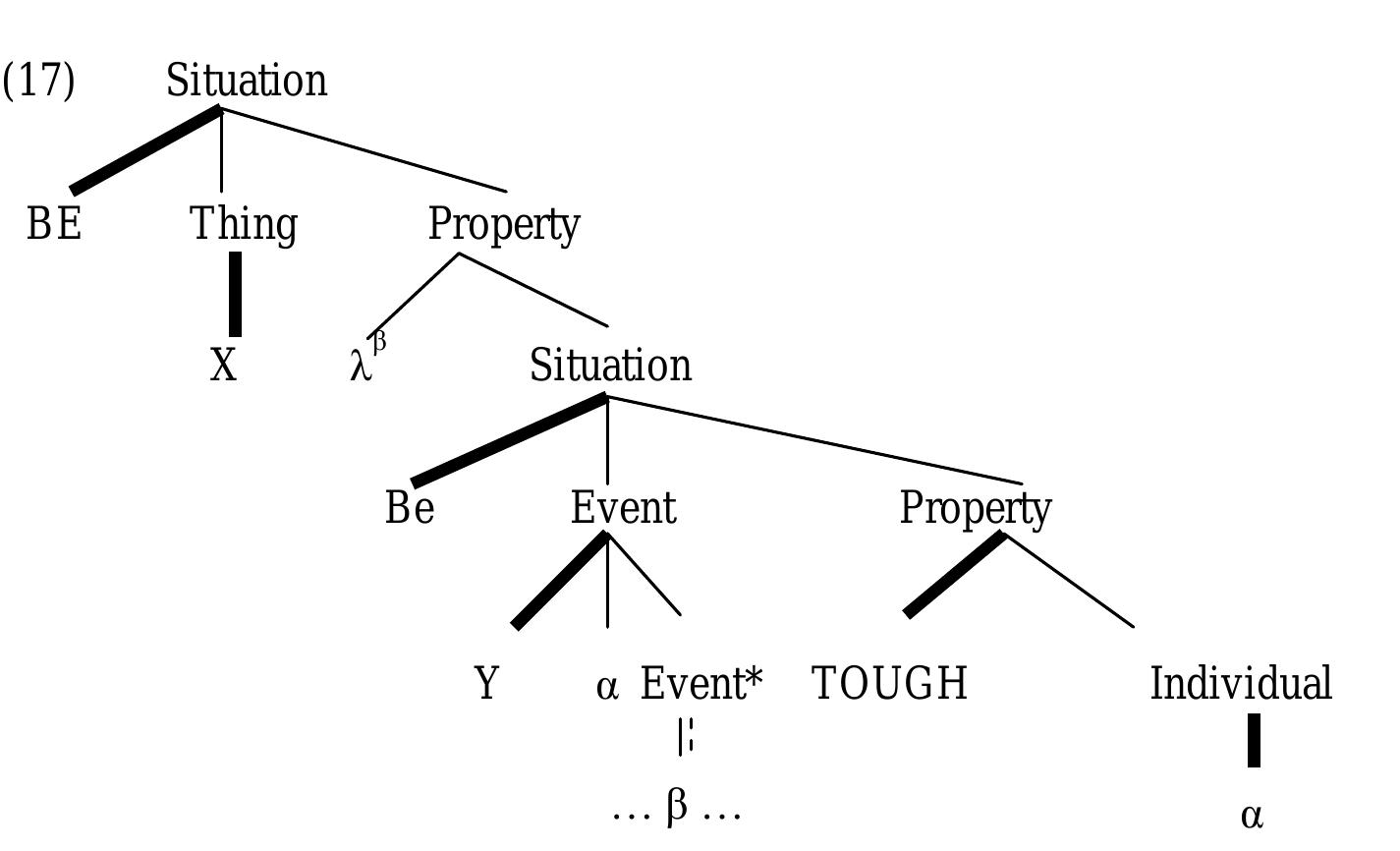
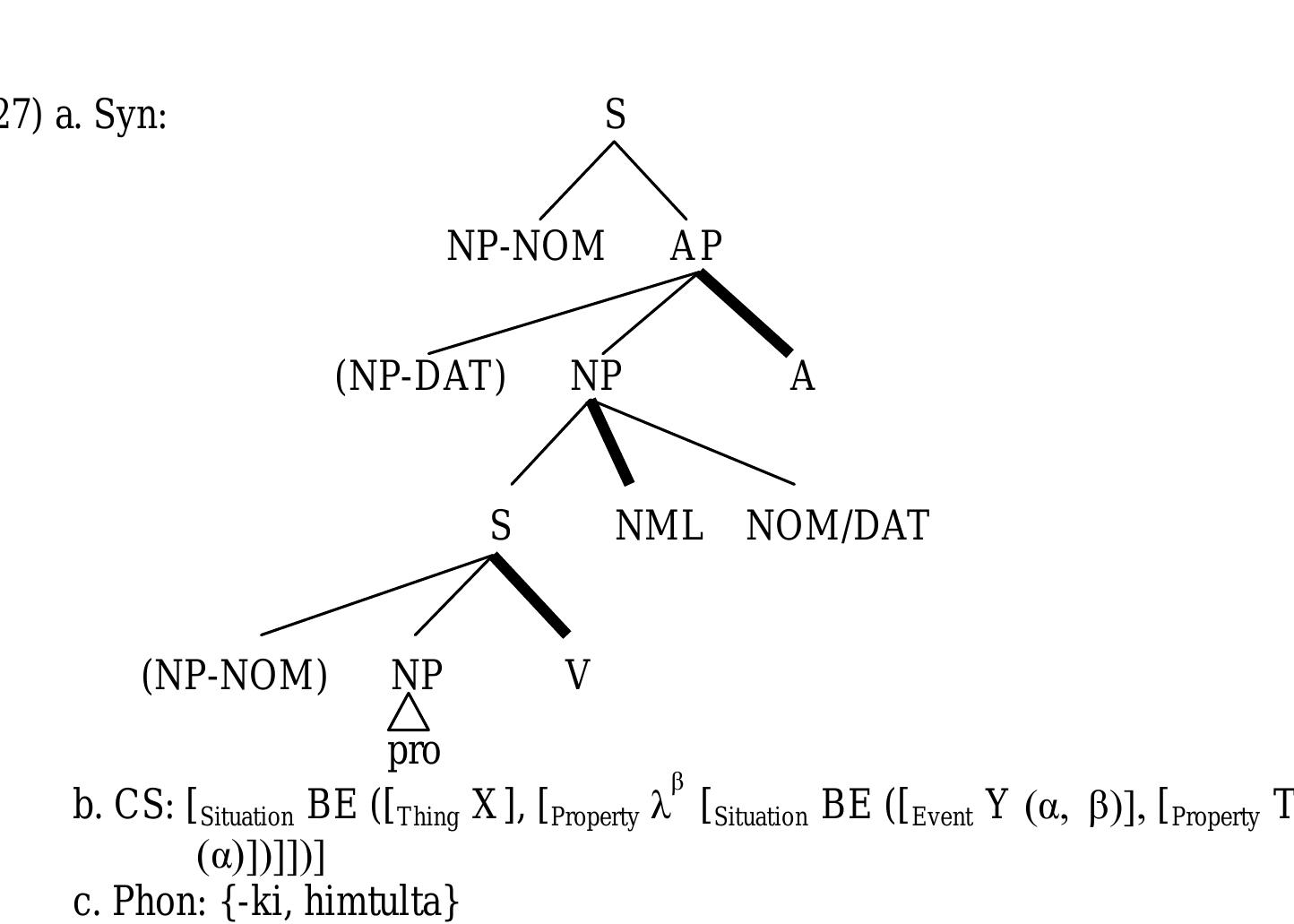
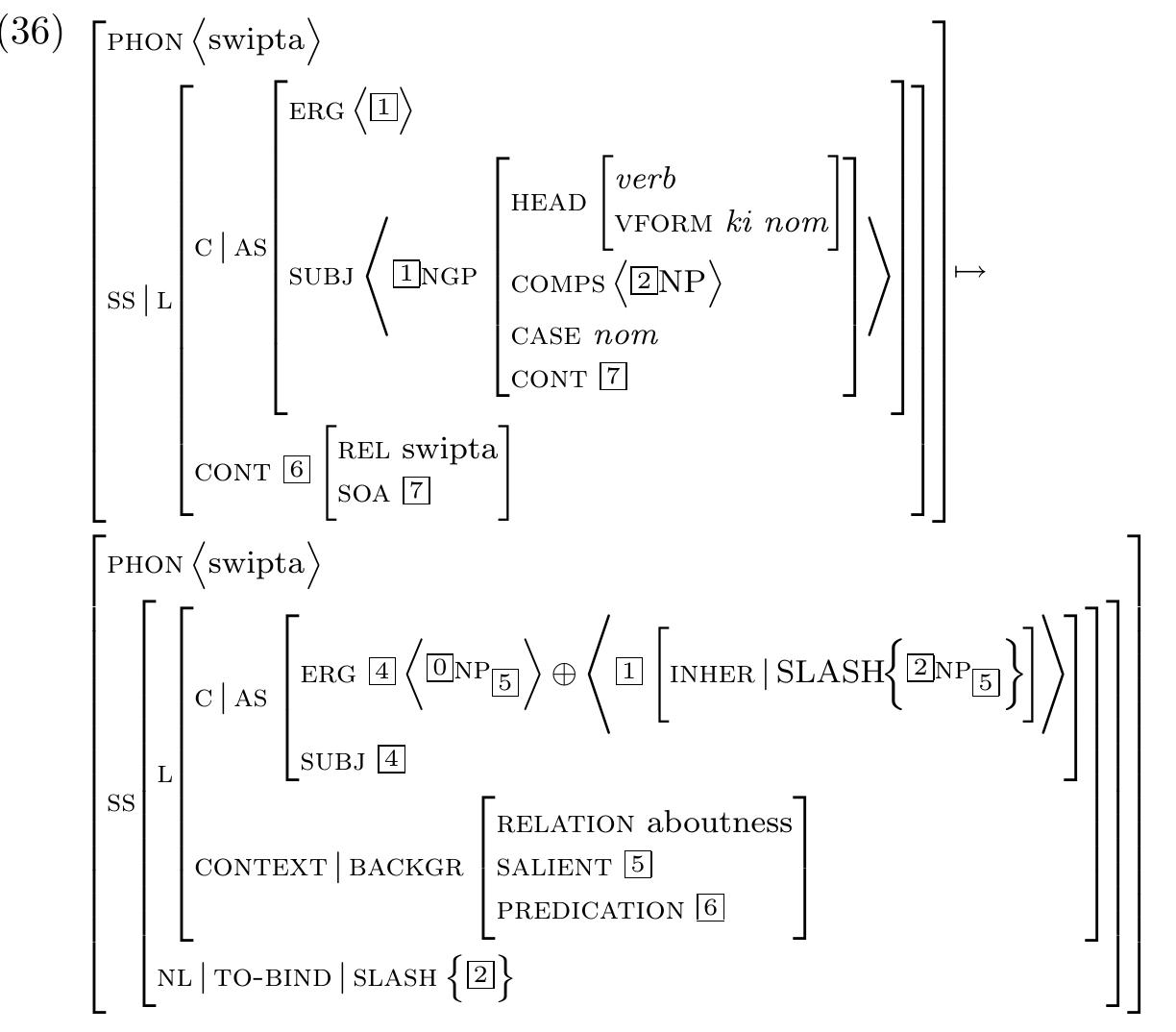
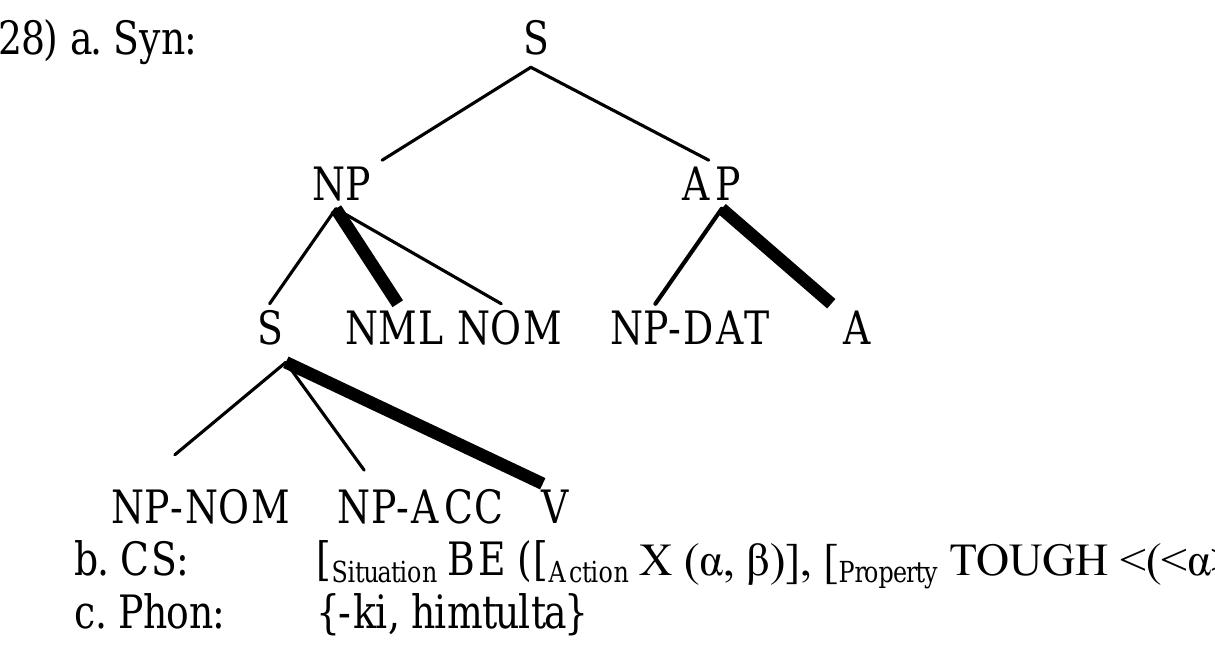
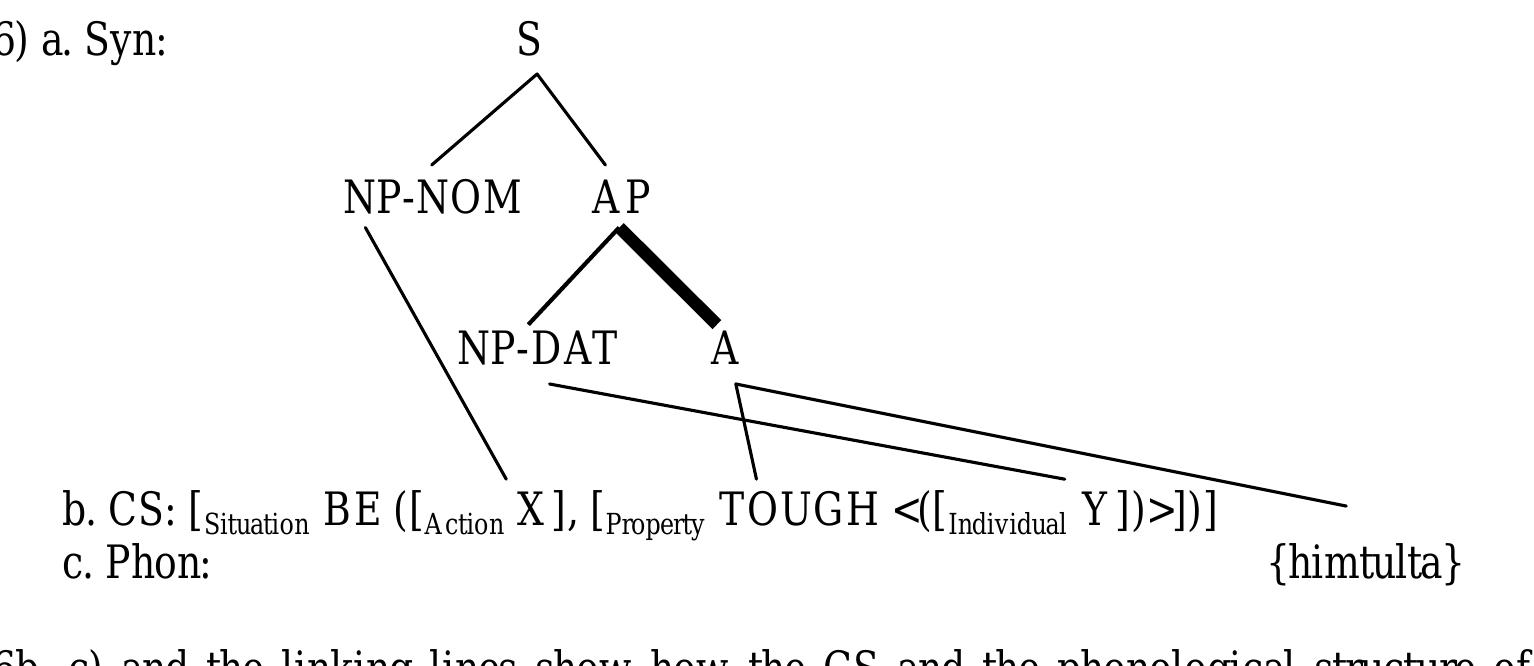
Unlike English tough-constructions, Korean tough-constructions have attracted few researchers’ attention, in spite of their interesting and important characteristics from both syntactic and semantic perspectives. In this paper, I propose... more
Many previous studies on Korean psych-predicates have tried to account for the NOM-DAT alternation of experiencer from various perspectives within various theoretical frameworks. Overall, these studies can be divided into two broad... more


![The nominative NP sar-/is licensed by the predicate Afuita as its subject, which is represented by the SUBJ feature. On the other hand, the next nominative NP ¢ta/-i is licensed by the noun san as its specifier, and the NP amuyli-ka by the noun ftal Please note that the feature SPR carries the information about the specifier. B-Y Park (2001: 175) assumes that the NP ¢ta/-/ is the subject of the clausal predicate [son-i kuhta] and the NP zayli-ka is the subject of | ¢tal-i son-i khutal. Let us examine B-S Park’s (2001: 182) analysis in a little more detail and see how it works:](https://figures.academia-assets.com/36735549/figure_002.jpg)
![According to this analysis, the unit of [NP2-V] (e.g. [Atio-ka kil-ta) is "reanalyzed" as a verb (p. 198) and, as a new verb, obtains the property of governing a new NP (i.e. NP:). The whole unit in (9) would also have to be reanalyzed as a verb when there is another nominative NP on the left. However, let alone the plausibility of the mechanisms responsible for the reanalysis, it is not clear at all how a fully productive clause can be treated as a lexical item. Furthermore, it is assumed that any [NP2-V] units can be reanalyzed as a verb. However, we will see that only those verbal units which represent a property can trigger MNC sentences. Not so many works are explicit about the mechanisms to account for the multiplicity of nominative (and/or accusative) NPs. M-c Ahn (2001) provides some mechanisms for a "Phrasal Verb" analysis (p. 192):](https://figures.academia-assets.com/36735549/figure_001.jpg)
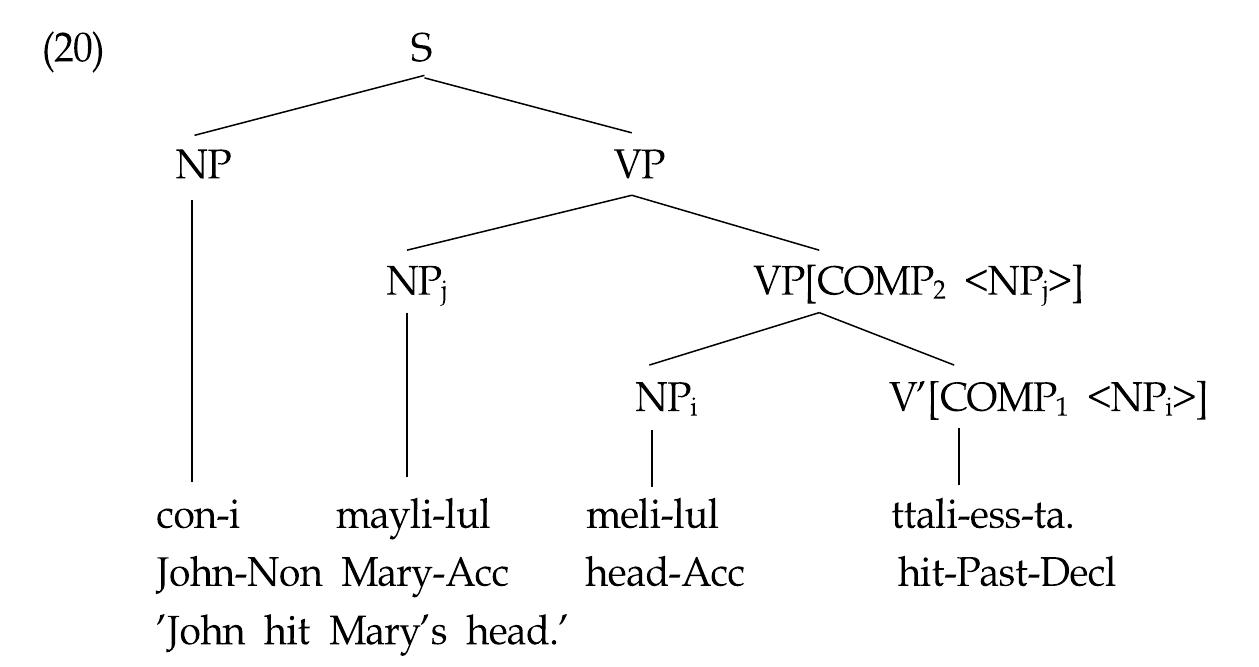
![As the verb pissata denotes a property, all the verbal projections, i.e. VP and S, have the feature [PROPERTY +]. The innermost nominative NP, NP, is licensed by the SUBJ feature introduced by pissata, i.e. SUB)i. The next NP is introduced by the rule in (14a) on the level of [S — NP, S] and the outermost one on the level of [5 — NP, S]. As there are two "extra" nominative NPs, the rule has been applied twice. The analysis here clearly captures the important characteristics discussed above. It shows that MNCs can have an unlimited number of nominative NPs. In addition, the structure shows that a MNC sentence consists of NPs and their clausal predicates and that the NPs do not make a single constituent. With the mechanisms introduced above, we can now provide syntactic analysis of MNCs:](https://figures.academia-assets.com/36735549/figure_003.jpg)
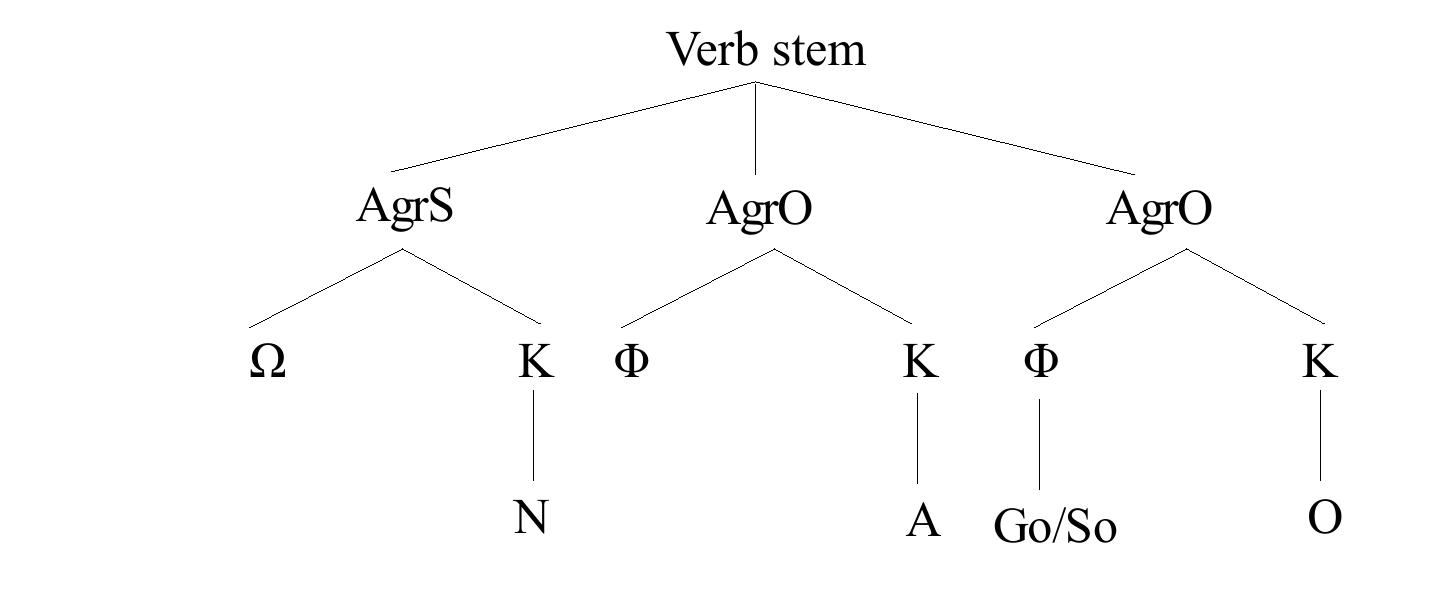
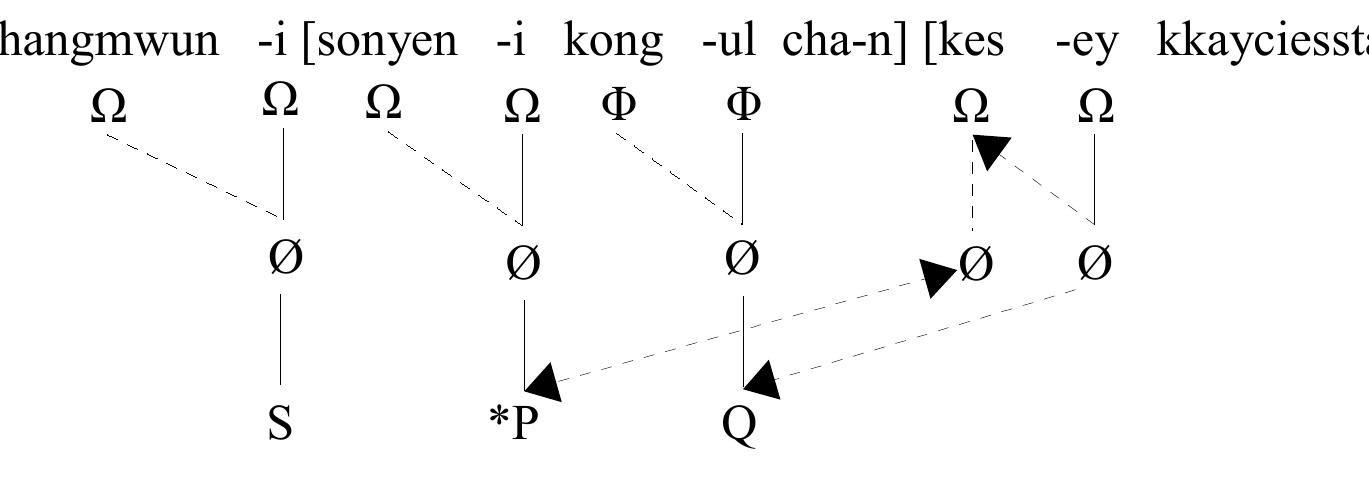
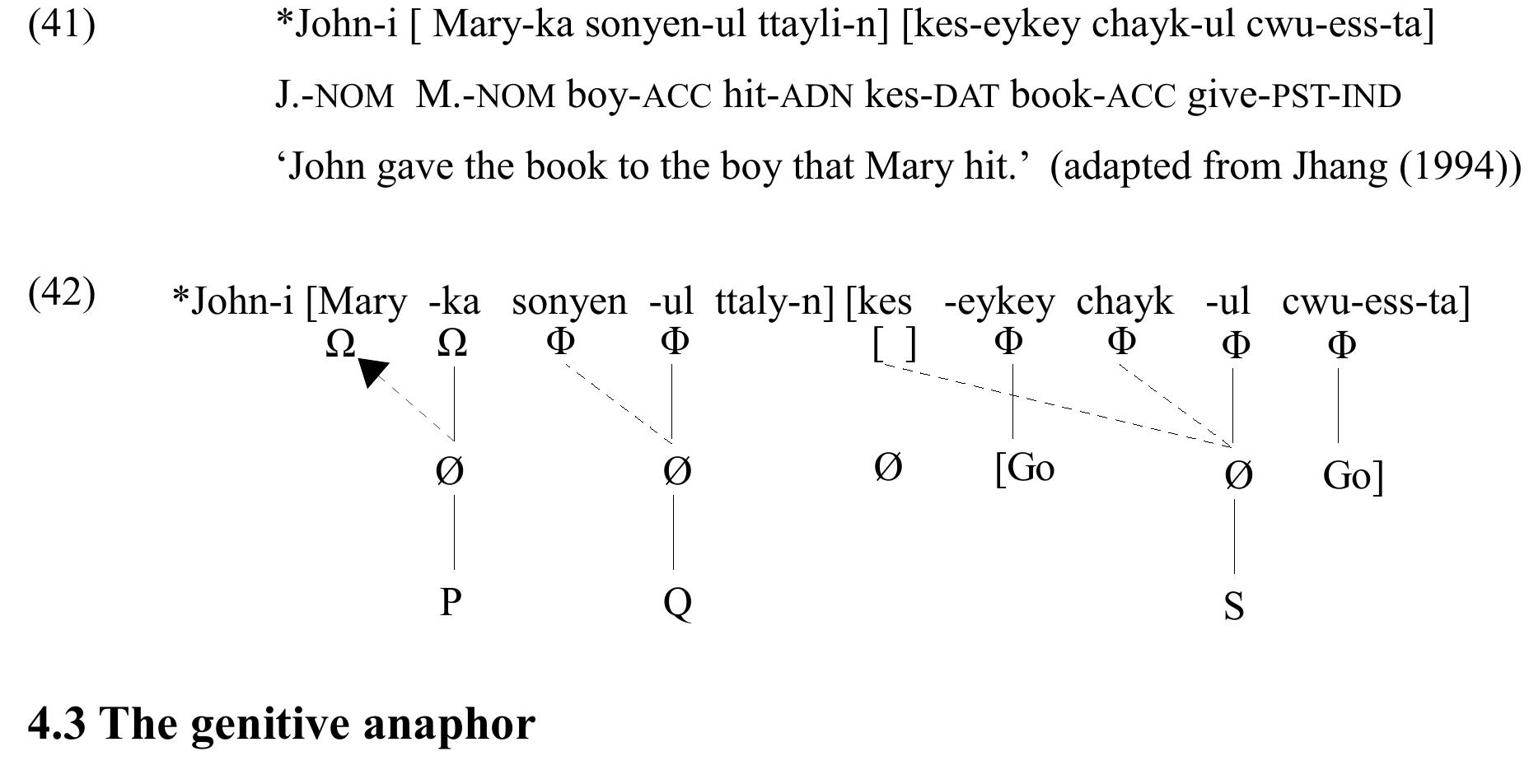
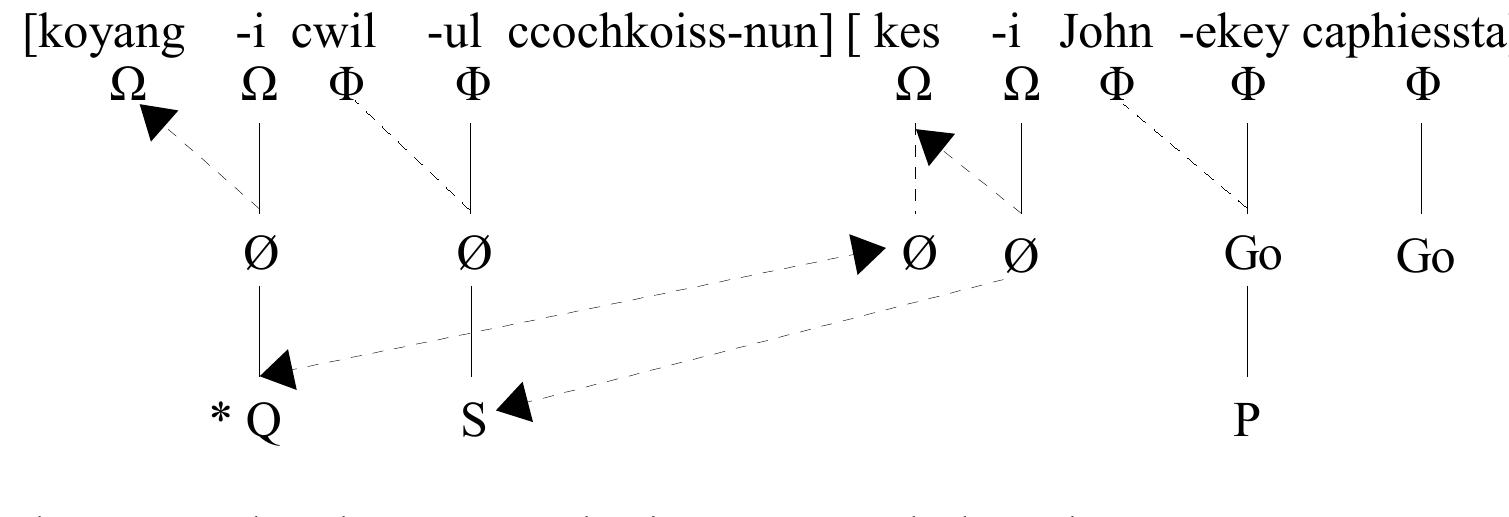
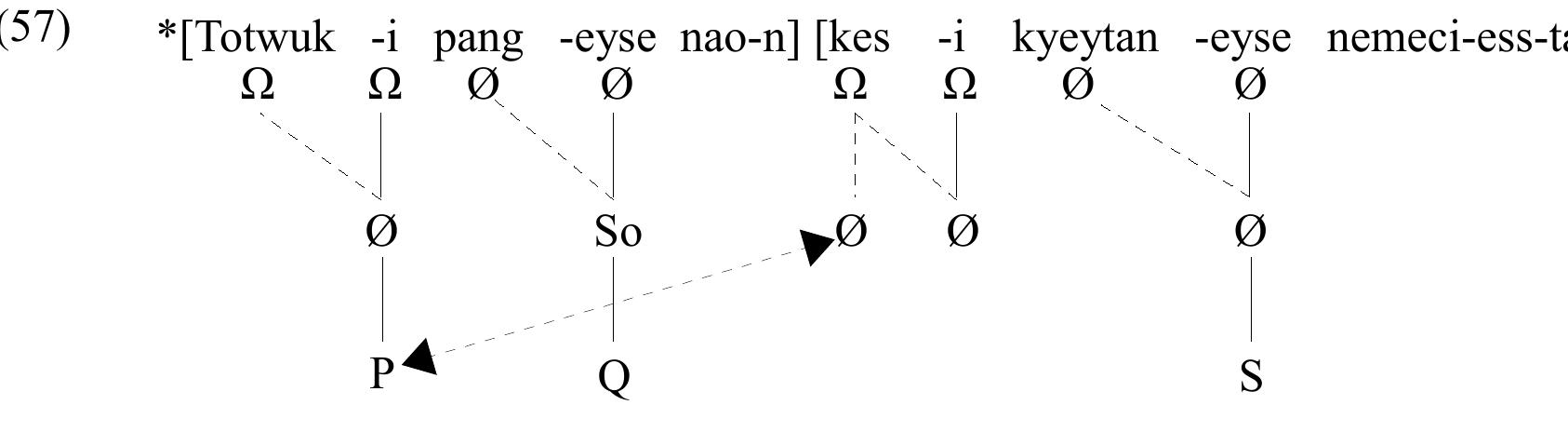
![This is how the DP; gets nominative case. However, as mentioned above, the —ki phrase can also take dative case, and it is impossible for DP, to be dative marked since it has to undergo obligatory movement to check off [EPP] which in tum gives it nominative case. Secondly, Yeo claims that DP2 gets its case by movement either to [Spec, vP] (for accusative) or to [Spec, DP1] (for nominative). A part from the problem of the optionality of accusative case marking, Robert Frank (p.c.) pointed out that it is very implausible for D to assign nominative case.](https://figures.academia-assets.com/2008483/figure_006.jpg)