The present study aims at providing a comprehensive overview and a general theoretical framework for the research of binominal constructions of the kind [N1 of N2], where N1 belongs to the semantic domain of nature, e.g. a river of... more
Este artigo investiga construções binominais quantitativas em uma perspectiva construcionista baseada no uso. Para isso, desenvolve, sobre os dados utilizados para a investigação, o método de análise colexêmica distintiva, um tipo de... more
1791-ben jelent meg Bécsben Kempelen Farkas könyve, Az emberi beszéd mechanizmusa, valamint a szerző beszélőgépének leírása német és francia nyelven [német címe: Wolfgangs von Kempelen, k.k. wirklichen Hofrats Mechanismus der menschlichen... more
Much (if not all) of the literature written on pseudopartitives so far has dealt with the socalled N-of-N constructions, or, in another denomination, the N1-of-N2 constructions. But nothing has been said about constructions in which, for... more
Constructional models of grammar are helpful tools for the analysis and description of un(der)-studied languages, leading to more accurate analyses. This is despite the fact that as a whole, working with and describing un(der)studied... more
he study aims at investigating the neoclassical formations in English and Arabic. Two fundamental issues are addressed, the first is the morphological status of the constituents or elements of such formations in both languages. The... more
IP-domain). I show that this distinction is reflected in a different distribution of universal quantifiers that appear in front of the determiner (henceforth 'predeterminer UQ'). 2. Problem: Zwarts (1992) observes that the Dutch... more
Este artigo investiga construções binominais quantitativas em uma perspectiva construcionista baseada no uso. Para isso, desenvolve, sobre os dados utilizados para a investigação, o método de análise colexêmica distintiva, um tipo de... more
Our usage case-study on binominal quantifiers in Spanish illustrates the role of syntagmatic analogy in textual coherence (synchrony) and in constructional change (diachrony). Quantifying nouns (QN) display a quantifying potential next to... more
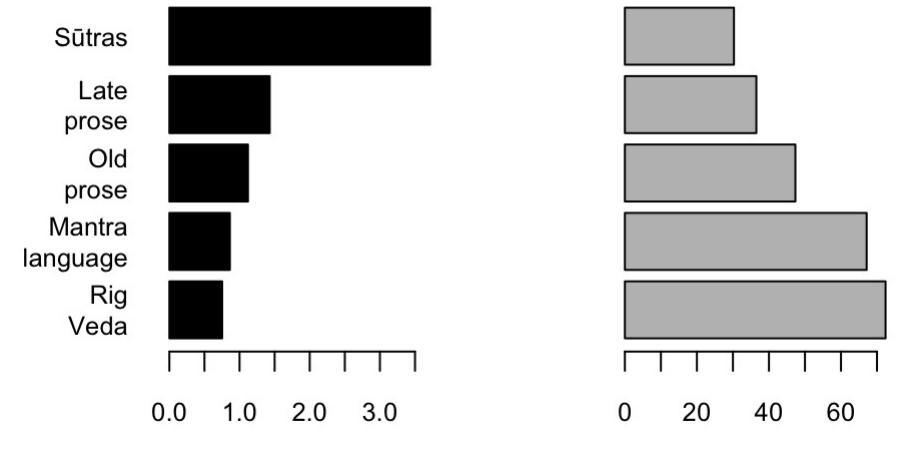
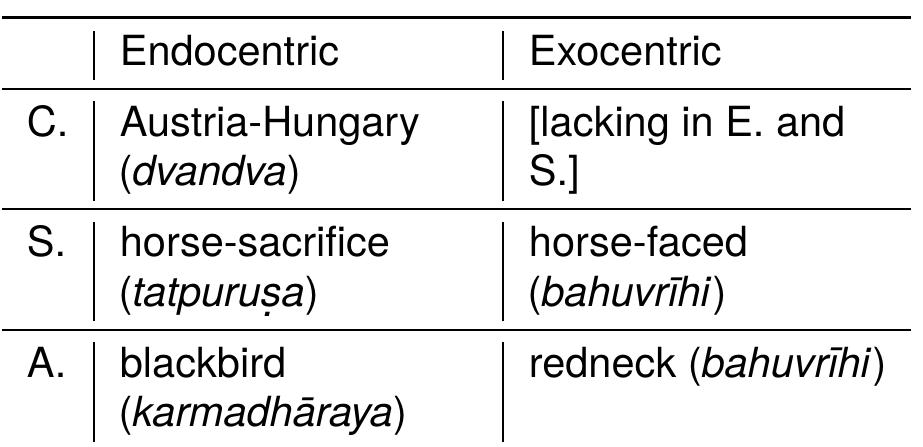
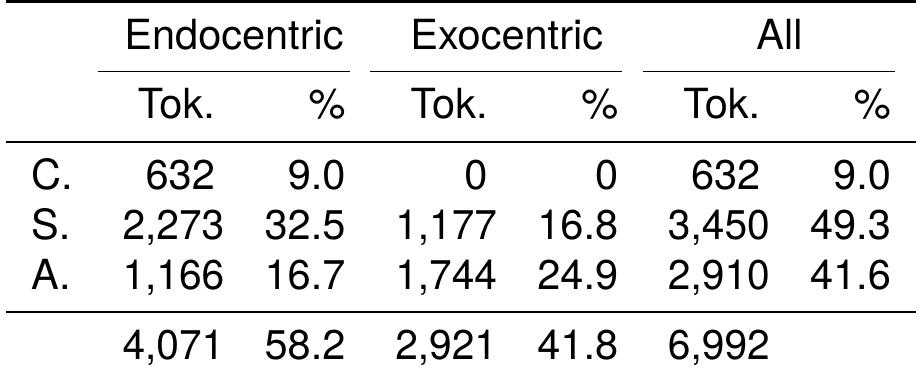
This paper introduces the Vedic Compound Dataset (VCD), the first resource providing annotated compounds from Vedic Sanskrit, a South Asian Indo-European language used from ca. 1500 to 500 BCE. The VCD aims at facilitating the study of... more
A key feature of binominal lexemes is the unstated (or underspecified) relation, ℜ, that pertains between the two major constituents. The nature of ℜ -- the kinds of relations -- has been the topic of considerable research during recent... more
This chapter starts by demonstrating the need for the comparative concept 'binominal lexeme' in order to cover both 'noun-noun compounds' and their 'functional equivalents' (§1). To complement this informal definition, four different, but... more
Dutch: (2) a. een boom van een kerel 'a tree of a man' b. een juweeltje van een universiteit 'a jewel-DIM of a university' French: (3) a. un diable d'homme 'a devil of a man' b. cet imbécile de Jules César 'this idiot of a Julius Caesar'... more
The book How to edit translations of English legal and economic documents? Correct Polish language for translators (Jak redagować przekłady angielskich dokumentów prawniczych i gospodarczych? Poprawna polszczyzna dla tłumaczy) discusses... more
This paper is concerned with the derivational affix-i, which is shown to represent a subclass of a new category in Hungarian grammar, that of the nominal modifier, since it is demonstrated not to derive adjectives per se, as has been... more
Recent work in Distributed Morphology, most prominently Harley (2014), argues for roots being able to take syntactic complements, which opens the door for the possibility of having syntactic features within a root’s representation –... more
English Binominal NPs (BNP) (e.g., a hell of a problem) are of empirical and theoretical interest due to their complex syntactic and semantic properties. In this paper, we review some basic properties of the BNP construction, focusing on... more
This paper discusses the properties of the quite de construction in the Baie Sainte-Marie, Nova Scotia variety of Acadian French in examples such as le/un quite de souper 'quite the/a supper' which have a hyperbolic connotation. Unlike... more
In this paper, we discuss functional aspects of the Modal construction with ficar de + infinitive. We aim to analyze semantic, sociointeractional and cognitive factors in instances of that construction. The theoretical support is the... more
Partindo da concepção de língua adotada pela Gramática de Construções (CROFT, 2001) e da perspectiva construcional da mudança (TRAUGOTT; TROUSDALE, 2013; TEIXEIRA; ROSÁRIO, 2016), objetivamos, neste estudo, analisar o deslizamento de... more
Este trabalho consiste em um estudo de construcoes binominais quantificadoras do tipo SN1 de SN2 no portugues brasileiro sob a otica da Linguistica Baseada no Uso ( Bybee, 2010; Barlow; Kemmer 2000; Boyland, 2009 ), associando os... more
Este artigo investiga construções binominais quantitativas em uma perspectiva construcionista baseada no uso. Para isso, desenvolve, sobre os dados utilizados para a investigação, o método de análise colexêmica distintiva, um tipo de... more
O artigo apresenta uma discussão a respeito dos usos da cadeia sintagmática um monte de seguida de SN numa perspectiva construcional. Defende-se a tese, baseada na teoria de mudança linguística proposta por Traugott e Trousdale (2013), de... more
The study presents a contrastive Italian-Polish-Russian analysis of the left-headed binominal constructions of the type [N1 of N2] composed of the metaphorical classifier It. montagna, Pol. góra, Russ. gora 'mountain'. The main aim of the... more
The article deals with the investigation of binominal substantival phrases known as close appositions. A special emphasis is laid on the morpho-syntactic, semantic and pragmatic peculiarities of these constructions. The issue of... more
Larisa Ponomareva (komi-permják), Onerva Lepistö (finn), Heete Sahkai (észt), Tatiana Efremova (mezei mari), Anastasiya Saypasheva (keleti mari) és Irina Burukina (orosz) anyanyelvi beszélőknek. Köszönjük F. Gulyás Nikolettnek és Tánczos... more
lorencestaresa en uniovi es Resumen Algunas expresiones lingüísticas están especializadas en presentar el tema del que se habla o en introducir un cambio de tema en el discurso. Se seleccionan aquí tres de ellas, en relación con, por... more
A nyelvi tények, valamint a történeti-összehasonlító nyelvtudomány mai álláspontja szerint a magyar nyelv az uráli nyelvek családjába, a finnugor nyelvágba, és az ugor nyelvek csoportjába tartozik. Az uráli nyelvcsalád onnan kapta a... more
El presente trabajo pretende explorar las relaciones intrelingüísticas que se establecen en las estructuras partitivas o clasificativas relacionadas con el campo de la emoción en inglés y español. En concreto, se estudiaron dos corpus de... more
Partindo da concepção de língua adotada pela Gramática de Construções (CROFT, 2001) e da perspectiva construcional da mudança (TRAUGOTT; TROUSDALE, 2013; TEIXEIRA; ROSÁRIO, 2016), objetivamos, neste estudo, analisar o deslizamento de... more
Tendo como pilares teóricos a Semântica de Frames (FILLMORE, 1982) e a Gramática das Construções (GOLDBERG, 1995), este projeto tem por objeto a Construção de Quantificação Indefinida com Determinantes Polilexêmicos no PB; uma construção... more
Aspectos del lenguaje económico español y alemán: cuantificadores y expresiones de cantidad en contraste Magazin 24 13 Alice Stender: Aspectos interculturales del lenguaje económico español y alemán: cuantificadores y expresiones de... more
In Italian appositive compounds like parola chiave 'keyword', the non-head constituent (N2) often undergoes a metaphorical interpretation and behaves like an adjective, emphasising a property of the head (N1). The main research question... more
Dutch has a construction consisting of a verbal part and something else: ′wɛrksə ‘enjoy your work’ (< werk ‘to work’), ′rujzə ‘enjoy your rowing’ (< roei ‘to row’). According to accepted wisdom, this ‘success imperative’, as it is... more
An Excel-based tool for the computer-assisted analysis of semantic relations in noun-noun compounds and other binominal lexemes, based on the Hatcher-Bourque classification (Pepper 2020; 2022).
Of special relevance for the NP vs. DP debate are nominals in which the determiner has other values for number, gender, case and/or person than the noun, for depending on whether such nominals share these values with the noun or with the... more
Since around the past fifteen years, contemporary studies in the field of functional linguistics have been more thoroughly turning to assumptions and frameworks built up by cognitive linguistics. Taking into consideration such an... more
Bibüothëque nationale du Canada Acquisitions and Acquisitions et Bibliographie SeMces senrices bibliographiques 395 Wellington Street 395. rue Wellington OttawaON K1A O(V4 OrrawaON K1AON4 CaMda canada The author has granted a non-L'auteur... more
The paper investigates pre-D non-possessor positions in Hungarian. In Hungarian, non-deverbal nominal constructions containing pre-D non-possessor positions are acceptable only if they contain a demonstrative pronoun and also an... more
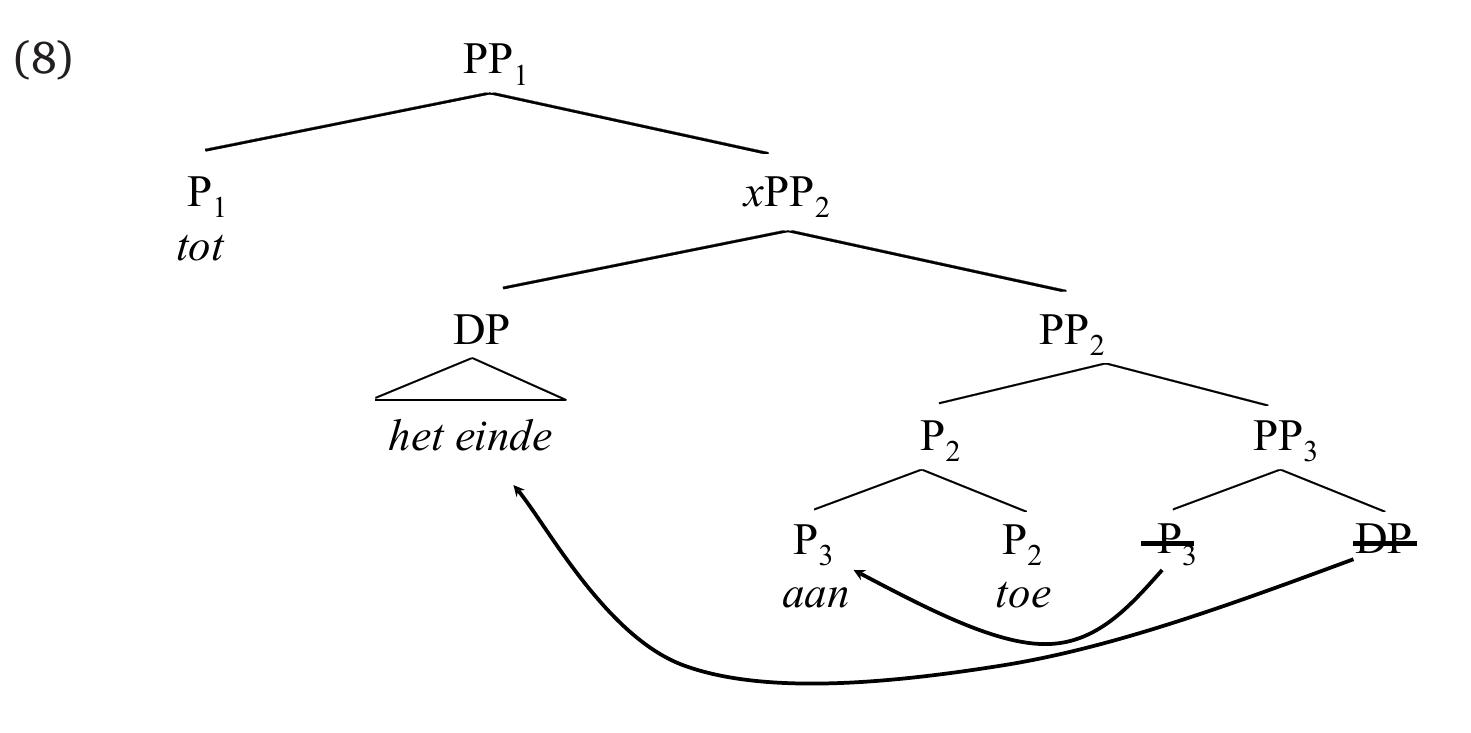
The topic of this paper is the internal syntax of the extraordinarily rich palette of Dutch expressions corresponding to English (right) up to the end, featuring six subtly different surface outputs, differing with respect to the number... more
For a little more than a century, a new quantifier has been developing in Norwegian: masse 'a lot, lots, many, much'. The article compares the quantifier to its source noun masse 'matter, mass, large amount'. The historical development is... more
Dutch has a construction consisting of a verbal part and something else: ′wɛrksə ‘enjoy your work’ (< werk ‘to work’), ′rujzə ‘enjoy your rowing’ (< roei ‘to row’). According to accepted wisdom, this ‘success imperative’, as it is... more
It is a matter of fact that the pragmatic reading of a construction is closely related to what is understood as the syntactic or morphological head of the structure. However, given a certain thematic relation between two nouns, human... more
Aspectos del lenguaje económico español y alemán: cuantificadores y expresiones de cantidad en contraste Magazin 24 13 Alice Stender: Aspectos interculturales del lenguaje económico español y alemán: cuantificadores y expresiones de... more
In this paper, we expand Morzycki (2009)’s claims that degree readings of size adjectives are attributed to syntax. We introduce a corpus-based analysis in Dutch to verify and extend his claim into the semantic domain. Using the LASSY... more
This paper explores from a cognitive linguistic perspective the continuity between lexical and semigrammaticalized uses of the lexeme caudal in the noun phrase of the type [Det. caudal N1 de N2] in written peninsular Spanish. This... more
Sur la base d'une analyse de corpus, cet article propose de reconnaitre la sous-classe des "Noms Legers ", dans laquelle peut se detacher une classe de Noms Support. Les Noms Support, a certains conditions syntagmatiques... more


![Table 5: Most frequent low-level semantic relations. This suggests that while the subtype relation, TAx-R (oak tree) is not especially common, it is rather versatile in terms of the range of meanings that it can express. Conversely, while the material (CoMP-R) and possessor (Poss) relations are rather frequent, their scope of application is relatively limited. It is also worth noting that of the 46 binominals that exhibit the subtype relation (Figure 7), 18 employ the der strategy. In many cases, the gloss indicates an (apparently redundant) nominalizer or diminutive affixed to a root whose meaning is the same as that of the derived form, as in Lithuanian [LIT] spen.elis [nipple.DIM] NIPPLE OR TEAT. Overall, the data indicate that the most frequent low-level semantic relations cross-linguistically, at least as far as binominal lexemes are concerned, are as shown in Table 5.](https://figures.academia-assets.com/113622762/table_009.jpg)



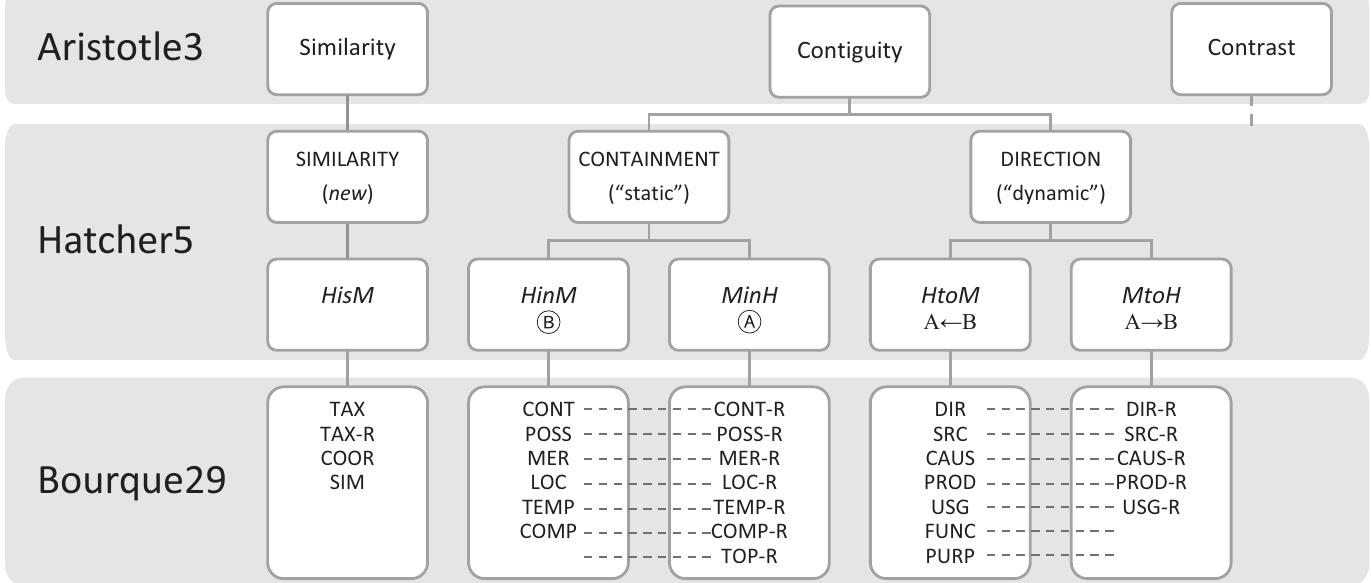
![Table 3: Frequencies of high-level relations in Arnaud (2016). epper (2020) examines each of the 12 low-level relations that seemed to Arnaud istify the creation of his four new high-level relations and shows that all but one 1em can in fact rst of Arnaud’s ckeys. But if A ing feature of B be accommodated by Hatcher’s four-way system. For example, t problematic forms, régime jockey, denotes a diet that is typical ‘jockey’) typifies (or characterizes) B (‘diet’), then it is a characté and therefore belongs, as Figure 2 shows, under Hatcher’s AcB, ; somehow, to some extent, contained, comprehended in B”. Thus it turns out, ther words, tha Hatcher’s system is broad enough to cater for eleven of the twel yw-level relations that prompted Arnaud to add four new high-level categories. Tha cinola aycrantinn ona of four ceihtynec af ANATOC ic avamniified hy f]](https://figures.academia-assets.com/113622762/table_004.jpg)


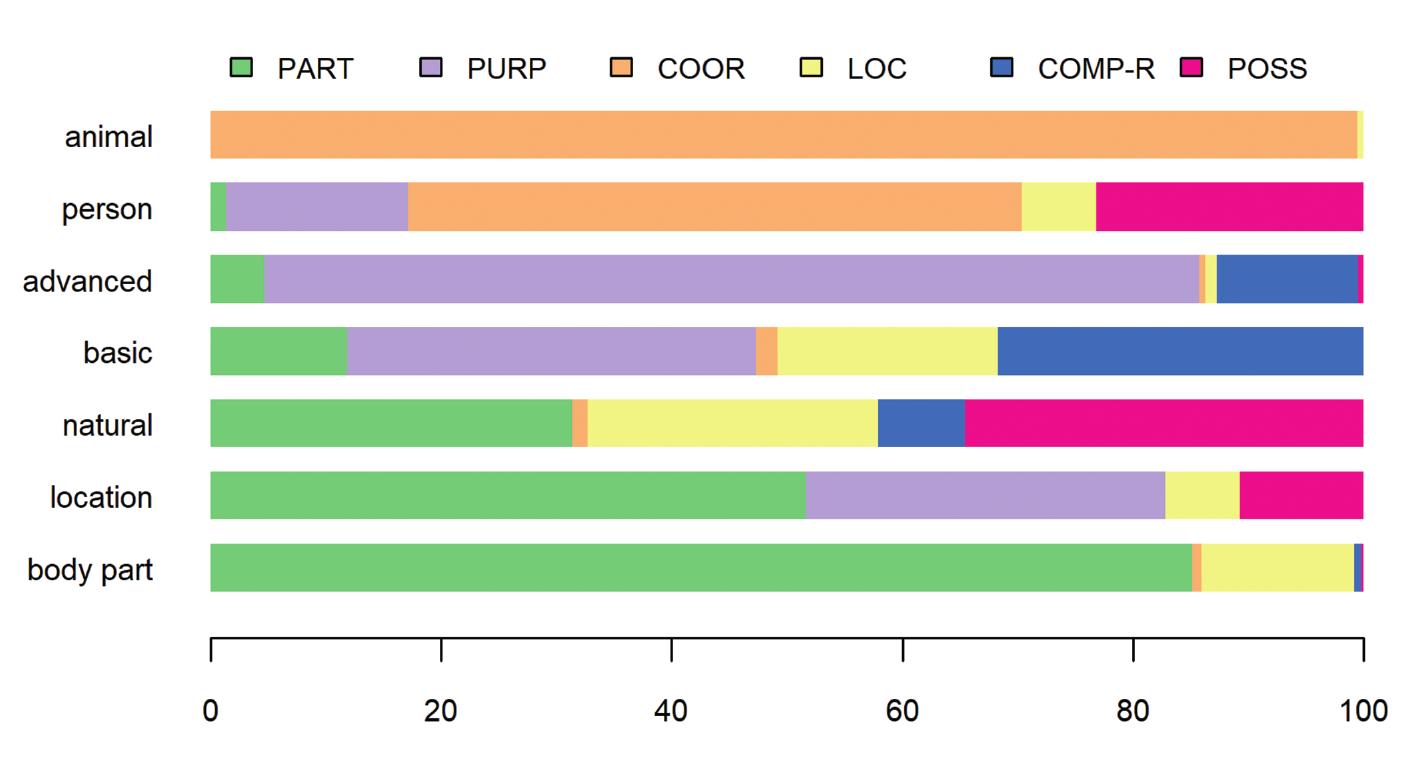
![AULICULU TL UE ULI TALE ad UIC Y ALL Laue Ui. The semantic type Basic technology (or concept) is more mixed: as witl Advanced technology (or concept), purpose and material are the most widespreac relations, but the two are now equally frequent; however, in contradistinction t« the latter, the whole (PART) and location (Loc) relations are also quite frequent These are also the most widely used relations for Natural phenomena — togethe with possessor (Poss), which expresses the relation between a spider and its web or bees and their hive, as well as phenomena viewed as belonging to some super natural being, such as Ket Albara kan ‘Milky Way, lit. Alba’s hunting trail’ anc Assamese [Asm] ramdhenu ‘rainbow, lit. Lord Rama’s bow’. \ similar variation is found across semantic fields. Figure 12 shows the frequenc yf the six most common seman ic relations across the nine most frequent semar ic fields. We note again that PART plays the dominant role in The body, but also i \griculture and vegetation and s dominated by the purpose re ind Kinship is remarkably simil. ng preference for either COOR o olitical relations. Finally, the Food and drink; and, as expected, Modern worl ation. We see also that the patterning in Animal ar: binominals in these fields have an overwhelr r Poss. The latter is also widely used in Social an ocation relation (Loc) that Bauer assumed to b nost widespread is in fact large ‘lothing and grooming. ly confined to the fields of The physical world an](https://figures.academia-assets.com/113622762/figure_008.jpg)


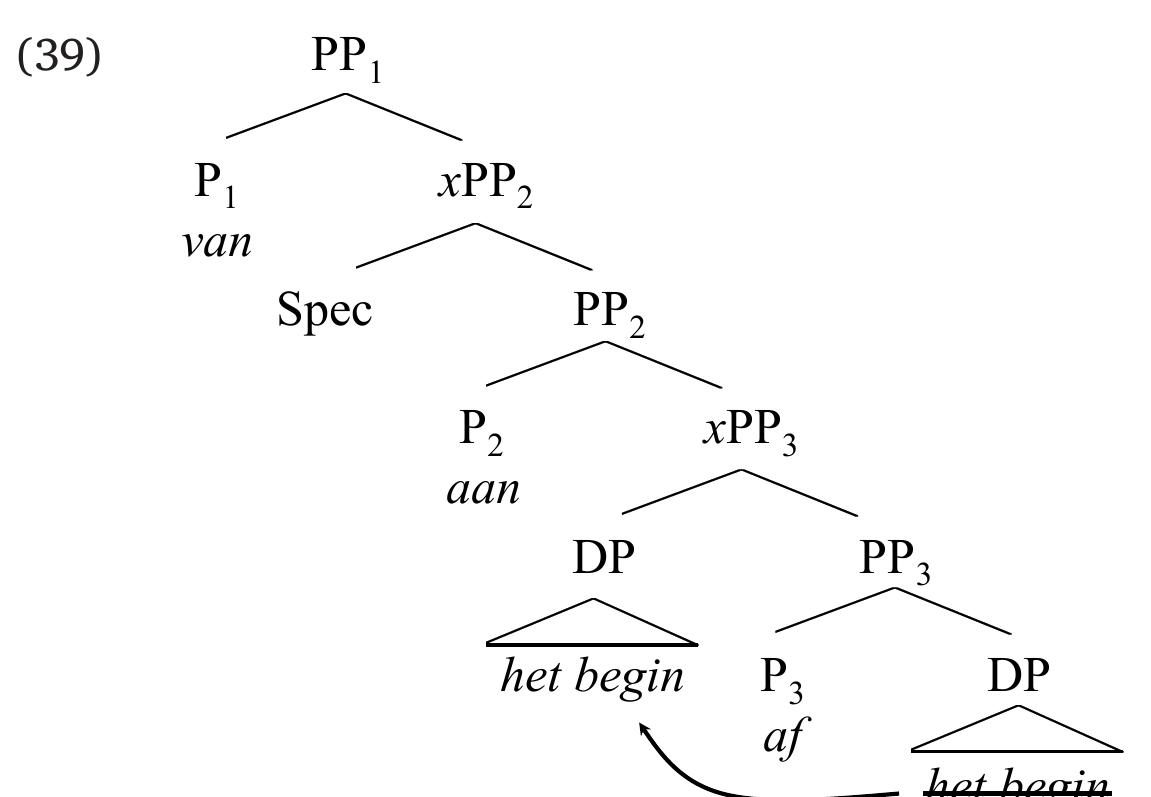
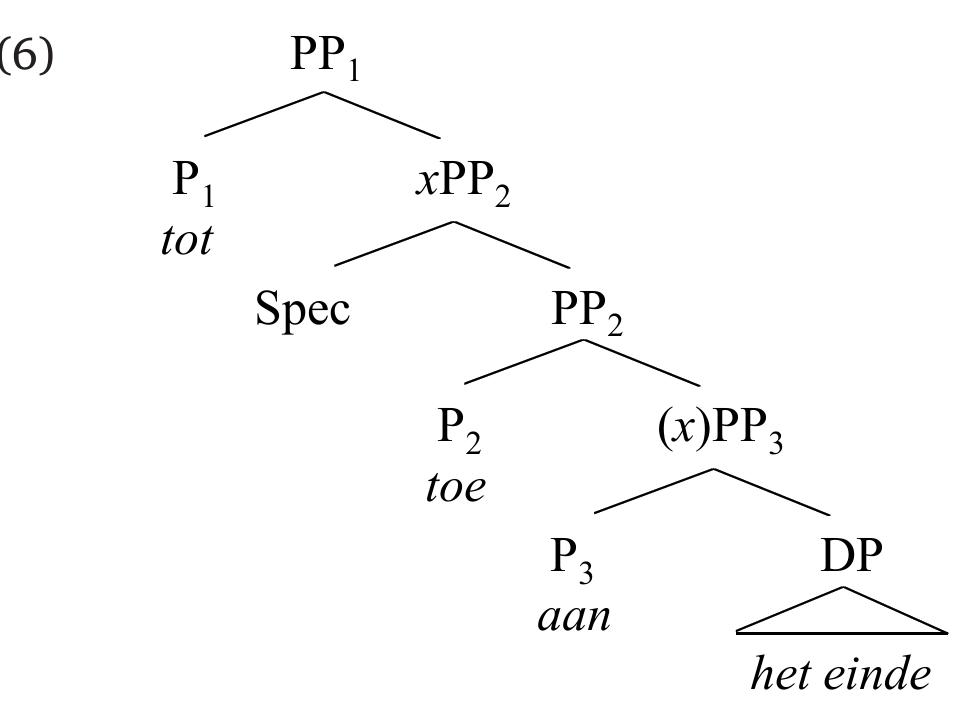
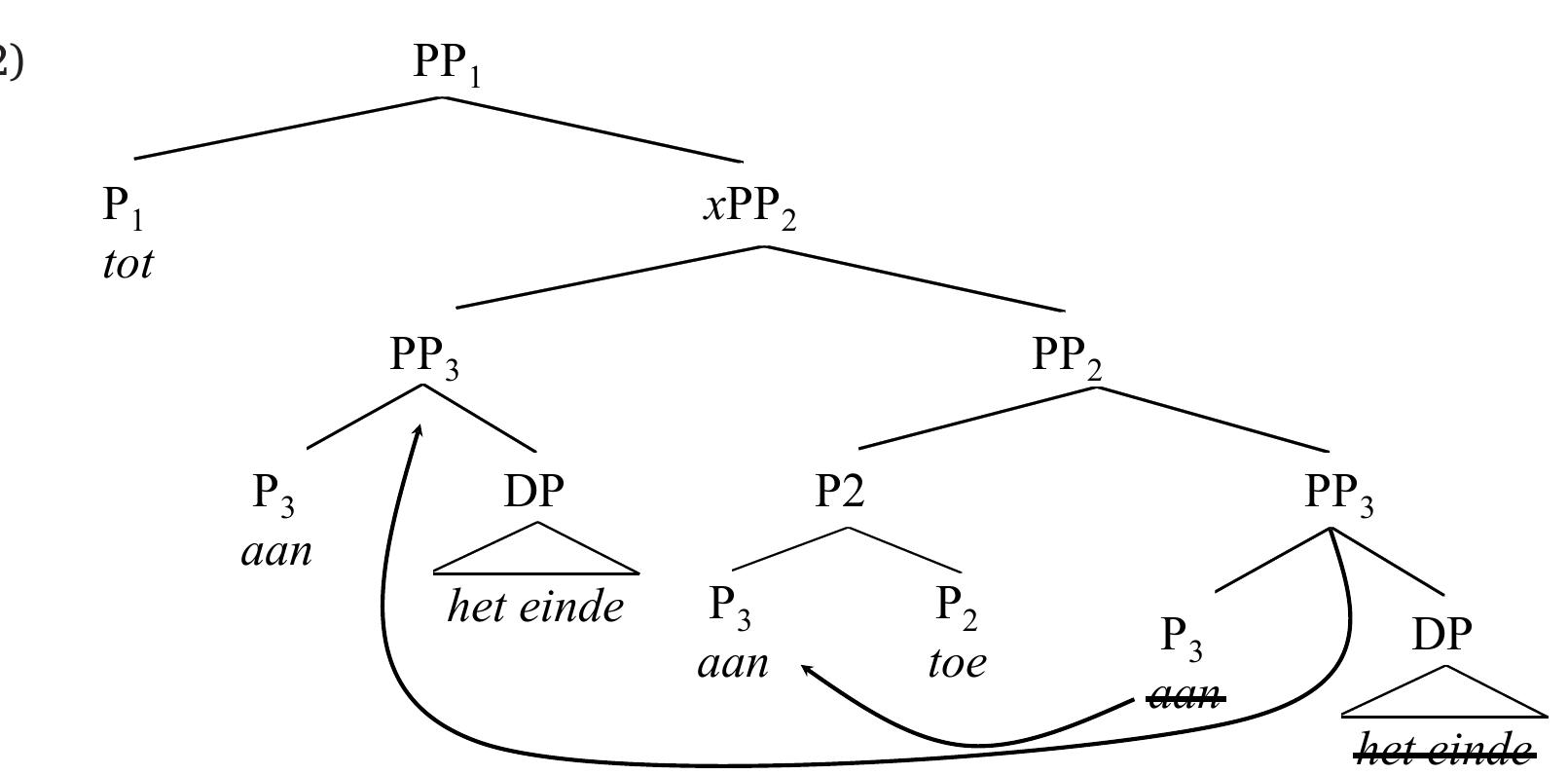
![The second way of meeting the requirement that SpecxPP, be filled starts out from the version of (6) with a “bare” PP, in the complement of P,. Because P, now lacks its own extended projection, it cannot be functionally licensed within the confines of its extended projection, and must instead be incorporated into (i.e., left-adjoined to) P,, resulting in the formation of a complex postposition [P,+P,] aan+ toe. A corollary of P-incorporation is the raising of the complement DP het einde of P, into SpecxPP,. Structure (8) illustrates this derivation. It delivers the output tot het einde aan toe in (1c).](https://figures.academia-assets.com/85215030/figure_002.jpg)