what would you say is the best way to approach race in a post-apocalypse/dystopian setting (similar to the fallout series)? in my case, the characters wouldve grown up in a society not too different from ours (more reminiscent of scifi than post-apocalypse), however since civilization had to be rebuilt from nuclear war, how much bearing would it have on things like systemic racism and peoples general view on race? obviously, it isnt a central part of the story, but id love to hear your thoughts.
Systemic Racism in the Apocalypse
Systemic racism would probably be uncommon in an immediately post-apocalyptic setting, simply because there is no system to be biased. Further beyond that, in a time they’ve managed to rebuild society, or dystopias in general? That would be heavily based on what the founders of the system thought, and highly likely to have at least some bias, no matter what the letters of the law say.
- Mod Rune
I’m not sure. It will depend on whether or not racial biases carry over to who is at the decision-making table to rebuild society. If the people who got together and said “let’s make a new civilization” were primarily white, with very limited representation of other cultures’ and races’ voices, then you might see history repeating itself.
~ Mod Rina
Another thing to consider might be what different cultural values survive in a post-apocalyptic world. In a lot of Asian cultures, in my experience, there’s more focus on community than in America, which is very focused on the individual. How would these cultural values carry over in a post-apocalyptic setting? How would these people react to those holding different cultural beliefs? That might be worth looking into, if you do the research and work to avoid turning cultural beliefs into stereotypes.
-Sophia
I would hope that in the case of racism, “Play stupid games, win stupid prizes” would apply. The people most likely to survive in an apocalypse are those who can cultivate and create while building a community, like weaves and gardeners. With that said, a good number of dystopias ignore the elephant in the room or claim as part of their false utopia that they have “solved” racism by either erasing color (something The Giver did cleverly and showing that “I don’t see color” is a big problem for many reasons) or merging the races to the point where everyone is mixed, which Scott Westerfeld explained in The Uglies trilogy.
There is no best way, but if you are going to address the element, the first question is to ask who survived. What biases survived with them, or how did they change as a result of a near-death experience? Most importantly, what do you want to say about your story that people who play stupid games and win stupid prizes still won’t change in the face of death?
hi, im a gentile writing an ashkenazi jewish character in a zombie apocalypse rpg and i have some questions about keeping kosher in such a setting, specifically with regards to properly slaughtering animals. from my understanding, the slaughtering must be performed by a trained shochet. in situations where such a person is unavailable, would my character realistically decide to do the slaughtering himself or would he just abstain from meat?
Kashrut in the Apocalypse
Probably just go vegetarian like some of the people I’m around if they’re in a situation where kosher meat is unavailable.
–Shira
Oh interesting! Maybe one of the character’s parents was a shochet? It would be possible for the character to have been learning from them, at least enough to feel comfortable giving it a go in the Zombie Apocalypse.
Going vegetarian is a very real possibility, and it’s likely they would do that first. I imagine as food got more scarce, they would be making more allowances. For instance, in the early days they would be eating carefully, trying to pick through cans of food to find things that are kosher certified, then later they are eating a vegetarian diet with whatever they can find. There may come a time when they try shechting themselves, simply because finding plant protein has become too difficult.
The preservation of life comes before most things, so doing your best in the extremity of that situation would be reasonable. Just avoid having them eat pork for the reader, it might encourage a more vicious, voyeuristic pleasure in watching people break laws, rather than the cool thing you are setting up: watching people do their best to keep their own traditions, in the worst circumstances.
– Dierdra
Agree with all of Dierdra’s great points – and I want to add that point at the end about pork is very important. Pork seems to take a special role in the minds of Christians/culturally-Christian and ex-Christian atheists in terms of how much brain space seems to be spent on remembering that a lot of us don’t eat it. I have a feeling watching someone eating non-ritually-slaughtered chicken would be a lot less voyeuristically weird than pork. Even another form of treyf like a crawdad wouldn’t have the same semiotics, the same feeling of “Ha, got you.”
–Shira
OP might find it cool to read about real-life situations where kosher-observant Jews have found themselves stuck in odd places without certified food. There’s even one in the musical Come From Away (in fact, I know someone who is related to the real rabbi that character is based on), so you don’t have to look as far as you might think – certainly not as far as the apocalypse!
Hello! I am writing a quasi post apocalyptic book with a subplot where my white MC finds a black toddler and cares for her (parents are deceased). The plot line was decided before the race of the characters as her struggling to take care of the baby (regardless of race) has its own role in the plot but I'm not sure if this would be a White Savior trope or if I am overthinking things? The stereotypes and White savior tags didn't quite have any previous asks that answered this for me. Thanks!
White Character Adopts Black Child in Apocalypse
This sounds fine. I’m actually reminded of two references for this working well:
The Walking Dead Telltale Game
Image of young biracial* girl and Black man sitting, his arm around her.
While the main character is a Black man (Lee) who finds and cares for a young biracial girl in the apocalypse (Clementine), I find it to be relevant.
She does happen to be racially ambiguous and the character awkward enough for strangers to question if it’s his child.
He takes care of her like any parent would, protecting her and even maintaining her hair in one scene.
His ability to care for her is questioned by others, which could happen in a white parent/ black child situation as it does today.
Lee just does his best and is only concerned by doing right by the child, not needing praise or complaining about the difficulties of essentially raising his ward of the apocalypse.
If your character doesn’t express a need for praise or attention for taking in this child, this will help avoid any white savior connotations.
The Passage (2019 TV Version)
image of white man and young black girl. embraced and crouched in hiding.
A white federal agent (Brad) protects a young Black girl (Amy) just as the apocalypse is slowly taking shape. They’re trapped in a facility bent on experimenting on Amy. They bond over mutual losses, Brad a daughter and Amy her mother.
What made this show successful in handling the dynamic:
Brad’s concern and protective love for her is genuine
He refuses to see an innocent child abandoned or manipulated.
Race wasn’t ignored. There’s a point where he tries to pass her to a trusted companion (A Black woman) who helps and even gives her a silk head wrap for sleeping.
What didn’t work / Improvement suggestions:
At first I was suspect about the negative language towards Amy’s deceased mother, but they begin to show she was indeed a loving mother who had struggled like anyone else.
I would avoid parent-bashing or implying neglect from the birth parent perspective, if possible.
Why is the child alone? Forced separation, death of parents?
This show was cancelled after the first season, so unfortunately I can’t comment on how the rest would’ve played out.
Summary:
Proper motivation is key. This is the apocalypse and there’s not much room to be picky about one’s adoptive parents. Most people see an abandoned toddler and they would care for them. And even if they didn’t feel equipped, they’d hopefully try to place them with someone they trusted enough to do it.
Don’t ignore race: It probably won’t be a big focus,but just don’t ignore race completely. Make it clear the child is Black, acknowledge hair stuff even briefly, and note perceptions of others if applicable encounters occur.
I didn't see anything about it in the search bar or the faq, so I thought I'd send in a quick ask. I'm planning out a story set in the zombie apocalypse, and 2 of the main characters are black (they're siblings). In the very beginning, their mom dies, and they're separated from their dad almost right after. A big plot is them trying to find and reunite with their dad. If I end up killing him off instead, would that be offensive? Are there any stereotypes I should know about regarding orphans?
Black Siblings & Black Death: Orphaning in Apocalypse
I’d be disappointed if you killed the Black dad off. The Black mother has already died (again, i’m sad) and even without them being Black, dead parents is a well-worn trope.
Survival of Black characters is generally good and welcome representation.
Still, I get that it’s the apocalypse and few actually survive in these concepts.
Here are my suggestions for alternatives, or ways to “soften” the pain of this concept:
Death is not the only solution. Long-term separation and other hardships that one has to live with is another way to create turmoil for characters without killing everyone.
Don’t kill every single Black character. And perhaps, not both parents.
Avoid graphic death scenes or needless torture/suffering of Black characters
Bitter-sweet endings. Keyword here is sweet. There’s a positive even within a bleak situation. Perhaps the family shares a special moment before saying goodbye, or they’re left with a key advantage thanks to the parent (not something they sacrificed themselves to provide, though, ideally)
Treat hardships equally. The Black people’s lives shouldn’t be the only ones faced with tragedy or losing family. If there’s other races, they should face hard times of comparable difficulty so as to not single out Black characters with all the pain.
Caring for natural (curly) hair in a setting with no access to modern hair products
So it’s the apocalypse. Your curly-haired character is on the run. They find themselves on an adventure in a fantasy world. It’s a castaway story. Or the whatever-eth century and they’re in an environment that doesn’t exactly accommodate curly, coily haired types.
Either way, manufactured hair products are far and few between, or they’re simply not made for afro hair. Considering how your Black character handles their hair in this environment makes their circumstances more realistic and relatable.
Topics Featured in this Guide:
Hair Products found in Natural Environment
Hair Oils - Benefits and How To Extract
Protective Hair Techniques & Styles
Curly Hair Types & Hair Needs
Hair Routine Samples
Hair Straightening
FAQ
There is a writing takeaway at the end of each topic.
Brief descriptions provided after images. Contact me for fully accessible version.
Hair Products found in Natural Environment
Consider the essential needs of afro hair: water and fat.
Water (or liquid) is essential for nourishing the hair.
Fat (hair oils, creams, butters) is essential for both growth and protection.
Many curly-haired folks already use natural resources and plants to care for their hair - aka DIY hair-care. So characters concocting their own products should not be a strange concept. (I personally buy most of my natural hair products, and create my own hair masks, protein treatments, and oil blends.)
What they could use would depend on environment, time, and availability.
Hair Healthy Produce
Coconut- The all-purpose hair aid with multi forms, from oil to solid cream. Hardens in cold weather; best not to use when environment has freezing temps. Banana - Typically removed after use (hair masks, conditioners) Avocado - Applied as hair products, masks, and oils. Strawberry - Mashed and applied directly to hair or mixed with oils.
Hair Healthy Proteins, Plants, Fats
Eggs - Hardens when dry. Strong odor. Removed after use. (protein masks) Honey - Pulls moisture from air into hair - avoid during the dry winter! Shea Nuts - Made into shea butter. All-purpose hair and body care. Flaxseed - Gel made by boiling & straining flax seeds. Many DIY videos online.
Hair Healthy Herbs and Flora
Hibiscus- Sebaceous = oil-producing gland. Flowers crushed into paste or oil. Peppermint- Can rub out oil from leaves. Often used in oil form on scalp. Lavender - Often used as an oil directly applied to the scalp, or brewed as tea. Rosemary - Often combined with olive oil in use with hair; can be used alone.
More Hair Healthy Herbs and Flora
Aloe Vera - Succulent. Can extract sap directly from leaf and apply like gel. Burdock - Contains essential fatty acids and phytosterol compounds. Dandelion - Can use the roots, stems, leaves and sap for hair and skin. Rose - Common use is rose water: steep roses in boiling water to create.
Hair Healthy Products (rare or require effort to make/find)
Apple Cider Vinegar (ACV) - Diluted before use and often washed out after. Bentonite Clay - Aged volcanic ash. Combined with ACV for best activation. Oils - Key component for sealing moisture. See the next discussion. Yogurt - Base of many DIY hair products like masks and deep conditioners.
Oils for Hair
Oil is a key component to afro hair care. It nourishes and seals in moisture. Let’s discuss common hair oils and extraction methods that could, more likely, be done using homemade or historical equipment.
Oil Extraction
If oils aren’t readily available to purchase, the person would need to find or create tools to either extract the oil via pressing or heat the nuts or seeds. Consider the basic tools that have been around since ancient times. For example, the mortar and pestle. What creative use can be made out of existing tools in the person’s environment?
Hair Oils and Benefits (by potential ease to extract.)
FYI: These aren’t the only methods or necessarily professional means of extraction. I also left off hair-healthy oils that seemed complicated to extract without high-grade equipment. So, this isn’t an all-inclusive list of oil or methods.
Natural Hair Product Creation
So what exactly would your character create? Here’s some natural hair products and potential main ingredients. May be used alone or combined.
Leave-in moisturizers: Plain water, coconut water, rose water
DIY Recipe Search: Try keywords like “DIY natural hair” + “curly hair” “Afro hair” or search all natural hair products and read over the ingredient list. Try small home business and independent sellers (Like etsy)
Most homemade products last everywhere from a few days - weeks
Extend the life of spoil-prone products via the cooling system in the work.
Honey does not spoil. Be mindful if it’s mixed with spoil-prone ingredients.
Oils can usually be kept at room temperature and last a long time.
Keeping a small bit of ready made supply may prove time-efficient. If impossible, they may opt to use products that don’t require much time and effort, and are worth their time to make in small batches or to potentially dispose of after.
Writing Takeaway - Natural Product/Oils Creation
With just the above compounds, I can see creative naturals being able to create styling products and moisturizing leave-ins, shampoos, conditioners and hair masks.
Do consider the following:
How simple or complex can their regimen be?
Would they rely more on protective hair styles in their situation?
What is the natural environment: what products are accessible?
How will they store products or must they make a new batch each use?
Can items be purchased by craftsmen or found in abandoned locations?
Can they afford to use edible plants if food is scarce? Food scraps and non-edible plants (like the flora) might be what they rely on.
What are their specific hair care needs? -Discussion on this later-
Natural Hair and Styling
LOC Method as base style
Moisture, sealing in the moisture, and protection are the basic needs for natural hair. The Liquid, Oil, and Cream (LOC) Method, or a variation of the steps, fulfills those basic needs. It can be treated as both a care routine and a style in itself. Personally, if my hair is not in a protective style, I use it every week.
Liquid - Liquid opens hair cuticles to allow moisture to enter hair strands.
Oil - Once cuticles are opened, the oil penetrates hair & seals in moisture.
Cream - Cream further locks in the moisture, and can be used as a styling agent as well to shape and define curls.
Should you use the “LOC method” by name in your work?
A modern setting? Sure. But don’t assume readers know what it means.
A fantasy setting? Probably not, unless earth and its terms carry over.
Protective hairstyles protect the hair by tucking ends away from the elements. For example, heat, air, hand and fabric manipulation. While not forever solutions (except maybe locs which are a permanent style) there’s many benefits to your character’s wearing them.
Benefits:
Hair growth retention
Saves time styling hair
Helps prevent damage and keep hair healthy
Ideal for any natural (the best style itself may depend on hair type)
Lessens hair’s need and dependence on moisture and hair products
Eliminates some hair maintenance activities (such as detangling)
Considerations:
Hair more difficult to wash and dry thoroughly.
Dryness (unable to access all tucked away hair to moisturize)
Styles kept in too long accumulates dead skin and product build up.
Uninstalling styles can be time consuming, and should be done gently.
Style gets frizzy from growth overtime and/or getting soaked in water.
Protective Styles Short-term (lasting days to weeks)
Afro puff(s) or bun(s)
Back Tuck or Roll and Tuck
Bantu knots
French roll
Pompadour
Roller set
Two-strand twists
Wash and go (low manipulation style)
Shaved(lower maintenance, but not an overnight decision)
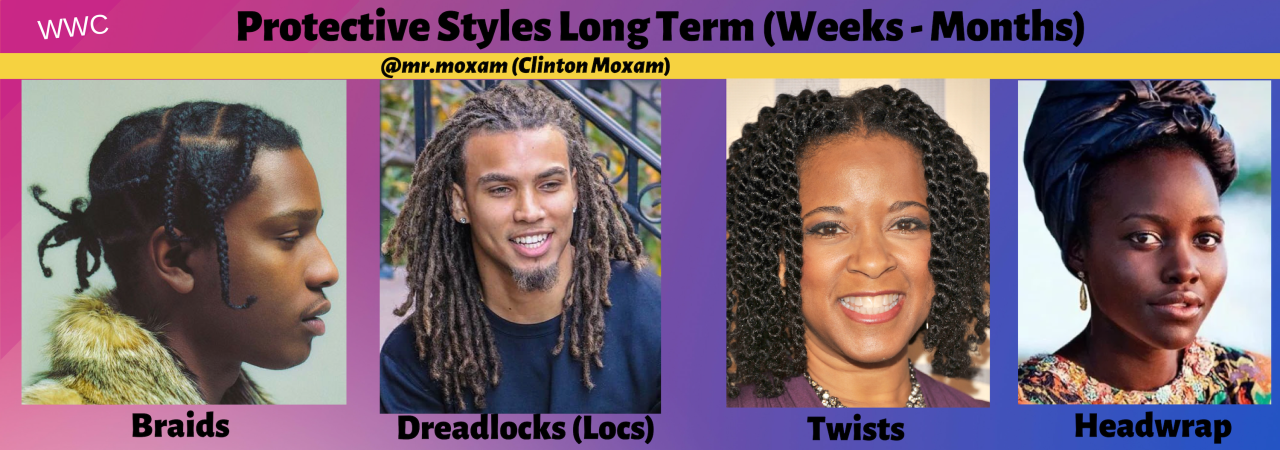
Protective Styles Long-term (lasting weeks to months+)
Braids (endless styles and patterns. Typically smaller braids last longer)
Cornrows
Dreadlocks/locs (permanent style, research the hair care)
Extensions
Flat Twists /Twists
Head wraps and hats (endless wrapping styles, colors and patterns!)
Wigs (unless glued, hair maintained underneath or often put in braids)
Writing Takeaway - Protective Hairstyles
Protective styles are an amazing way to protect the character’s hair and would very likely be the go-to for any natural in an uncertain or fast-paced environment. Just in everyday life they’re highly worn so it would especially be the case! Just remember the character needs to eventually undo whatever protective style they have installed to do some hair maintenance (washing, detangling, etc) and give their strands a rest. Also, even hair in protective styles need some attention.
Curly Hair Type and Associated Needs
Determining your hair type is important to knowing its needs. Certain ingredients work best for certain hair types. However everyone is unique and there are more factors to consider than just curl pattern (Also, most curly folks cross into a mix of hair types). There is hair thickness (width & density) and how much moisture and product your hair absorbs (porosity) to consider as well.
I will only cover curl pattern and the commonly associated needs here. To learn more about porosity, width, and density check out the FAQ under the read more.
naturallycurly.com is a great resource and is the source for the images, terms, and information provided below.
Curly Twirly (3A)
Defined loopy “S” pattern. Curls well defined and springy. Big, loose and shiny. Size: Sidewalk chalk size. Best Products: Gels and creams with light moisture and curl definition.
Curly Spirally (3B)
Well-defined, springy copious curls that range from bouncy ringlets to tight corkscrews. Size: Sharpie size. Best Products: Gels and styling creams with extra moisture and frizz control.
Curly Kinky (3C)
Voluminous, tight corkscrew curls. Either kinky or very tightly curled, with lots of strands densely packed together. The very tight curls are usually fine in texture. Size: Pencil. Best Products: Styling creams, butters, and oils. Needs gentle care.
Coily Springy (4A)
Well-defined “S” Pattern. Tight, coily, and the most fragile curls.
Size: Crochet Needle or smaller.
4A Best Products & Tips: Styling creams, butters, and oils.
Clarify scalp with tea tree or jojoba oil during washes
This hair needs extra moisture and tender care
Be gentle when handling and detangling hair to avoid stress & breakage
Use thick moisturizers like mango and shea butters to maximize styles
While hair type is just the start of all the intricacies of natural hair needs, it’s definitely a good start. There are other important parts to consider for real life naturals, but going off from hair type and the commonly associated needs should be enough for a story. (But read the FAQ under the read more to keep learning)
Do not get lost in the details, especially for a story that won’t need to cover tons of it. Learn enough to know what you’re talking about and can describe hair care accurately for situations that would affect hair.
Writing Takeaway - Overall:
You don’t have to be lavish in detail, but acknowledging how hair is handled here and there or in a dedicated section is thoughtful and satisfying to see included. It’s also a neutral way to show race without the use of micro-aggressions or racism. Finding the time and means for proper hair care would be a part of their life and potentially a stumbling block on the adventure, so mentioning how hair is handled during these circumstances is a fine idea.
It’s also a great means for representation.
–Mod Colette
Additional Info:
The following information will be nestled under the read more:
Hair Routine Samples - One super simple and one complex hair routine
Hair Straightening - Not ideal to maintain in survival situations, but also was a means of survival and daily living during some historical contexts
FAQ - Would any of this matter during the apocalypse? And what about natural products that attract bugs? Plus more.
Hi, i was wondering if you had any tips on how to maintain religion in a post-apocalyptic/otherwise desolate setting. I have a Hindu character and a Jewish character and I want them to keep their religion and remain devout but I also want it to be realistic given the lack of resources etc...
Maintaining religion in a post-apocalyptic setting - Jewish & Hindu Emphasis
A lot of the signs of Jewish devoutness are things you can totally do in a postapocalyptic setting. I mean first of all, you can break any rule to save a human life, so if you’re not supposed to kindle a flame on Shabbat but you have to light a fire to not die, then you’re fine.
But anyway. Shabbat is about rest and renewal, so your character can take one day in every seven, starting at sundown (Friday night if they have a way of knowing what the days of the week were in the Before Times!) to rest, say the special prayers – if they’re devout enough to be “devout” as you said in your question, they’ll know a lot of this stuff by heart – and refrain from the kind of work you do on weekdays. Like maybe if they’re a posthole-digger they don’t dig any post-holes on “Saturday” morning.
Not eating pork, shellfish, rabbit, the back end of beef, and bugs is another thing – but again, people did wind up eating all kinds of whatnot in the Warsaw Ghetto – these rules aren’t meant to be dying over. If they know when Passover is in this world they can leave off eating bread for a week and maybe even cobble together a makeshift seder from memory.
If you have a married woman and she’s Orthodox she can still cover her hair. If she’s not Orthodox this is probably not an issue.
If they have any way of knowing when Yom Kippur and Tisha b'Av are, and it’s safe to do so, they can fast.
Especially if they’re Orthodox, they can start the day with the morning prayers. If this person is Orthodox and menstruating, and there’s water in which to do so, they can say the mikveh prayer while taking the bath after their period is all finished. (I’m Reform but I find comfort in this kind of thing, too.)
If we’re talking about someone who wasn’t raised in the normal world – I was assuming the apocalypse in this was recent, but I mean if they’ve never known normal-Earth – then they might have learned all these things by rote from parents or community instead of from going to temple.
This, plus living up to Jewish values like tikkun olam (healing the world) and tzedekah (justice) and all that – that’s all it takes to feel like good/satisfying rep to me.
–Shira
As I’ve probably mentioned before, the term “Hinduism” is kind of a misnomer, as it implies that there’s one such thing. If Christianity or Islam are families of sibling belief systems that share obvious commonalities, “Hinduism” is a huge family of distant cousins, groups of which often don’t seem to have much of anything in common and you just have to take their word that they’re related. If you look hard, there might be a family resemblance.
I often think about this when confronted with the question of how I’d live my life in a post-apocalyptic wasteland (and this is something I consider with alarming regularity these days). Which are the parts of my upbringing that are actually important? What of it have I already jettisoned by choice or changes in circumstance and what more would I? And what of it is silly garbage that’s going to get me killed by the next band of water bandidos marauding the blasted hellscape that is New New York City?
Anything that you might broadly categorize as a religion has aspects that range from the ritualistic to the philosophical so of course Hinduism is no exception. I’d posit that extreme ritualism and extreme navel-gazing are both things likely to get you shanked by bandidos so in the interests of survival your character is probably going to want to tread a middle path. Any rules against eating beef are probably out the window (unless it just makes them sick regardless). So is strict adherence to doing a morning prayer or yoga, or meditating so deeply you don’t notice the bandidos coming. On the other hand, there may be good reasons for maintaining dietary restrictions (e.g., you can’t trust that any food grown outside the Safe Zone isn’t deadly). Meditation can relieve stress and you could probably use some stress relief after the apocalypse. However, arguably these markers are matters of culture rather than belief (that is, not all Hindus eschew beef or practice meditation; those that do do because they were exposed to the concept somewhere).
This is a hard question to answer because it would really depend what kind of Hindu background this character comes from and how (if relevant) they related to their culture “before the fall” so to speak. They may identify with one particular deity due to their circumstances (for example, Vishnu, to preserve the world they do have; Shiva or Durga, as a reflection of the destruction that presumably brought about said apocalypse, and from which there will hopefully come renewal; or Ganesh, to remove the obstacles they surely encounter every day). I should note that were it me in that position, any identification with or invocation to a god would probably be extremelysarcastic: the gods didn’t prevent the apocalypse, why the hell would they help me now? Again, it depends on the character’s personal outlook.
You might also consider some of the relations elemental factors have to most Hindu rituals and how that might change in this environment. For example: water, light, fire, and food are all typically revered or at least valued greatly.
- Water is a life-giving resource and many Hindus revere rivers. In a wasteland, protecting clean and safe water might very well have sacred significance as a matter of literal life and death.
- The divine is often thought to dwell in food and sustenance and gods receive offerings of food at festivals. You may not be having very many festivals but the value of food may be thrown into stark new focus.
- Does this world lack for sunlight, warmth, or energy? Orthoprax Hindu priesthood often revolves around keeping a sacred fire. In a world where flame is the power source of a community, for example, the person who keeps the fire going could very well think of it as a sacred ritual, and maybe that’s a connection to the beliefs or practices they or their family held before. You can even abstract it a bit more. What if a postapocalyptic community runs off some relict solar panels? Some character might see that as very literally depending on the sun for their survival.
If there is one thing that unites most flavors of Hinduism, it’s the notion of dharma, which is hard to translate, but loosely means “order” or “duty,” or more generally “that which is established or held firm.” So, what about this character holds firm? I’d say in such an extreme circumstance, devotion or religious practice is more than just throwing out the names of some gods every now and then to remind people of your roots (especially if you keep praying for help and it never comes). It’s more about how you conduct yourself in relation to the world, and when you reach back into those old virtues ingrained in you by your family, how you exercise them relative to nature and the people around you when literally may not be sure that the sun will rise tomorrow. It’s not easy but the apocalypse rarely is.
I searched in a lot of tags already but was wondering if there was a specific tag that would go more in depth for black hair in post-apoclyptic settings. I only found one post. I'm specifically looking for care and maintainance of 4b hair, and styles that would be best for a fallout universe situation, as well as styles that would be most likely based off of the 1950's and what to take into consideration when one goes from having the means to take care of hair to suddenly no clean water
Black Hairstyles for the Apocalypse II: Post-Nuclear
For a situation like the Fallout game universe, post-nuclear with limited/no clean water, I can only reinforce what has already been said in Black Hairstyles for the Apocalypse; a character with afro hair would need those dependable protective styles on lock down (braids, dreadlocks, etc. look up and take your pick of protective natural styles), more so with little to no safe water to dip her head into.
AFRO HAIR CARE RESEARCH
Everything you read up on regarding afro hair’s needs is still relevant; Black hair generally needs lots of moisture and protection.
Afro hair routines tend to involve a lot of water, oils, gels, butters and creams. You mention the character’s hair type is 4b, but hair type isn’t even the most important factor when it comes to Black hair maintenance. 4A, 4B, AC, or a mixture of– these numbers are more of a general assessment of what that hair type looks like, needs and reacts, but every individual is different. Hair width, density, and porosity is super, if not more important. Research, research, research. This information is quite accessible nowadays.
My favorite natural hair site is www.naturallycurly.com/. Pinterest has an addictive mash-up of natural hair tips, info and DIY solutions too. Note that doesn’t mean everything is relevant to your character, or even accurate so i’d check with other sources on any information you find.
Important Takeaway:Water to moisturize + Oil to keep it in.
Hair needs water (or water-based moisturizer, typically referred to as leave-in conditioner) to moisturize, and oil to seal it in lest it deplete rapidly (take it from me; my hair gulps down any bit of moisture it gets).
Most oils do not moisturize by themselves because it cannot penetrate the hair shaft (save a privileged few like coconut oil).
Research key terms: natural hair + moisturizing/sealing, L.O.C. method
If your character has a protective style in most of the time, i’d also be researching “natural hair care with [x].” Though hair needs lessen, they do not disappear.
SOLUTIONS IN NUCLEAR APOCALYPSE
Depending on what resources can be scraped up, there may be opportunity to make or find items that would work as extra hair protection that add and seal in moisture, or even a silk scarf or bandana for extra coverage and for sleeping.
Whether a character does come across these things is mostly out of their control, so the protection that comes with a long-term style like braids is the main tool they’d have to rely on.
As for the 1950s: If this is America, you could look up African American hairstyles in the 50s but the popular styles you’ll see will likely be unfitting for the apocalypse, especially one of this nature. Straight, loosened-textured looks for afro hair won’t thrive well and will be sweated out to one’s natural state quickly, plus their hair weakened from the straightening process.
However, there were some braided styles popular in the 50s (unspecific to Black people) that could be done for afro hair and would serve as protection.
For example: the “crown braid” comes up a lot in a quick search (See the image above). Not sure how much one would care to style their hair to stay “with the time’s” in this situation, but that’s for you to work out.
SUMMARY:
Protection is the key here. Reliable long-term styles like braids that tuck in the ends endure breakage and tangling way more than any free-flowing style. It’s that low manipulation and vulnerability to the elements (and hands) that’s key.
For other maintenance questions, do your research and see what you come up with in terms of what the character may scavenge and make do with.
Hi! So I know you wrote "black hairstyles for the apocalypse", but i have a question. my main character is black in my twd fanfic, I was wondering if her asking Michonne if she could braid her hair would be like a stereotypical thing?And is not letting really anyone touch her hair a stereotype? Because I was hoping that the interaction between her and Michonne would be a bonding type thing? (Btw Thank you so much for this blog, it has helped so much)
So I have already talked about avoiding mistaking culture with stereotype:
Having braids isn’t a stereotype.
Black people braiding each other’s hair isn’t a stereotype.
Not wanting one’s hair touched is not a stereotype (especially by strangers and especially when so many feel entitled to touch Black people’s hair without permission).
Now, recognize these things can still be used as stereotypes, especially if you group all Black people as liking and doing the same things. No, not all Black people like rap or automatically should you assume they do because Black. And if they do, that doesn’t mean they don’t wind down to classical music in the evenings! Don’t compose characters based on only what you assume you “know” about Black people. That’s when you’ll get a flat stereotypical character who lacks depth. People are dynamic, and many many things.
How you treat the circumstance is what can make a situation an issue or not. For example, if your character just assumes Michonne can braid because she’s Black and has dreads, that might be awkward. I’ve had braids at numerous points in my life. I suck at braiding. Hey, that’s what the salon is for.
Not every Black woman, man, or person automatically knows how to braid or braid well , even if it is something many grow up learning. Some people, even if they do know how, don’t enjoy it. And of course, some do. Again, Black people’s interests, culture, and skill sets are not one and the same.
In short, I think the two Black character’s bonding over hair braiding can be special. Culture shouldn’t be mistaken as a stereotype.
My question is a bit related to the ethnicity based magic question. The setting is zombie post apocalypse northern USA, the protags are mostly poc with mixed heritage (afroamerican/Ethiopian, korean\white, afroamerican/Irish + one white character). They all experience a disconnect to their root's, but when low level magic returns to the world, I want gods close to their personality, NOT their roots, to teach them. I. E. a Norse god teaches a black char & vice versa. Would that be OK?
Cultural Disconnect, Taught by Gods from Other Cultures
>> They all experience a disconnect to their root’s, but when low level magic returns to the world, I want gods close to their personality, NOT their roots, to teach them.
That’s not a “but.” That continues the pattern of them all being disconnected from their roots.
A non-Scandinavian-diaspora girl in the zombie apocalypse being helped by a supernatural figure significant to her own traditions and the same girl being helped by Freya or some other Norse god are two entirely different stories. (Or a Swedish-American being helped by Freya vs. by Venus.) The not-their-culture god just continues the disconnect from their heritage plus serves as a kind of invalidator of some cultures, whose religions hold that the other ones don’t count.
Plus, why is the spirit from their own culture not good enough to help them? I understand what you mean about personalities, but most cultures with polytheism have a variety of different personalities to pick from. For example, if I am kind of a clever trickster outsider I get paired with Loki and if I’m bold and brave I get paired with Thor, but other cultures with lots of gods to pick from would ALSO have a trickster and a brave character.
In other words, there are probably supernatural figures close to their personality AND their roots lurking within world mythology, and readers within the culture may think “Why didn’t they just use Freya?” if your character is of Nordic heritage and you used Venus instead. (Sorry that my examples are so Eurocentric.)
–Shira
Continuing on the topic of cultural sensitivity, I’m noticing a glaring omission: Natives.
You have to remember that all of the people you’re putting on this backdrop do not actually come from the area they’re living in. So if you start omitting Natives, then you’re basically saying “magic can now colonize, too”.
I get that you’re not going to change around the whole population of an area, considering the Northern USA is a mix of a whole bunch of ethnicities. But it rings really false to me that magic is returning to the land and there not even being a hint of Native people getting their ownership back.
Like, I get that I’ve talked about how exhausting it is to have Natives= land magic, and I still stand by that. But when you consider how intimately Natives and land magic are tied in the real world, it gets a little eyebrow-raising to see “magic returns to the land” and there being absolutely nothing about Natives. I’m not saying there needs to be an all-Native cast here. I’m saying that it would be continuing colonial legacy to ignore original ownership of who first settled on the land under their feet. It doesn’t have to be much, but I would much prefer something.
And please do not “fix” this by having Native religions/deities pick members of your pre-existing cast. Native religions are closed to only those who are within the tribe. If you do want a Native person in your cast, pick somebody who is actively aware of their identity and the responsibility that comes with their identity. Non-Natives should never, ever, ever be the authority over Natives, especially when it comes to their own religion. As Shira said, having gods from other cultures come in to teach people their ways continues disenfranchisement.
Just something to consider.
~Mod Lesya
Please consider the historical and current relationships between the source culture of the character being taught and the source culture of the being doing the teaching. It’s unfortunate but nonetheless true that there have existed and still exist power and cultural dynamics between nations and societies that could make such mentor/mentee relationships awkward, to say the least, due to colonialism, religious conversion, or economic exploitation. For instance, if it were me in this position and the “god” or being teaching me were, say, the English image of St. George or something, I can tell you may reaction would almost definitely be “oh boy, an Indian being lectured to by a Brit… again."
There are a billion Indians in this world; we survived and thrived; so imagine how much more pronounced that feeling would be when the mentee character is from a culture who was almost wiped out by people from another nation who worshipped or invoked the mentor character. There are so many ways that it can go wrong.
So there are certain mentor/mentee pairs for which this would be all kinds of nope and others for which it’s less off-putting. In those latter cases, think about the ways that exploring the teachings delivered by that god or being might prompt the mentee character to rediscover and connect with their own heritage. I realize it’s postapocalyptic and good research material might be hard to come by in-universe, but if a character knows that they are of a certain heritage, they may become curious about the philosophy and worldviews that come from those people. Maybe this sounds a little bit tribalistic but different peoples throughout history have often explored similar ideas, either by way of shared history or cultural contact, or even independent innovation, and learning about ideas in a different culture can be an avenue to exploring similar ideas in one’s own, in way that comes off as seeming less contrived and allows the character to reconnect with that culture.
For example, if a Celtic god starts talking about transmigration of souls, it might prompt a Korean character to explore Korean Buddhist notions of reincarnation—it’s a similar germ of an idea from a divergent source, but it can be explored from a perspective that is more intrinsic to the character rather that being foisted on them by an outside force. This makes it more of a honest exchange than a "schooling,” and gives agency to your characters of color when the “god’ in question may be of European origin.
What would be acceptable for a Muslim woman to wear in an apocalypse? I know they're supposed to wear loose clothing, but I'm stuck as to how to make this work in a zombie setting.
What would be acceptable for a Muslim woman to wear in an apocalypse?
With all due respect, I had to eye this question twice, because I cannot understand what else a Muslim woman would be expected to wear during an apocalypse - except for her usual clothing.
If you are implying that loose clothing would be abandoned, I still don’t see why that would be necessary. There are obviously ways to pin a hijaab so that it may pose less of a threat than someone being yanked backwards by long hair.
Throughout the ages, though the Western eye has done its best to frown upon it, Muslim women can be seen wearing their traditional clothing style or whatever makes them comfortable, and being just as awesome and protecting themselves as anyone else.
The Prophet, peace be upon him, had an aunt, Safiyyah, that is particularly remembered for defending women on horseback against a man that had invaded their sanctuary - all in what is described as loose-fitting clothing. And that doesn’t just mean a long dress or abaya. Muslim women vary culturally in their clothing.
I’ve personally ridden horseback in a comfortable-fitting shalawar kameez. I’ve misplaced my gi for martial arts class and substituted for it with a similar outfit. Of course, Muslim women’s tastes and styles vary, as I’ve said several times through this answer, but if the implication was that a Muslim woman would not be able to survive without abandoning what she personally preferred (or else, forced into the suggestively ripped clothing most creators seem to think women in the zombie apocalypse need to wear)…I don’t think so.
I recently saw a post criticising dystopias like The Hunger Games for assuming an apocalypse would erase race and gender issues. This made me question my own novel, because I was also going to write from the angle that a global disaster would pull people together. What are your thoughts on this? Do you think race issues would be aggravated or diminished in a post-apocalyptic world?
Racism in Dystopian Stories
I would say it depends on how the global disaster came about. The basis of racism partly stems from access to resources. (i.e. those People are taking our jobs). If there is a lack of resources, racial issues might be aggravated. I was certainly not surprised to see some racist guy in “The Walking Dead.”)
You’d think with a zombie apocalypse, people would put aside their differences and help each other out. I think the issue of race would be dependent on who survives and who doesn’t, what resources are available, and how the survivors determine how to allocate resources. Here’s a more detailed post on the same issue.
I actually cried tears of joy when I found this blog! Two questions: what's a good way to include relevant ethnic/cultural details in a post-collapse, survival based world where typical cultural sign posts (food, clothing, music, celebrations, etc.) no longer exist? Is it okay if there is no racism in this world, because they're all just small, family-like groups struggling to survive?
Culture and Racism in a Post Apocalyptic World
I’m not sure whether typical cultural sign posts would just stop existing to be honest. I don’t know how the world collapsed in your story, but even when some cultures have been thought to be decimated there are a few survivors who carry on the traditions. Some cultures are thousands of years old and while they have changed over time, they still exist.
The culture could be influenced by natural disasters, technology, conquest, etc, but they still exist in some shape or form. I guess it just depends on how far removed these cultures are from our current time and what cultures are in your story.
It would be hard to imagine a culture with a rich history suddenly disappearing. It would depend on how the world collapsed and what happened to people as a result. Is this story set far into the future? if so, it would make sense that some cultural signs might have morphed into something different, but that wouldn’t mean that they ceased to exist or disappear entirely.
I don’t think racism would cease to exist in this world either, but it also depends on how far into the future the story is and the details of the world’s collapse. I do think people would put aside their racial differences to help each other survive, but depending on when your story takes place (whether it’s far into the post collapse world or at the beginning) you may have some hints of racism or you may not.