WritingWithColor (Posts tagged antagonists)

1.5M ratings
277k ratings

See, that’s what the app is perfect for.

Sounds perfect Wahhhh, I don’t wanna

sweet-star-cookie asked:

Hello there, thank you for creating this wonderful resource! Your post about lizard people really opened my eyes, as I was not aware of it being an antisemitic trope specifically until now. I absolutely love making reptile heroes and villains alike, but I'm not Jewish myself and I’m now concerned about a dragon character I have as a main antagonist for one of my stories. Your other posts regarding this topic do point out that having one aspect of the trope does not guarantee that it will evoke the trope itself, but I'm afraid that this character has several aspects of it without me realizing prior to now, and I'm looking for advice on what to do with him.

I did not intend to make him Jewish at all, but if I were to use other ways to specifically show that he isn’t Jewish/a Jewish equivalent in this fantasy world (and I definitely will when I reach the scripting/panelling phase), I’m still concerned that even the base idea for this character will read as such regardless.

(I also apologize for the length of this ask, feel free to cut it down as needed when posting it)

Dragons, lizards, and other reptiles are not considered evil or vile in this universe, in fact there is an entire kingdom that worships a dragon god to the point where things like their clothing and architecture resemble them. Having even a fabricated appearance of a reptile (or any other animal for that matter) is encouraged and celebrated across all the kingdoms, so this isn’t meant to be a “humans vs reptiles” or “humans vs non-humans” story, even if humans are still a dominant species.

That said, this character is still an outsider to the monarchy (in fact his and the protagonist's status as non-royal is deliberate), and his appearance as a dragon man is the reason he is able to sway this particular kingdom so easily. The general populace views him as a second coming of their god, even more so than its current royalty, so I’m not sure if that makes his case better or worse here.

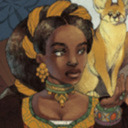
(I know this isn't a visual design blog necessarily but if it helps, this is the most recent design I have for him. If you have any critiques about the visuals as well then I'm all ears)

He is not motivated by greed as I thought the “dragon hoarding treasure” angle was overused already, but he does intend to overthrow and abolish the monarchy of all of the kingdoms in a “burn them to the ground” kind of way, so I’m concerned that his conquest of this and the other non-dragon kingdoms will still read poorly from the manipulation/government takeover perspective.

The protagonists that ultimately defeat him are each from different parts of this world, one of whom is the princess of the dragon kingdom and is fighting to get it back from him, though she resembles a bat more than a dragon visually (they share the same wing type). Would adding more scaly/lizard characters on the side of good help matters?

This antagonist’s own cohorts are also from various parts of this world as well (i.e. not a group of lizard people), which is intended to create a parallel between them and the group of protagonists thematically, but he’s still the leader and mastermind of his group's schemes.

So with all that in mind, do you think this concept could still be used/reworked or should it be scrapped entirely? Do you have any advice on writing lizard folk villains specifically when it comes to avoiding antisemitism? Are there questions I’m not asking myself about this particular story concept that I should be? I'm happy to clarify any further questions about the world building as needed, though admittedly there are a lot of details that need ironing out regardless. In any case, thank you for your time, I appreciate it!

Dragon antagonist trying to overthrow a kingdom

Having him be an anomaly in dragonkind, and having the good guys be more dragonlike, will help. Because then it shows that reptilian-ness, in your world, is not the reason he’s a bad guy. So yes, you’re right that adding more good lizard characters would help.

How do you feel about switching his character design with the bat princess character? Or even making her more dragonlike (without making him less so necessarily?) Just some thoughts.

–Shira

I’d like to gently move you away from looking at this as “am I inadvertently checking a box that I don’t want to check?” and toward “What are the ways in which I am and am not playing into a constellation of tropes that might or might not add up to something I don’t want to say?” Dragon = reptilian = antisemitic is a decent start, and it’s good that it got your attention. Taking a deeper look will help you evaluate what’s happening with your character development.

“Lizard people,” as in the accusation of literally being reptilian, or the use of “Lizard people” as a dog whistle to imply “Jewish” without saying it, grew into significance in the 90s, but it builds on tropes that had been established in art and literature for the span of Western history. “Lizard people” works as a dog whistle because of how many of the tropes for negatively portraying Jewish characters also work for negatively portraying humanoid reptilians. So instead of simply giving the sign-off on whether “dragon-man” is a subset of “lizard person” and therefore antisemitic, let’s look at the various components of the trope and how a writer might find themselves upholding, bypassing, or directly counteracting any selection of them. 

Here’s a short list of character design elements often linked with negative Jewish coding in male characters (the tropes for non-men Jewish characters can overlap with these but will also have their own components). 

Note that a lot of them are only negative if the context establishes them as negative:

  • Skinny and nerdy, not physically strong or imposing, gaining power through trickery rather than force;
  • Fat and lazy, not physically strong, gaining power through financial pressure or tricky contract language;
  • Narrow, pointy nose and chin, close-set eyes, high forehead, black or red curly hair, olive undertones to complexion; portrayed as negative in contrast to the fair and square or rounded features portrayed on non-Jewish-coded characters;
  • Cowardly in a setting where physical violence is a virtue, violent toward family members or politically bloodthirsty in a setting where the virtue is pacifism, but never personally a warrior and never willing to take personal safety risks;
  • Never shown wearing armor or holding weapons except in 20th-21st century settings;
  • Elements of autistic coding including monotonous, robotic, cracking, or otherwise “unmasculine” voice;
  • Failure to dominate women, romantically or in his own family, but also failure to respect women who are outside of his family. Pursues women who have made it clear that they are not interested. Not a supportive or attentive partner;
  • Dismissive of others’ boundaries, whether sexual/romantic or just personal space;
  • Excels in careers that don’t require charisma, especially in math and technology fields. 
  • Lacks loyalty to the group that includes them: that is, lacks a sense of noble patriotism in settings where patriotism is noble; lacks loyalty to the revolution or resistance movement where those are the heroes; even when an antagonist will show disloyalty to the other antagonists. This will be the case either because he values nothing above personal gain or because he has a stronger loyalty to another group or nationality than the one he is betraying.
  • Unpleasant, unlikeable, unappealing: even people who work for him find him repulsive and follow him because they have been manipulated out of other options or are villainous themselves.

Right off the bat, we see that some of these are contradictory. Your character–and any other character we hold up to it–might wind up upholding one of these elements specifically by intending to counteract another. Some of them are only understood as negative when placed in a context that specifically extolls a different virtue. Historically, Jews have been a handy all-purpose antagonist: to capitalists, Jews are communist, to communists Jews are capitalists. To radical Leftists Jews are faking being marginalized and to racists Jews are faking whiteness. In the face of this, a checklist attempting to encode tropes to avoid would quickly become too sprawling and unwieldy to use. Since “vibes” are hard to convey in text, though, let’s do our best to figure out what applies here.

Your character is an antagonist who gains power through trickery, by using his draconic appearance to gain the trust of a people who revere dragons. He’s also red-toned, armored, and motivated by something other than greed, characteristics which generally run counter to negative Jewish coding. You have a two-sided task: to make it clear that he isn’t intended as a dog whistle, and to avoid implying that the actions he takes that make him an antagonist are inherently results of his Jewish-coded aspects. 

What are his other attributes?

  • Do people follow him because he offers them kindness or because he tricks them into contracts or maneuvers them out of options? 
  • Does he respect and listen to his allies? Is he loyal to them? 
  • Does your story frame his motives as noble even if his methods are misguided? 
  • What would it take to get him to sell out his allies? 
  • Would he do it for money? To save their lives?
  • Is he heroic on the battlefield, a formidable foe, or does he send others to take risks he wouldn’t take? 
  • Does he have romantic relationships? If so, how does he treat his partners? 
  • Is he loyal to a long-term spouse? Is he predatory and coercive? 
  • Does he have genuine friendships and loving familial relationships, or only yes-men? 

I’m not saying that your bad guy has to be a good person; rather these are some openers to considering what the coding of villainy consists of, and how one codes for evil without employing antisemitic coding as a handy shorthand. 

- Meir

Jewish Judaism Coding Jewish coding dragons lizards antisemitism antisemitic coding antagonists supernatural beings religion coding asks

aacme-deactivated20210524 asked:

I have been writing a Christ-like antagonist. He’s meant to oppose the mc for personal reasons in which they’re after the same zero-sum goal, but the story around him is that he is respected by the very same leaders who once persecuted him and continue to persecute his people. This is meant to reveal his motivations to the mc (who, btw, is coded Arab/Muslim since thats my own background). Knowing this, do you think a Christlike antagonist can be anti-Semitic? (1/2)

This might seem like a strange question since Christ figures are associated w Christianity, but it feels different when you antagonize him, plus I don’t include any Christian symbols like martyrdom or crucifixes, which are usually included in a Christ *figure* trope

Christ-like Antagonist; is this antisemitism?

Thank you for considering this. I think you’re right, most people would automatically think of Christianity, but there is potential for anti-Semitism here.

My first question is how close your antagonist is to actually being Jesus? Because lots of stories have a character who is a metaphor for Jesus in some way, and while that makes the story a bit less interesting to us and can be used as Christian propaganda to our detriment, the character is seldom read as an anti-Semitic portrayal of a Jewish character. Sure, they’re based on a historical/Biblical figure who was Jewish, but the character themselves is Christian.

Assuming the parallels are more literal than for, say, Aslan from The Chronicles of Narnia or Jack from Room, then yes, you have a Jewish character with all the associated responsibility. Since your character is an antagonist, you’ll need to make sure they don’t fall into negative stereotypes. You’ll also need to have some good Jewish characters to avoid the implication that Jews are just bad people.

The main stereotypes I’m worried about here are string-pulling, since he has befriended the leaders, and possibly money-grabbing, depending on what the goal is that he wants to reach before the MC and why he wants it.

The idea of a Jewish character befriending the leaders who continue to persecute his people is a little troubling to me. When I reflect on Trump’s relationship to Jewish people, it seems to me that he likes to surround himself with a certain type of Jewish person: those who can help him with finance, since that’s what Trump thinks Jews are for. Meanwhile, he has no qualms about using anti-Semitic tropes to boost his popularity, or empowering white supremacists who want to kill us. Does this sound like your Jewish character’s relationship with those in power? Why do they suddenly like him, if they used to hate him and still hate his community? Is there a power imbalance, and if so, who holds the cards? Is it fair that your Jewish character is the antagonist, or does the blame really belong with the bigoted leaders? These are questions you should be able to answer confidently without invoking anti-Semitic stereotypes. It sounds like you will be walking a fine line between suggesting that the Jewish character is covertly controlling the leaders, and blaming him for the story’s conflict when really he is a victim of the leaders’ control.

It’s harder to talk specifics about the money-grabbing stereotype as we don’t know much about the goal he is trying to achieve before the MC. You say he wants it for personal reasons. As long as these reasons aren’t to do with being greedy, materialistic or miserly, you should be fine. The more humanising his motivation, the better.

Finally, about the good Jewish characters. Its totally up to you how you do this, but I personally would love to see an Arab Muslim MC, like yours, with some trusted Jewish friends! I’ve always been blessed to have many Muslim friends, but white Christians will sometimes make it sound like Jewish and Muslim people are always enemies, or like you can’t care about protecting both groups simultaneously. Fiction definitely needs more Jewish/Muslim friendships based on love, respect and good times!

-Shoshi

aacme Christianity Judaism antisemitism trump tw antagonists Jewish asks

Avoiding a Jewish-coded antagonist

 Hello. I have an idea for an antagonist in a story I’m trying to make. they are a mage called The merchant, and they are a vague cloaked figure that existed in the far past. But what concerns me is that they, as a greedy and traitorous person, could be construed as an antisemitic allegory, since my story’s main themes are about the damages of oligarchy and socio-economic scapegoating. How can I avoid any subtle or accidental allusions to the “global elite Jew” caricature, because euugh obviously :/

Avoid stereotypically Jewish associations + include actual Jewish characters

One way to make this character absolutely not read as Jewish-coded is to give them opposite traits of things stereotypically associated with us. 

For example: this person can have pale blonde hair (yes there are blondes among us including me but it’s not the stereotype), be really enthusiastic about Christmas or otherwise consciously care about Christian stuff, if they’ve got a familiar pick something that isn’t reptilian or rats, etc. Also, having textually Jewish characters (neutral to positive representation) can go a long way towards taking the air out of accidental subtextual negative representation.

Basically, look into the stuff that Western fantasy does to reinforce the idea that we’re a Creepy Other (whether it’s specific physical traits or some other type of stereotype) and then do the opposite of that. – Shira

Code (as not-Jewish) explicitly 

Coding, or explicitly stating that the character is not Jewish would be a great start. Having that non-negative Jewish representation elsewhere will also do a lot to help prevent folks drawing those lines between the character and conspiracy theories and antisemitic nonsense.

I would add: be wary of making in-world words the Mage speaks read like faux Yiddish, or Hebrew. I also would personally expand Shira’s advice to avoid a reptilian or rat familiar, and encourage you not to use those critters when talking about the broader story’s oligarchy either, and to use the same care you are using for the Mage in the rest of the work.

– Dierdra

Hi! Thanks for spotting this and reaching out. I agree with the others that you can fix this character quickly by including a detail that rules out the character being Jewish. However, I’m not quite in agreement that blonde hair is enough in this case. In particular, the name The Merchant sounds perfect for the character you’re describing, but also makes me really uncomfortable when taken alongside the other stereotypical traits. It calls to mind The Merchant of Venice, a play so wildly anti-Semitic that Shakespeare may as well not have written it and spent the time punching Jewish people instead (some English graduates may disagree with me but I’m sticking with it…). To counter-act that, I would say you need to be super clear that the character is not Jewish. A book that does this well is A Skinful of Shadows by Frances Hardinge. It features an antagonist family who steal children for their rituals. There’s one line about how the local Christian leaders don’t protect the children as they should, because said family are so involved and important in the Church. This swiftly ruled out the villains being Jewish, neatly avoided a stereotype and actually enhanced the story without taking up too much space on the page.

I would also echo Dierdra’s advice to tread carefully throughout the rest of the work. It sounds like the themes you want to cover are really interesting and important, but are also…treading a fine line. I would encourage you to do plenty of research into left-wing anti-Semitic conspiracy theories and dog whistles, so you can differentiate between those arguments and the ones you actually want to make.

Hope that helps, and thanks again for asking!

–Shoshi

I can’t believe I didn’t think of the Merchant of Venice thing because yes that is really important. So it’s a very good idea to establish the not-Jewishness of this character. And very very good suggestion about making sure the language doesn’t evoke ours. I was rolling my eyes a lot at the fake Hebrew lettering on that “occult” looking phone charger that was going around the internet a few weeks ago. Although the fact that part of it ended up saying ‘tit’ amused me.

–Shira

Jewish coding stereotypes tropes caricatures antagonists villains submission Jewish stereotypes asks Jewish tropes religion coding Jewish coding

needyqueer asked:

My "villain" (I aim to humanise her) is the leader of a massive family-owned company that supports militants. Her son has disowned her and joined the protagonist. She also happens to be Jewish. I'm worried that this will perpetuate the "money-loving" Jewish stereotype, but I’d prefer her family to remain Jewish to discuss religious themes outside of a solely Christian (and Agnostic) perspective. I've tried to make it clear money isn't her motive. She believes she is moral, and later becomes (1)

obsessed with power and security. Her son has flaws, but is a good person and isn’t stereotypical to my knowledge. Her father wasn’t motivated by money, starting the company to develop medicines. She also had a sister who was company heir, but declined it to fight in the navy. She is VERY rich. Her company is probably worth billions and she owns a mansion. Besides her family the cast is Romanian, except for two Germans and two Russians (all of these by nationality at least). Is this a problem? 2 

Reducing the tropey effects of your villain being a wealthy, company-running Jewish mom

“I’d prefer her family to remain Jewish to discuss religious themes outside of a solely Christian (and Agnostic) perspective.”

Wanting to avoid the dominant paradigm and actually treating a specific minority group respectfully are not the same thing. They’re related, but avoiding Christianity is only the first step of a two-part process that needs to include both elements. If the whole reason you’re picking her to be Jewish is to avoid Christianity rather than representing Judaism, how accurate are those religious conversations going to be? We have our own distinct approach to these things that’s not just Christianity without Jesus.

Putting it bluntly: yes, a fabulously wealthy Jewish woman can be dangerous to write, especially from the outside. There are a variety of ways one can make up for the place many gentiles’ minds will go when reading her: having less rich Jewish walk-ons or secondary characters, making her a total warm and cuddly peach of a woman (obviously not an option in this particular plot), outnumbering her with wealthy gentiles, etc. If she has people to cook and clean for her in the mansion or drive her around either have her pay them appropriately and fairly (preferable) or have someone else Jewish call her out on not doing it.

In the case of your specific character the key would be to show her as a distinct character rather than a walking star of David carrying a designer purse. What books/movies/foods does she enjoy? Does she have any quirks like comically misquoting famous expressions, reading the comments on news articles even though they make her angry, distracted from literally anything and everything to go say hello to strange cats (hi, this one is me), or having a weakness for Disney collectibles? She has a lot of money, so what is her philanthropy like–ballet/opera/symphony, art museums, children’s illnesses, supporting political candidates (which side?) That can be a window into her philosophy as well. Are there any buildings at the local college named after her or deceased members of her family?

But other than that, I’d urge you to revisit your initial motivations, or at least put in the research to make sure that those discussions “outside of a Christian perspective” sound right. Representation doesn’t do anyone favors when it’s inaccurate, and it’s totally valid not to represent a specific group, in an individual story by story basis, if the work seems a little intimidating.

–Shira

allthelightyoucanmanage2 Jewish Jewish woman characters character design Villains antagonists tropes stereotypes wealthy characters Jewish tropes Jewish stereotypes asks

hermestheghost asked:

I have a "Sidhe" setting in book 2 of my trilogy. The Sidhe are dark skinned, like midnight. My MC, Merlin, is half Sidhe and has skin of warm-gold-brown. But the Sidhe are my main antagonists. The story is v diverse otherwise, (1/2)

but I’m worried about my antag. being dark skinned w my protagonist being lighter skinned (even if she is a pirate captain and no one in the story is morally great.) Do you have any suggestions for how to work this or if I need to change it? (2/2) 

Dark-Skinned Antagonist

It’s not really a problem if your main antagonist is dark skinned, but make sure it’s not a theme that all antagonists are dark skinned while the rest are a diverse range of skin colors. This gives the idea that antagonism/evil/villainy is linked to being dark. Another thing to make sure of is that you don’t make that link in another way, like through black/white symbolism or making the Sidhe inherently evil. 

~ Mod Alice

bi-bookrobin colorism Villains black and white color symbolism character creation antagonists asks

Wicked Black Warlock: Violent & Absent Father Tropes

I’m writing a fantasy novel about witches and the protagonists are 2 Black Creole sisters fighting for leadership of their coven.  When the girls were babies, their father killed their mother and then disappeared.  He’s an evil warlock who travels the world to find the most powerful witches, seduce them so he can plant his seed, and then after his kids are born, he kills the women to steal their power.  After 15 years, MCs’ dad comes back into their lives.  

When I gave my friend a rough draft, she was afraid that making the main antagonist a black man who has many kids he doesn’t raise would be a stereotype.  I don’t know how to change this without changing the race of my lead characters and I really don’t want to do that.  If it matters, there are also good black fathers in the book.  One of the MCs’ love interest is a black girl who is very close to her dad and they are both a major part of the story.  Another witch in the coven is a Haitian who was adopted by a very loving African American couple.  There is also a white witch (he’s actually the only white character in the story) who was abandoned by his father, so MCs’ dad isn’t the only deadbeat.

What do you think?  Is making the antagonist (and therefore my MCs) white the only way to fix this problem?  Is there even a problem to fix?

The father is undeniably an absent father and on top of that violent. This is tricky because on one hand Black characters need not be perfect or good, particularly when you have non-evil Black characters among them. How important those other characters are matters, though.

I can’t speak for all, but it looks like you have a plethora of positive representation of Black people, including men, that one evil Black man isn’t “defining” all Black men as evil, sexist absent fathers in the story. Removing that connection is essential. Perhaps you do give him a reason for why he is and does what he does. The reason doesn’t need to redeem his actions by any means; it’ll just help better move away from it being defined by his “nature” as a Black man.

~Mod Colette

I agree, Black characters need to not be perfect and should have the freedom to be villains in stories as well (as ironic as it may sound when we need more positive representation). We are a varied people and this variety should be allowed to be portrayed in worlds and settings where we are dominant in appearance, as long as it is balanced and done with respect. Allow room for complexity and agency.

~ Mod Alice

Writing question submission villains Black Black men representation Characters antagonists absent black father scary black man tropes asks Black tropes Black men tropes Black stereotypes

emyon asked:

I have a problem. I'm writing a mystery novel, and I have a black character (male) who started as a potential romantic interest for one of my MCs, but I later decided to make him reveal himself as one of the criminals. Is this harmful? If so, is there any other ethnicity I could give him other than white? I'm trying to avoid having white characters as much as possible, but I can make him white if need be (I have another black man, the other MC's dad, who is a doctor) I'm sorry if I offend anyone

Black Potential Love Interest as a Criminal

I would say it is harmful for the fact that yet another Black man is being relegated to a criminal.

Changing the race to say, a brown man, won’t really help because while Black men are often seen as “thugs” other Men of Color are typecast as criminals as well. The fact that you’ve got another Black man who isn’t a criminal helps the situation, but I just want to put it out there that in general i’m pretty tired of seeing Black people as the criminals. Not to say you can’t have bad guys who are Black (see our villain tag) but give me Black heroes too, and more of them!

For what it’s worth, sometimes “criminal” is in the eye of the beholder and if you’ve got a robin hood type going on, that makes him a bit more sympathetic and sometimes we can actually root for him, even if society or the law shuns his actions. Antagonist does not always mean villain. It simply means he’s in opposition of the protagonist. Knowing the reasons why he does the crimes he does can also help, though some crimes are not really redeemable, so this isn’t a foolproof way to “remedy” this either.

I personally just find this a little backwards in terms of positive representation. It is nice to see Black men in a romantic role without being hypersexualized, yes, but then to turn around and make him a bad guy kinda snatches away that representation,particularly if he’s unsympathetic and is actually, truly a Bad Guy/Villain.

It’s really up to you whether you change him to white or not, but my suggestion would be to, if he’s redeemable in anyway, add shades of depth to his character so he’s not Stock Bad Guy. Also, actually having other white criminals would be useful in this because unless your story is actually an all-poc cast, it’s not a good look if all of the criminals are Men of Color.

~Mod Colette

emyon black black men criminalization men of color representation antagonists

italeteller asked:

Thank you so much for opening again. my Q: I'm writing a fantasy story where a worldwide terrorist organization is lead by a black woman who is kind and caring towards her underlings, as opposed to the usual "I'll kill you if you fail". This is meant to draw a sort of "we're not so different" situation between her and the leader of the worldwide peacekeeping force, a black man who is also kind and caring towards his underlings. Am I falling into any harmful racial stereotypes?

“Caring” Black Female Terrorist Leader

I’m not really seeing racial stereotypes here. Arguably, she might be “motherly” towards her underlings but in this context I doubt that will translate into Mammy-like in any way. Sounds like a dynamic and interesting character.

I would suggest including non-terrorist Black women characters, too.

~Mod Colette

italeteller black black women stereotypes characters antagonists Black stereotypes asks

absurdistbear-blog asked:

In my story I'm creating a white totalitarian society that's under attack by POC rebels. My MC is from that society and they get labeled a terrorist and end up having to join the rebels to save her son. How could I make sure that this doesn't follow the white savior trope? The MC gives information to help the rebels start a coup but ultimately the POC do the coup with their own strength. Is the MC giving them pivotal info still following the trope or is this okay to do?

White savior joining PoC rebels

Hmm so if I understand this right, there is a society with mostly white people with a totalitarian political system with white people at the top and PoC living there are rebelling against the system?

I think, if you don’t want your MC to become a white savior, you should make her be integral to her own plot, but not to that of the rebels. They will manage without her, even if her information or even some actions come in handy. The rebels should not be dependent on her (or any white person I think, in this case).

But, I do have to say that this setting sounds like the series sci-fi Continuum. You should definitely watch it. It has a white – kind of – totalitarian government and mostly PoC are rebelling against it. The MC is a white woman. I think the series gets best in the second season.

Concerning this setting and plot, I do have to say though that I feel like it is a story written by white people for white people, because it still focuses on white people’s lives predominantly and leaves PoC in antagonistic roles. Even if they are written to be understandable (in the end or from the beginning, it doesn’t matter), it leaves out the possibility for PoC to have positive representation without it being tainted. 

This would not be the case if the rebels were the focal point of the story, because then they’d be protagonists and actually heroes. It would put them in a much more positive light. Just think about how the rebels in the Hunger Games and Divergent have been portrayed vs. Continuum and other stories like these. Remember that we are often put in these types of roles and portrayed as rebellious, violent, etc. even when we are fighting for our rights and lives, while white people are always seen as innocent even while extremely violent. They get more sympathy from most readers than their PoC equivalents. You’ll give your PoC more sympathy of you give them a voice in your novel.

~ Mod Alice

princepolarbearmeowcat dystopia white savior characters people of color government settings Villains antagonists representation pov asks recommendations

Anonymous asked:

I'm writing a dystopian that goes into the current leader's backstory. She is Chinese, and was fighting against the tyranny of an all-white "Congress" who let racism and police brutality run rampant, as well as other atrocities. She later becomes the antagonist, but her heart is in the right place. Does it fall under the "all villains are PoC" trope? I make a point of the "Congressmen" being white and oppressive.

Chinese Woman Antagonist

Antagonist is in the eye of the beholder. She may be an antagonist to the government because she gets in their way of upholding white supremacy but is the protagonist of her own story, while the congress might be her antagonist. 

If she’s fighting racism and police brutality then she definitely sounds like my hero. Depending on her means of achieving her goals, she may lean into the anti-hero category, though.

For more on POC as villains, please check out this post on Villains of Color

~Mod Colette

chinese villains chinese women people of color antagonists anti heroes protagonists characters asks

Anonymous asked:

three of my main characters are mixed race, half greek, half hindu, and the antagonist is their greek, white, mother. she refers to all of them by nick names, and i was wondering; would it be racist for me to have her refer to her children who dont pass as white (only one one of them looks white) by food based nicknames? i make sure that she is the only one who compares them to food and she is definitely shown as a bad person.

Racist and/or Problematic Antagonists

I think that would really add on to the antagonist’s creepiness.

 ~ Mod Alice

Agreed, and as she’s the antagonist, it makes sense.

It doesn’t make you racist to have a problematic character as long as you aren’t “endorsing” their behaviors per se as in passing their actions as okay in the story. 

For example, if her children are notably uncomfortable with these nicknames, that’d be a way of showing you’re not passing these names off as acceptable “endearments.”

Although, the creepiness of the nicknames (and her) might speak for itself.

~Mod Colette

racism food antagonists Villains names asks