

Main series: The Main Cast (The Mario Brothers— The Princesses — Toads — Allies) | The Koopa Kingdom (Bowser — Bowser Jr. — The Koopalings — Other High-Ranking Subordinates — Bosses) | Assorted Nasties
RPG characters: Super Mario RPG (The Smithy Gang) | Paper Mario (64 — The Thousand-Year Door [Villains] — Super — Sticker Star — Color Splash — The Origami King) | Mario & Luigi (Recurring Characters — Superstar Saga — Partners in Time — Bowser's Inside Story — Dream Team — Minion Quest: The Search for Bowser — Brothership)
Spin-off series: Yoshi's Island | Luigi's Mansion | Mario Golf | Mario Tennis | Super Mario Maker | Donkey Kong series (Kongs [Donkey Kong] — Pauline) | Wario series (Wario and Waluigi)
Crossovers: Punch-Out!! | Super Smash Bros. | Mario & Sonic at the Olympic Games | Skylanders | Mario + Rabbids Kingdom Battle | Mario + Rabbids Sparks of Hope
Other media: The Great Mission to Save Princess Peach! | Super Mario Bros. (DiC) | Super Mario Bros. (1993) | The Super Mario Bros. Movie
"Hey! It's the character page for the Paper Mario subseries! You know, it really does have a lot of characters, huh? Max HP is 10, attack is 2, defense is 0."
"...Do you think it's the page itself attacking us, or the spirits of all the characters on it? ...Hmmm..."
Characters originating in the main series like Mario, Peach, and Bowser can be found on their respective pages. Otherwise, tropes pertaining to specifically the Paper Mario incarnations of these characters can be found below.
All spoilers on these pages are unmarked. You Have Been Warned.
- Paper Mario
- Paper Mario: The Thousand-Year Door
- Super Paper Mario
- Paper Mario: Sticker Star
- Paper Mario: Color Splash
- Paper Mario: The Origami King
Main Characters
Mario
Voiced by: Charles Martinet (The Thousand-Year Door, Super)

The Hero who always saves the day. Mario does what he does best: rescue Princess Peach, stop any and all bad guys in his way, and even save the world every so often.
- The Ace: He's a pretty effective hero and he's generally given his respect, at least when he's in the Mushroom Kingdom.
- All-Loving Hero: He's quick to befriend just about everyone he comes across and is even willing to team up with Bowser to save the day.
- Always Someone Better: In an odd twist of fate, Paper Mario winds up being considered as such by Mario himself. After saving the group from falling to their doom in Paper Jam, Mario is openly insecure over lacking the paper abilities of his counterpart. Luigi, Starlow, and Paper Mario all assure Mario that he's fine the way he is.
- Art Attacker:
- In The Thousand Year Door, the Art Attack special move lets him use the Ruby Star to, well, make art to attack. He can draw lines around enemies to deal damage to them.
- In Sticker Star and Colour Splash he makes use of actual arts and crafts like stickers and paint to fight, while in Origami King, he can even fold his body into big origami arms that can thrash, bash, and throw his enemies around.
- Badass in Distress: Despite having had plenty of experience fighting Boos and even having gone through a Luigi's Mansion lite in the Enigmansion, Paper Mario's just as bad at dealing with King Boo as his main counterpart. He and Mario get kidnapped by the ghost king in Gloomy Woods, with only Starlow and Luigi escaping and the latter needing to come to their rescue. During King Boo's boss fight, he can even get re-kidnapped over and over again.
- Bag of Spilling: He loses his boot and hammer upgrades between the first and second games, his paper abilities between the second and third ones, and his flipping technique in between the third and fourth ones.
- Big Damn Heroes: He introduces himself in Mario & Luigi: Paper Jam by saving the main Mario and Luigi from a Paper Goomba Stack.
- Big Good: Mario's the hero, who never backs down to save the Princess and even the world.
- Black Bead Eyes: Drawn with these in this series.
- Blank White Eyes: Has these when surprised.
- Boring, but Practical: In Super Paper Mario, apart from flipping, he doesn't have any crazy moves or increased attack like the other heroes have. But at the same time, he lacks their drawbacks, making him the best-suited for general gameplay.
- Characterization Marches On: As far as his relationship with his brother is concerned, Paper Mario has been all over the place due to his Heroic Mime status. Throughout the original trilogy, Mario is largely distant and indifferent towards Luigi and has limited interactions with him, with the occasional Jerkass Ball moment thrown into the mix (especially the moment in TTYD where he impersonates his brother for a fan and Luigi gets ruthlessly insulted and accused of being an imposter). This started to lessen near the end of Super Paper Mario, only to then shift towards them having no interactions in Paper Mario: Sticker Star outside of five hidden Luigi encounters with no dialogue. In Mario & Luigi: Paper Jam, Paper Mario is written as the same loving brother he is in the main game and Mario & Luigi series, with moments such as him immediately offering Luigi a hug while mistaking him for Paper Luigi and allowing Luigi to use him as a tissue when he's upset after losing the book housing the paper characters' world. Paper Mario: Color Splash is similar to Sticker Star, though this time Luigi helps Mario in the endgame and frequently sends him letters reminding him who he is. Paper Mario: The Origami King has Mario interacting with and also occasionally saving Luigi during several events needed to advance the plot.note
- Chick Magnet: In The Thousand-Year Door, all of his female partners, and even some NPCs are all attracted to him somehow, even though it's clear to most of them that he already has a girlfriend in the form of Princess Peach that he's trying to rescue.Flurrie: Oh dear me! Mario, you're popular with all the girls, aren't you?
- Cursed with Awesome: The "curses" placed upon him in The Thousand-Year Door allow him fold his body into various shapes like tubes, boats, and airplanes to be used for puzzles and combat. Paper Jam implies that these curses never went away and he's still able to utilize them to his advantage.
- Death Dealer: In Color Splash, he utilizes magical cards to attack his opponents.
- Death of a Thousand Cuts: His basic attacks in Paper Jam. While none of his individual hits can reach Mario and Luigi's massive numbers, Paper Mario makes up for it by being able to attack multiple times with proper timing.
- Deuteragonist: Of Paper Jam, being the third playable character after the main Mario and Luigi themselves.
- Dimensional Traveler:
- In Super Paper Mario, while the game is built around characters traveling between different dimensions, Mario is able to take things further by using his flipping technique to switch between two- and three-dimensional planes of existence.
- In Paper Jam, he travels to the main Mario universe to help stop the Bowsers, and further utilizes his nature as a 2D character in a 3D world to his advantage.
- Genius Bruiser: Aside from being the same One-Man Army that he is in the main games, the turn-based combat that most of this series relies on requires Mario to use his brain and plan out how and when to attack his opponents. Outside of combat, he's also extremely adept at solving puzzles navigating the world.
- Goomba Stomp: One of his signature move. It can't be used against some enemies with shells or spikes on top of them but is, most of the time, necessary to attack a flying enemy.
- Heroic BSoD: In The Origami King, in a rare display of vulnerability, Mario is so shocked and saddened by Bobby's Heroic Sacrifice that he can't bring himself to tell Olivia what happened. In fact, he's so shaken with grief that he can't even bring himself to look at her.
- Heroic Mime: Unlike the other playable characters, Mario doesn’t have any spoken dialogue. The player can pick dialogue options for him though, but generally anything he says is reiterated by other characters. In The Thousand-Year Door, when Doopliss takes possession of his body, we get to see "Mario" talking. All his partners comment on how Mario has become more talkative.
- Hero Protagonist: The star and main playable character of each game, with (usually) some partners tagging along for the adventure.
- Jack of All Stats: In Paper Jam, he serves as the middle ground between Mario and Luigi. Paper Mario is better at tanking than Mario, due to his floaty jumps, his copies, and many boss attacks ignoring him entirely, but his low HP and fire weakness make him less reliable than Luigi. Paper Mario generally dishes out higher total damage than Luigi due to his copies, but he's held back from reaching Mario's damage output due to his being proportional to the number of copies active and him needing both bros to use Trio Attacks, whereas Mario only needs Luigi.
- Leitmotif: In Super Paper Mario, when he's the selected character, the tune Piccolo plays is an upbeat-sounding jazzy rendition of the game's main theme.
- Magnetic Hero: People seem to gravitate towards Mario due to how kindhearted he is, to the point that he amasses several entire parties over the course of the series.
- Me's a Crowd: The Paper Toads created a Copy Block for him in Paper Jam. Selecting it in battle allows him to create copies of himself to give himself extra jumps, attack multiple enemies with hammer attacks, or shield him from taking damage. One of his unique Rank Up bonuses is to increase the maximum number of copies he can create.
- Meteor-Summoning Attack: His final Trio Attack has him summoning several paper meteors.
- Nice Guy: Mario is endlessly cheerful, compassionate, and ready to help others no matter the cost. In one particular example, after his name and identity is stolen, leaving him down a party and unable to leave Twilight Town, he still takes time to help out Vivian, one of his previous foes, when he finds her crying over being blamed for losing a superbomb. Vivian is touched that someone with a problem she considers much worse than hers went out of his way to help her like that and decides to replay the favor.
- No Hero Discount: In Super Paper Mario, he's initially charged 10,000 coins in exchange for being taught how to flip, with Bestovius straight-up telling him that being a hero doesn't mean he should have it given to him for free. You can barter with him in order to lower the cost and eventually ditch it entirely.
- Oh, Crap!: He has a big one midway through The Origami King when he realizes Bobby's plan to save Olivia is to detonate himself.
- One-Man Army: From Sticker Star onwards, Mario rarely battles with companions by his side, yet remains no less of a threat in combat and is perfectly able to take out massive portions of the Koopa Troop by himself.
- OOC Is Serious Business: Mario usually takes dangers in stride, save moments of surprise, and doesn't speak much. In The Origami King, he gets completely shaken when he realizes that Bobby has lit his friend's fuse so he can detonate himself and save Olivia from underneath a boulder. Afterwards, he is so depressed that when Olivia asks where they are, he can't bring himself to look at her.
- Paper Master: Nearly all of his abilities revolve around folding himself or manipulating the paper world around him. After all, he is called Paper Mario for a reason.
- Paper People: Everyone in his universe is made of paper, but Paper Jam particularly emphasizes this quality with him, as he gets to stand alongside his mainstream counterpart and most of his abilities revolve around being flat and/or made of paper.
- The Quiet One: He doesn't really speak much, and isn't given any written dialogue, although the player can pick dialogue options for him anyway.
- Reality Warper: From the second game onwards, Mario consistently finds new ways to screw with the rules of his paper world:
- In The Thousand-Year Door, he's able to fold himself like origami for whatever situation he sees fit.
- In Super, he can swap between a 2D and 3D plain at will.
- In Sticker Star, he can literally peel off pieces of the reality and put them wherever he pleases. Color Splash sees him doing the same thing by flat-out cutting out entire pieces of level geometry.
- In The Origami King, he can turn his arms into massive, 3D origami pieces that warp the environment and destroy Olly's forces.
- Recognition Failure:
- When Bestovius first meets him, he notes how impeccably identical Mario's appearance is to that of the hero written of in the Light Prognosticus...and then assumes he's an impersonator.
- On the flip side, Mario himself fails to recognize anything about Mr. L — who, for the record, is definitely not Luigi — on their first encounter. He does pick up a slight familiarity by their second meeting, but Tippi dismisses it as being his imagination.
- Zigzagged at the start of Paper Jam. While he does recognize Luigi for who he is immediately (compared to the Paper Toads who needed to get a better look before identifying the bros), it takes a bit before he realizes this man in green isn't Paper Luigi.
- Red Is Heroic: He is the hero of the series, and dons his signature red cap and wears a red shirt. Both the Light and the Dark Prognosticus even refer to him as the "man in red". Paper Jam, however, has his signature color be orange due to red already being taken by the non-paper Mario.
- Refusal of the Call: He has this option in Super Paper Mario, as the player can turn down Merlon's offering of the Pure Heart and the quest that goes with it. Doing so results in a Non-Standard Game Over.
- Vibrant Orange: His signature colour in Mario & Luigi: Paper Jam, due to red already being reserved for his three dimensional counterpart.
- The Voiceless: Although Paper Mario is capable of talking and does so on a regular basis, the audience consistenly never actually gets to hear what he says directly, with the information having to be repeated by another character. This is taken to a more literal level with the modern era, as Mario has no voice clips (despite Luigi, also voiced by Charles Martinet, still having them in Color Splash and Origami King).
- Voluntary Shapeshifter: In The Thousand-Year Door, he's "cursed" with the ability to fold himself into various different objects. This mechanic is carried over into his appearance in Paper Jam.
- We Can Rule Together: Despite Mario's good-hearted nature, the player can choose to accept deals from villains and join them instead. They do usually result in a game over though.
- In The Thousand Year Door, the Shadow Queen offers this to Mario after acknowledging his strength. If you accept, Mario's sprite changes into the creepier looking Doopliss-Mario sprite, and the Shadow Queen plunges the world into darkness.
- In Super Paper Mario, Dimentio asks Mario and Luigi to help stop Count Bleck, and throws in ridiculous offers like a rare card and some cologne. If you keep ignoring Tippi and Luigi and accept the deal, then Dimentio immediately goes back on his word and brainwashes the Bros. to be his slaves.
- In Origami King, Origami Peach offers him the choice to become "folded" like her and join in on Olly's plan. Unlike the other examples, this actually doesn't result in a game over, because your answers don't matter. Origami Peach will just end up capturing him anyway.
- Worthy Opponent: After defeating Rubber Band, Mario takes a moment to applaud their final performance.
Princess Peach
Voiced by: Jen Taylor (The Thousand-Year Door), Leslie Swan (Super), Samantha Kelly (Sticker Star, Color Splash, The Origami King)

The fair princess of the Mushroom Kingdom who frequently gets kidnapped, but that doesn't stop her from helping the way she can.
- All-Loving Hero: She's more than willing to forgive and team up with her enemies, regardless of how evil they may be, as long as they accept her kindness.
- Badass Adorable: She's a playable character the first three games, going out of her way to help Mario in the first two and engaging in combat in the third. Of course, she's just as cute and lovable as ever while doing so.
- Barrier Maiden: In Super Paper Mario, Peach and Bowser are a Barrier Couple. If they ever got married, the Chaos Heart would be formed and begin to destroy the world. Naturally, this is the first thing the Big Bad does in the first part of the game. Peach is so easily kidnapped...
- Beast and Beauty: With Bowser in Super Paper Mario. While she isn't romantically inclined toward him, the Dark Prognosticus calls for such a union in order to summon the Chaos Heart, and so Count Bleck uses the both of them (along with a bit of brainwashing) to complete the formula.
- Berserk Button: Implying that she's weak because she gets kidnapped all the time is one of the very few ways to truly get on her bad side, as Mimi learns the hard way.
- Beware the Nice Ones: As kind as Peach can be, taunting her or threatening her kingdom is a great way to earn an ass-kicking from her.
- Big Good: The ruler of the Mushroom Kingdom and the primary reason for Mario's (and sometimes even Bowser's) heroics.
- Brainwashed and Crazy: In The Origami King, she is folded into an origami by King Olly, causing her to become an evil minion at his will.
- Damsel in Distress: Being who she is, you can expect her to be captured at least once in each game.
- Damsel out of Distress: While she is captured in the first three games, in all of them she strives to find a means of escaping her imprisonment or at least helping Mario succeed however she can.
- Deadpan Snarker: In Super Paper Mario, in stark contrast to her more normal portrayals as The Ditz and the Cloudcuckoolander. She unloads on Bowser quite a bit, even calling him a giant baby at one point (Bowser was going through the nadir of his Villain Decay in this game).
- Demonic Possession: In The Thousand-Year Door, she's used as a vessel by the main antagonist, the Shadow Queen.
- Demoted to Extra: Gets hit with this hard in The Origami King, getting turned into an origami soldier before the game even starts and remains out of focus until being returned to normal at the end of the game.
- Deuteragonist: Of the series as a whole, being the second most important character behind Mario himself, but she especially serves as these in the first two games, where she is playable in between chapters and assists Mario even while in captivity.
- Dude Magnet: The first Paper Mario game explicitly spells out that Bowser is in love with her, Francis falls for her instantly in Super Paper Mario, TEC the computer falls for her, and there's always the question about how Mario himself feels about her.
- Fairytale Wedding Dress: Peach's wedding dress when she was forced to marry Bowser in Super Paper Mario was basically a white version of her usual dress, but that was already a fairytale dress on its own.
- Fanservice Pack: Peach is the subject of an unprecedented level of implied fanservice in The Thousand-Year Door, with an optional Shower Scene almost every time you play as her and two segments in which she must undress to sneak around the Big Bad's Supervillain Lair; the second of these requires her to become an Invisible Streaker, no less.
- Flanderization: Early in the series, despite being captured, Peach would often make use of her situation to help Mario during his journey in any capacity. In the case of Super Paper Mario, she actually travels and fights alongside him. Sticker Star and onwards relegates her to the Damsel in Distress role her main counterpart is typically known for and leaves it at that, not doing much of anything while she waits for Mario to rescue her.
- Forced Sleep: Thanks to an enchanted apple in Super Paper Mario.
- Forced Transformation:
- Played for Laughs in Super. During the moment when she is trapped in a sleeping curse, feeding her a pink apple ends up turning her into an actual peach for a few seconds, before returning to normal.
- Played for Horror in The Origami King. In the opening scene, she saunters out of her room after being folded into origami by King Olly, and proceeds to ask Mario a series of unsettling questions in the creepiest tone possible.
- Girls With Mustaches: Feeding her a Yellow Apple during her Forced Sleep in Super Paper Mario described above causes a mustache rivaling Mario’s to sprout on her face. It goes away after a few seconds, thankfully.
- Hair of Gold, Heart of Gold: A very kind-hearted princess. Despite all she goes through, she never wishes harm on anyone, not even Bowser.
- Heroic Willpower: Her extreme femininity disguises her incredibly strong will. In Super Paper Mario, she's able to stand up to Nastasia's Mind Control longer than any other character (including Luigi), and the villain has to focus extremely hard to get the Princess to obey her commands. She also has enough willpower to briefly break out of the Shadow Queen's Demonic Possession in The Thousand Year Door and heal Mario and his party.
- It's All My Fault: As her forced marriage to Bowser kicks off the world-ending catastrophe of Super Paper Mario, Peach believes it's her responsibility to join the adventure in order to fix the problem she unwillingly created.
- Made of Iron: Peach demonstrates her durability in Super Paper Mario, where she stands up to Nastasia's mind control impressively, as well as during gameplay, where she also can take lots of damage from most anything (fire, spikes, ice, and bottomless pits) and still able to come back for more. And if that wasn't enough, Peach's umbrella effectively makes her invincible, with the cost of her not being able to move.
- Morality Chain: One of the only reasons Bowser is convinced to join up with Mario in the third game is because Peach asks him to. He also gets a number of Pet the Dog moments showing how he genuinely values her well-being, and the only time he reneges on his alliance with Mario is when Peach isn't there to mediate.
- Nice Girl: She's about as kind and selfless as they come, and goes out of her way to be as helpful as possible even when captured.
- Out-of-Character Alert: Her first scene in The Origami King has her asking Mario cryptic and vaguely threatening questions, culminating in her asking if he would like to "silence" her own people, the Toads, forever. Such uncanny and malevolent dialogue from the princess is a clear-as-day warning sign that she's been brainwashed.
- Out of Focus: She has a rather prominent role in the first three games, being the Deuteragonist of the first and second who assists Mario from the shadows while being held hostage, and eventually joins Mario’s party in third game while kicking butt in all her finery. Starting with Sticker Star, however, she takes a backseat and only has any real relevance during the start and end of the game when she is captured and rescued respectively.
- Parasol Parachute: In Super Paper Mario while in midair, she can pull out her parasol to slow her fall and glide a certain distance before landing.
- Pretty Princess Powerhouse: In Super Paper Mario, Mimi foolishly mocked her usual Damsel in Distress role and her Princess Classic status. What follows is the first time in the franchise Peach ever loses her composure, she even yelled at the Mario Bros. to leave Mimi to her. And then gives Mimi herself a serious beatdown.
- Princesses Prefer Pink: If her Iconic Outfit and parasol are any indications.
- Pure Is Not Good: In The Thousand-Year Door, Beldam of the Three Shadows reveals to have exploited this twice regarding Peach. The first instance was finding someone of pure heart to be able to unlock the enchanted chest containing the Magical Map, which is able to reveal the location of the Crystal Stars, as part of her plan to unseal the Shadow Queen. Peach winds up doing so in Rogueport, kicking off the whole adventure, and she also acknowledges her responsibility over it upon the mess it caused Mario and herself. The second instance was Beldam revealing her search of a pure heart to use as a vessel for the Shadow Queen to possess upon reawakening, likely to best stabilize her immense dark power. Peach fits the description and is accepted as the Shadow Queen's new vessel temporarily until Mario and his partners defeat her and free Peach from her Demonic Possession.
- Save the Villain: In the third game, she tries, at least, to save Mimi from a collapsing floor, shocking Mimi enough to make her turn over a new leaf later on.
- Silk Hiding Steel: While she's never that much of a pushover in spirit, Super Paper Mario exemplifies this side of her. She's as resolute as Bowser's men when it comes to resisting Nastasia's brainwashing, and responds to a slight from Mimi with a one-on-one duel to defend her own honor.
- Stone Wall: In Super Paper Mario, Peach can use her parasol to protect herself. While she can't move or attack while doing so, she's Nigh-Invulnerable to most attacks.
- Tempting Fate: The first game starts with her being a bit more smug than usual, telling Bowser that he always loses to Mario and to just give it up already. Cue the Star Rod.
- Turn the Other Cheek: She's quick to forgive even the most vile of creatures. In Super Paper Mario, she commits to saving the life of Mimi even after Mimi insults her to her face.
- Uncanny Valley: Her origami appearance is intentionally unnerving, with her stiff movements and dialogue that seems to be spoken in a Creepy Monotone.
- Underestimating Badassery: In Super Paper Mario, Mimi makes the terrible mistake of mocking Peach for being kidnapped and rescued by the Mario Bros. Peach proceeds to smack her around and Mimi is left an emotional wreck afterwards.
Bowser
Voiced by: Scott Burns (The Thousand-Year Door), Eric Newsome (Super), Kenny James (Sticker Star, Color Splash, The Origami King)

The King of the Koopas, who antagonizes Mario and doesn't like competition when it comes to playing the villain.
- Accidental Hero: Bowser unintentionally saves Mario's life in The Thousand-Year Door by crashing through the ceiling on top of Grodus right before the latter delivers a finishing blow to Mario.
- Affably Evil: Much like in the main games, Bowser, despite wanting to kidnap Peach and Take Over the World, is still an honorable guy willing to team up with his nemesis against greater threats, and is even fairly cordial to Peach when holding her captive.
- Anti-Hero:
- In the third game, where he allies with Mario and Peach solely to keep the universe from being destroyed.
- Downplayed in The Origami King. While he's still on the side of evil, Bowser never actually commits any crimes in the game and is genuinely helpful towards Mario.
- Anti-Villain: In Color Splash, Bowser becomes the Big Bad by complete accident after he gets possessed by the black paint in a non-malicious attempt to color his shell.
- Arch-Enemy: To Mario, as per usual.
- Armor-Piercing Question: In the original N64 game, he asks the Koopa Bros, which consists of four members, who was guarding the Star Spirit. All of them realize they left the spirit unguarded, leading to Bowser yell at them to get back to their fortress.
- Arson, Murder, and Jaywalking: His first diary entry in 64 has him explaining his day (and all the crimes he committed) as follows:Bowser: Today I went to Star Haven and stole the Star Rod. Now I'm invincible! Cool! I also captured those seven Star Spirits, so they won't annoy me anymore. It was a hard day's work and I'm feeling pretty bushed. Dinner was nice but a bit bland.
- Ax-Crazy: While under the influence of the Royal Sticker, Bowser is noticeably more aggressive and less restrained than usual, and in Color Splash his plan is to essentially nuke the world with black paint bombs.
- The Bad Guy Wins: Paper Mario starts with Bowser defeating Mario thanks to the Star Rod, to the point where it takes being revived by the Star Spirits for him to even wake up again.
- Beware the Silly Ones: Despite his goofy traits and occasional screw-ups, Bowser has repeatedly proven himself as a force to be reckoned with, to the point that he manages to nearly kill Mario in the opening of the first game.
- Big Bad: Of the first game, Sticker Star, and Color Splash (albeit Not Himself in the latter).
- Big Bad Duumvirate: With his main counterpart in Mario & Luigi: Paper Jam, despite how much they can't stand each other.
- Big Bad Wannabe: His role in The Thousand Year Door, pretty much. Despite him wanting to do his usual thing of kidnapping Peach and taking over the world, no one takes him seriously, he's almost always one step behind the heroes, and the game's villains are completely independent of him. The most he does is just be a thorn in Mario's side a few times.
- Blood Knight: His answer to most obstacles usually involves some form of violence.
- Boss Remix: Averted in Sticker Star, where both of his battle themes are different from his Leitmotif, but played straight in Color Splash, where it is remixed for his first fight and can be heard in his second.
- Brainwashed and Crazy: The black paint takes control of him in Color Splash.
- Breath Weapon: Fire breath, specifically. Pretty much a Bowser trademark.
- Card-Carrying Villain: He prides himself on being the biggest, baddest villain around, and trying to upstage him is a great way to earn his ire.
- Demonic Possession: In Color Splash, he ends up accidentally creating a malevolent black paint, which proceeds to possess him and use him to try and spread its influence worldwide.
- Depending on the Writer: Much like in the main series, Bowser's level of villainy tends to vary from game-to-game. Sometimes he's the Big Bad, other times he's a Noble Demon on Mario's side, or he may even be an Omnicidal Maniac; it all depends on what the plot requires.
- Devil in Plain Sight: In some of the places in The Thousand-Year Door, nobody recognizes him until he tells them who he is, and only if he brings up the "evil king" part.
- The Dreaded: Except for far-flung places where nobody knows who he is, Bowser typically has a fearsome reputation. The Fright Jar/Fright Mask item notably summons a shadowy apparition resembling him to scare off minor enemies, and in The Thousand-Year Door many NPCs will run away in fear when he shows up.
- Enemy Mine:
- He agrees to partner up with Mario in Super Paper Mario, partly because he doesn't want the world to end before he's able to rule it, partly because Count Bleck has brainwashed all of his loyal minions, and partly because Peach asks him to.
- Even more so in The Origami King where he shows no reluctance siding with Mario to defeat their common enemy, King Olly.
- Epic Flail: One of his attacks during the final phase of his first battle in Sticker Star is to throw his Chain Chomp at Mario like this.
- Even Evil Has Loved Ones:
- Like in the main games, Bowser loves his son dearly and cares about his troops almost as much.
- Additionally, his love for Peach, while definitely twisted, appears to be genuine. He clearly goes out of his way not to harm her during his kidnappings, is strangely polite and accommodating while holding her prisoner, and shows concern for her upon briefly coming to his senses in Color Splash.
- Even Evil Has Standards:
- In Super Paper Mario, he prides himself on being a great and evil king, but even he's rendered speechless when he sees what Sammer's Kingdom is reduced to after being consumed by the Void.Bowser: I'm all for being evil, but this is overkill.
- In The Origami King, he also explicitly points it out to King Olly that he find his antics too evil even though he isn't the nicest guy himself.Bowser: I wouldn't even do that. And I've done some mean stuff, believe me!
- In Super Paper Mario, he prides himself on being a great and evil king, but even he's rendered speechless when he sees what Sammer's Kingdom is reduced to after being consumed by the Void.
- Evil Versus Oblivion: Directly invoked as the reason for him to join the heroes in Super Paper Mario. Peach tries to convince him with other reasons first, which fail, but once Mario brings up that Count Bleck’s victory would mean he would no longer have a world to rule, he sees the logic and joins.
- Evil vs. Evil: In The Origami King, Bowser helps Mario against King Olly after being freed, when the latter starts converting his minions into Folded Soldiers to carry out increasingly harsh misdeeds against the Toads. This culminates in Bowser condemning Olly for taking this Toad tribulation to an extreme the former hasn’t in a long time.
- A Father to His Men: He might have a fiery temper and doesn’t tolerate incompetence, but he is shown to sincerely care about his troops and is a firm believer that No One Gets Left Behind, per his underlings in the third game. He considers it a personal offense should anyone make a mockery of his loyal followers, whether it be Mario himself or an even greater villain.
- Fiery Redhead: He has a fiery temper and hair to match.
- Flunky Boss:
- The entirety of his first fight in Sticker Star has Bowser using minions to either attack Mario, or to prevent Mario from attacking him (either by making it so Mario cannot target him or by shielding himself with a Whomp). Mario can either fight normally or use a Thing to counter/remove the mooks.
- Taking a page from Huff N Puff, whenever Black Bowser takes damage, he creates Black Podoboos. If not taken out quickly, they'll re-merge with Bowser, restoring some of his paint.
- Friendly Enemy: As the series progresses, Bowser becomes less and less hostile towards Mario, despite still remaining his Arch-Enemy. Color Splash reveals that the two regularly go-kart they're not battling, and by the time of The Origami King, Bowser is pretty nice to Mario (well, as nice as Bowser can get) and teams up with him without any reservations.
- Generic Doomsday Villain: In Sticker Star, where he is completely silent and has no clear goal other than "kidnap the princess". This is averted in every other installment, though, as he tends to be very talkative and has fleshed-out motives.
- Go-Karting with Bowser: Discussed in Color Splash; apparently, it's a regular pastime between him and Mario.Bowser: MARIO?! What are YOU doing here? Do we have a kart race scheduled today?
- Green-Eyed Monster: His diary entries in the first game show that he's extremely jealous of Mario's relationship with Peach.
- Heel–Face Revolving Door: Goes from a villain to a hero depending on the game.
- Hopeless Boss Fight:
- The first fight with him in the first Paper Mario. He's invincible due to being powered up by the Star Rod and Mario cannot do anything about this yet, so the fight is unwinnable.
- Mario fighting Bowser at the start of Sticker Star is also meant to evoke this, though the fight itself is skipped.
- Hopeless Suitor: Paper Mario was the first game to give his kidnapping Peach a much more intimate motivation, regardless of how little she actually reciprocates his feelings, and the series really doesn't hesitate to hammer home just how hopeless his crush is. The universe itself considers their pairing so against nature as to summon the multiverse destroying Chaos Heart!
- Hypocritical Heartwarming:
- He turns out to take Princess Peach's well-being very seriously. Under no circumstances is she allowed to be kidnapped by anyone unless it's under his orders!
- While Bowser tried to destroy the book leading back to his world in Paper Jam with the intent of destroying all within in general or at least cutting off the way home and had turned the Toads into power-up Blocks a much longer time ago, at the end of the day, he only wishes to oppress the Toads- not take a page out of King Olly’s playbook and personally destroy them outright.
- I Just Want to Be Special: Implied in Color Splash, where he accidentally kicks off the entire plot by diving into Prisma Island's fountain in an attempt to give his shell a new, unique rainbow design.
- Inferiority Superiority Complex: His resentment towards Mario and general haughtiness seem to stem from his own insecurities about his abilities in comparison to the hero.Bowser: "Ohh, I'm Mario, I'm so big and strong and good and helpful…" I hate him!
- Jerk with a Heart of Gold: While it won't stop him from continuing to be a princess-kidnapping tyrant, Bowser does truly care about his troops deep down, is very protective of his son, and has a few lines that he won't cross.
- Karma Houdini: In Paper Jam, Paper Bowser is sent back to his dimension without any consequences, but they make it clear he can cause trouble there.
- Ladder Physics: In Super Paper Mario, he can't climb ladders.
- Late to the Party: All the time in The Thousand-Year Door. He shows up in places that Mario has already been to, but by the time he gets there, Mario has already left and everything important has already happened. Except for the end of the game when he shows up after Mario's fight with Grodus, that time he arrived in time for a fight before the finale.
- Laughably Evil: Even when he's plotting world domination, Bowser never fails to behave like a complete buffoon.
- A Lighter Shade of Black: While he plays the role of main villain straight in most games, he is definitely less evil than Sir Grodus and the Shadow Queen from The Thousand-Year Door, and even becomes one of the heroes in Super Paper Mario and The Origami King.
- Mighty Glacier: In Super Paper Mario, he does double the damage of the other characters, but he's much larger, slower, and less graceful than them as well.
- More Hero than Thou: After facing O'Chunks alone inside Castle Bleck, the two of them enter a grudge match about who will hold up the collapsing ceiling for longer, while also giving the other heroes the chance to escape.
- Nominal Hero: In Super, he begrudgingly allies with Mario to keep the universe from being destroyed. He can't rule the world if there's not even a universe left to rule, after all.
- No One Could Survive That!: After his fight with O'Chunks in Count Bleck's castle in Super Paper Mario, the ceiling comes down on them and he stays behind to hold it up. After everybody else gets out, it collapses. The trope isn't quite played straight since Mario, Luigi, and Peach knew better than to think that would kill him, not that it mattered since the floor collapsed underneath him as the ceiling came down. And by a stroke of luck, he landed where Peach later fell after her fight with Mimi and landing on him cushioned her fall somehow.
- Not Himself:
- Implied in Sticker Star, where Bowser seems to have gone mad with the power of a Royal Sticker, much like everyone else who comes in contact with them.
- Played straight in Color Splash, where he is possessed and suddenly develops an obsession with black paint.
- Not Me This Time: When the Mario Bros. confront him in the prologue of Super Paper Mario over Peach's latest kidnapping, he's rather flabbergasted, to say the least. He was only just preparing to march on her castle when they showed up.
- Omnicidal Maniac: In Paper Jam, he and the main Bowser decide to burn the magical book presumably containing the Paper world, with the heroes still inside it, although it is possible that the book simply is a portal to that universe rather than literally containing it.Bowser: First, we're gonna beat you! Next, we're going to trap you in this book! And then we're gonna throw the book in the garbage...AND LIGHT THE GARBAGE ON FIRE! BWAHAHA!
- Other Me Annoys Me: He finds his main counterpart to be absolutely insufferable. The feeling is very much mutual.
- Out-of-Character Moment:
- Upon reaching him in Color Splash, it's revealed that Bowser drained Peach's color and hung her above his throne in a portrait, even making a dark joke at her expense. This cements that Bowser is definitely Not Himself.
- His plan to destroy the Paper world in Paper Jam is unusually destructive by Bowser's standards. The Origami King reins him back in and re-establishes his usual morals.
- Out of Focus: Similarly to Peach, in the first three Paper Mario games he has a rather prominent role. The first game has him as the Big Bad with full autonomy and several of the chapters’ ends give some focus on him, the second game gives him playable sections at the end of each chapter, and the third game has him as a playable character. In Sticker Star and Color Splash, however, while he is the Big Bad in each game, it’s heavily implied in Sticker Star and outright stated in Color Splash he’s being possessed by an artifact with no autonomy of his own, hardly any focus is given on him as a character, and he only shows up in a handful of scenes. It’s justified in The Origami King, where he has been stapled and therefore is unable to help Mario in fights in his current state; once he’s freed from that staple, he joins Mario at Peach’s castle and helps him against King Ollie.
- Pet the Dog: In Super Paper Mario, despite regarding Squirps as a Small, Annoying Creature, Bowser shows concern for him after seeing him get stomped on by Mr. L.
- The Pig-Pen: Implied to be one by Bowser Jr. in The Origami King.Bowser Jr.: Dad has NEVER taken a bath, and he's doing just fine.
- Plot-Irrelevant Villain: In The Thousand-Year Door, Bowser spends the entire game moping about someone else kidnapping Peach and replacing him as the Big Bad. His attempts to stay relevant eventually lead to a couple of bouts with Mario, but neither winds up being significant in a narrative sense.
- Poisonous Person: In the first two Paper Mario games, Bowser has a claw and bite attack that can poison Mario if not guarded against.
- Pre-Final Boss: Fought just before the Shadow Queen in The Thousand-Year Door.
- Promoted to Playable: First during three of the chapter interludes in The Thousand-Year Door, then as one of the main cast in Super Paper Mario upon his recruitment in Chapter 3-1.
- Psychopathic Manchild: His diary entries reveal that he's pretty insecure and immature beneath his Big Bad exterior, with later games implying that he also regularly argues with and/or ignores Kamek, who is essentially his father.
- Reality Warper: In Paper Mario, he steals the wish-granting Star Rod, though he mostly just uses it as an Amplifier Artifact for both himself and his Elite Mooks.
- Recurring Boss: In The Thousand Year Door and Super Paper Mario, where he's fought twice throughout the game.
- Sequential Boss: He has two forms in Paper Mario and Color Splash. Taken to absurd lengths in Sticker Star, where his first battle is split into four phases of its own on top of having another phase after that.
- Shock and Awe: He uses the Star Rod to call down lightning bolts as an attack in Paper Mario, as well as summon a giant shockwave that can immobilize your partner.
- Silent Antagonist: In contrast to his other appearances, he has not a single onscreen line of dialogue in Sticker Star. An easily missable Toad in Decalburg claims he overheard Bowser speak about “taking him (another Toad) out back” earlier, and it’s implied Bowser has been talking with some of his minions offscreen, but the lack of onscreen dialogue causes him to fall into this for the player.
- Spanner in the Works: In Thousand Year Door, his sudden appearance at the end of the game prevents Grodus from killing Mario or Peach.
- Super Mode:
- When he had the Star Rod and used it to make himself invincible in Paper Mario. It wasn't truly invincible, though. Despite the plot saying that the Star Beam was needed to disable it, Mario could still hurt him despite the raised defense and win the fight before the damage of Bowser's attacks becomes too much, but in the final fight, it makes it impossible to hurt him.
- After getting knocked off of his castle in Sticker Star, Bowser returns in a giant cardboard form, implied to be due to the Royal Sticker's power. Much like in Paper Mario, it is possible for Mario to win the fight and negate the need for Kersti's Heroic Sacrifice due to Bowser taking Scratch Damage rather being totally invincible despite the plot saying otherwisenote
- Take Over the World: His usual motive for invading the Mushroom Kingdom and/or stealing MacGuffins.
- Teeth-Clenched Teamwork: In Paper Jam, he can't stand his main counterpart, but continues to work with him anyways so they can defeat Mario.
- Token Evil Teammate:
- In Super Paper Mario, he is one of the heroes, though he is still fought twice and has much more draconian tendencies than the other three.
- Very downplayed in The Origami King, in which his villainy is next to absent.
- Token Non-Human: In Super Paper Mario. Mario, Luigi, and Peach are regular humans whereas he is a giant Koopa.
- Too Dumb to Live: He's done things like set a bomb on fire that was three feet away from him to demonstrate how to detonate it in The Thousand-Year Door, and in Super Paper Mario, he needs Mario to explain to him that there would be no world for him to rule if the world was destroyed.
- Took a Level in Jerkass:
- In The Thousand-Year Door, he's MUCH meaner to Kammy Koopa, in contrast to his Affably Evil demeanor towards her in the first game.
- In Paper Jam, he decides to torch the entire paper world, which runs contradictory to his usual stance against universal destruction. Admittedly, it's unclear if the book truly contains the world in it or is just a portal, or if it's the former but Bowser mistakenly believes it's the latter.
- Took a Level in Kindness: In The Origami King, which is the first time that Bowser is never fought in a Paper Mario game, he is actually fairly nice, especially towards Olivia, and expresses no teeth-clenching at the thought of working alongside Mario.
- Universally Beloved Leader: Bowser's people follow him not out of fear, but out of respect and admiration, and they are just as loyal to him as the people of the Mushroom Kingdom are to Peach.
- Villainous Crush: The series establishes that he has one on Princess Peach, hence his constant kidnapping of her and jealousy towards Mario.Bowser: I kidnapped Princess Peach! I couldn't be happier, diary! I hope she likes me…
- Villainous Rescue: In The Thousand Year Door, he collapses through the ceiling of the Palace of Shadow and right onto Grodus, unintentionally saving his arch-nemesis from the clutches of the X-Naut leader. He still picks a fight with Mario right after though.
- Villainy-Free Villain: In Color Splash, the worst thing that he willingly does is jump into the paint fountain and make a mess; even then, he only did so in a misguided attempt to paint his shell, rather than for any malicious reasons. Everything he does after that is under the influence of the black paint.
- The Voiceless: In Sticker Star, he had no onscreen dialogue, unlike previous Paper Mario games. He regains his voice in Color Splash.
- With Great Power Comes Great Insanity: Implied in Sticker Star, where Bowser is noticeably Not Himself after obtaining one of the Royal Stickers, which are shown to corrupt almost anyone that touches them.
Luigi
Voiced by: Charles Martinet

Mario's underdog brother. Not as heroic, but still brave and adventurous.
- All for Nothing: In Paper Mario: The Thousand-Year Door. While you're off rescuing Princess Peach by gathering the Crystal Stars, Luigi leaves on his own journey to rescue Princess Eclair by gathering the pieces of the Marvelous Compass. As he regales you with his exploits at Rougeport, it becomes clear that he's falling for the Princess (whom he's never actually met) due to hearing her voice every time he finds a new Compass piece. With her thoughts lighting his heart, he goes to the final battle, and discovers she already has a fiancé. Also, the entire "heroic quest" was just a plot by the Princess' Treacherous Advisor to take the Marvelous Compass for himself. Luigi never had a chance with the Princess, and had just been a pawn of the Big Bad the whole time. He manages to thwart the advisor, but leaves wishing he never started in the first place. The intro to his in-universe book adaptation says it best;Super Luigi, Chapter 1: Have you ever experienced a time when no matter how hard you tried, you failed, and the time you spent felt wasted? If you ever feel such pangs of regret, try to remember this tale... the story of a young man's quest to save a sweet princess.
- Apocalypse Maiden: In Super Paper Mario. The Dark Prognosticus identifies Luigi of all people as the ideal host for the multiverse destroying Chaos Heart!
- Big Brother Worship: He idolizes Mario and seeks to become The Hero just like him.Luigi: I'm my bro's bro.
- Brainwashed and Crazy: In Super Paper Mario, Mr. L is an alter-ego of Luigi, being brainwashed by Nastasia and later by Dimentio.
- Butt-Monkey: He's constantly living in the shadow of his more famous brother and tends to find himself trapped in dangerous situations.
- The Cameo:
- He appears in the background of several levels in Sticker Star, where he can be pulled out via Paperization. Successfully doing so every time will result in him leading the parade in the closing credits.
- In Mario & Luigi: Paper Jam, he shows up in the Music Player after beating the game.
- Chekhov's Gunman: He's first seen as a Recurring Extra in Color Splash, but he's essential to making it to Bowser's Castle.
- Death Glare: Paper Luigi is also capable of performing the iconic "Luigi Death Stare". Huey mentions Luigi having given him and Mario said look while driving them to Bowser's Castle in Color Splash, telling him to use it if anyone tries to give him trouble.
- Demoted to Extra:
- After having a major role in Super, Sticker Star reduces him to a silent bit character. Color Splash gives him more lines and an actual role in the plot towards the end, while The Origami King restores him to main character status even if he isn't directly a part of the main adventure itself.
- He's reduced to a very small, silent, and easy-to-miss cameo in Paper Jam, where he can be found in the Music Player.
- Disguised in Drag: One of his feats in his search for the Marvelous Compass involved dressing as a bride in feigned tribute to a snake-monster. The look was apparently so scarring that one of his partners stuck with him only to make sure Luigi never dressed like that again (except in the remake, where Luigi was so clumsy in a dress that his partner wants to make sure he never wears one again).
- Failed a Spot Check: That key he's spent the whole of The Origami King looking for? It was in his kart.
- Fearless Fool: In contrast to his usual characterization, in The Origami King he seeks to find the key to Princess Peach's castle. He's oftentimes charging on ahead courageously, and getting into trouble because of it. He also consistently finds the wrong key, but coincidently always a useful key for your current objective.
- The Friend Nobody Likes: To highlight his Butt-Monkey status and contrast him with Mario and his partners, most of Luigi's party members in The Thousand-Year Door end up hating him due to what a klutz he is, and only stick with him for reasons like payback, revenge, or to save others from their own fate.
- Genius Ditz: This Luigi isn't the brightest bulb, but he still repeatedly proves himself to be a competent hero (even if it's sometimes by accident).
- Glass Cannon: In Super Paper Mario, his Spring Jump deals double damage, but makes him vulnerable for one second.
- Green-Eyed Monster: While Luigi still loves his brother as he always does, he's shown in the Paper Mario games to be much more envious of Mario's success as a hero. In 64, his diary has him complain how it's not fair that Mario always goes on adventures without him, and in The Thousand-Year Door, he recaps his adventures in the Waffle Kingdom to Mario in a rather smug manner, showing how he wants to actually be viewed as a hero like Mario is.
- Hero of Another Story: In The Thousand-Year Door, he's busy saving Princess Eclair of the Waffle Kingdom during Mario's adventures in and around Rogueport. He'll show up in between chapters to regale you about what he's been up to, complete with his own team of partners with their takes on the tale.
- Idiot Hero: Luigi's heart is definitely bigger than his brain, but at least said heart is always in the right place.Luigi: I don't give my name to scoundrels! Just watch as Luigi punishes you for your badness!
- In a Single Bound: In Super Paper Mario, he has the highest regular jump of the four heroes, but has less traction on the ground.
- Leeroy Jenkins: He often runs head-on into dangerous situations to prove his worth as a hero.
- Nice Guy: Despite his jealousy towards Mario, Luigi is nevertheless kind and supportive towards him, and is generally friendly to everyone he meets. Notably, in The Origami King, he always makes sure to say goodbye to Mario and Olivia whenever he leaves, despite being in a rush and barely knowing the latter.
- No-Respect Guy: In The Thousand-Year Door, Luigi's role during his off-screen adventure has him engaging in multiple shenanigans that cause most of his partners to get annoyed with him. Bowser thinks so low of him that he gets shocked and upset when he's under the impression that Luigi beat him to a Crystal Star. Even Mario isn't exempt from this, what with him falling asleep while Luigi recounts his own adventures and everything that happened during Toadia's trouble.
- Out of Focus: Outside of his major role in Super Paper Mario, where he is important to the plot and is playable, though only late into the game and not permanently, Luigi's role in the other games in the series is generally minor, if not inconsequential, especially for a main character, and even when he does help Mario, he doesn't do much. This is quite the massive contrast with his Mario & Luigi self, who shares the spotlight with his brother as one of the two protagonists.
- In the original N64 game, Luigi is with Mario when they go to Peach's Castle, but after that, he stays at home, writing his diary and feeling jealous that he can't go on adventures with his brother but his new friends can, and does nothing more than lead the parade in the end credits.
- In The Thousand-Year Door, Luigi has a minor role outside of the intro. He can help Mario in the audience, but outside of that, he has a subplot where he goes on a solo adventure parallel to Mario's, though it happens off-screen.
- In Sticker Star, Luigi is reduced to nothing more than a cameo, appearing hidden in five levels where Mario has to pull him out by paperizing him. Finding him in all the five spots only makes him lead the parade.
- In Color Splash, he is hidden in six spots across the world like the game's predecessor. He does have a more important role in the endgame where he leads Mario to Bowser's castle, but that's pretty much it.
- Luigi's role is slightly larger in Origami King, where he needs to be saved by Mario several times while searching for the key to Princess Peach's Castle, and after that, he will give him the key that he needs to proceed. However, while he does have a few sections where he accompanies Mario, he doesn't get to do much, and he is not even among the partners who can attack in battle.
- Promoted to Playable: After spending the first two games as an extra, he becomes one of the main characters in Super Paper Mario.
- Recurring Extra: In Sticker Star and Color Splash, though in the latter game he proves vital to getting to and from Black Bowser's Castle.
- The Runt at the End: In Super Paper Mario:
- He's the last hero to join Mario's party and does so four chapters after Bowser and one before the end of the game.
- Unlike Peach and Bowser, his grudge match with Count Bleck's associative minion (in his case, Dimentio) doesn't end with him reforming them.
- He's also the only one of the four heroes who isn't playable during the final battle. He's the final boss instead.
- Spanner in the Works: Early in Super Paper Mario, his attempt to disrupt the birth of the Chaos Heart ends up scattering everyone present across the interior of Castle Bleck, preventing them from being brainwashed by Nastasia right away.
- Spring Jump: His signature move in Super Paper Mario.
- Thicker Than Water: Despite his jealousy, it's clear that Luigi loves Mario more than anything else and will often drop whatever he's doing to provide him a helping hand.
- Too Dumb to Live: His tendency to rush into danger without thinking often leads him becoming trapped and/or cursed in some way.
- Took a Level in Dumbass: While Luigi is a Cowardly Lion in the main games, he makes up for it by being extremely clever, able to expertly navigate hostile areas and solve puzzles using his wits alone. Here, Luigi's cowardice is heavily downplayed and largely replaced by a sense of recklessness that leads to him getting into trouble. When looking for the key to Princess Peach's Castle in Origami King, he keeps finding the wrong key, forgetting that he left it in his kart the whole time.
- Took a Level in Jerkass: Downplayed in the first three games. While he still cares about Mario despite his jealousy of him and still wants to do right thing and prove himself, he complains much more in regards to his insecurities, openly wishes he could go on quests like Mario does and often complains to his brother when he doesn't allow him to go with him in the first game, which is the complete opposite of how he acts in the rest of the Mario franchise when it comes to go on dangerous adventures, and tends to be overconfident, traits that are further exaggerated in Super Paper Mario when he's Mr. L.
- Unreliable Narrator:
- In The Thousand-Year Door, we get three versions of Luigi's adventures; Luigi's own accounts, which are mostly true, even if he stretches it a little, his companion's version, who usually fill in the bits Luigi left out, and the Super Luigi book series, which makes Luigi out to be a great hero and grossly overexaggerates his exploits.
- This is turned on its head in the last stage of Luigi's adventure; Luigi talks at length about his epic battle against the evil Chestnut King, who kidnapped the fair princess, and just as he's about to describe landing the final blow... he suddenly clams up. He says he beat him, beat the true Big Bad, and saved Princess Eclair, but refuses to go into detail. It's only through the last volume of the Super Luigi books that we learn why he's suddenly so mum; the "evil king" was actually the princess' beloved fiancé that was under a curse. Luigi had been tricked by the true villain as part of his plan to take over the world. Luigi defeated him, but left feeling that his time had been wasted.
Recurring Characters
The Toads
Appears in: 64, The Thousand-Year Door, Super, Sticker Star, Mario & Luigi: Paper Jam, Color Splash, The Origami King
Voiced by: Samantha Kelly

A species of fungi people that inhabit the Mushroom Kingdom and serve Princess Peach. As loyal as they are, they're also quite cowardly.
- Accidental Murder: In Color Splash, it's very possible for the Toads to accidentally kill Mario by yelling at and damaging him with their hurtful words.
- Always Lawful Good: All of the Toads encountered in the series are friendly NPCs. The closest thing to an "evil" Toad is the Shady Toad and the Swindler Toad from Sticker Star, the latter is just a Con Man who can sell you an overpriced poison mushroom, and the former is nothing more than as his name suggests— shady.
- Ambiguous Situation: The "main" Toad (as in, the red-spotted one that usually accompanies Mario and Peach in the main games) finally shows up as a main character in Color Splash. However, thanks to how identical all of the Toads are in terms of design, it's unclear if this is the main Toad's first appearance in the series or if he's been there since the very first game and the narratives simply hadn't acknowledged his presence.
- Ascended Meme:
- Sticker Star was frequently criticized online for having an overabundance of identical Toad NPCs, to the point that it became a meme among Paper Mario fans. Starting with Color Splash, the Toads themselves have begun commenting on how indistinguishable they are.Red Rescue Toad: Mario, sir! I'm a huge fan! Thanks for taking the time to talk to a normal Toad like me with no unique traits or discernable characteristics!
- Relating to the above, the constant overuse of Toads in the newer games led to Paper Mario fans getting sick of the Toad species as a whole and wishing for them to be removed entirely. The Origami King introduces a Big Bad who seeks to "silence" the Toads forever, even giving the player the opportunity to agree with him. However, this is deconstructed in a very dark manner once it's revealed what "silencing" the Toads actually entails…King Olly: If you've seen one Toad, you've seen them all! They're all the same to me! That's why I have to turn them all into blank pieces of paper. So I never have to see a single one of their stupid faces again!"
- Sticker Star was frequently criticized online for having an overabundance of identical Toad NPCs, to the point that it became a meme among Paper Mario fans. Starting with Color Splash, the Toads themselves have begun commenting on how indistinguishable they are.
- Butt-Monkey: With each passing installment, the Toads seem to be subjected to more and more slapstick and suffering.
- In Sticker Star, the game literally opens with dozens of Toads being forcibly stuck to walls and beneath floors, resulting in Mario having to peel them off one-by-one.
- In Color Splash, the Toads on Prisma Island are drained of their color and terrorized by the menacing creatures known as… Shy Guys.
- A two-fold example in The Origami King:
- At the beginning of the game, the Toads are attacked by the Folded Soldiers, who either crumple them up, trap them in various spots, fold them into various shapes, or force them into hiding, resulting in Mario having to find each of them. Adding onto this, some of the Toads can only be rescued by Mario smacking them with his hammer.
- A much darker variant comes in the form of King Olly's master plan: the complete and utter genocide of the Toad species.
- Color-Coded Characters: Generally, the easiest way for both Mario and the player to tell the Toads in an area apart from one another is by the color of their spots and clothes. This is especially true in the aptly named Color Splash, where each squad of Rescue Toads is designated a specific color.
- Cowardly Lion: Although the Toads are generally timid, when push comes to shove, they can and will band together to help Mario and Peach whenever they can.
- Deadpan Snarker: Many of the Toads that Mario rescues have some kind of self-deprecating or sarcastic remark afterwards.Toad: Now I have to actually call my friends. Thanks, Mario.
- A Dog Named "Dog": Almost all of the Toads are either named "Toad" or have "Toad" in their names.
- Final Solution: In The Origami King, King Olly's ultimate plan is to use 1000 Origami Cranes to wish for the annihilation of all Toads, much to the heroes' (and Bowser's) horror.
- Flanderization: In the first few games, the Toads appeared in various shapes and sizes with unique names. From Sticker Star onwards, however, they all share an identical base model and almost exclusively named "Toad". Likewise, their Lovable Coward and Deadpan Snarker tendencies are played up in later games to go along with the Denser and Wackier natures of those stories.
- Inexplicably Identical Individuals: Starting with Sticker Star, nearly all of the Toads look exactly the same, leading to even Mario being unable to tell them apart at a glance.
- Leaning on the Fourth Wall: Many Toads are not only aware that they're in a world of paper, but will make comments that lampshade the events going on around them, hinting that they know they're in a video game.
- Lovable Coward: The Toads are generally timid and cowardly, but nevertheless helpful and peaceful.
- Misplaced Retribution: Played for Laughs in Color Splash. While Mario attempts to fix the Sunset Express after it breaks down, a bunch of Toads will get impatient, form a single file line, and proceed to vent their frustrations at Mario one after the other despite the situation not being his fault. Additionally, one of them blames Mario for his wife leaving.Toad #1: Hurry up and repair the train!
Toad #2: What's taking so long?
Toad #3: I'm starving!
Toad #4: When are we leaving?
Toad #5: My wife left me!
Toad #6: I'm tired!
Toad #7: Luigi wouldn't do this to us!
Toad #8: You're too slow!
Toad #9: My butt is getting kinda numb!
Toad #10: My foot's asleep too!
Toad #11: I'm bored!
Toad #12: GAAH! - Mushroom Man: Obviously. They're a race of people with mushroom-like heads who inhabit the Mushroom Kingdom.
- Planet of Hats: In later games, the Toads generally look and behave identically, albeit with a few exceptions such as the Shady Toad, Professor Toad, and Captain T. Ode.
- Punny Name: In some games, the Toads have names like "Tayce T.", "Zess T.", and the like.
- Tertiary Sexual Characteristics: The female Toads in the earlier games tend to have longer hair (usually in pigtails) and wear dresses and skirts.
- Too Dumb to Live: Some Toads simply wander into dangerous situations out of blind curiosity.
- Words Can Break My Bones: When a dozen Toads verbally accost Mario in Color Splash, their words are so hurtful that they physically inflict damage on him.
- You All Look Familiar: The Toads in the later games all look so identical and are so interchangeable that they often have to remind Mario himself who they are.Toad: Toad #35 of the red Rescue Squad, reporting for duty! Hey, Mario! Remember me? Toad? From that other game we were in together?
Kammy Koopa
Appears in: 64, The Thousand-Year Door

An elderly female Magikoopa adorned in purple robes, Kammy Koopa is one of Bowser's top henchmen, seemingly on par with Kamek. Despite showing signs of senility, she is an adept magic user and strategist, at one point being described as "the brains behind Bowser".
- Alliterative Name: Kammy Koopa.
- Brick Joke: One with actual bricks, no less! At the beginning of Paper Mario, Kammy uses her wand to create a block in Goomba Village to impede Mario's progress. At the end of the game, she uses the same spell as an attack against Twink.
- Buffy Speak: When bombarding Bowser with compliments, she tends to just take a random word and stick "-ness" to the end of it.
- Chuck Cunningham Syndrome: She's conspicuously absent in Super Paper Mario, possibly because it would've been too hard to insert her into the story due to Bowser being one of the main protagonists. Starting with Sticker Star, her role has been taken by Kamek, in part due to the restrictions put on the Paper Mario development team by Nintendo that affected her especiallynote . She makes a spirit cameo in Super Smash Bros Ultimate, though, and is the only Paper Mario character blacklisted by these restrictions to appear in the game.
- Cool Shades: She foregoes the usual Scary Shiny Glasses worn by Magikoopas in favor of pink, triangular shades.
- Crazy-Prepared: Creates the Power Platform in the possibility that Mario rescued all seven Star Spirits and defeated Bowser by removing his invincibility granted to him by the Star Rod. She even lampshades this during the game's second to last Peach Intermission.Kammy: It pays to expect the worst.
- Distaff Counterpart: To Kamek, being a high-ranking female Magikoopa with a sycophantic loyalty to Bowser. Ironically enough, her role has been taken by him in the later games, with this trope and the restrictions likely being part of the reason why.
- The Dragon: To Bowser in both appearances.
- Dual Boss: She is fought alongside Bowser at the Palace of Shadow in The Thousand-Year Door, buffing up and healing Bowser during the battle.
- Dub Name Change: From Kamekkubaba, which translates to "Old Magikoopa Hag", or "Magikoopa Grandmother".
- Flying Broomstick: A fancy one that looks and sounds like the "putt-putt-putt-putt" sounds The Alleged Car often makes.
- Foregone Victory: It's impossible to lose against her during the final battle in Paper Mario.
- Gadgeteer Genius: She apparently built the platform Bowser uses to power himself up in the final battle in Paper Mario. It's possible that magic was involved.
- Hyper-Competent Sidekick: She proves to be this, investigating leads about Mario's progress throughout the game, and hindering him however she can. This comes to a head when she anticipates the possibility of Mario rescuing all seven Star Spirits, and prepares for it. The only reason Mario comes out okay is because of a Deus ex Machina.
- Instant Runes: As a boss in The Thousand-Year Door, she casts the same "three shape" spells that other Magikoopas do. She also uses this spell in a friendly duel against Jr. Troopa at the end of the first game.
- King Mook: Or rather, Queen Mook for the Magikoopas, fitting for a Distaff Counterpart of Kamek. She's clearly the highest ranked of them to appear in her respective appearances, and she displays both feats of magic far above the standard and utilizes spells from all kinds of colored Magikoopas.
- Leitmotif: She has Kammy Koopa
 in her debut, a short and eerie theme that on at least one occasion plays over her silently watching Mario's progress, fitting Kammy's status as a legitimately competent antagonist and threat to the heroes.
 - Make My Monster Grow: Does this to Bowser in a cutscene in the first game (albeit with the assistance of a magical device) and as a battle option in the second.
- Miniature Senior Citizens: Magikoopas are seldom very tall to begin with, but Kammy stands with a noticeable hunch and is even smaller than most, to the point her own staff is sized down to be proportionate for her!
- My Master, Right or Wrong: Unlike Bowser she sees through Peach's lies if the latter tells Bowser that Mario's weaknesses are helpful items, though when Bowser commands her to conjure them anyway she does so without argument.
- Properly Paranoid: Unlike Bowser, she actually anticipated that Mario would save the Star Spirits and somehow make it to Bowser's Castle. Because of her preparations, Bowser almost defeated Mario at the end of the game.
- The Red Mage: In The Thousand-Year-Door, she primarily plays a supporting role to Bowser in battle, but she still has a defense-piercing magic blast, and her buffing spells can be cast on herself as well to make her offense even deadlier.
- Remember the New Guy?: She just shows up in Paper Mario with little explanation.
- Robe and Wizard Hat: Her outfit is a personalized version of the standard Magikoopa uniform, with unique blend of purple and pink. Though her hat is far more witch-like in design.
- Shock and Awe: Demonstrated twice. In Paper Mario, she forcibly strips Peach of her Clubba disguise via the Sneaky Parsol using magical lightning while in The Thousand Year Door, she uses the Green Magikoopa's Zap ability to grant the Electrified status effect to either her or Bowser.
- The Smurfette Principle: The only explicitly female Magikoopa up until the introduction of Kamella in Super Mario Galaxy.
- Squishy Wizard: To ludicrous extremes in Paper Mario, where she has only ten HP, and only uses one attack over and over again. It's not nearly the case in the second game, however, where she is battled alongside Bowser with 50 HP and all of the powers of every Magikoopa you can find in the game.
- Suspiciously Similar Substitute: To Kamek. They are both Magikoopas, Dragons to Bowser, and have similar names. Fittingly, Kamek would end up taking her role in later games.
- Sycophantic Servant: No matter how much Bowser tells her off, she still worships the ground he walks on. In the second game, Goombella wonders (via a tattle on Kammy) whether Kammy has more difficulty dealing with Bowser, or vice-versa.
- The Unfought: In the first game, Mario never fights her. She is, however, the enemy in a Scripted Battle fought by Twink. Averted in the second game, where she fights alongside Bowser near the end of the final chapter.
- Villain Decay: Since Bowser was demoted from Big Bad to comic relief Big Bad Wannabe in The Thousand-Year Door, Kammy ended up following in his footsteps. In Paper Mario, Kammy had humorous qualities and dialogue mostly in response to others but had relatively little in the way of comedic traits herself, and took her role as The Dragon very seriously, with an appropriately ominous theme the reason for the near Hopeless Boss Fight against Bowser at the end being thanks to her machinations. In The Thousand-Year Door, she tries to get Bowser's permission to take his minions on a picnic in Petal Meadows, is terrified when the Puni Elder yells at her, and gets kicked in the face by Rawk Hawk. Bowser also seems to have less respect for her, repeatedly calling her a hag and even roasting her with his fire breath at one point purely out of frustration from his Clown Car breaking down mid-flight.
- Villains Out Shopping: The Koopa Troop are pretty outgoing in general, but she stands out because of her attempts to organize picnics in peaceful meadows, and she enjoys watching Glitz Pit fights and snacking on Glitzville cuisine.
- Wicked Witch: Kammy is a wicked old crone with incredibly powerful magic and a legitimate threat particularly in the first game, and she's occasionally known to insist on her own beauty. She even has a bent and wide-brimmed hat and a more gnarled appearance unlike other wizardly Magikoopas, making her really look the part.
- Wizard Duel: During the end credits parade, she and Jr. Troopa get into a magic spell battle.
Parakarry
Appears in: 64, The Thousand-Year Door
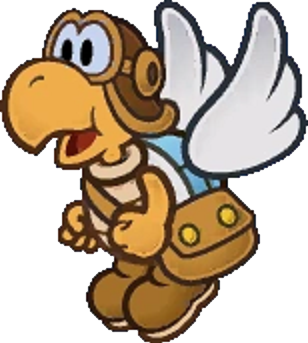
This harried courier is Mario's fourth party member in Paper Mario 64. He's a Paratroopa who uses his wings to help him deliver mail. He can carry Mario across short gaps, but he's also involved in a lengthy sidequest to nab one of the game's rarer badges.
- All or Nothing: His Shell Shot ability. If the aiming line is not aligned with the enemy reticule upon release or the end of the action command, the shot completely misses the enemy and deals no damage whatsoever. This can make using the ability against smaller enemies particularly challenging.
- Almighty Janitor: He can kick ass for someone who's usually delivering packages and mail.
- Beware the Nice Ones: According to Goombario, despite his friendly personality, he is downright intimidating in battle.
- Catchphrase:
- He always introduces himself with "The name's Parakarry. I deliver letters."
- Whenever he delivers a letter during his sidequest, he says, "Another letter, duly delivered. A postman's job is never done." In at least one instance, he says "duly received" instead of "duly delivered".
- Disc-One Nuke: Joins Mario as early as the first third of Chapter 2, and is a contender for best party member alongside Sushie. His innate Shell Shot ability already deals 5 damage, enough to one-shot most enemies at that point in the game, and unlike Bombette's Bomb, its action command is much easier and it can hit any enemy on-screen.
- Early-Bird Cameo: In the first game, he delivers Peach's invitation to Mario well before he actually joins your party in Chapter 2. He can also be seen in the Toad Town Post Office during the prologue and Chapter 1.
- Flying Postman: He's a mailman from a winged species that flies the mail across the land.
- The Klutz: He has a habit of losing mail whenever he tries to make a delivery.
- Master of All: Arguably the most formidable party member in the game (alongside Sushie). Shell Shot does 7 damage at max, can hit any enemy on-screen, and does not involve Parakarry making direct contact with the target, meaning it can still damage spiked and fire enemies. Meanwhile, Air Raid is arguably the best partner move that involves attacking multiple enemies (apart from Sushie's Tidal Wave, which can be even more effective if executed correctly); it consistently deals 6 damage for a reasonable FP cost (6 as opposed to Bombette's 8 for Mega Bomb), hits every enemy, and is particularly useful in clearing swarms of enemies quickly, making Parakarry the perfect choice for many battles in the later stages of the game.
- Previous Player-Character Cameo:
- He appears in the prologue of Paper Mario: The Thousand-Year Door to deliver the Magical Map to Mario, making Parakarry one of only two former partners (along with Bow) to appear in The Thousand-Year Door. In the remake, he starts off the credit sequence.
- As with the rest of the 64 partners, Parakarry appears on a Catch Card obtained in the fiftieth level of the Flopside Pit of 100 Trials in Super Paper Mario.
- In Paper Mario: Sticker Star, a letter from Parakarry can be found within World 5-1's junkyard. All of this, in addition to his Catch Card in Super Paper Mario, made him the only character introduced in the first game to feature in every entry of the series, up until Color Splash was released in 2016.
- Useless Useful Spell: Parakarry's Air Lift is easily the worst move in the entire game. It has no use other than moving a single target out of battle, with even less range than Bow's Spook or Lakilester's Hurricane.
Lady Bow
Appears in: 64, The Thousand-Year Door

Mario's fifth party member in Paper Mario 64, Bow is a member of the Boo gentry who's unapologetic about scaring the living daylights out of people. She likes smacking people around with her fan and can make Mario briefly invisible and intangible, which is useful for avoiding enemy attacks. She kidnaps and holds the Star Spirit Skolar hostage, refusing to free him until Mario vanquishes Tubba Blubba.
- Achilles' Heel: She's completely crippled by anything with defense, as her slaps only do 1 damage (2 for Fan Slap) per hit. Her regular Smack ability is also a direct attack, meaning she can't hurt fiery or spiky enemies.
- Anti-Hero: She's a mischievous Boo who has no problem terrorizing people or holding sacred beings hostage, but she cares about her people and sticks up for Mario when he needs it.
- Appeal to Inherent Nature: While she has noble qualities and comes to care about Mario, she bluntly tells Mario he'll have no luck getting remorse from her for terrorizing Tubba Blubba and kidnapping Skolar, as such mischief is what her kind do.
- Awesome, but Impractical: Smack and Fan Smack. The attacks allow her to deal out the highest damage at the lowest cost per FP any party member. But relying on large numbers of weak attacks leaves her crippled when she runs into enemies with any defense ratings, which become more common as the game goes on.
- Badass Adorable: A cute Boo girl who wears ribbons and joins Mario on his quest to save the world.
- Bitch Slap: She slaps enemies silly as her default attack and it is quite effective, but her slaps don't do much damage individually, leading to the Death of a Thousand Cuts trope below.
- Blue-and-Orange Morality: According to her, scaring people and being mischievous is what she and other Boos do and are known for, so it was okay for them to terrorize Tubba Blubba before he became invincible, even more so because he was a wimp. And when Blubba gets the chance to get payback on the Boos, Lady Bow will be working towards stopping him because the Boos were just being themselves.
- Cute Ghost Girl: This haughty Boo has a cute design, especially noticeable in comparison to the more conventionally ghastly appearance of her fellow Boos in the Paper (and Yoshi's Island) style.
- Death of a Thousand Cuts: Her Smack and Fan Smack attacks do 1 or 2 damage per hit but strike multiple times.
- Demon Head: Invokes this with her "Spook" ability, in which she makes a scary face to chase enemies away.
- Gallows Humor: When attempting to clear Mario's name of being the suspect who killed Mayor Penguin, she swears "on [her] own grave" that Mario's innocent, seemingly taking the fact that she's dead in stride.
- Invisibility: Her Outta Sight ability allows her to turn Mario invisible, evading enemy attacks, though Bow cannot make a move in the followup turn.
- It's Personal: Has the most personal reason for initially joining Mario, as she seeks to defeat Tubba Blubba for his oppression and eating of her fellow Boos.
- Jerk with a Heart of Gold: While wealthy and entitled, Bow is willing to help rescue the world's wishes and journey with Mario to save the Star Spirits. Even though it is in her nature to scare innocent people, she does have a nice side to her.
- Lone Wolf Boss: Interestingly, while later games tend to have at least one actual Chapter boss who acts as this, in this story, Bow is the sole character to hold a Star Spirit hostage that isn't explicitly one of Bowser's lackeys tasked with doing so and fighting Mario. Instead, she just happened to find Skolar after he had already escaped Tubba's fortress, and cages his card to use as a bargaining chip to ensure Mario and the party comply with her own agenda; seeing that her people are saved.
- Noble Demon: Bow and her local Boos enjoy frightening others to the point the antagonist introduced eating them was their bullying victim and she shows no remorse for this or caging Skolar to use as a hostage, but she did do the latter largely to save her people, she does personally assist Mario in doing so, and she also accompanies and fights alongside him to free the Star Spirits and save Peach and the Star Rod from Bowser afterward.
- Noblewoman's Laugh: Due to her apparent status in Boo society, she always covers her mouth with her fan when she laughs.
- Ojou: As a noblewoman of the Boo gentry who even has her own butler, she definitely qualifies. Complete with a Noblewoman's Laugh and Paper Fan of Doom even!
- Overly Long Tongue: Being a Boo herself, this a given.
- Paper Fan of Doom: Her fan serves as her main weapon, and can make targets dizzy.
- Pragmatic Villainy: After defeating Tubba Blubba, she decides it's best she advise her kind not scare him anymore unless he bites back again. Ethically, she's quite vocal in that she doesn't see why she should be sorry about doing so in the first place, given scaring is in Boos' nature.
- Previous Player-Character Cameo:
- Appears in Poshley Heights in Paper Mario: The Thousand-Year Door after you beat the game. She still remembers her adventure with Mario, and retains her posh personality.
- Reaching the sixtieth floor of the Flopside Pit of 100 Trials in Super Paper Mario grants you a Catch Card with Lady Bow on it, as with the rest of the Paper Mario 64 partners.
- Proud Beauty: Takes much pride in her personal beauty and appearance, noting to Mario how appreciative he should be of it. Also invokes this in her cameo in Paper Mario: The Thousand-Year Door, citing her desire to "turn some heads on the road" as a reason for her traveling to and vacationing in Poshley Heights, and even gives Mario the privilege of being "overwhelmed by [her] beauty" once more.
- Royals Who Actually Do Something: Or the wealthy equivalent. She recruits Mario to help her take down Tubba Blubba, and joins his party for good to take down Bowser.
- Tertiary Sexual Characteristics: Her bows, obviously. When Tattling one of the NPC Boos in Gusty Gulch, Goombario will complain that he can't tell the males and females apart and wish that they all wore bows like she does to make it easy.
- Token Evil Teammate: She's a Boo, and while she has no allegiance to Bowser, she and her kind love to haunt innocent people. Tubba Blubba, the antagonist eating her kind, only turned to evil because Bow and the rest of the Boos would scare him on a daily basis. Her approach to solving this in turn is using Skolar, a Star Spirit, as ransom bait so Mario will help deal with Tubba. While Bow does warm up to Mario and willingly continues helping him afterwards, she still explicitly refuses to be sorry for all the mess she caused in the first place.
- The Unapologetic: Bow explicitly states (without any seeming instigation from Mario) that she is not sorry about terrorizing Tubba Blubba into becoming a menace in the first place, and still thinks it served the big chicken right. She does add, however, that it's probably safer that the Boos leave him alone now and not provoke another revenge scheme.Lady Bow: Scaring folks is what ghosts do, so Boo on him! Ha!
- Useless Useful Spell: Bow's Spook is one of the worst moves in the game, scaring away enemies so they yield no Star Points, which is detrimental to leveling up and has a low chance of working. Its only real uses are avoiding fights in areas you've already been to, but the player could just as easily defeat the enemies or run from them.
- Well-Intentioned Extremist: She holds a Star Spirit captive, but only so Mario has absolutely no choice but to help her save the Boos.
Bootler
Appears in: 64, The Thousand-Year Door

The butler of Boo's Mansion, he's the one to request Mario's assistance. He's a proper Boo who's great at giving scares, but he's fretfully protective of Lady Bow.
- All Love Is Unrequited: It's said that he deeply loved one of Boo's Mansion's previous mistresses, Lady Bow's grandmother.
- Ambiguously Related: Several of the portraits in the mansion resemble him. It's likely that these were former boo butlers, though their relation to Bootler is pure speculation.
- Battle Butler: Possibly, as he was known to adventure with known Retired Badass Goompa and former hero Koopa Koot in his youth, and his body wouldn't seem to have aged much since then. Maybe his request to tag along and protect Bow wasn't just fatherly doddering, after all...
- Dub Name Change: In Japan, Bootler's name is Sebastian, which is an exceedingly common name for butlers in Japanese media.
- Eyes Always Shut: His eyes are closed tight most of the time, usually in an unreadable - - face fitting his proper façade. They do show in his Nightmare Face, and he can't help opening them in shock when he first hears Bow intends to visit Tubba Blubba's Castle.
- High-Class Glass: He has a monocle that can only be seen when he expresses shock.
- Implied Death Threat: His "we'll GET YOU!" to Mario carries this impression, but given the typical nature and hobbies of Boos, it's very possible they would only intend to spook and torment the plumber.
- The Jeeves: Bootler is an unfailingly polite old butler in conversation towards the likes of Mario. It makes his abrupt threat to the plumber all the more bone-chilling.
- Jump Scare: After requesting the hero's aid, Bootler vanishes... before suddenly reappearing, twice his size, to screech a grisly warning to Mario while the screen shakes.Bootler: And if you don't come... we'll GET YOU!! BOOO!
- Nightmare Face: Like Boos often do when attacking or startling people, Bootler can do a killer scary face. And given the way he does his, it's probably one of the most effective.
- Not So Stoic: You would get the impression Bootler is The Stoic and a totally professional fellow, whether he's simply being a proper butler or doing his ghostly duties, up until you see his frightful attitude towards his dear Lady Bow being anywhere near danger.
- Old Retainer: To Lady Bow, and he's actually quite a bit like a Boo version of Toadsworth while predating the old Toad's debut by a year or two.
- Punny Name: Being a boo butler, he's called Bootler. But whether he's dubbed Bootler just because he is a butler but his brethren love to bestrew their verbalising with "boo", or it's actually his bona-fide birth-given name as a Boo, is a true Boo enigma.
- Retired Badass: While his fighting capabilities were never confirmed, in his youth he traveled the world with Goompa and Koopa Koot who are confirmed examples of this trope.
- Undead Servant: He's the ghostly personal servant of the also ghostly Lady Bow, the mistress of Boo Mansion in Forever Forest.
Whacka
Appears in: 64, The Thousand-Year Door, Super

An incredibly rare mole-like creature that drops the extremely powerful Whacka Bump when attacked.
In the 2024 remake of The Thousand-Year Door, a Whacka appears at the bottom of the Pit of 100 Trials in subsequent runs after defeating Bonetail and whacking a Whacka on Keelhaul Key, as an Optional Superboss.
- Artificial Stupidity: In his boss fight, Whacka can tremor the stage to cause objects to fall on him, which each cause 1 damage to him but give him additional Whacka Bumps to use against you. However, as seen here, it is possible for him to defeat himself by doing this.
- Beware the Nice Ones: While extremely docile and friendly, turns out that their idea of "playing" is to fight with someone. And considering the one time they decide to "play" is when they're a Superboss, one wouldn't expect these little guys to be such a deadly threat.
- The Cameo: Appears on the Snowflake Lake board in Mario Party 6.
- Cast from Hit Points: If you refuse to hit Whacka during his boss fight, he will have to self-inflict damage (by making ceiling objects fall on his head) to build up Whacka Bumps for use. Considering that one Whacka Bump can restore 25 HP or inflict 10 damage when he loses only 1 HP per bump, there is arguably no drawback at all besides a wasted turn. Though it is possible for Whacka to drop their HP to 0 if they do this at low enough health.
- Cranial Eruption: Exaggerated; hitting a Whacka causes it to grow a bump so big, that it falls off of its head. Unfortunately, it also has the added side effect of gradually giving it brain damage the more you hit it for its bumps, to the point of being driven to insanity, and possibly even death. It's then weaponized in the remake of The Thousand-Year Door during its Superboss fight, where every individual hit on it releases a bump, and it can throw all available bumps to deal huge damage per bump if not Super-guarded.
- The Dog Bites Back: After only being there to potentially suffer at the hands of the player in the first three games, he gets his chance to return the favor in his boss fight in the remake of The Thousand-Year Door.
- Drop the Washtub: In his boss fight, one of the possible objects to fall on him is a washtub.
- Edible Ammunition: Whacka uses his own bumps as projectiles to attack Mario and his partners; the normal ones deal 10 damage per hit, while the red ones deal 27. Fittingly, it also allows him to consume a bump to heal 25 HP, and woe betide the unlucky player who sees him eat a red bump to heal 75.
- Endangered Species: Whacka is frequently said to be an endangered species, and is often hunted due to their valuable and extremely delicious bumps. The game constantly reminds you of this, in an attempt to make you feel guilty for harming (and possibly even killing) such a rare, delicate creature. The added text in the description of Whacka Bumps in Super Paper Mario even puts it best:
- Feed It with Fire: As a Superboss, Fire is the only status effect Whacka isn't immune to, but only because the Damage Over Time actually helps him more than it hurts by creating a bump every turn.
- Geo Effects: For whatever reason, stage hazards occur with far more frequency against Whacka than in a regular fight. This is ultimately beneficial to him, since it gives him a way to create Bumps without wasting a turn.
- Healing Factor: Is able to consume his own bumps to heal 25 HP in his boss fight, which is exactly how much a single Whacka Bump will heal Mario.
- Hoist by His Own Petard: It is entirely possible for his tremor move (which damages him minimally but gives him a Whacka Bump for each hit) to actually finish him off.
- Killer Rabbit: Despite his cute exterior, he's a rather dangerous opponent to fight when encountered in the Pit of 100 Trials.
- Logical Weakness: Veil. Whacka's focus on doing absurd amounts of damage means that it often saves up a lot of Whacka Bumps to toss all at once, and will waste a turn to generate more if there isn't enough. A player can deal as much damage as they like and then use Vivian's Veil move to void Whacka's counterattack, leading to Whacka hurting itself even more by shaking the battlefield to, you guessed it, make more Bumps. Which can then be voided with Veil again. To a lesser extent, Lucky badges, Repel capes, and other items that raise evasion get around the question of how to survive its attacks as well.
- Mystical 108: His total HP. You couldn't just resist the temptation to hit him, could you?
- Nice Guy: He's nothing but friendly and cheerful. The Superboss variant in The Thousand-Year Door's remake in particular is quite friendly, simply seeing Mario's whack on his head as a request to play, and even after losing the fight, he gleefully awaits to see Mario again.
- Pain and Gain: Hitting Whacka with physical attacks in-battle will grant him Whacka Bumps that he can use as projectiles or healing.
- Puzzle Boss: Multi-hit attacks, which are usually the cornerstone of late-game high-damage builds, are specifically ill-advised by Goombella to use against Whacka since each hit provides him a Whacka Bump to heal with or use against you. Normal bumps deal 10 damage, while red bumps deal 27 damage, and should Whacka choose to attack, he will lob all available bumps at you in a single turn. You'd better be a master of Superguarding or have some means to nullify the attack if you go this route, or else you'll learn what it's like to be on the receiving end of a multi-hit blitzkrieg.
- Russian Reversal: The time-honored practice of badge-focused builds that focus on ludicrous damage to flatten enemies and bosses alike is turned against the player here, with a boss that can both deal massive amounts of damage in a single turn and can also heal it off faster than it can be damaged.
- Schmuck Bait: In the remake, there's a lone Whacka dwelling at the bottom of the Pit of 100 Trials after defeating Bonetail. It's easy to be fooled into thinking there's another source of Whacka Bumps after hitting the Whacka one too many times in Keelhaul Key, but whack it, and you will be in for a world of hurt.
- Superboss: In the Switch remake of The Thousand-Year Door. If you have whacked the Whacka on Keelhaul Key enough to make it disappear AND beaten the Pit of 100 Trial's original superboss Bonetail, then Mario will receive an email tited "RDM Extra Issue" stating that a "mythical creature" has been sighted at the bottom of the Pit. Said creature is a Whacka, who replaces Bonetail at the end of subsequent runs of the Pit, with one of the highest HP totals in the gamenote , brutally high attack power, and the ability to heal himself.
- Tap on the Head: Subverted. The more you hit Whacka the more his speech and memory becomes broken and limited, indicating increasing brain damage.
- This is fortunately played straight with the Whacka you fight as a Superboss in the remake of The Thousand-Year Door who is a lot more durable, enough so as to endure a full-blown fight with Mario, and eagerly awaits to "play" again if he loses.
- Video Game Cruelty Potential: It's already pretty cruel to repeatedly injure and potentially kill an innocent creature to harvest items from it, but there's nothing stopping you from just not even bothering to pick up the bumps afterward.
- Video Game Cruelty Punishment: In the The Thousand-Year Door Switch remake, a singular Whacka appears at the bottom of the Pit of 100 Trials after Bonetail has been vanquished, as Goombella warns you not to whack him if she's out. Notably, he only appears if you have also whacked the Whacka on Keelhaul Key enough times to make it disappear. Trying to whack this Whacka results in him retaliating with a very, very tough battle.
- Whack-a-Monster: Based on the concept of a Whack-a-Mole.
- When All You Have Is a Hammer…: Whacka fights only through his Bumps. Even his ability to make tremors is dedicated exclusively to building up a hoard of the stuff for attacking/healing.
Kamek
Appears in: Sticker Star, Mario & Luigi: Paper Jam, Color Splash, The Origami King
Voiced by: Atsushi Masaki

Bowser's loyal second-in-command who raised him from birth, as well as the leader of the Magikoopas.
- Adaptational Jerkass: In Sticker Star, Kamek is introduced as a condescending Jerkass who goes out of his way to make Mario's day worse, often in incredibly petty ways, which contrasts the Affably Evil Beleaguered Assistant that his main counterpart is usually portrayed as. The Origami King would reverse this by bringing his characterization more in-line with the main series.
- Admiring the Abomination: After encountering a Paper Macho Chain Chomp for the first time, Kamek has this to say:Kamek: It's some kind of hideous corruption of one of Lord Bowser's fiercest and most loyal minions! …Bowser would love it. I'll order him a few as a surprise…
- Affably Evil: In The Origami King, Kamek has largely drops his Jerkass tendencies and works with Mario without much issue, even if he is (self-admittedly) still plotting new ways to defeat the plumber later on. He's also extremely protective of Bowser Jr. and downright nice to Olivia.
- Beleaguered Assistant: Carried over from the main series, Kamek is often saddled with carrying out the hardest parts of Bowser's plans and is at the end of his rope 90% of the time. This is emphasized in The Origami King, where he serves as a party member for a chapter and does a good job of it, while making it clear that Bowser and Bowser Jr. would be far more effective villains if they would actually listen to him for a change.
- Characterization Marches On: In his introduction in Sticker Star, Kamek is a Faux Affably Evil villain who goes out of his way to antagonize Mario and Kersti at every opportunity and personally drives most of the plot. Fast forward to The Origami King, and Kamek's traits have shifted to more closely resemble his mainstream counterapart, having him behave more respectfully and placing an emphasis on his role as Bowser and Bowser Jr.'s Beleaguered Assistant.
- Continuity Nod: In Sticker Star, Kamek repeatedly calls Mario as "little Mario", referring to their long history in the Yoshi's Island series.
- Deadpan Snarker: Kamek has a pretty sharp wit and won't hesitate to deliver dry remarks, especially in Sticker Star.Kamek: Ooh, just look at your powerful arsenal of stickers… I'm ever so scared.
- Defeat Means Friendship: In Color Splash, his Enemy Card can be won from the Rock Paper Wizard in Super Roshambo after his defeat, which summons him to cast a spell for a turn. However, he refuses to attack bosses like the Koopalings or Bowser.
- Demoted to Extra: After being the major antagonistic force in Sticker Star, Kamek's role is comparatively smaller in Color Splash, where he mainly appears by cursing Mario during battles and his role in the plot largely replaced by the Koopalings. He is still responsible for playing around with the sizes in Mondo Woods, but is overall a step down from being The Dragon.
- The Dragon: He is Bowser's most trusted enforcer, and seems to have even more control of the Koopa Troop than Bowser Jr. himself.
- Dragon-in-Chief: Since Bowser is largely absent in Sticker Star, Kamek steps in to personally command his army and interfere with Mario and Kersti as often as possible.
- Dual Boss: Like the Bowsers and the Jrs., Kamek and his paper counterpart fight together in Paper Jam.
- Dude, Where's My Respect?: While Bowser rarely berates or insults Kamek like he does to Kammy, Kamek nevertheless works a thankless job and will occasionally snark or mutter about it as a result.
- Enemy Mine: Forms one with Mario in The Origami King to retake Bowser's Castle.
- Even Evil Has Loved Ones: Just like in the main games, Kamek raised Bowser and cares for him as if he were his own son. He also loves Bowser Jr. and dutifully babysits him when Bowser is preoccupied.
- Evil Genius: As Sticker Star and Paper Jam show, Kamek is very much the brains of the Koopa Troop, regularly concocting schemes and attempting to steer Bowser in the right direction.
- Evil Is Petty: In Sticker Star and Color Splash, Kamek often appears solely to mess with Mario, either by placing random curses or turning all of his stickers into flip-flops.
- Evil Laugh: He lets out a sinister chuckle whenever he confronts Mario.
- Evil Sorcerer: He is a powerful Magikoopa capable of casting a variety spells and hexes on a whim.
- Failed a Spot Check: Despite their long history with each other, Kamek completely fails to notice that Bowser is Not Himself in Sticker Star and Color Splash due to the influences of the Royal Sticker and the black paint, respectively. Instead, he continues to carry out Bowser's (very questionable) orders like nothing is out of the ordinary.
- Faux Affably Evil: In contrast to his more polite and reasonable portrayal in the main series, this version of Kamek is blatantly condescending and often goes out of his way to "compliment" Mario and Kersti in a sarcastic manner.Kamek: Well, this will seem rather rude since we've only just met, but… Let's get you out of the way quickly, shall we? Prepare for ruin!
- Flying Broomstick: His preferred method of transport.
- Friend to All Children: Aside from the fact that he regularly takes care of Bowser Jr., Kamek also immediately takes a liking to Olivia and gets along with her quite well.
- Gameplay and Story Segregation: Even if he is defeated, he still has a chance to ambush Mario during a Random Encounter.
- Graceful Loser: Despite his general smugness, he usually takes his defeats in stride and considers Mario a Worthy Opponent.
- The Heavy: Bowser may be the Big Bad of Sticker Star, but he appears only at the start and end of the game and has no dialogue. Kamek shows up repeatedly throughout the worlds to make Mario's life more difficult.
- Jerkass: In Sticker Star, he is needlessly rude and condescending towards Mario and Kersti, and occasionally does mean things for the sake of it.Kersti: I don't get mad too easily, but that Kamek really STINKS!
- King Mook: Of the Magikoopas, being the most powerful and most significant of their race.
- Laughably Evil: As much of a Jerkass as he can be, Kamek is so blunt and snarky that it's hard not to chuckle whenever he shows up.Kamek: I'd love to stick around and sweep the floor with you, but I've got places to be, lives to ruin. You know how it is for us big wigs.
- Leitmotif: Sticker Star gives him his own theme, called "The Blue Wizard", which is remixed into "Malevolent Magikoopa". It reappears yet again as the aptly titled "Kamek's Theme" in Color Splash and "Meet Kamek" in The Origami King.
- Magical Nanny: To Bowser as during the Koopa King's youth. Even though Bowser is a grown adult now, not much has changed.
- Mana Burn: In Sticker Star, he has a spell that randomly destroys one of your stickers. This is especially an issue at Bowser's Sky Castle: hope that sticker wasn't one of Bowser's weaknesses!
- Never My Fault: In The Origami King, Kamek recounts the story of how he crashed Bowser's Castle by accidentally pressing the wrong button while trying to activate an emergency protocol. He then immediately proclaims that it wasn't his fault.
- Odd Friendship: He immediately hits it off with Olivia despite her being the Nice Girl companion to his master's sworn enemy.
- OOC Is Serious Business: The normally calm and collected Kamek completely freaks out upon seeing Bowser Jr. get sliced to pieces by Scissors.
- Other Me Annoys Me: Just like the Bowsers, Paper Kamek seems to find his main counterpart intolerable, though they do end up having respect for each other and get along in the end. For all of ten seconds.
- Papa Wolf: Pretty much everything he does is to protect and appease Bowser, who he basically raised as his own. This also extends to Bowser Jr., who he takes care of in Bowser's absence and is willing to risk his life for.
- Pet the Dog: In The Origami King, he saves and re-folds Olivia after she nearly drowns in one of the Shangri-Spa's tubs. Notably, he had no ulterior motive and seemed to just do it out of genuine kindness towards her.
- Pragmatic Villainy: Often engages in this. Kamek is not particularly powerful when compared to Bowser or the other bosses, but he makes up for it by using his brain and carefully choosing his battles.Kamek: Yes, my logic-based system—along with timely retreating and tactical cowering—have gotten me far.
- Random Encounter: In Color Splash, Kamek will occasionally ambush Mario and cause a random event, such as obscuring Mario's Battle Cards, randomizing their positions, turning all of his cards into Worn-Out Boots or Worn-Out Hammer Cards, or outright stealing a bunch of Mario's Battle Cards, heavily reducing your already limited attack count. Additionally, Kamek folds up the "Flee" command to prevent running away, and knocks off the Battle Spin. And yes, it is entirely possible for a battle to become completely unwinnable due to one of Kamek's curses. So if you're unlucky enough to get stuck in a curse battle where you cannot touch the enemy at all, you're either gonna have to restart the game, or just deal with getting the guaranteed Game Over.
- Recurring Boss: In both Sticker Star and Paper Jam, he's fought three times, with two of his battles in the latter being a Dual Boss alongside his main counterpart.
- Red Oni, Blue Oni: The blue to Bowser and Bowser Jr.'s red.
- Robe and Wizard Hat: He's clad in the traditional blue robes and peaked hat of the Magikoopas.
- Servile Snarker: His Undying Loyalty to Bowser and Bowser Jr. doesn't keep him from snarking at their boneheaded decisions.
- Shoe Slap: For his second and third battles in Sticker Star, he turns all of Mario's stickers into... sandals, forcing the plumber to fight by slapping him in the face with flip-flops.
- Smug Snake: In Sticker Star, Kamek takes great pleasure in mocking and belittling Mario and Kersti at every turn.
- Snark-to-Snark Combat:
- The majority of his encounters in Sticker Star have him snarking back and forth with Kersti.
- He also throws shade at his main counterpart over the course of Paper Jam, with the latter returning the favor.
- Squishy Wizard: Very much so in Sticker Star. Compared to the staggering amounts of health that the chapter bosses boast, Kamek has a measly 20 HP each time Mario faces him. Instead, he relies on trickery to avoid being curb-stomped.
- Took a Level in Jerkass: While the main series Kamek can be pretty smug, he generally at least tries to reason with Yoshi and doesn't have much against Mario himself. Here, he's far less respectful and often goes out of his way to Troll Mario for no reason.
- Took a Level in Kindness: In The Origami King, he's far less condescending towards and more cooperative with Mario.
- Troll: He enjoys screwing with Mario by placing random or nonsensical curses on him in the midst of battle.
- Undying Loyalty: Towards Bowser and his son, both of whom he constantly supports and looks after (often to his own detriment).
- Unexplained Recovery: He turns to ash at the end of Sticker Star, shatters to pieces after being drained white in Color Splash, and explodes along with his main counterpart in Paper Jam, yet always returns no worse for wear. Admittedly, this happens all the time to both named and minor members of the Koopa Troop.
- Villainous Parental Instinct: He's completely indifferent to the suffering he causes in pursuit of his goals, but he genuinely cares about Bowser and Bowser Jr., his adopted son and grandson, respectively, to the point that he'll form an Enemy Mine with Mario to rescue them.
- Villain Respect: In Sticker Star, Kamek reveals that he was watching Mario and Kersti conquer the Enigmansion the entire time, but never interfered simply because he genuinely enjoyed witnessing their victories and respected their tenacity.
- Worthy Opponent: In Sticker Star and especially Color Splash, he expresses great respect for Mario upon being defeated.
Bowser Jr.
Appears in: Sticker Star, Mario & Luigi: Paper Jam, The Origami King
Voiced by: Caety Sagoian

Bowser's bratty son and the heir to the Koopa throne.
- Affably Evil: He forms a genuine friendship with his Alternate Self in Paper Jam, and once he forms an Enemy Mine with Mario in The Origami King, he has no problem getting along with him and Olivia.
- Alas, Poor Villain: He may be a Spoiled Brat who willingly aids in his father's schemes for world domination, but him being sliced to bits by Scissors is completely Played for Horror, to the point that even Mario and Olivia rush to help save him.
- Anti-Villain: Ultimately, all Jr. wants us to make his dad proud and finally get some friends… even if he has to kill Mario to do so.
- Barrier Warrior: In Sticker Star, he'll activate a domed barrier over his Clown Car to protect himself.
- Black Bead Eyes: Like Mario, Bowser Jr. has tiny black eyes, which contrast his father's.
- Blood Knight: The Origami King depicts him with a voracious appetite for combat, mainly so he can make his dad proud.Bowser Jr.: I haven’t fought anyone in over an hour! Let’s hurry up and do this!
- Body Horror: He gets sliced to pieces by Scissors in The Origami King, and unlike with the Scissors Thing in Sticker Star, it's played dead seriously this time.
- Bratty Half-Pint: But of course. Being the spoiled son of an Evil Overlord, Jr. is about as arrogant and obnoxious as can be, especially when he doesn't get what he wants.
- Children Are Innocent: Despite technically being evil, Jr.'s motives are far more benign than his father's and motivated more by insecurity and immaturity than genuine malice.
- Child Soldier: Despite being a young child, he's still an active member of his father's army.
- Combination Attack: In Mario & Luigi: Paper Jam, he and his main counterpart attack in tandem.
- Cool Airship: He pilots one of the Koopa Troop's signature airships in the climax of Sticker Star.
- Cool Car: He often cruises around in the iconic Koopa Clown Car.
- Demoted to Extra: Ever since his introduction in the main games, Bowser Jr. has been portrayed either as Kamek's equal or as The Dragon directly behind Bowser himself, to the point of being the Big Bad in some games. Here, however, it's blatantly obvious that Kamek is above him in the Koopa Troop, and Jr. never takes center stage.
- Dramatic High Perching: He seems to enjoy being in high places. Lampshaded in Paper Jam, where he comments to himself that he has no fear of heights, and even seems to enjoy the thrill of being at the top of an incredibly high mountain.
- Dual Boss: With his main counterpart in Paper Jam, where the duo will work together using attacks and even healing/reviving each other.
- Enemy Mine: Forms one with Mario and Olivia alongside Kamek to rescue his dad.
- Even Evil Has Loved Ones: Obviously, Jr. loves his father more than anything else, and everything he does is to make him proud. The Origami King implies that he cares about his Magical Nanny, Kamek, as well.
- Evil Redhead: Just like his dad, he sports flaming red hair and is a tyrannical villain.
- Fiery Redhead: On top of the red hair, Jr. has inherited Bowser's temper and bratty behavior.
- Gadgeteer Genius: Like his main counterpart, Bowser Jr. relies on building and designing machines to take down Mario, as opposed to his father's affinity for magic.
- Generation Xerox: In terms of appearance, he's essentially just a smaller version of his father.
- Goldfish Poop Gang: In Sticker Star, thanks to him not being a real threat and having no major role in the plot, unlike Kamek.
- Gotta Catch 'Em All: In Sticker Star, his main objective seems to be hunting down rare stickers. At least until the last time he's encountered, at which point he just wants revenge.
- Green-Eyed Monster: In the fourth game, he attacks Mario twice simply because he wants to take the plumber's stickers for himself.
- Guest-Star Party Member: For a brief period in The Origami King, Bowser Jr. can aid in battles during the period between restoring him back to normal and fighting the miniboss. However, the player can go straight to the miniboss after the preceeding sequence and he permanently leaves the party (as far as the game is concerned) afterwards, meaning that its unlikely that they'll see him in battle unless they put off fighting the miniboss.
- Healing Factor:
- Throughout his boss battles in Sticker Star, he'll start to heal himself once his health gets too low.
- In Paper Jam, both of the Juniors can pull a Mushroom or even a 1-Up Mushroom out of their Clown Car to heal their buddy.
- Hot-Blooded: He loves fighting, hates Mario, and generally acts more on impulse than logic as a result.
- I Just Want to Have Friends: In Paper Jam, it's heavily implied that he's much lonelier than he cares to admit. When he finally finds a friend in the main Bowser Jr., he worries so much about losing him that the two try to hunt down the only way back to the paper world and destroy it.
- Ineffectual Sympathetic Villain: In Sticker Star, he serves as more of a nuisance to Mario and Kersti than anything else, and suffers a brutal beatdown each time he encounters them.
- Japanese Delinquent: Like the stereotypical Japanese street punk, Bowser Jr. wears a painted bandanna over his face, sports a rebellious hair style, wears punk jewelry, slings graffiti, and rides around in heavily modified vehicles.
- Junior Counterpart: As his name implies, he serves as one to his father.
- Leeroy Jenkins: In The Origami King, he attempts to rush in and retake Bowser's Castle on his own. It goes VERY badly.
- Leitmotif: In Sticker Star, he has a theme called "My Things!". The Origami King replaces it with "Enter, Bowser Jr.!" (not to be confused with the Super Mario Galaxy theme), a more cutesy-theme that bears similarities melody-wise to his father's new leitmotif.
- Like Father, Like Son: He not only does looks identical to his dad papa, but he inherits the Koopa King's signature temper and drive to defeat Mario.
- Literally Shattered Lives: His attempted charge at Bowser's Castle's in The Origami King ends with Scissors cutting him to pieces.
- Lonely Rich Kid: He's heavily implied to be one in Paper Jam, where he only seems truly happy when he finally finds a playmate in his main counterpart.
- Missing Mom: His mother is now where to be found, and unlike in the main series, he doesn't even have Peach to fall back on as a Parental Substitute.
- Never My Fault: After being defeated for the first time in Sticker Star, he whines and calls Mario a bully, despite the fact that Mario only fought him in self-defense.
- Overlord Jr.: Not only does he share a name with his Evil Overlord father, but he's also the heir to the Koopa throne.
- Plot-Irrelevant Villain: Unlike Kamek, Jr. has absolutely nothing to do with Bowser's plan in Sticker Star, only showing up every so often to pester the heroes.
- Recurring Boss: In Sticker Star, where he's fought three times in each act of the story.
- The Rival: To Mario in general, as Jr. constantly seeks to defeat him in order to impress his dad, while Mario constantly tries to get Jr. out of the way.
- Shoo Out the Clowns: At the end of Paper Jam, he and his main counterpart are knocked unconscious just in time for their fathers to take center stage.
- Sore Loser: Resorts to whining and crying to his dad whenever Mario defeats him.
- Spikes of Villainy: Has a spiky turtle shell, just like his dad.
- Spoiled Brat: Bowser spoils him absolutely rotten, resulting in a Bratty Half-Pint that picks on anyone who annoys him. In Paper Mario: The Origami King, Bowser sums up this part of his son in one sentence:Bowser: Try parenting a "high-energy" kid with access to a flying car and his own army!
- Suspiciously Similar Substitute: To Jr. Troopa from Paper Mario 64, being a Recurring Boss and The Rival who is utterly obsessed with defeating Mario. They both even have "Junior" in their names!
- Tragic Villain: Paper Jam portrays him as a lonely kid who is neglected by his father and simply wants a friend. He manages to find one in the main Bowser Jr., but the two are ultimately separated by the end and forced to continue going on as lonely as they were before.
- Villainous Friendship: In Paper Jam, Bowser Jr. and Paper Bowser Jr. form a friendship so ironclad that it borders on Heterosexual Life-Partners territory. The two love each other's company and quickly become fearful that, should the Paper World book be discovered, Paper Bowser Jr. would have to leave and the two would be bored and lonely again.
- "Well Done, Son" Guy: His primary motivation is simply to make his father proud, no matter what it takes.
Birdo
Appears in: Sticker Star, Color Splash, The Origami King

A lovestruck pink dinosaur with an affinity for the spotlight.
- Adaptational Heroism: Unlike in the main series, Birdo is never a villain or a boss in these games. In fact, every time she shows up, she manages to help Mario in some way.
- The Cameo: Each of her appearances is a short, yet extremely memorable sequence.
- Drama Queen: Birdo adores drama, and thus strives to be as extravagant as possible.
- Dramatic Spotlight: Her appearances are almost always marked by one of these. It's justified in Color Splash and The Origami King, since she's performing for a crowd in both.
- Girly Girl: She's pink, wears a bow, and is entranced by the concepts of drama and romance.
- Kiss of Life: In The Origami King, when she blows a kiss at those she admires, it has healing properties.
- Nice Girl: She's nothing but friendly and pleasant (if a bit flirty) whenever she comes across Mario.
- Running Gag: The later games feature her in humorous cameos, with at least two of them involving showstopping musical numbers.
- Say It with Hearts: Much of her dialogue is punctuated with heart emojis, emphasizing her romantic nature.
- Single Woman Seeks Good Man: Flirts with just about anyone who crosses her path. Most recently, Mario was the target of her affections in The Origami King.
- The Tease: She's quite flirtatious, winking and blowing kisses at whomever catches her fancy. She even manages to make Mario flustered!
Host Snifit
Appears in: Sticker Star, Color Splash

The host of the game show "Snifit or Whiffit". He returns in Color Splash, where he now hosts "Snifit or Whiffit: Seabed Edition".
- Affably Evil: He's clearly working for Bowser as he introduces Mario to the show as "the man we all detest", he holds a Wiggler segment hostage, and his questions reveal that he thinks that Bowser is straight-up cooler than Mario. But he's generally a fun-loving host who has Mario participate in his game and plays fair for the most part, genuinely respecting him if he wins. The only thing that's considered harmful that he did to Mario is filling the room with poison gas, and later threatening to pop Mario's bubble underwater if he got too many questions wrong.
- A Dog Named "Dog": The host's name is "Snifit" and he's a Snifit. Otherwise, he doesn't actually have a name-name.
- Ladies and Germs: "Gentlebuddies" and "Goodbuddies' are variants of his introduction.
- Noble Demon: He works for Bowser and is willing to kill Mario for the sake of his game show, but he does honor his word and remains friendly to Mario all throughout.
- Punch-Clock Villain: Being part of Bowser's army and running a deadly game show is just his job. Outside of that, he's a pretty friendly guy.
- Studio Audience: According to one of the answers to his questions, there are 30 Snifits in the audience.
- Whack-a-Monster: One of his challenges is to whack 20 "unpaid Snifit interns."