Journal Articles by Edward A S Ross
AI & Antiquity, 2025
Hallucinations (misleading, inaccurate predicted text presented as fact) are a critical problem f... more Hallucinations (misleading, inaccurate predicted text presented as fact) are a critical problem for using generative artificial intelligence (GenAI) tools to support ancient language teaching and learning. For a teacher, significant editing time is required to correct any inaccuracies or misrepresentations prior to making use of AI-generated content to support their teaching practice. For students, these convincing errors may not be recognised, and this may lead to misconceptions in their knowledge formation. OpenAI and Google released public-facing, customizable conversational AI models which allow users to upload their own datasets to create personalised AI chat agents, known as GPTs (2023) and Gems (2024) respectively. This presents an opportunity for teachers to personalize their own models to streamline their students' experiences. However, can personalised conversational AI tools provide a fine-tuned experience that reduces the major, problematic ancient history and ancient language hallucinations that we see in standard ChatGPT and Gemini outputs? This paper discusses the creation of a personalised Latin Tutor GPT and Gem through the development of a series of exhaustive Latin vocabulary spreadsheets. We tested these personalised tools against their standard GenAI counterpart to determine if personalisation improved their efficacy and efficiency for supporting ancient language learning. The development of the spreadsheets and testing process both closely addressed current GenAI ethical issues, including copyright, environmental impact, and content restrictions. The results of these tests found that personalised GPTs and Gems made small efficacy and efficiency improvements, but the time and energy required greatly outweighed the results.
Journal of Classics Teaching, 2024
Over 2023, many universities and policy organisations in the higher education (HE) sector are wor... more Over 2023, many universities and policy organisations in the higher education (HE) sector are working to create guiding principles and guidelines for the use of generative artificial intelligence (AI) in HE Teaching and Learning (T&L). Despite these guidelines, students remain unsure if and how they should use AI. This article discusses the AI information sessions held over the Autumn 2023 term in the Department of Classics at the University of Reading, which aimed to provide students with the knowledge and tools to make informed judgements about using AI in their studies. These sessions discussed the benefits and drawbacks of generative AI, highlighting training data, content policy, environmental impact, and examples of potential uses. Staff and student participants were surveyed before and after these information sessions to gather their opinions surrounding AI use. Although at least 60% of participants had previously used generative AI, 80% of participants were apprehensive of or against using generative AI tools for learning purposes following the AI information sessions. By providing staff and students with the ethical considerations surrounding generative AI, they can make an informed judgement about using AI in their work without misplaced faith or excessive fear.
Journal of Classics Teaching, 2023
In November 2022, ChatGPT 3.5 was released on a public research preview, gaining notoriety for it... more In November 2022, ChatGPT 3.5 was released on a public research preview, gaining notoriety for its ability to pull from a vast body of information to create coherent and digestible bodies of text that accurately respond to queries (OpenAI, 2022). It is able to recognise the grammar and vocabulary of ancient languages, translate passages, and compose texts at an alarmingly accurate and rapid rate. For teachers, this AI has had mixed reviews. Some fear its ability to produce well-written work effortlessly, while others are excited by its abilities to push the boundaries of current teaching practices. This paper explores how well ChatGPT explains grammatical concepts, parses inflected forms, and translates Classical Latin, Ancient Greek, and Classical Sanskrit. Overall, ChatGPT is rather good at working with Classical Latin and Sanskrit, but its abilities with Ancient Greek are deeply problematic. Although it is quite flawed at this time, ChatGPT, when used properly, could become a useful a tool for ancient language study. With proper guiding phrases, students could use this AI to practise vocabulary, check their translations, and rephrase grammatical concepts.
Symposia: The Journal of Religion, 2019
The Ten Ox-Herding Pictures are a prime example of the use of calligraphy as a teaching tool in Z... more The Ten Ox-Herding Pictures are a prime example of the use of calligraphy as a teaching tool in Zen Buddhist practice. Each school of Zen Buddhism interprets their depiction of practice differently. Within their practices, certain schools of Zen Buddhism maintain a tradition of chanting the direct transmission of the dharma from the historical Buddha to their most recently deceased master. These dharma lineages are a window into the development of practice and philosophy for Zen schools and communities. Dai Bosatsu Zendo Kongo-ji (DBZ), a Rinzai Zen Buddhist training monastery in the Catskill Mountains, follows this tradition of dharma lineage chanting and provides access to the Ten Ox-Herding Pictures. An examination into the DBZ lineage and its commentaries of the pictures reveals a tailored, personalized, and experiential presentation of the themes that directly relates to North American practitioners.
Hirundo: The McGill Undergraduate Journal of Classical Studies, Apr 2017
The tradition of epic poetry is deeply tied to that of oral transmission. The works of Homer, for... more The tradition of epic poetry is deeply tied to that of oral transmission. The works of Homer, for instance, were not fully recorded until approximately two hundred years after their creation. With no complete textual versions widely available, it was necessary for these works to be disseminated verbally. Rhapsodes would perform epic poems for crowds at festivals and, depending on the audience, sing specific episodes from the well-known narrative. Each of these performances would vary depending on the rhapsode, although the most important aspects of the narrative were preserved. It was not until 530 BCE, under the direction of Pisistratus, that the poems were crystallized into the twenty-four books we know today. The Epic of King Gesar of Ling went through a very similar system of oral transmission and crystallization. Bards, comparable to the Greek rhapsodes, would travel around Tibet and sing of the life of Gesar of Ling. Although several partial accounts exist, a full written record of the Epic of King Gesar of Ling was not developed until the 1979. The completed version of thirty-one books now exists in Bhutan. By looking at the more documented process of the crystallization of the Epic of King Gesar of Ling it is possible to come to a better understanding of how other epics, such as the Iliad and the Odyssey, were crystallized from oral tradition. This essay will compare the Iliad and the Odyssey with the Epic of King Gesar of Ling by looking at oral performance and the textualization of the works. The first section of this essay will describe the crystallization of the Iliad and the Odyssey in the context of the Ancient Greek world, and the second section will describe the crystallization of the Epic of King Gesar of Ling in the context of pre-modern and modern Tibet.
Canons: The McGill Undergraduate Journal of Religious Studies, Apr 2016
Prior to the Tokugawa period, Buddhism was an elitist religion in Japan. It was practiced by gove... more Prior to the Tokugawa period, Buddhism was an elitist religion in Japan. It was practiced by government officials and was part of the state cult. After the Tokugawa shogunate took power, Buddhism was separated from the state cult and forced to fend for itself. As a way to prevent the spread of Christianity, the Tokugawa shogunate forced the populace to register within the Buddhist temple system, bringing the working class into the Rinzai Zen temples. Zen master Hakuin Ekaku developed a form of teaching using koan and calligraphy in order to bring Rinzai Zen to the everyday people. He turned Rinzai Zen Buddhism into a more universal practice that would accept anyone who was willing to devote themselves to Zen, regardless of social class. This essay follows a chronological structure, discussing the political movement of Rinzai Buddhism from its entrance into Japan during the Kamakura Period to the Ashikaga Period and then the Tokugawa shogunate. Hakuin Ekaku used his new koan based practice to revitalize the elitist Rinzai tradition through the percolation of Zen into the common populace. The practices he developed are still used today, and have helped hundreds of students attain new levels of enlightenment.
Hirundo: The McGill Undergraduate Journal of Classical Studies, Apr 2016
The Roman marriage ceremony of the early Roman Empire was heavy with symbolism. The ceremony was ... more The Roman marriage ceremony of the early Roman Empire was heavy with symbolism. The ceremony was focused on the bride, and each aspect was an attempt to impart onto her the ideals of a Roman aristocratic woman. These symbols, such as the sex crines and the flammeum, were taken from various Roman priestesses, who were used as symbols of Roman marriage and represented the ideals of aristocratic Roman women. “Aristocratic girls, at least, were expected to bring to their husbands enough education to lend sparkle and desirability as a spouse, maidenly chastity and finally the dual charms of wifely fidelity and fertility.” This essay discusses the standard Roman aristocratic marriage and how the diverse symbolism within the ritual depicted the ideal Roman aristocratic married woman. Because several of these symbols are directly taken from different orders of Roman priestesses, this essay looks at case studies of three orders in the time of the early Empire. Each priestess represented an aspect of what the ideal Roman aristocratic married woman should be. The Vestal Virgins represented chastity, the Flaminicae represented the importance of modesty and fidelity, and the priestesses of Ceres represented the ideal of motherhood and fertility. The ideal aristocratic woman would be a combination of all of three orders of priestesses.
Edited Translations by Edward A S Ross
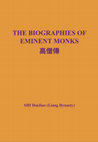
Shi Huijiao. The Biographies of Eminent Monks. Tianshu Yang, translator. Edward A. S. Ross, editor. Hong Kong: Centre of Buddhist Studies, University of Hong Kong, 2022
This book is a compilation of the lives of over 500 Buddhist figures from 67 CE to 519 CE. This 1... more This book is a compilation of the lives of over 500 Buddhist figures from 67 CE to 519 CE. This 14-chapter volume became the widely accepted basis for Chinese Buddhist, historical biography literature from the 6th century onwards. Extending from China’s first interactions with Buddhism to the Liang Dynasty, the text of the Biographies of Eminent Monks discusses Buddhist figures that were well known during the time of Shi Huijiao (慧皎) (497-554 CE), the compiler and author.
It is our hope that this new English translation of Shi Huijiao’s Biographies of Eminent Monks will make these poignant stories and crucial aspects of Chinese Buddhist history widely available to the English-speaking public, practitioners, and academics.
ISBN: 978-988-76424-2-8 (ebook)
Encyclopedia Entries by Edward A S Ross
The Database of Religious History, Dec 18, 2023
This encyclopedia entry discusses International Dai Bosatsu Zendo Kongo-ji, a Rinzai Zen Buddhist... more This encyclopedia entry discusses International Dai Bosatsu Zendo Kongo-ji, a Rinzai Zen Buddhist training monastery in the Catskill Mountains, New York, USA. It is published as part of the Database of Religious History project at the University of British Columbia.
The Database of Religious History, May 6, 2023
This encyclopedia entry discusses Shi HuiJiao's Biographies of Eminent Monks from the Liang Dynas... more This encyclopedia entry discusses Shi HuiJiao's Biographies of Eminent Monks from the Liang Dynasty (502-557 CE). It is published as part of the Database of Religious History project at the University of British Columbia.
Book Reviews by Edward A S Ross
Bryn Mawr Classical Review, 2023
Teaching Documents by Edward A S Ross
This document is a short introductory guide to the digital tools available for supporting the stu... more This document is a short introductory guide to the digital tools available for supporting the study of Ancient Greek and Latin. The first part of this guide is a list of our preferred digital tools for supporting Ancient Greek and Latin learning. This list is not exhaustive, but it does include a variety of generative AI tools and their ideal uses for supporting ancient language learning. The second part of this guide is a series of pre-prepared prompts which can be copy-pasted into a conversational AI tool to guide the conversation towards your expected learning level.
Conference Posters by Edward A S Ross
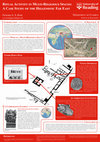
Fourth Meeting of the Hellenistic Central Asia Research Network, 2022
As more archaeological evidence is published from Central Asia, the daily life of its people beco... more As more archaeological evidence is published from Central Asia, the daily life of its people becomes clearer. Recent material from the Hellenistic temple complex in Ai Khanoum (Martinez-Sève, 2021) suggests that at least three different groups of cult activity occurred simultaneously in the temple site during the Greco-Bactrian period (c. 256-100 BCE). This poster will examine the archaeological evidence of religious life in the Hellenistic temple of Ai Khanoum to determine how it was used as a multi-religious space. Due to the lack of comparable contemporary evidence in the Hellenistic Far East, a multi-religious Kushan period temple site is used to theorize how Hellenistic people would have engaged with the temple complex on a daily basis. Stepping away from seeing these sites as different cult spaces clustered together, we can see the nuances of Hellenistic religious life and its daily practices. The temple at Ai Khanoum was a multi-religious space during the Hellenistic Period and viewing it from that perspective deepens our understanding of lived religious activity in the Hellenistic Far East.
Conferences by Edward A S Ross
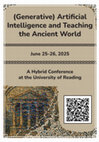
iGAIAS, 2025
This hybrid conference brought together teachers, researchers, scholars, and practitioners to exp... more This hybrid conference brought together teachers, researchers, scholars, and practitioners to explore the intersection of artificial intelligence (AI) and teaching about the ancient world, broadly conceived. From the exponential environmental impact to the distortion of ancient history to the development of new models, Generative artificial intelligence (GenAI) tools are making growing impacts on how the ancient world is taught, investigated, perceived, and understood. It is crucial to discuss these arising issues with those involved at all stages of the teaching, research, and development processes so that the many disciplines engaged in ancient world studies might have a consensus about the use, ethics, and impact of GenAI.'
The keynote speaker was Prof. Federica Lucivero (Ethox Centre, University of Oxford).
This conference was sponsored by the Institute of Classical Studies, Bristol Digital Game Lab, and the Department of Classics at the University of Reading.
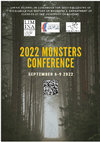
Monsters Conference, 2022
Limina Journal in collaboration with the ARC Centre for the History of Emotions and the Classics ... more Limina Journal in collaboration with the ARC Centre for the History of Emotions and the Classics Department at the University of Reading host a four-half day conference on the theme of 'Monsters'. Papers will be presented both in-person and virtually (via Microsoft Teams) with the first two days based at the University of Reading, UK and the latter two days based at the University of Western Australia, Perth.
The conference papers cover a wide range of topics themed around the concept of Monsters and Monstrosity from monsters' presence and construction (or deconstruction) in various media and genres, including mythology, literature, and film to the concept of monstrous 'othering', especially around women and female bodies. The conference papers cover monsters from antiquity to contemporary times and representations of monsters from across the globe.
This conference also features a poster session, a special exhibition at the Ure Museum in Reading (which can be seen virtually as well as in-person), and three fantastic and exciting workshops on: The GLAM Sector and Academic Engagement, Australian Gothic Literature, and The Monstrous Witch - A Manifesto.
The conference will feature three keynote speakers:
• Prof Marguerite Johnson (Newcastle) speaking on 'Making a Monster, or Justifying Hunting Women'
• Dr Ionat Zurr (UWA/SymbioticA) speaking on 'The Monstrous Act of Caring and Curating'
• Dr Victoria Flood (Birmingham) speaking on '"I Want to Believe": Medieval Monsters and the Limits of Credibility'
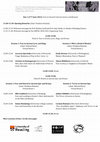
AMPAL, 2021
Postgraduates in the Department of Classics at the University of Reading were delighted to host t... more Postgraduates in the Department of Classics at the University of Reading were delighted to host the Annual Meeting of Postgraduates in Ancient Literature (AMPAL) in 2020-2021. The theme was Fear, and the conference was held at the University of Reading from the 17th to 19th June, 2021.
This event is described as AMPAL 2021 in shorthand, but it also stands as AMPAL 2020-2021 since it brought together already confirmed speakers due to present in AMPAL 2020 and new speakers joining the conference in 2021.
We were delighted that this year’s Keynote Speech was delivered by Professor Fiona McHardy (University of Roehampton, London). Professor McHardy spoke about fear of revenge in Euripidean tragedy. Through exploration of contemporary ideas about young children and babies as avengers, underpinned by comparative anthropology and psychology, this lecture unraveled the dynamics of fear associated with children within the plays of Euripides set within their literary and social context.
AMPAL 2020-2021 included a virtual tour of the Ure Museum of Greek Archaeology, our departmental museum founded by Percy and Annie Ure. In addition to the museum’s permanent display, we were proud to host an online presentation of an inaugural student exhibit, ‘Fear Beyond Words’, designed specifically for AMPAL 2020-2021.
Given the travel restrictions and social distancing rules due to COVID-19, this year’s meeting was held online on Microsoft Teams. In these strange times, the Organizing Team of AMPAL 2020-2021 was determined to preserve the engaging and interactive character of the event. To that purpose, we transformed this online environment into a welcoming setup in which postgraduate students in Ancient Literature from across the world could gather again (albeit virtually) and celebrate another year of research on Classics.
AMPAL 2020-2021 was kindly supported by the Department of Classics at the University of Reading, the Classical Association, and the Ure Museum of Greek Archaeology at the University of Reading.


Uploads
Journal Articles by Edward A S Ross
Edited Translations by Edward A S Ross
It is our hope that this new English translation of Shi Huijiao’s Biographies of Eminent Monks will make these poignant stories and crucial aspects of Chinese Buddhist history widely available to the English-speaking public, practitioners, and academics.
ISBN: 978-988-76424-2-8 (ebook)
Encyclopedia Entries by Edward A S Ross
Book Reviews by Edward A S Ross
Teaching Documents by Edward A S Ross
Conference Posters by Edward A S Ross
Conferences by Edward A S Ross
The keynote speaker was Prof. Federica Lucivero (Ethox Centre, University of Oxford).
This conference was sponsored by the Institute of Classical Studies, Bristol Digital Game Lab, and the Department of Classics at the University of Reading.
The conference papers cover a wide range of topics themed around the concept of Monsters and Monstrosity from monsters' presence and construction (or deconstruction) in various media and genres, including mythology, literature, and film to the concept of monstrous 'othering', especially around women and female bodies. The conference papers cover monsters from antiquity to contemporary times and representations of monsters from across the globe.
This conference also features a poster session, a special exhibition at the Ure Museum in Reading (which can be seen virtually as well as in-person), and three fantastic and exciting workshops on: The GLAM Sector and Academic Engagement, Australian Gothic Literature, and The Monstrous Witch - A Manifesto.
The conference will feature three keynote speakers:
• Prof Marguerite Johnson (Newcastle) speaking on 'Making a Monster, or Justifying Hunting Women'
• Dr Ionat Zurr (UWA/SymbioticA) speaking on 'The Monstrous Act of Caring and Curating'
• Dr Victoria Flood (Birmingham) speaking on '"I Want to Believe": Medieval Monsters and the Limits of Credibility'
This event is described as AMPAL 2021 in shorthand, but it also stands as AMPAL 2020-2021 since it brought together already confirmed speakers due to present in AMPAL 2020 and new speakers joining the conference in 2021.
We were delighted that this year’s Keynote Speech was delivered by Professor Fiona McHardy (University of Roehampton, London). Professor McHardy spoke about fear of revenge in Euripidean tragedy. Through exploration of contemporary ideas about young children and babies as avengers, underpinned by comparative anthropology and psychology, this lecture unraveled the dynamics of fear associated with children within the plays of Euripides set within their literary and social context.
AMPAL 2020-2021 included a virtual tour of the Ure Museum of Greek Archaeology, our departmental museum founded by Percy and Annie Ure. In addition to the museum’s permanent display, we were proud to host an online presentation of an inaugural student exhibit, ‘Fear Beyond Words’, designed specifically for AMPAL 2020-2021.
Given the travel restrictions and social distancing rules due to COVID-19, this year’s meeting was held online on Microsoft Teams. In these strange times, the Organizing Team of AMPAL 2020-2021 was determined to preserve the engaging and interactive character of the event. To that purpose, we transformed this online environment into a welcoming setup in which postgraduate students in Ancient Literature from across the world could gather again (albeit virtually) and celebrate another year of research on Classics.
AMPAL 2020-2021 was kindly supported by the Department of Classics at the University of Reading, the Classical Association, and the Ure Museum of Greek Archaeology at the University of Reading.