Hackaday Links Column Banner

Hackaday Links: May 24, 2026

If your first-generation Chromecast was acting a little wonky this week, don’t worry. Contrary to fears online, the 2014 device hasn’t been excommunicated by Google. In a statement to Ars Technica, a rep for the search giant explained that the issue, which was keeping the devices from being able to stream video from services like Netflix, was temporary and should now be resolved. That said, the OG Chromecast hasn’t officially been supported since 2023, so it’s not clear how much longer they will remain operational. Google be Google, after all.

After resisting for years, this week, Mozilla finally relented and brought Web Serial to Firefox. While there’s been some debate about the wisdom of letting the Internet directly talk to hardware gadgets, anyone who’s flashed Meshtastic or configured their Betaflight-powered drone from the browser can attest to how convenient it is. In the announcement, Mozilla acknowledges that “most folks won’t use this API”, but points out that the “community of builders and tinkerers” (that’s us!) is sure to be excited about the news. They’ve even teamed up with Adafruit to ensure their web-based microcontroller workflows are compatible in Firefox 151 and beyond. If you give it a shot, let us know how it goes.

Speaking of hardware support, the Linux Vendor Firmware Service (LVFS) recently picked up a couple of big-name sponsors. As reported by It’s FOSS, this week, Lenovo, Dell, and HP have signed on as Premier-level sponsors to the tune of $100,000 per year. For those unfamiliar, LVFS offers a central repository where hardware vendors can upload firmware updates. On the client side, fwupd can be used to pull these updates down automatically without having to hunt around on each vendor’s website. The experienced players don’t need a service like LVFS, but it’s certainly one of those quality-of-life improvements that make the desktop experience a bit more accessible.

While on the subject of getting hardware working, we hear that more PlayStation 5 consoles can now run Linux. Last month, a software solution for booting the operating system on PS5 consoles running the relatively ancient 3.x and 4.x firmware was released, but now developer Andy Nguyen has gotten it working on firmware 5.x and at least some versions of 6.x. That’s still considerably behind Sony’s latest release, but it does open things up for more consoles to get in on the action.

In space news, the successful first flight of Starship V3 has understandably dominated the headlines for the last few days, but SpaceX wasn’t the only commercial launch provider with good news this week. On Friday, Blue Origin announced they had completed the investigation into the failure of its New Glenn rocket back on April 19th and that the Federal Aviation Administration has approved its return to flight.

According to a statement from the FAA, Blue Origin “identified the direct cause of the mishap as a cryogenic leak that froze a hydraulic line and led to a thrust anomaly during the second stage engine burn.” This resulted in the payload, a next-generation communications satellite featuring a massive 2,400 sq ft deployable antenna array developed by AST SpaceMobile, being placed in an unsustainable orbit.

If you’ve always dreamed of piloting your own walking battle tank, you might finally be in luck. China’s Unitree Robotics has unveiled a mech standing 2.7 meters tall, complete with a promotional video showing it smashing cinder blocks. Because what else would you do with a robot you just paid more than half a million dollars for? Unfortunately, there isn’t much information about the bot’s speed or endurance, and a company spokesperson says the design still needs some refinement before it is ready for production. But still, we’re getting there. Might as well start saving up now.

Finally, we were thrilled to hear that the iconic soundtrack for DOOM has been inducted into the National Recording Registry by the Library of Congress. There’s perhaps no piece of software more emblematic of the hardware hacking world than the 1993 shooter, and while we don’t think that had anything to do with the decision to formally recognize the game’s heavy metal-inspired digital riffs, it will be all that much sweeter the next time we see some oddball gadget running through E1M1.


See something interesting that you think would be a good fit for our weekly Links column? Drop us a line, we’d love to hear about it.
Building A Multi-Ton Power Loader For Fun

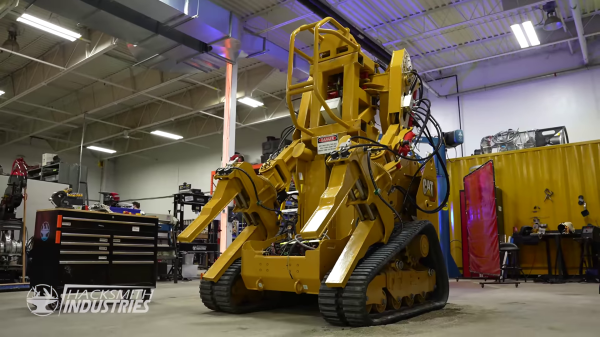
Exoskeletons, power suits, and iron suits in science fiction have served as the inspiration for many engineers and engineering projects over the years. This is certainly the case at [Hacksmith Industries], where Hackaday alum [James Hobson] has been building a massive mechanical exoskeleton since January 2019, inspired by the P-5000 Power Loader from the Alien movies. (Video, embedded below.)

Unlike the movie version, the [Hacksmith] power loader is not bipedal but built on top of the chassis of a small tracked skid-steer loader. Its existing hydraulic power unit also feeds all the upper body hydraulic cylinders. The upper body maintains the basic look of the movie version and was built from plasma-cut steel sections that fit together with a tab and slot system before being welded. Each arm has five degrees of freedom, controlled by proportional hydraulic valves. The power loader is controlled by an industrial grade control system based on the Raspberry Pi, running ROS.

Every single actuator is capable of applying enough force to kill, so safety is an important consideration in the design. It has emergency stop buttons mounted in several locations, including on a wireless remote. The ROS controller monitors the position of every cylinder using string potentiometers for closed-loop control, and to trigger the emergency stop if an actuator goes out of bounds. The power loader can be controlled by the onboard pilot using a pair of simulator flight controller joysticks, or remotely using a PS4 controller.

[Hacksmith Industries] is clear about the fact that they are building multi-ton power loaded for fun and entertainment, not because it’s necessarily practical or a commercially viable product. However, other exoskeletons have proven that they are a viable solution for reducing fatigue and risk of injury for industrial workers, and carrying heavy loads in rough terrain.

Continue reading “Building A Multi-Ton Power Loader For Fun”

Giant Robot Arm Uses Fluid Power, Not Electronics

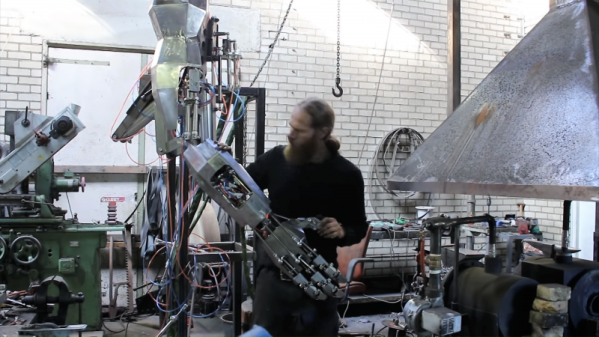
Fair warning that [Freerk Wieringa]’s videos documenting his giant non-electric robot build are long. We’ve only watched the first two episodes and the latest installment so far, all of which are posted after the break. Consider it an investment to watch a metalworking artist undertake an incredible build.

The first video starts with the construction of the upper arm of the robot. Everything is fabricated using simple tools; the most sophisticated tools are a lathe and a TIG welder. As the arm build proceeds we see that there are no electronic controls to be found. Control is through hydraulic cylinders in a master-slave setup; the slave opens a pneumatic valve attached to the elbow of the arm, which moves the lower arm until the valve closes and brings the forelimb to a smooth stop. It’s a very clever way of providing feedback without the usual sensors and microcontrollers. And the hand that goes at the end of the arm is something else, too, with four fingers made from complex linkages, all separately actuated by cylinders of their own. The whole arm looks to be part of a large robot, probably about 3 or 4 meters tall. At least we hope so, and we hope we get to see it by the end of the series.

True, we’ve seen terrifyingly large robots before, but to see one using fluid power for everything is a treat.

Continue reading “Giant Robot Arm Uses Fluid Power, Not Electronics”

Say Hello To Our New Robot Overlords

Well, that’s it. If SkyNet goes live once this 4-meter tall Avatar-style mech suit is in production, we’re all doomed.

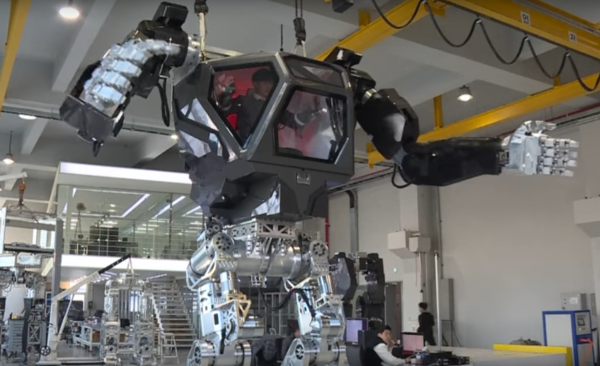
Named [Method-2], the bipedal giant towers over the engineers testing it at Korea’s Hankook Mirae Technology, where they appear to have done everything possible to make this thing look terrifyingly awesome. The first video below shows the mech with a pilot on board, putting the arms through their paces. We count at least six degrees of freedom on each arm, not including the five digits on each hand that look like they could punch through a brick wall. Later in the video we see a tethered walking test with no pilot, but we also found a webcam video that purports to be the first walk with a pilot. Either way, the 1.5-ton machine shakes the floor with every step.

This is still a development phase project, as evidenced by the fact that the mech seems to be getting its power from an umbilical. But this company has dumped a lot of money into this thing, and we’d bet they intend to capitalize on it. Once it can run untethered, though, watch out. Until then, we’ll settle for this mecha-baby costume.

Continue reading “Say Hello To Our New Robot Overlords”