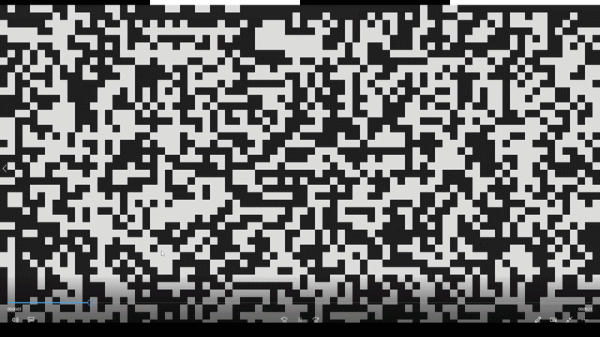
NoiseCloud: Storing Data On YouTube

Storage is expensive these days, whether you’re looking at the prices of spinning rust or magic little sticks of silicon. But what if there was some benevolent overlord that you could trick into giving you unlimited storage? That’s where Noisecloud comes in.

Created by [Lucas], Noisecloud is a tool that lets you use YouTube as a form of effectively-unlimited file storage. It works by taking whatever file data you have on hand, and turns it into frames of digital noise that can be stored and transported as an MP4 file and uploaded to YouTube. The encoding process involves first compressing the data with gzip, then packaging it into a high-constrast series of video frames that are then encoded with FFmpeg. Video containers can be produced in various resolutions, all the way down to 640×360 @ 30 fps. There’s also a special “TikTok mode” which is optimised to best preserve data on short form sites that use vertical orientation as default. More commentary from the creator is available via the supporting article on Github.

It’s probably not a practical way to store your files, given the fussy encoding and decoding required to actually use the data. However, it’s an interesting proof of concept that explores how data can be stashed in unexpected places via publicly-accessible services. We’ve explored similar work before, too.
Adorable ASCII Aquarium Lives On Your Desk

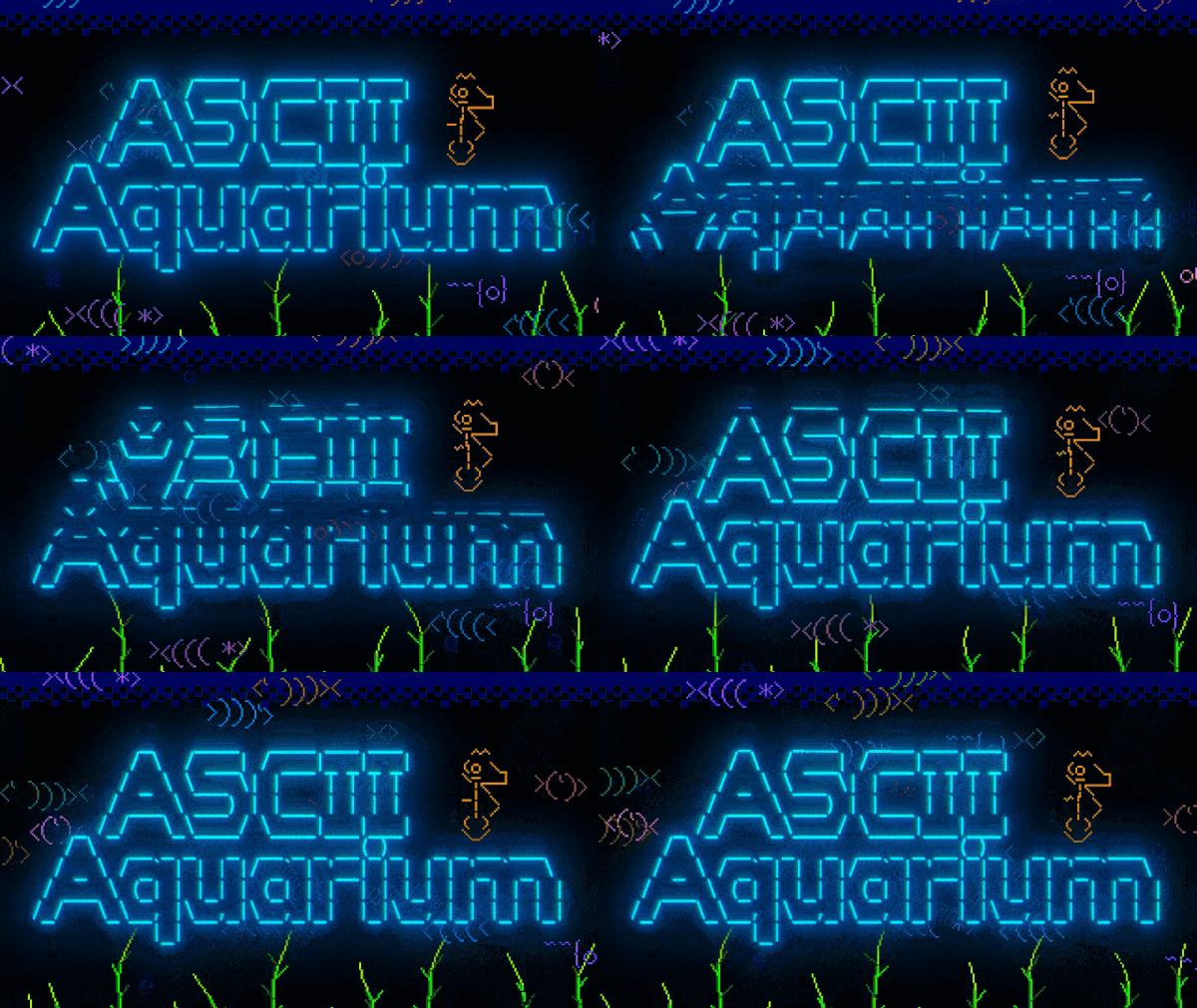
[Kert Gartner]’s ASCII Aquarium turns a cheap yellow display (CYD) into a tiny simulated aquarium, complete with ASCII sea creatures each with their own behaviors. There’s all kinds of options and even timekeeping functionality, so the miniature water world can also pull its weight as a desk clock.

The fish and other animal movements are not a series of canned animations; each creature has its own behaviors and responses to things like feeding, which is accomplished by tapping on the screen. A hidden menu offers a wide range of configuration and display options, and there’s even an option to export screen contents as bitmaps.

Add a 3D-printed enclosure and the whole thing looks like a pretty nice weekend project. There’s even a display flip mode, just in case you have a spare 50 mm beamsplitter kicking around.

It’s a very clever use of a CYD that shows how good color and graphics can look when one designs with the hardware’s capabilities (and limitations) in mind.

The CYD is an ESP32-based development board with integrated touchscreen display, and is known for its affordable price and wide availability. This one would look great next to a CYD electric jellyfish.

Spacelab’s Mitra 125 MS

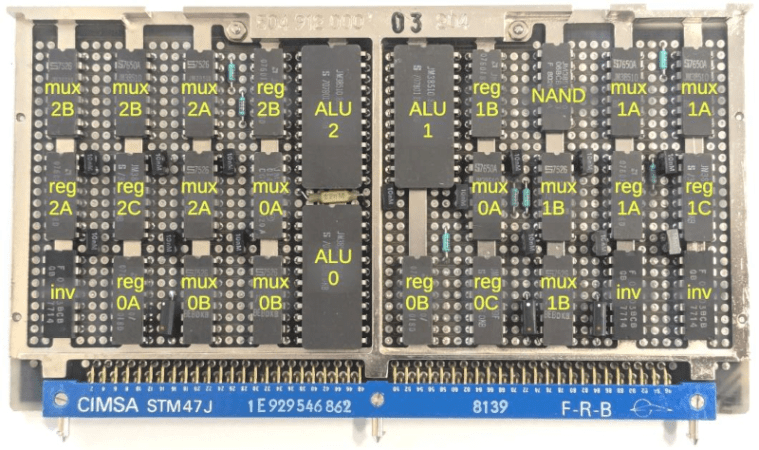
[Ken Shirriff] does some of the most interesting teardowns. This time, he’s looking at a French-built minicomputer called the Mitra 125 MS from around 1980. In particular, it was the computer inside Spacelab, a European lab that could fit in the back of the Space Shuttle.

As you might expect, the computer doesn’t contain a microprocessor. Instead, it is a series of cards and, in this post, [Ken’s] looking at the ALU that allows the computer to perform math operations.

Continue reading “Spacelab’s Mitra 125 MS”

Meet The Raven: An Atari Clone Computer Based On The Motorola 68060

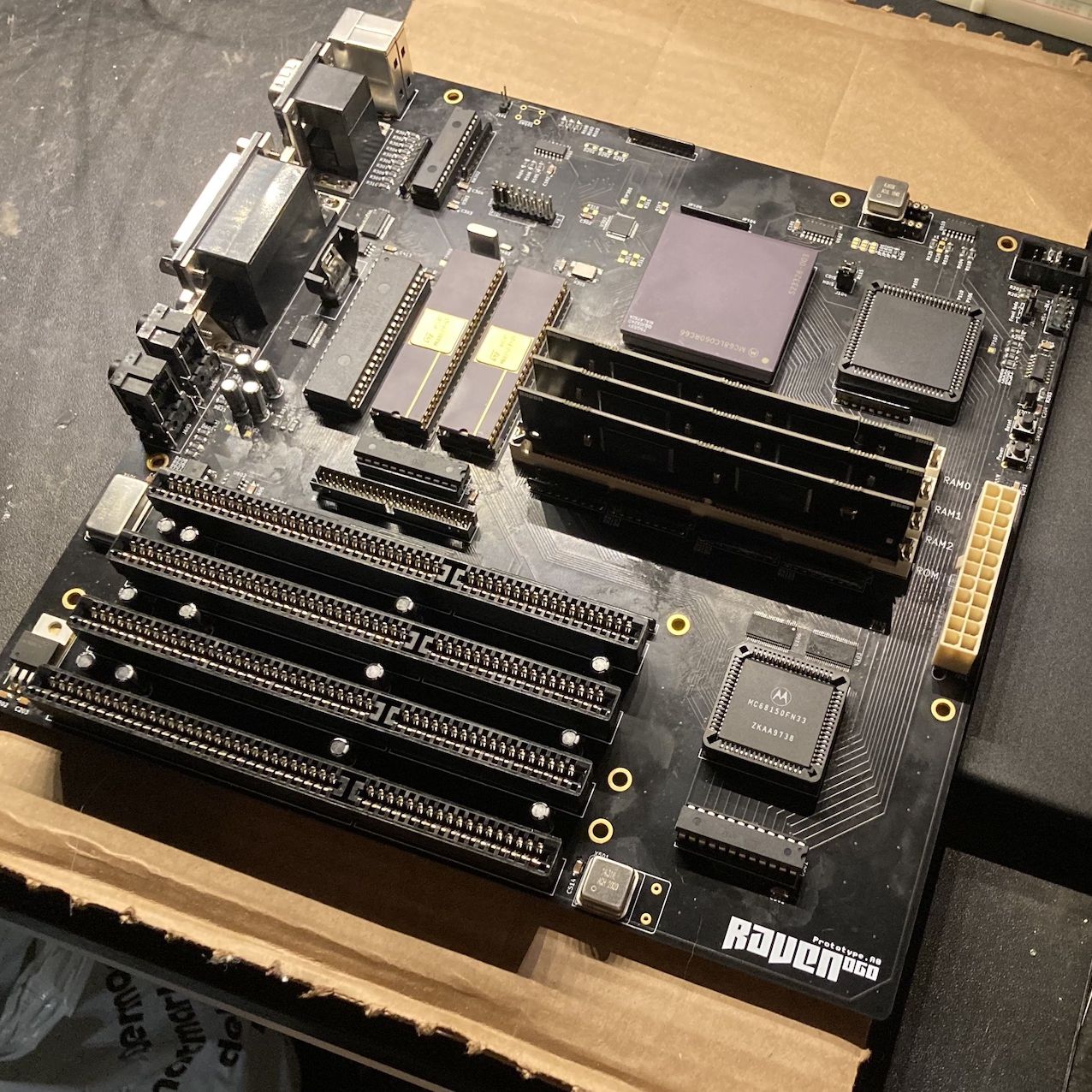
Some people who have a hankering to run GEM/TOS applications might just fire up an emulator, or maybe coax an old Motorola 68k-based Atari ST system back to life. Then there are people like [Anders Granlund], for whom hard mode is a way of life and making a custom mainboard around a genuine 68060 CPU and associated peripherals is a reasonable approach to pick. Thus quoth the Raven project.
The project commenced in 2024, when [Anders] started a thread on it over at the Exxos Forum which thus became pretty much the project log for the endeavor.

Both RAM and ROM ICs are on SIMM sticks, which seems like a pretty nifty idea compared to the typical socketed or soldered-in approach here, allowing for up to 48 MB of RAM and 16 MB of ROM.

On the custom ATX-compatible mainboard you get a total of 4 ISA slots, as well as everything from YM2149 audio, IDE HDD and legacy Atari peripheral support. All of which fits in a standard ATX case with an ATX power supply. If this tickles your fancy, you can find the design files for the current A1 board revision, though you will have to source your own ICs.

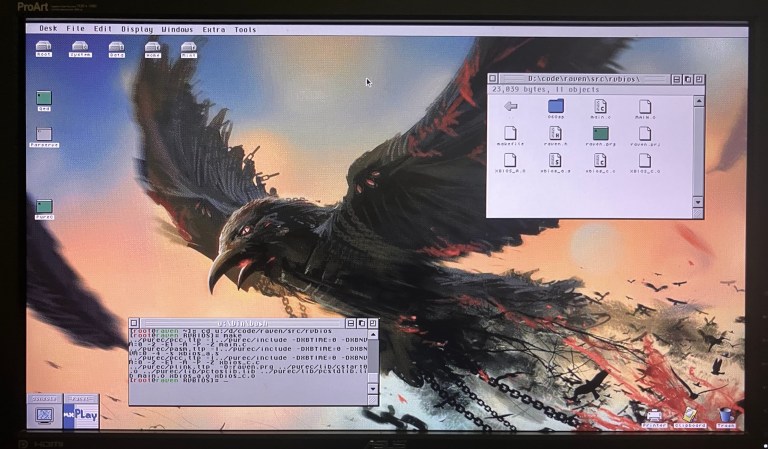
With all of it assembled you can run Atari’s TOS with its GEM UI, or the modern equivalent in the form of FreeMiNT.

Designing A Printable Cyclone Dust Separator For 99.95% Efficiency

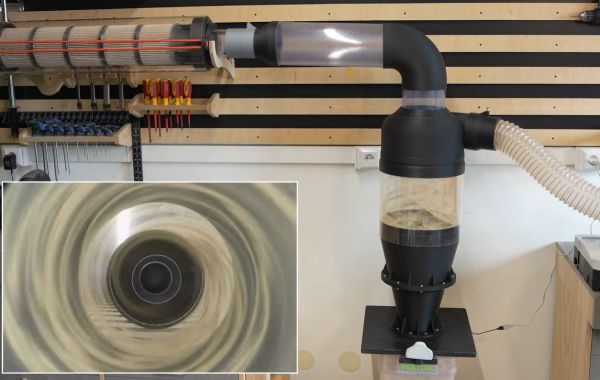
Filtering sawdust out of an airflow is easy until you try to do it with cyclone separation, but the obvious appeal here is of course not spending a fortune on filters. Over the years we have thus seen a lot of DIY takes on this concept alongside commercial offerings. Recently [Ruud] of the [Capturing Dust] YouTube channel gave it a fresh shake with a claimed 99.95% filtering efficiency that outperforms a commercial solution.

As a starting point the commercial and very succinctly named Oneida Air Super Dust Deputy Cyclone Separator was used, which retails for about $179 and claims a 99.9% filtrating rate of fine dust and debris. Based on its design a 3D model was created and printed with an FDM printer.

Initially only about a 98% rate was measured, but after some investigation this appeared to be due to the incoming and exciting airflows interfering. One tweak later to add some separation between the flows and a lot of testing of different configurations a final design was settled on that would seem to be rather quite efficient compared to the commercial option.

Continue reading “Designing A Printable Cyclone Dust Separator For 99.95% Efficiency”