(1) OR THE HORSE MAY TALK. Judith Tarr analyzes “The Universal Appeal of the Talking Animal” at Reactor.
…Humans all over the world tell stories and sing songs of animals who talk to each other like humans, act like humans, think like humans. The world is a mirror. Everywhere we look, we see ourselves.
The technical term is anthropomorphism. Imputing human traits to nonhuman things. When that thing is an animal, the animal talks, because humans do. Human language, human ideas, human ways of doing things.
In folklore and oral storytelling, animals talk to each other. They talk to humans. Humans talk to them. Everyone communicates on the same level, in the same words.
Literary animals may be their natural selves—rabbits, lions, horses, cats—or they may be fully anthropomorphized. Peter Rabbit and his family wear human clothes and do human things. So do Toad and his friends in The Wind in the Willows. And then there’s Winnie the Pooh, who begins his life as a child’s toy, inhabiting a world of toys based on living animals: a bear, a donkey, a tiger, a kangaroo. (And let’s not forget Paddington Bear and Calvin’s inimitable Hobbes.)
Animals rule the world of animated comedy. Mickey Mouse, Mighty Mouse, Donald Duck, Bugs Bunny, Felix the cat, Sylvester the cat and his arch-foe Tweety Bird, Foghorn Leghorn (whose accent inspires a human avatar, Benoit Blanc), Yogi Bear, Rocky the flying squirrel and Bullwinkle the moose, the list goes on and on.
These animals and their stories are often consigned to the children’s section. Adults are expected to grow out of them. Grownup stories are “real” stories, stories about humans doing “real” things, in a world in which animals stay strictly in their lane. They may make sounds, but they’re not talking. Talking is a human thing.
And yet, humans of all ages keep right on loving their talking animals. Cartoons are grand entertainment for kids, but there are whole levels and layers of wit and satire that the grown-up kid will catch. Bugs Bunny’s riff on Wagnerian opera is central to my childhood; the older I get, the more I appreciate the gloriously cracked genius of a wiseass rabbit in a brass bra and a winged helmet (and that horse) …
(2) WOLF WOMEN. “Sam Beckbessinger: A Brief History of the Female Werewolf” at CrimeReads.
…So the glorious exceptions that do center female werewolves usually tread quite different thematic territory. Unlike male werewolves, who are usually infected through a random physical attack, female werewolves are more likely to see their transformation linked to a moment of innate reproductive change: menarche, childbirth or menopause….
…All cultures have animal shapeshifter myths, but the European werewolf tradition, specifically, starts from two places: ancient Greek texts (Lycaon from Ovid’s Metamorphoses is the origin of the term “lycanthropy”) and the Old Norse tradition of warriors wearing enchanted wolfskins to “become” wolves in battle.
By the Middle Ages, werewolves are well-established in folklore all across Europe, to varying degrees, but there are only a couple of notable women in these stories. There’s an Irish story about the Daughters of Airitech (which appears in the Acallam na Senórach from around 1200), who are three wolf-women who live in the wild and are a nuisance to local villagers because they eat their sheep. They have a weakness for certain elements of human culture, though (in some stories harp music; in others cooked meat), and turn back into human women to enjoy them, in which state they are vulnerable enough to be either murdered or (worse) married off. There’s also a story of the Werewolves of Ossory from 1188’s Topographia Hibernica, which features a man and woman who must live seven years at a time as wolves, transforming (like the Norse) when they don wolfskins. In these stories, the werewolf isn’t violent so much as uncultured….
(3) SOMETIMES THEY KEEP THE TITLE AND THROW THE BOOK AWAY. But not always. Movieweb’s discussion of“8 Book-to-Movie Adaptations That Ended Up Nothing Like the Source Material” includes three sff works: Starship Troopers, Lawnmower Man, and A Clockwork Orange (excerpted below).
‘A Clockwork Orange’ (1971)
A Clockwork Orange is a peculiar case. While Stanley Kubrick stuck close to the general source material, the release of Anthony Burgess’s 1962 novel differed between US publishers and the original release. The version that Kubrick read and adapted the script from was the American release of the book, which cut the final 21st chapter in its entirety. The final chapter offers a redemption arc for Alex, showing that he is redeemed. While this is just a minor change, it drastically shifts the entire messaging of the film versus the novel.
Kubrick, when he found out, said he preferred his ending to the one Burgess wrote, while Burgess hated the film Kubrick made. There were also some smaller changes worth mentioning. Alex in the book is 15 years old, and it is almost entirely written in Nadsat slang (a made-up mash of English and Russian) that readers have to decode; Kubrick used some of it, but not all. Finally, the novel has more explicit Christian and free-will themes, with the prison chaplain having a more prominent role.
Many of Kubrick’s changes to the screen made sense, and the movie still managed to draw acclaim and controversy, but a single chapter left out makes the novel and the film drastically different experiences.
(4) PITCH MEETING. Deadline quotes “Peter Jackson On How Stephen Colbert Got ‘LOTR: Shadow of the Past’”.
Freshly lauded Cannes Palme d’Or honoree Peter Jackson tells us that Stephen Colbert‘s attachment as writer on a new Lord of the Rings movie, which is being released after 2027’s Hunt for Gollum, occurred when The Late Show host pitched himself for the gig.
“He was re-reading Lord of the Rings over Christmas and thought this section would make a great film,” Jackson tells us at Cannes.
“He pitched this whole idea… I said it sounds interesting, let’s have a go at this, doing a treatment. Philippa Boyens flew over and Colbert has come down to New Zealand a couple of times.”
“This is before he knew his show was going to get canned.”
“It’s a part of Lord of the Rings that we never filmed. There were these big chunks of Lord of the Rings that we skipped over,” says Jackson, the three-time Oscar winner.
The Lord of the Rings: Shadow of the Past is based on the section “Fog on the Barrow-downs,” the eighth chapter of The Fellowship of the Ring, in which the Hobbits are trapped by a Barrow-wight in an unnatural fog. The story also includes a fan-favorite character omitted from the previous films, Tom Bombadil. The feature is being adapted from chapters three through eight of JRR Tolkien’s book.
“Next week, he’s doing his final show and the next day he’ll be a Tolkien screenwriter,” said Jackson of Colbert.
(5) ‘THE NEXT GENERATION’ CLASSIC REVISITED. Collider tells why “Patrick Stewart Still Calls This 34-Year-Old ‘Star Trek’ Episode a True Masterpiece”.
…While never a fully serialized series, The Next Generation‘s later seasons inject lasting character growth into its episodic formula. As a standalone that grafts permanent ripple effects onto Captain Jean-Luc Picard (Patrick Stewart), Season 5’s “The Inner Light” deserves the glowing superlatives fans, critics, the Hugo Awards, and Stewart himself have sent its way since 1992. Often regarded as the already sophisticated series’ pinnacle achievement, “The Inner Light” is an arresting and resonant example of everything sci-fi’s genre trappings can offer, swapping out epic scale for a character study that’s as psychologically contemplative as it is philosophically driven.
What Is “The Inner Light” About?
When the Enterprise investigates an unidentified space probe, the device targets Picard with a mysterious energy bolt. Struck comatose, he wakes upon the planet of Kataan, where every stranger recognizes him as Kamin, a local iron weaver. Kamin’s wife, Eline (Margot Rose), assures Picard that his memories of French vineyards and starship corridors are delirious inventions caused by a week-long fever. As years pass without answers, Picard makes the most of his unwelcome circumstances. He falls in love with Eline, grows old with her while raising their children, and practices the flute in his leisure time.
However, Kataan’s scientists determine that a nearby exploding star will annihilate the planet within their lifetimes. Since Kataan dwells outside the Federation’s borders, they lack access to the cutting-edge resources that might reverse its inevitable demise. During this civilization’s final moments, Picard learns the last four decades were an interactive mental simulation induced by the probe’s beam. Kataan’s long-dead citizens didn’t want to be forgotten, and their floating time capsule chose Picard as the best person to safeguard their legacy. Its purpose fulfilled, the program returns Picard to the Enterprise bridge, his body never left. The 40 years Picard experienced have been just 25 minutes for his concerned crew…
…”The Inner Light” rises above its classic “what if?” structure thanks to its laser-focused purpose and restrained execution. Written by Morgan Gendel and directed by Peter Lauritson, the two share a kind of harmonious understanding over which emotional beats to imply and which need lingering with. The episode’s broad concepts about our fleeting mortality and the value of cherishing humble joys are straightforward enough not to court sentimentality and are conveyed through an earnest accessibility that stands the test of time. What could be an overt laundry list of ideas instead gracefully flows through legacy, identity, second chances, environmental decay, what determines a well-lived life, and the resolved wisdom required to carve out that existence while facing imminent destruction….
(6) THE RUMBLE AND THE ROAR. [Item by Steven French.] Keza MacDonald reminiscences in this week’s “Pushing Buttons” newsletter in the Guardian: “Star Fox 64, a game I loved in my childhood, is returning – but I have mixed feelings”.
The Nintendo 64 was not my first video game console, but it was my formative one. Getting to grips with 3D movement in Super Mario 64 with that weird three-pronged controller is one of my most visceral childhood memories; the long, long wait for The Legend of Zelda: Ocarina of Time was the background noise to a huge chunk of my youth. But back in the 1990s (in the UK at least), it felt as if nobody had an N64. When everybody had a PlayStation instead, I felt I was the only kid in my whole city who cared more about Banjo-Kazooie than Crash Bandicoot.
If even Zelda seemed comparatively niche in Europe in the 90s, Lylat Wars (known elsewhere as Star Fox 64) was a real deep cut. It’s a 1997 space-flight shooter starring Fox McCloud and his squad of animal pilots laser-blasting across different planets in nimble crafts called Arwings. I played this game to absolute death in 1998, when I got it for my birthday alongside the fabled Rumble Pak, which made your controller vibrate and shudder whenever something cool was happening on screen (fun fact: Lylat Wars was the first console game to feature controller rumble). But I really hadn’t thought about it much since. Then, last week, Nintendo announced a Switch 2 remake….
(7) “THESE DETECTIVES LOOK UP!” EXCLAIMED TOM SHEEPISHLY. [Item by Daniel Dern.] A short video, “The Sheep Detectives – Behind the Scenes“, for the new movie starring, among others, Hugh Jackman,
(8) TODAY’S BIRTHDAY.
[Written by Paul Weimer.]
May 14, 1944 – George Lucas, 82.
By Paul Weimer: To talk about George Lucas for me is to first talk about Star Wars.
Star Wars lurked in my imagination long before seeing any of it. I didn’t see Star Wars in the theater but my younger brother and I got a joint Christmas gift of a Death Star playset, and a few action figures. We only had the commercials for the set to go on, not Lucas’ own vision, and so our playing of the set led to very strange scenarios having nothing to do with the movie.
It would not be until 1983, and Return of the Jedi, that I saw a George Lucas movie at all, and in the theater. I saw the magic of his world, having only the fuzziest idea of the first two movies, but I was swept along. This shows the power of Lucas harnessing the power of serial fiction to allow watchers to get in on the action quickly. This is something the Marvel cinematic universe could still learn from Lucas today. It’s not just the crawls at the beginning, it’s the economy of storytelling, the establishment of characters that let you hit the ground running.
Like Star Wars, I missed the first Indiana Jones movie in theaters, but did see Temple of Doom (Lucas did not direct but his story was the basis of the film). And of course, too, Indiana Jones and the Last Crusade. Same principle applies. Early Lucas knew the power of crafting episodic sequels and making them work.
In keeping with those films, Lucas was also responsible for getting me hooked into the idea of the Hero’s Journey, since I read the Joseph Campbell book The Power of Myth thanks to Lucas’ forward in the book. Sure, the Hero’s Journey is a very outdated, patriarchal and restrictive story framework but it was my first real engagement with the nature and form of stories. Lucas helped introduce me to that whole new world.
However, I would not see another Lucas directed film until the late 1990’s…but that is another story, one that deserves its own entry.

(9) COMICS SECTION.
- Barney and Clyde reflects on memorable TV theme music.
- Dinosaur Comics pins the blame for bad fan fiction.
- Mother Goose and Grimm did not expect to need a permit.
(10) DOCTOR WHO, WHERE? The Hollywood Reporter tells where to find the Doctor: “’Doctor Who’ Gets New U.S. Streaming Home on AMC+”.
The TARDIS is set to land in a new location in a few weeks.
AMC+ has acquired streaming rights to most of the 21st century run of Doctor Who. Thirteen seasons of the series, spanning the runs of the ninth through thirteenth Doctors (2005-22), will be available on the streamer starting June 11.
The AMC+ acquisition is something of a homecoming for Doctor Who. BBC America, which like AMC+ is part of AMC Networks, was the U.S. home for the series from 2009-22 (Sci Fi Channel, the forerunner to Syfy, had the first few seasons)….
…The acquisition does not include the two most recent seasons of Doctor Who, which the BBC produced in conjunction with Disney. Those seasons, starring Ncuti Gatwa as the Doctor, remain on Disney+ in the United States….
(11) “DO HAVE A CACO, MAN!” “Chocolate now has standards for excellence, like wine and coffee” – NPR tells how that works.
In central Rome, Julien Simonis holds a tiny bar of chocolate made from cacao beans that originated in Hawaii. He cracks it into pieces before unwrapping the gold foil that surrounds it. Simonis places a morsel on his tongue and then breathes in through his mouth and out through his nose to heighten his perception of the chocolate’s aroma and taste.
A look of reverence comes over him.
“My god,” he whispers. “Each time I taste this, I’m always amazed. You have a boost of acidity. This burst of fresh flavors.” Simonis detects a fruitiness and a hint of cardamom and nutmeg….
… The standardized processing of the cacao takes place at a lab tucked inside the Chocolate Experience Museum in hilly Perugia, about a hundred miles north of Rome.
To begin, lab assistant Julia Butac empties a burlap bag of beans into a bin and starts to sift them a couple handfuls at a time, removing anything that isn’t a full bean. “It’s really physical work,” she says, acknowledging the rigorousness of the method.
Butac is from the Philippines and was never a huge chocolate fan, but this process has given her a deeper appreciation for it….
…Those two chocolates that Simonis tasted — the one from Hawaii and the other from Peru — had been processed and prepared identically in Perugia. But they have two very different personalities.
“Just realize that the difference in these chocolates [is] only coming from the cacao bean,” he says. “Despite the recipe being exactly the same, flavors are completely different.”
Simonis relies on a panel of 15 trained professional tasters to evaluate a chocolate’s unique blend of acidity, bitterness, astringency and more. The result is a standardized way of comparing chocolate, allowing cacao to be priced and valued according to its quality.
More and more people are joining the program. There’s a charge for trainings and certification but access to resources including a step-by-step guide to cacao processing and the flavor wheel that the official tasters use to do their evaluations are free. “We are trying to work with every single producing country in the world,” he adds….
(12) TRAINING DAY. “Blue Origin’s lunar lander mockup is ready for NASA Artemis astronaut training” reports Space.com.
NASA’s Orion space capsule training simulator is located inside Building 9 at the Johnson Space Center in Houston. It’s a full-scale, high-fidelity model of the real thing, and where the Artemis 2 astronauts spent more than a year preparing for their recent mission around the moon.
For a long time, the Orion simulator sat alone in its own corner, away from the group of International Space Station training modules lined up inside the Space Vehicle Mockup Facility (SVMF). But now, Orion has a neighbor.
A mockup of Blue Origin’s Blue Moon Mark 2 (MK2) lunar lander has been assembled at the SVMF, and is ready for astronauts to come aboard to begin training, according to a NASA release. Standing adjacent to the Orion capsule, the Blue Moon crew cabin and exterior resemble the design of the lander’s Mark 2 variant, which will eventually land Artemis astronauts on the moon, if all goes according to plan.
With Blue Origin’s mockup now assembled at JSC, astronauts can now seamlessly transition from training inside Orion to training in Blue Moon as they prepare for the Artemis missions ahead. The next mission, Artemis 3, is dependent on at least one lunar lander being ready to fly before the mission can launch.
Blue Moon is one of two lunar landers NASA has chosen through the agency’s Human Landing System (HLS) contracts, the other being SpaceX’s Starship, and is a critical component of NASA’s Artemis program that aims to establish a permanent presence on the moon’s surface….
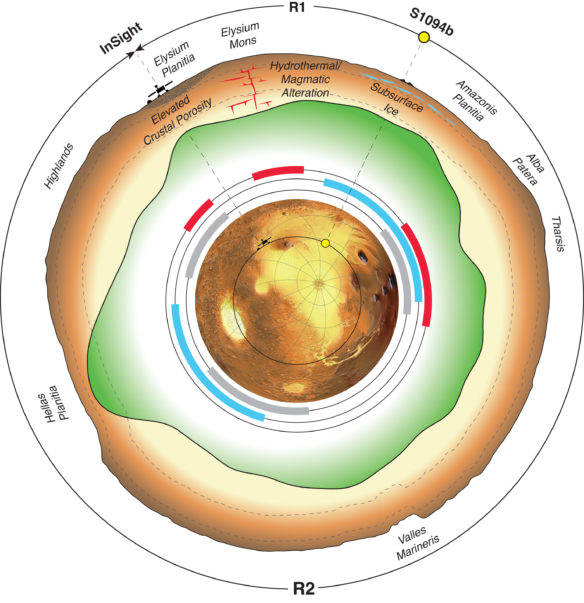
(13) NEW ORGANIC MOLECULES DETECTED ON MARS. COULD IT BE LIFE JIM? [Item by SF Concatenation’s Jonathan Cowie.] Hot on the news of water-altered molecules detected by the Perseverance rover in Mars’ Jezero crater is fresh research from another Martian crater, the Gale crater. There the Curiosity rover has taken samples and subjected them to the Sample Analysis at Mars instrument suite onboard the rover. And the results are now in. There are benzothiophene, methyl benzoate, and single and dicyclic aromatic molecules present. The researchers, mainly US-based, do not know whether the source of these molecules comes from meteors or were they formed in situ either by life or some geological process. What they can say is that these molecules are most likely around 3.5-billion years old as that is the age of the strata from which they were taken.
The importance of this work is that it is an indication that with further development of robotic lab analysis on future Martian rovers, it is likely that some future missions will have the capability to detect biosignatures should they exist.
Primary research: Williams, A. J. et al. (2026) Diverse organic molecules on Mars revealed by the first SAM TMAH experiment. Nature Communications, vol. 17, 2748.
(14) RE-VISITING PIRANESI BY SUSANNA CLARKE. [Item by SF Concatenation’s Jonathan Cowie.] Moid Moidelhoff’s Media Death Cult has a YouTube Channel but is bigger on Patreon where Cult followers discuss all things SFnal. Recently, the Cult has had a read-along of Susanna Clarke’s novel Piranesi and this has fired up Moid to make, possibly his longest video yet. It has only just been posted and in it he shares his thoughts on the novel and some of the comments made on the Media Death Cult Patreon thingy.
This is a video about the evolving theories surrounding Piranesi by Susanna Clarke.
[Thanks to Chris Barkley, Mark Roth-Whitworth, Kathy Sullivan, Paul Weimer, Daniel Dern, Steven French, Mike Kennedy, Andrew Porter, John King Tarpinian, Cat Eldridge, and SF Concatenation’s Jonathan Cowie for some of these stories. Title credit belongs to File 770 contributing editor of the day Chris S.]