Welcome to the Sweden Portal! | |||||||||
 |
 |
.svg) | |
Sweden, formally the Kingdom of Sweden, is a Nordic country located on the Scandinavian Peninsula in Northern Europe. It borders Norway to the west and north, and Finland to the east, and shares a maritime border with Denmark to the south. At 450,295 square kilometres (173,860 sq mi) and with a population of 10.6 million, Sweden is the largest and most populous Nordic country, and is the fifth-largest country in Europe. Its capital and largest city is Stockholm. The population density is 25.5 inhabitants per square kilometre (66/sq mi), and 88% of Swedes reside in urban areas, mostly in the southern and central portions of the country. Sweden's urban areas together cover 1.5% of its land area. Sweden has a diverse climate owing to the length of the country, which ranges from 55°N to 69°N.
Sweden has been inhabited since prehistoric times around 12,000 BC. The inhabitants emerged as the Geats (Swedish: Götar) and Swedes (Svear), who formed part of the sea-faring peoples known as the Norsemen. A unified Swedish state was established during the late 10th century. In 1397, Sweden joined Norway and Denmark to form the Scandinavian Kalmar Union, which Sweden left in 1523. When Sweden became involved in the Thirty Years' War on the Protestant side, an expansion of its territories began, forming the Swedish Empire, which remained one of the great powers of Europe until the early 18th century. During this era Sweden controlled much of the Baltic Sea. Most of the conquered territories outside the Scandinavian Peninsula were lost during the 18th and 19th centuries. The eastern half of Sweden, present-day Finland, was lost to Imperial Russia in 1809. The last war in which Sweden was directly involved was in 1814, when Sweden by military means forced Norway into a personal union, a union which lasted until 1905.
Sweden is a highly developed country ranked fifth in the Human Development Index. It is a constitutional monarchy and a parliamentary democracy, with legislative power vested in the 349-member unicameral Riksdag. It is a unitary state, divided into 21 counties and 290 municipalities. Sweden maintains a Nordic social welfare system that provides universal health care and tertiary education for its citizens. It has the world's 14th highest GDP per capita and ranks very highly in quality of life, health, education, protection of civil liberties, economic competitiveness, income equality, gender equality and prosperity. Sweden joined the European Union in 1995, and in response to the 2022 Russian invasion of Ukraine, NATO in 2024. It is also a member of the United Nations, the Schengen Area, the Council of Europe, the Nordic Council, the World Trade Organization and the Organisation for Economic Co-operation and Development (OECD). (Full article...)
 Good article -

Charm School is the eighth studio album by Swedish pop duo Roxette, released on 11 February 2011 by Roxette Recordings and Capitol. It was their first studio album since 2001's Room Service, and their first since vocalist Marie Fredriksson's brain tumour diagnosis in 2002. "She's Got Nothing On (But the Radio)" preceded the album as its lead single, which became the duo's highest-peaking single in almost two decades in territories such as Austria, Germany and Switzerland. The song also entered Billboard's Adult Contemporary Chart—making Roxette the only duo who appeared on that chart in the 1980s, 1990s, 2000s and 2010s.
The album received mixed reviews, particularly from the Swedish press, who criticised it for being too similar to the band's earlier work, although others commended it for mixing various styles from throughout their discography. International reception was more positive; it was chosen as BBC Radio 2's 'Album of the Week'. The record was a commercial success upon release, becoming their first number one album since the early 1990s in countries such as Germany and Switzerland. It was certified gold in the Czech Republic, Russia, Sweden and Switzerland, and platinum in Germany. Within a year of release, the album sold over of 500,000 copies worldwide. (Full article...)
Selected article -

The Scanian War was a part of the Northern Wars involving the union of Denmark–Norway, Brandenburg and Sweden. It was fought from 1675 to 1679 mainly on Scanian soil, in the former Danish–Norwegian provinces along the border with Sweden, and in Northern Germany. While the latter battles are regarded as a theater of the Scanian war in English, Danish, Norwegian and Swedish historiography, they are seen as a separate war in German historiography, called the Swedish-Brandenburgian War (German: Schwedisch-Brandenburgischer Krieg).
The war was prompted by Swedish involvement in the Franco-Dutch War. Sweden had allied with France against several European countries. The United Provinces, under attack by France, sought support from Denmark–Norway. After some hesitation, King Christian V started the invasion of Skåneland (Scania, Halland, Blekinge, and sometimes also Bornholm) in 1675, while the Swedes were occupied with a war against Brandenburg. The invasion of Scania was combined with a simultaneous Norwegian front called the Gyldenløve War, forcing the defending Swedes to fight a two-front war in addition to their entanglements in the Holy Roman Empire. (Full article...)
Did you know -

- ... that Elin Falk caused a national controversy in 1913 with her proposals for reforming gymnastics in Swedish schools?
- ... that Nils Elias Anckers was a kommendör in the Swedish Navy who won a silver medal at the 1900 Paris Exposition for his artwork?
- ... that Swedish naval officer Axel Lagerbielke was imprisoned in Lima for over a year, held in Callao and eventually escaped from Panama on an English packet boat to Jamaica?
- ... that Gävle Hospital in Sweden was so overrun with scarlet fever in 1934 that it considered requisitioning a local gymnasium?
General images -
 Homann's map of the Scandinavian Peninsula and Fennoscandia with their surrounding territories: northern Germany, northern Poland, the Baltic region, Livonia, Belarus, and parts of Northwest Russia. Johann Baptist Homann (1664–1724) was a German geographer and cartographer; map dated around 1730. (from History of Sweden)
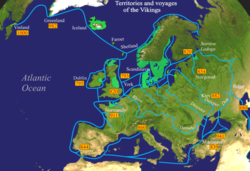 Viking expeditions (blue): depicting the immense breadth of their voyages throughout most of Europe, the North Atlantic and the Mediterranean (from History of Sweden)
 Two golden 20 kr coins from the Scandinavian Monetary Union, which was based on a gold standard. The coin to the left is Swedish and the right one is Danish. (from History of Sweden)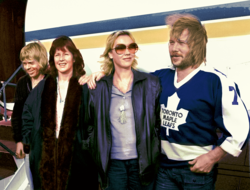

 Coastal defence ship of the Swedish Navy HM Pansarskepp Gustaf V (Agfacolor photo until 1957) (from History of Sweden)
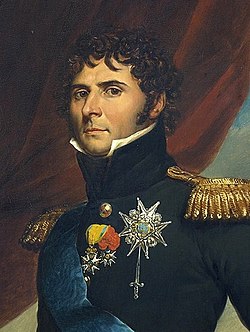 The Swedish Crown Prince Charles John (Bernadotte), who staunchly opposed Norwegian independence, only to offer generous terms of union. (from History of Sweden)
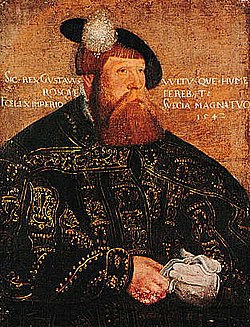 Gustav Vasa (Gustav I) in 1542 (from History of Sweden)
 Main line railways built 1860–1930 (from History of Sweden)
 Köttbullar - Swedish meatballs, a typical dish throughout the country (from Culture of Sweden)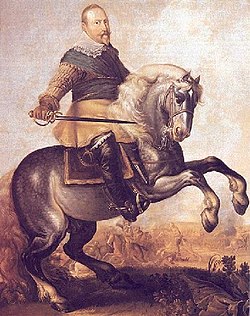
 St. Lucy's Day (Luciadagen), an important Swedish annual celebration. (from Culture of Sweden)
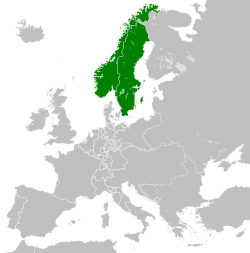 Map of Sweden-Norway (from History of Sweden)
 Swedish tribes in Northern Europe in 814 (from History of Sweden)
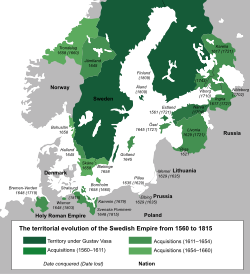 The Swedish Empire, 1560–1815 (from History of Sweden)
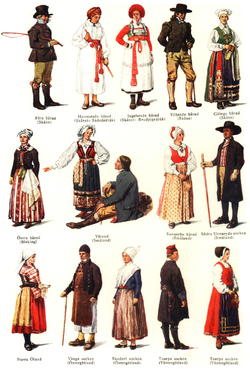 Traditional Swedish folk costumes according to Nordisk Familjebok (from Culture of Sweden)


.jpg)
.svg)


 Featured article -


The Battle of Öland was a naval battle between an allied Danish-Dutch fleet and the Swedish navy in the Baltic Sea, off the east coast of Öland on 1 June 1676. The battle was a part of the Scanian War (1675–1679) fought for supremacy over the southern Baltic. Sweden was in urgent need of reinforcements for its north German possessions; Denmark sought to ferry an army to Scania in southern Sweden to open a front on Swedish soil.
Just as the battle began, the Swedish flagship Kronan sank, taking with it almost the entire crew, including the Admiral of the Realm and commander of the Swedish navy, Lorentz Creutz. The allied force under the leadership of the Dutch admiral Cornelis Tromp took full advantage of the ensuing disorder on the Swedish side. The acting commander after Creutz's sudden demise, Admiral Claes Uggla, was surrounded and his flagship Svärdet battered in a drawn-out artillery duel, then set ablaze by a fire ship. Uggla drowned while escaping the burning ship, and with the loss of a second supreme commander, the rest of the Swedish fleet fled in disorder. (Full article...)
Featured picture -
 Map of Gothenburg, Sweden, published by N. P. Pehrsson in 1888
 Katarina Church and cemetery. Södermalm, Stockholm, Sweden
 A small greenhouse with grapevines (Vitis vinifera) escaping from the roof hatch, In Gåseberg, Lysekil Municipality, Sweden
 A Life Guard in Stockholm
 Allehandaborgen is a historic office building in Örebro, Sweden that was built 1891.
 Mount Helagsfjället (left) and Sylan mountain range, seen from Torkilstöten, Ljungdalen
 Tjörnbron (the Tjörn bridge) is one of three bridges along Tjörnbroleden that connects the islands of Tjörn and Orust to the mainland.
 A view of the Rådhuset metro station in Central Stockholm


Categories

Main topics
Subdivisions: Counties of Sweden • Municipalities of Sweden • Provinces of Sweden
History: 1975 Occupation of the West German embassy • Ådalen shootings • Consolidation of Sweden • Early Swedish history • Enlightened Absolute Monarchy in Sweden • Early Vasa era • Industrialization of Sweden • Post-war Sweden • Prehistoric Sweden • Rise of Sweden as a Great Power • Suiones • Swedish Empire • Sweden after the Great Northern War • Sweden and the Winter War • Sweden during late 19th century • Sweden during World War II • Swedish allotment system • Swedish emigration to the United States • Union between Sweden and Norway
Politics: Alliance for Sweden • Constitution of Sweden • Foreign relations of Sweden • Government of Sweden • Parliament of Sweden • Riksdag • Swedish general election, 2006 • Swedish general election, 2010 • Swedish neutrality • Swedish welfare
Demographics: Education • Ethnic minorities • Languages • Religion • Subdivisions • Cities • People • Healthcare • Immigration
Culture: Cinema of Sweden • Cuisine of Sweden • Music of Sweden • Sports in Sweden • Swedish literature • Tourism in Sweden
Symbols: Flag • Coat of arms • National anthem
Things you can do
 |
Here are some tasks awaiting attention:
|
Wikipedia in Swedish
 |
There is a Swedish version of Wikipedia, the free encyclopedia. |
 |
WikiProjects


Featured and good content

Related portals


Northern Europe


Other countries