

| Main Page | Gazetteer |
Welcome to the France Portal!
Bienvenue sur le Portail France !
 |
 |
 | |
France, officially the French Republic, is a country primarily located in Western Europe. Its overseas regions and territories include French Guiana in South America, Saint Pierre and Miquelon in the North Atlantic, the French West Indies, and many islands in Oceania and the Indian Ocean. Metropolitan France shares borders with Belgium and Luxembourg to the north; Germany to the northeast; Switzerland to the east; Italy and Monaco to the southeast; Andorra and Spain to the south; and a maritime border with the United Kingdom to the northwest. Its metropolitan area extends from the Rhine to the Atlantic Ocean and from the Mediterranean Sea to the English Channel and the North Sea. Its 18 integral regions—five of which are overseas—span a combined area of 632,702 km2 (244,288 sq mi), with a total population estimated at over 69.1 million in 2026. Its capital, largest city and main cultural and economic centre is Paris.
Metropolitan France was settled during the Iron Age by Celtic tribes known as Gauls before Rome annexed the area in 51 BC, leading to a distinct Gallo-Roman culture. In the Early Middle Ages, the Franks formed the kingdom of Francia, which became the heartland of the Carolingian Empire. The Treaty of Verdun of 843 partitioned the empire, with West Francia evolving into the Kingdom of France. In the High Middle Ages, France was a powerful but decentralised feudal kingdom, but from the mid-14th to the mid-15th centuries, France was plunged into a dynastic conflict with England known as the Hundred Years' War. In the 16th century, French culture flourished during the French Renaissance, and a French colonial empire emerged. Internally, France was dominated by the conflict with the House of Habsburg and the French Wars of Religion between Catholics and Huguenots. France was successful in the Thirty Years' War and further increased its influence during the reign of Louis XIV.
The French Revolution of 1789 overthrew the Ancien Régime and produced the Declaration of the Rights of Man, which expresses the nation's ideals to this day. France reached its political and military zenith in the early 19th century under Napoleon Bonaparte, subjugating much of continental Europe and establishing the First French Empire. Its collapse initiated a period of relative decline during which France endured the Bourbon Restoration until the founding of the French Second Republic, which was succeeded by the Second French Empire upon Napoleon III's takeover. His empire collapsed during the Franco-Prussian War in 1870. This led to the establishment of the French Third Republic, and a period of economic prosperity and cultural and scientific flourishing known as the Belle Époque. France was one of the major participants of World War I, from which it emerged victorious at great human and economic cost. It was among the Allies of World War II, but it surrendered and was occupied by Germany in 1940. Following its liberation in 1944, the short-lived Fourth Republic was established and later dissolved over the course of the Algerian War. The current Fifth Republic, a semi-presidential system, was formed in 1958 by Charles de Gaulle. Algeria and most French colonies became independent in the 1960s, with the majority retaining close economic and military ties with France.
France retains its centuries-long status as a global centre of art, science, cuisine and philosophy. It hosts the fourth-largest number of UNESCO World Heritage Sites, with 54 in total, and is the world's leading tourist destination, having received 102 million foreign visitors in 2025. A developed country, France has a high nominal per capita income globally, and its economy ranks among the largest in the world by both nominal GDP and PPP-adjusted GDP. It is a great power, being one of the five permanent members of the United Nations Security Council and an official nuclear-weapon state. The country is part of multiple international organisations and forums. (Full article...)
 Featured article –


The Falaise pocket or battle of the Falaise pocket (German: Kessel von Falaise; 12–21 August 1944) was the decisive engagement of the Battle of Normandy in the Second World War. Allied forces formed a pocket around Falaise, Calvados, in which German Army Group B, consisting of the 7th Army and the Fifth Panzer Army (formerly Panzergruppe West), were encircled by the Western Allies. The battle resulted in the destruction of most of Army Group B west of the Seine, which opened the way to Paris and the Franco-German border.
Six weeks after the 6 June 1944 Allied invasion of Normandy, German forces were in turmoil, having expended irreplaceable resources defending the frontline and with Allied air superiority threatening the availability of food and ammunition. However, on the Allied side, British forces had expected to liberate Caen immediately after the invasion, an operation which ended up taking nearly two months, and US forces had expected to control Saint-Lô by 7 June, yet German resistance delayed this until after Caen's liberation. (Full article...)
Featured biography –
Olivier Messiaen was a French composer, organist and ornithologist, one of the major composers of the 20th century. His music is rhythmically complex (he was interested in rhythms from ancient Greek and from Hindu sources); harmonically and melodically it is based on modes of limited transposition, which he abstracted from his early compositions and improvisations. Many of his compositions depict what he termed "the marvellous aspects of the faith", and drew on his deeply held Roman Catholicism.
Messiaen entered the Paris Conservatoire at the age of 11 and was taught by Paul Dukas, Maurice Emmanuel, Charles-Marie Widor and Marcel Dupré, among others. He was appointed organist at the Église de la Sainte-Trinité in Paris in 1931, a post held until his death. He taught at the Schola Cantorum de Paris during the 1930s. On the fall of France in 1940, Messiaen was made a prisoner of war, during which time he composed his Quatuor pour la fin du temps ("Quartet for the end of time") for the four available instruments—piano, violin, cello and clarinet. He was appointed professor of harmony soon after his release in 1941, and professor of composition in 1966 at the Paris Conservatoire, positions he held until his retirement in 1978. His many distinguished pupils included Pierre Boulez and Yvonne Loriod, who became his second wife.
He found birdsong fascinating, believed birds to be the greatest musicians, and considered himself as much an ornithologist as a composer. He notated bird songs worldwide and incorporated birdsong transcriptions into most of his music. His innovative use of colour, his conception of the relationship between time and music, his use of birdsong and his desire to express religious ideas are among features that make Messiaen's music distinctive.
Selected fare or cuisine –

Beef bourguignon (/ˌbʊər.ɡɪn.ˈjɒ̃/) or bœuf bourguignon (UK: /ˌbɜːf ˈbɔːrɡɪn.jɒ̃/, US: /ˌbʊf ˌbərɡɪnˈjɑːn/; French: [bœf buʁɡiɲɔ̃]), also called beef Burgundy, and bœuf à la Bourguignonne, is a French stew of beef braised in red wine, often red Burgundy, and beef stock, typically flavored with carrots, onions, garlic, and a bouquet garni, and garnished with pearl onions and mushrooms.
"Bourguignon" is, since the mid-nineteenth century, a culinary term applied to various dishes prepared with wine or with a mushroom and onion garnish. It is probably not a regional recipe from Burgundy. (Full article...)
 Good article –

.jpg)
Arnaud Tsedri (born 11 March 1975), better known by the stage name Arnaud Tsamere (French: [aʁno tsamɛʁ]), is a French comedian, actor, television presenter and sports journalist. Born in Bordeaux and raised in the Yvelines, he joined the Déclic Théâtre group after quitting his sales job. There, he acted in plays and participated in improvisation events. He wrote his first one-man show, Réflexions profondes sur pas mal de trucs, in 2002 with Arnaud Joyet, and his second, Chose Promise, in 2007 with Joyet and François Rollin. His third, Confidences sur pas mal de trucs plus ou moins confidentiels, has been performed since 2014. He has attended numerous comedy festivals and is currently a member of the Ligue Majeure d'Improvisation.
Tsamere's television career began when he presented the weather forecast on Canal+. From 2010, he became well known for appearing on France 2's sketch comedy show On n'demande qu'à en rire—and its short-lived spin-off the ONDAR Show—after he was discovered by Laurent Ruquier; he often performed sketches with Jérémy Ferrari. He also plays Captain Sport Extrême in the comedy science fiction programme Hero Corp. In 2014, he hosted TMC's Canapé Quiz; he has also appeared on various French talk, sports and game shows. Tsamere has acted in several films, including the short Being Homer Simpson with Philippe Peythieu and Véronique Augereau, and Fonzy, a 2013 adaptation of Starbuck. (Full article...)
Featured pictures
 Painting credit: Marie-Gabrielle CapetMarie-Gabrielle Capet (6 September 1761 – 1 November 1818) was a French Neoclassical painter. Until the French Revolution, the Royal Academy of Art in Paris was responsible for training artists and exhibiting artworks at the Salon, but limited the number of female students to four at a time. Unable to gain a place, she moved to Paris in 1781 to become a student of Adélaïde Labille-Guiard, with whom she struck up a lifelong friendship. She specialised in painting portraits, her works including oil paintings, watercolours and miniatures. This oil-on-canvas self-portrait of Capet, dating from around 1783, is in the collection of the National Museum of Western Art in Tokyo.
 Photograph: Łukasz GolowanowThe Patrouille de France, a precision aerobatic demonstration team, in full formation at the Radom Air Show. The team was established as part of the French Air Force in 1947, although aerobatic teams had existed in the country since 1931. The Patrouille fly Dassault/Dornier Alpha Jets.
 Painting credit: Jules Joseph LefebvreGraziella is an 1852 novel by the French author Alphonse de Lamartine. It tells of a young French man who falls in love with the eponymous character, a fisherman's granddaughter, during a trip to Naples, Italy; they are separated when he must return to France, and Graziella dies soon afterwards. The novel received popular acclaim; an operatic adaptation had been completed by the end of the year, and the work influenced paintings, poems, novels, and films. This 1878 oil-on-canvas painting by the French artist Jules Joseph Lefebvre shows Graziella sitting on a rock, fishing net in hand, gazing over her shoulder at a smoking Mount Vesuvius in the distance. The painting is now in the collection of the Metropolitan Museum of Art in New York.
 Photograph: DXRLes Invalides is a complex of buildings in the 7th arrondissement of Paris, France, containing museums and monuments relating to the military history of France, as well as a hospital and a retirement home for war veterans. The buildings house the Musée de l'Armée, the Musée des Plans-Reliefs, and the Musée d'Histoire Contemporaine. It is also home to the Dôme des Invalides, a large church where some of France's war heroes, including Napoleon, are buried.
 Artist: Unknown; Restoration: Lise BroerA schematic depiction of the first successful frameless parachute, invented by André-Jacques Garnerin (1769–1823). On October 22, 1797, Garnerin rode in a basket hanging from the parachute, which was attached to the bottom of a hot air balloon (centre). At a height of approximately 3,000 feet (910 m), he severed the rope that connected his parachute to the balloon. The basket swung during descent, then bumped and scraped when it landed, but Garnerin emerged uninjured.
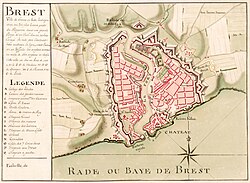 A map of the French city of Brest, dated to around 1700. Located in the Finistère department of Brittany, Brest lies in a sheltered bay close to the western extremity of metropolitan France. Originally named Bresta, possibly derived from a Celtic word meaning hill, the city came under the rule of the duke of Brittany in 1240. From 1342 to 1397 the city was under English rule, and became part of France in 1491 when a marriage unified Brittany with the French crown. Cardinal Richelieu designated the city a major naval base in 1631, a status it retains today. The city centre was mostly rebuilt after heavy Allied bombing during World War II.
 Painting: Gustave CaillebotteHomme au bain ("Man at His Bath") is an oil painting completed by the French Impressionist Gustave Caillebotte in 1884. The canvas measures 145 by 114 centimetres (57 in × 45 in). The painting was held in private collections from the artist's death until June 2011, when it was acquired by the Museum of Fine Arts, Boston. Interpretations of the painting and its male nude have contrasted the figure's masculinity with his vulnerability.
 Photograph credit: Leroy SkalstadThe 15th-century St. Joan of Arc Chapel was initially built in the village of Chasse-sur-Rhône, France. Originally called the Chapelle de St. Martin de Seyssuel, it is said to have been the place at which Joan of Arc prayed in 1429 after she had met King Charles VII of France. The present name was given to the chapel when Gertrude Hill Gavin, the daughter of an American railroad magnate, had the derelict building dismantled, transported to America and rebuilt beside her French Renaissance–style château in Brookville, New York, in 1927. The chapel was undamaged when the château burned down in 1962, and was later given to Marquette University in Milwaukee, Wisconsin, once more being transported stone by stone.
 Photograph credit: Atelier Nadar; restored by Adam CuerdenGeorges Ernest Boulanger (29 April 1837 – 30 September 1891), nicknamed Général Revanche, was a French general and politician. An enormously popular public figure during the Third Republic, he won a series of elections and was feared to be powerful enough to establish himself as dictator at the zenith of his popularity in January 1889. This photograph of Boulanger was produced by the atelier of the French photographer Nadar.
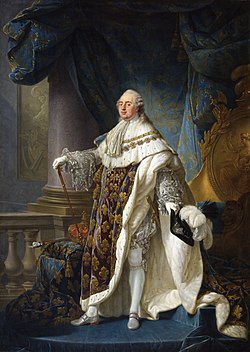 Painting: Antoine-François CalletLouis XVI (1754–1793) was King of France (later King of the French) from 1774 until his deposition in 1792. His early reign was marked by attempts to reform France in accordance with Enlightenment ideals, including ultimately quashed efforts to abolish serfdom, remove the taille, and increase tolerance toward non-Catholics. However, after several years of national debt and financial and food crises, Louis was arrested during the insurrection of 10 August 1792, found guilty of high treason, and executed by guillotine on 21 January 1793.
 Les raboteurs de parquet (The Floor Scrapers) is an 1875 oil on canvas painting by French impressionist Gustave Caillebotte. Measuring 102 by 146.5 centimetres (40 in × 57.7 in), it depicts three men scraping the floor of what is thought to be Caillebotte's own studio, apparently engaged in conversation. According to the Musée d'Orsay, where the painting is held, this is one of the first paintings to feature the urban working class, and indeed the subject matter proved scandalous at the time.
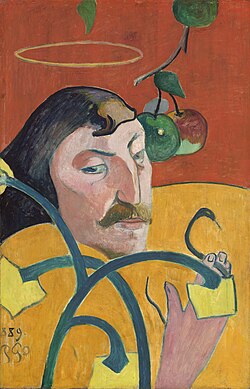 Self-Portrait with Halo and Snake is an 1889 oil on wood painting by French artist Paul Gauguin, which represents his late Brittany period in the fishing village of Le Pouldu in northwestern France. It shows Gauguin against a red background with a halo above his head and apples hanging beside him as he holds a snake in his hand while plants or flowers appear in the foreground. The religious symbolism and the stylistic influence of Japanese wood-block prints and cloisonnism are apparent. The work is one of more than 40 self-portraits he completed. It is held at the National Gallery of Art in Washington, D.C.
 Coin: Monnaie de Paris, Republic of France; Image: National Numismatic Collection, National Museum of American HistoryThe French franc is a former currency of France and Monaco and, alongside the Spanish peseta, a former de facto currency in Andorra. The first franc was a gold coin introduced in 1360, which showed King John II of France on a richly decorated horse, earning it the name franc à cheval. A later coin, showing Charles VII on foot, under a canopy, was named the franc à pied. The decimal franc was established by the French Revolutionary Convention in 1795 as a decimal unit, and became the official currency of France in 1799. France joined the euro in 1999, and the franc was replaced by euro notes and coins in 2002.
This picture shows a 40-franc coin, dated 1807. The obverse shows an image of Napoleon.
See also: 1803 20-franc coin Coin credit: Monnaie de Paris; photographed by the National Numismatic CollectionThe French franc is a former currency of France and Monaco and, alongside the Spanish peseta, a former de facto currency in Andorra. The first franc was a gold coin introduced in 1360, which showed King John II of France on a richly decorated horse, earning it the name franc à cheval. A later coin, showing Charles VII on foot, under a canopy, was named the franc à pied. The decimal franc was established by the French Revolutionary Convention in 1795 as a decimal unit, and became the official currency of France in 1799. France joined the euro in 1999, and the franc was replaced by euro notes and coins in 2002.
This picture shows a 100-franc gold coin, dated 1889, with a "winged genius" designed by Augustin Dupré on the obverse. Only a hundred proof coins of this design were minted. Saint George Palace is an historic building in the city of Rennes, France. Built in 1670, it was used as an abbey residence, replacing a much older abbey building that stood on the same site. During the French Revolution the abbey was closed and the property was seized by the government. Since 1930 the building has been listed as a monument historique of France. It now houses the fire services for the city and other civil administrative offices.


,_revêtu_du_grand_costume_royal_en_1779_-_Google_Art_Project.jpg)


In the news

- 21 May 2026 –
- The Court of Appeal of Paris, France, convicts Airbus and Air France of manslaughter over the 2009 crash of Air France Flight 447, which killed 228 people, and orders both companies to pay the maximum corporate fine and compensation to victims' families. (Al Jazeera) (The New York Times)
- 20 May 2026 – 2026 Ebola epidemic
- An Air France flight from Paris, France, to Detroit, Michigan, U.S., is diverted to Montreal, Quebec, Canada, due to flight restrictions imposed by the U.S., as a passenger on the flight is from the DR Congo. (CBS News)
- 20 May 2026 – United States and the United Nations, United States support for Israel in the Gaza war
- The U.S. Office of Foreign Assets Control removes sanctions on Francesca Albanese, the UN Special Rapporteur on occupied Palestinian territories, after district judge Richard J. Leon of the District of Columbia blocked measures imposed over Albanese's criticism of Israel and its actions in Gaza. (AFP via ABS-CBN News)
- 11 May 2026 –
- Three people are killed and five others are injured in a suspected arson attack on a seven-story building in Décines-Charpieu, Auvergne-Rhône-Alpes, France. (Entrevue)
Did you know –

- ...that French manufacturer Vétra built trolleybuses (example pictured) for transit systems in 12 countries, on three continents?
- ...that Étienne-Émile Baulieu, the "father of the abortion pill", first described the concept of neurosteroids?
- ...that the Church of St Pothinus in Lyon holds a 17th century painting depicting St Paul in front of the Areopagus that was previously kept at the Notre-Dame de Paris?
Topics
-
Main Category - France, List of basic France topics
- Historic Periods - Prehistoric France - Celtic Gaul - Roman Gaul - Frankish Empire - Medieval France - Early Modern France - Nineteenth century France - Twentieth century France
- Major Events - Hundred Years' War - French Renaissance - Wars of Religion - French Revolution - Franco-Prussian War - Dreyfus Affair - World War I - World War II - Vichy France - Algerian War - Military history
- Dynasties and Regimes - Merovingians - Carolingians - Capetian Dynasty - Valois Dynasty - Bourbon Dynasty - Ancien Régime in France - First Empire - Second Empire - Third Republic - Fourth Republic - Fifth Republic
- Monarchs of France - List of French monarchs - Charlemagne - Louis I the Pious - Charles II the Bald - Louis II the Stammerer - Louis III - Carloman - Charles III the Fat - Eudes (Odo) - Charles III the Simple - Robert I - Raoul (Rudolph) of Burgundy - Louis IV d'outremer - Lothair - Louis V the Indolent - Hugh Capet - Robert II the Pious - Henri I - Philippe I - Louis VI the Fat - Louis VII the Young - Philippe II Augustus - Louis VIII the Lion - Louis IX Saint Louis - Philippe III the Bold - Philippe IV the Fair - Louis X the Quarreller - Jean I the Posthumous - Philippe V the Tall - Charles IV the Fair - Philip VI of Valois - Jean II the Good - Charles V - Charles VI - Charles VII - Louis XI - Charles VIII - Louis XII - François I - Henri II - François II - Charles IX - Henri III - Henri IV - Louis XIII - Louis XIV - Louis XV - Louis XVI - Napoleon I - Napoleon II - Louis XVIII - Charles X - Louis-Philippe - Napoleon III
- Other Major Historical Figures - Catherine de Medicis - Cardinal Richelieu - Mazarin - Jean-Baptiste Colbert - Jacques Necker - Jean Jaurès
- Heads of State of France since 1871 - President of the French Republic
- Third Republic: Adolphe Thiers • Patrice MacMahon, duc de Magenta • Jules Grévy • Marie François Sadi Carnot • Jean Casimir-Perier • Félix Faure • Émile Loubet • Armand Fallières • Raymond Poincaré • Paul Deschanel • Alexandre Millerand • Gaston Doumergue • Paul Doumer • Albert Lebrun
- Vichy France: Philippe Pétain
- Free France: Charles de Gaulle
- Provisional Government: Charles de Gaulle • Félix Gouin • Georges Bidault • Léon Blum
- Fourth Republic: Vincent Auriol • René Coty
- Fifth Republic: Charles de Gaulle • Georges Pompidou • Valéry Giscard d'Estaing • François Mitterrand • Jacques Chirac • Nicolas Sarkozy • François Hollande • Emmanuel Macron
- Heads of Government of France since 1871 - Prime Minister of France
- Third Republic: Dufaure • de Broglie • de Cissey • Buffet • Dufaure • Simon • de Broglie • de Rochebouët • Dufaure • Waddington • de Freycinet • Ferry • Gambetta • de Freycinet • Duclerc • Fallières • Ferry • Brisson • de Freycinet • Goblet • Rouvier • Tirard • Floquet • Tirard • de Freycinet • Loubet • Ribot • Dupuy • Casimir-Perier • Dupuy • Ribot • Bourgeois • Méline • Brisson • Dupuy • Waldeck-Rousseau • Combes • Rouvier • Sarrien • Clemenceau • Briand • Monis • Caillaux • Poincaré • Briand • Barthou • Doumergue • Ribot • Viviani • Briand • Ribot • Painlevé • Clemenceau • Millerand • Leygues • Briand • Poincaré • François-Marsal • Herriot • Painlevé • Briand • Herriot • Poincaré • Briand • Tardieu • Chautemps • Tardieu • Steeg • Laval • Tardieu • Herriot • Paul-Boncour • Daladier • Sarraut • Chautemps • Daladier • Doumergue • Flandin • Bouisson • Laval • Sarraut • Blum • Chautemps • Blum • Daladier • Reynaud • Pétain
- Vichy France: Pétain • Laval
- Provisional Government: de Gaulle • Gouin • Bidault • Blum
- Fourth Republic: Ramadier • Schuman • Marie • Schuman • Queuille • Bidault • Queuille • Pleven • Queuille • Pleven • Faure • Pinay • Mayer • Laniel • Mendès-France • Faure • Mollet • Bourgès-Maunoury • Gaillard • Pflimlin • de Gaulle
- Fifth Republic: Debré • Pompidou • Couve de Murville • Chaban-Delmas • Messmer • Chirac • Barre • Mauroy • Fabius • Chirac • Rocard • Cresson • Bérégovoy • Balladur • Juppé • Jospin • Raffarin • de Villepin • Fillon • Ayrault • Valls • Cazeneuve • Philippe • Castex
- Third Republic: Dufaure • de Broglie • de Cissey • Buffet • Dufaure • Simon • de Broglie • de Rochebouët • Dufaure • Waddington • de Freycinet • Ferry • Gambetta • de Freycinet • Duclerc • Fallières • Ferry • Brisson • de Freycinet • Goblet • Rouvier • Tirard • Floquet • Tirard • de Freycinet • Loubet • Ribot • Dupuy • Casimir-Perier • Dupuy • Ribot • Bourgeois • Méline • Brisson • Dupuy • Waldeck-Rousseau • Combes • Rouvier • Sarrien • Clemenceau • Briand • Monis • Caillaux • Poincaré • Briand • Barthou • Doumergue • Ribot • Viviani • Briand • Ribot • Painlevé • Clemenceau • Millerand • Leygues • Briand • Poincaré • François-Marsal • Herriot • Painlevé • Briand • Herriot • Poincaré • Briand • Tardieu • Chautemps • Tardieu • Steeg • Laval • Tardieu • Herriot • Paul-Boncour • Daladier • Sarraut • Chautemps • Daladier • Doumergue • Flandin • Bouisson • Laval • Sarraut • Blum • Chautemps • Blum • Daladier • Reynaud • Pétain
- Historic periods: French Renaissance - French Baroque and Classicism - French Rococo and Neoclassicism - French art of the 19th century - French art of the 20th century
- Artistic Schools: Impressionism - Cubism - Surrealism
- Art museums and galleries: Louvre - Palace of Versailles - Musée d'Orsay - Centre Georges Pompidou - Musée Picasso - Musée Rodin
- Historic periods: Medieval French literature - French Renaissance literature - French literature of the 17th century - French literature of the 18th century - French literature of the 19th century - French literature of the 20th century
- Football (Soccer): French football clubs - French footballers - Football in France
- Rugby (union): Clubs in France - French rugbymen - Rugby union in France
- Tennis: French Open
- Cycling: Tour de France
- Motorsport: 24 Hours of Le Mans - French Grand Prix
- Ski resorts: Chamonix - Tignes - Val Thorens - Les Trois Vallées - La Plagne - Les Arcs - Courchevel - Méribel - Val d'Isère - Les Deux Alpes - Megève
History of France - History of France
Culture and People -
Culture of France -
Culture of France -
Museums in France -
French people -
Health in France -
Education in France -
Education in France -
Religion in France -
Languages of France - Languages of France - French language -
French cuisine -
French cuisine -
French wine -
Archaeology of France -
Basque culture -
Culture of Brittany
Politics and Government -
Government of France -
Government of France -
French National Assembly -
French Senate -
Law of France -
French politics -
Politics of France -
Military of France -
Foreign relations of France -
Flags of France
Economy, Industry and Media -
Economy of France -
Economy of France -
Economic history of France -
French businesspeople -
Companies of France -
French trade unions -
Communications in France -
Mass media in France -
French space program -
French airlines
Visual and Plastic Arts -
French art -
French artists -
French architecture -
French art
Literature -
French literature -
French writers -
French literature - French poetry
Music -
French music -
French composers -
French musicians -
Music of France -
French folk music -
French rock -
French hip hop and rap
Cinema -
Cinema of France -
Cinema of France -
French actors -
French film directors -
French film producers -
César Award winners -
Cannes Film Festival
Theater -
French theatre -
French dramatists and playwrights -
Theatres in France -
Avignon Festival -
Comédie française
Sports-
Sport in France -
French sportspeople -
France at the Olympics -
Geographic topics
-
Main Category - France
- Coastlines: Atlantic Ocean - Bay of Biscay ("Golfe de Gascogne") – Mediterranean Sea (Golfe du Lion) - Côte d'Azur ("French Riviera") – English Channel
- Islands: Belle Île – Corsica – Île d'Oléron – Ouessant – Île de Ré – Île d'Yeu - Réunion - Martinique - Guadeloupe - Saint Barthélemy - Saint Martin - Saint Pierre and Miquelon
- Rivers and streams:
- Major rivers: Loire – Rhine – Rhône – Seine – Garonne - Gironde estuary - Dordogne – Meuse – Escaut – Saône – Marne – Moselle
- Other rivers: Adour – Charente - Aulne – Blavet – Erdre – Hérault – Odet – Orb – Orne – Rance – Sèvre Nantaise – Sèvre Niortaise – Var - Aisne – Allier – Ariège – Aube – Cher – Doubs – Durance – Indre – Ill – Isère – Lot – Maine – Mayenne – Meurthe – Oise - Somme - Tarn – Verdon – Vienne – Vire – Yonne
- Canals: Canal du Midi – Canal de Nantes à Brest – Canal Saint-Martin – Briare Canal – Canal of Burgundy – Grand Canal d'Alsace – Sambre–Oise Canal
- Lakes: Lake Annecy – Lac du Bourget – Lake Geneva (Lac Léman) – Étang de Thau – Étang de Berre
- Mountains:
- Major Mountain ranges: Alps – French Prealps – Pyrénées – Massif Central – Jura – Vosges
- Other Mountain ranges: Aravis Range – Bauges – Belledonne – Chartreuse Mountains – Massif des Écrins – Vercors
- Mountain peaks: Mont Blanc – Aiguille du Midi – Barre des Écrins – Ballon d'Alsace – Crêt de la Neige – Grandes Jorasses – Meije – Mont Aigoual – Mont Ventoux – Pic du Midi - Mont Pelvoux – Puy de Dôme – Puy de Sancy
- Forests: Forest of Fontainebleau – Forest of Compiègne – Paimpont forest – Forest of Saint-Germain-en-Laye
- National parks and natural regions: Cévennes National Park – Écrins National Park – Mercantour National Park – Port-Cros National Park – Pyrénées National Park – Vanoise National Park – Boulonnais – Bresse – Beaujolais – Camargue – Pays de Bray – Sundgau – Vexin
- Major cities: Paris (Paris) – Marseille – Lyon – Lille – Toulouse – Nice – Nantes – Strasbourg – Montpellier – Bordeaux – Rennes – Douai – Le Havre – Reims – Lens – Saint-Étienne – Toulon – Grenoble – Angers – Brest – Le Mans – Dijon – Clermont-Ferrand – Aix-en-Provence – Amiens – Nîmes – Tours – Limoges – Metz – Besançon – Caen – Orléans - Mulhouse – Perpignan - Boulogne-Billancourt – Rouen – Dunkirk – Nancy – Villeneuve-d'Ascq – Saint-Denis, Réunion
- Other: Gardens in France - Cemeteries in France - Transport in France - Tourism in France - Nature conservation in France
- Ski resorts: Chamonix - Tignes - Val Thorens - Les Trois Vallées - La Plagne - Les Arcs - Courchevel - Méribel - Val-d'Isère - Les Deux Alpes - Megève
Geography - Geography of France - Geography of France - Regions of France - Provinces of France - Subdivisions of France - Subdivisions of France - Overseas France

Categories

Related portals


Things you can do

French Wikipedia
 |
There is a French version of Wikipedia, the free encyclopedia. |
Wikiproject
| Project pages | |
|---|---|
| Departments | |
| Announcements | |

Associated Wikimedia
The following Wikimedia Foundation sister projects provide more on this subject:
-
 Commons
Free media repository -
 Wikidata
Free knowledge base -
 Wikiquote
Collection of quotations -
 Wikisource
Free-content library -
 Wikiversity
Free learning tools -
 Wikivoyage
Free travel guide -
 Wiktionary
Dictionary and thesaurus


More portals





Parent portals: Europe | European Union