The History Portal

History by Frederick Dielman
History is the systematic study of the past, focusing primarily on the human past. As an academic discipline, it analyses and interprets evidence to construct narratives about what happened and explain why it happened. Some theorists categorize history as a social science, while others see it as part of the humanities or consider it a hybrid discipline. Similar debates surround the purpose of history—for example, whether its main aim is theoretical, to uncover the truth, or practical, to learn lessons from the past. In a more general sense, the term history refers not to an academic field but to the past itself, times in the past, or to individual texts about the past.
Historical research relies on primary and secondary sources to reconstruct past events and validate interpretations. Source criticism is used to evaluate these sources, assessing their authenticity, content, and reliability. Historians strive to integrate the perspectives of several sources to develop a coherent narrative. Different schools of thought, such as positivism, the Annales school, Marxism, and postmodernism, have distinct methodological approaches.
History is a broad discipline encompassing many branches. Some focus on specific time periods, such as ancient history, while others concentrate on particular geographic regions, such as the history of Africa. Thematic categorizations include political history, military history, social history, and economic history. Branches associated with specific research methods and sources include quantitative history, comparative history, and oral history.
History emerged as a field of inquiry in antiquity to replace myth-infused narratives, with influential early traditions originating in Greece, China, and later in the Islamic world. Historical writing evolved throughout the ages and became increasingly professional, particularly during the 19th century, when a rigorous methodology and various academic institutions were established. History is related to many fields, including historiography, philosophy, education, and politics. (Full article...)
 Featured articles –


Benjamin Harrison (August 20, 1833 – March 13, 1901) was the 23rd president of the United States, serving from 1889 to 1893. He was a member of the Harrison family of Virginia—a grandson of the ninth president, William Henry Harrison, and a great-grandson of Benjamin Harrison V, a Founding Father. A Union army veteran and a Republican, he defeated incumbent Grover Cleveland to win the presidency in 1888.
Harrison was born on a farm by the Ohio River and graduated from Miami University in Oxford, Ohio. After moving to Indianapolis, he established himself as a prominent local attorney, Presbyterian church leader, and politician. During the American Civil War, he served in the Union Army as a colonel, and was confirmed by the U.S. Senate as a brevet brigadier general of volunteers in 1865. Harrison unsuccessfully ran for governor of Indiana in 1876. In 1881, the Republican-controlled Indiana General Assembly elected Harrison to a six-year term in the Senate, where he served from 1881 to 1887. (Full article...)
Niels Henrik David Bohr (/niːlz bɔːr/; Danish: [ˈne̝ls ˈpoɐ̯ˀ]; 7 October 1885 – 18 November 1962) was a Danish theoretical physicist who made foundational contributions to understanding atomic structure and quantum theory, for which he received the Nobel Prize in Physics in 1922. He was also a philosopher and a promoter of scientific research.
Bohr developed the Bohr model of the atom, in which he proposed that energy levels of electrons are discrete and that the electrons revolve in stable orbits around the atomic nucleus but can jump from one energy level (or orbit) to another. Although the Bohr model has been supplanted by other models, its underlying principles remain valid. He conceived the principle of complementarity: that items could be separately analysed in terms of contradictory properties, like behaving as a wave or a stream of particles. The notion of complementarity dominated Bohr's thinking in both science and philosophy. (Full article...)
Thomas Crisp VC, DSC, RNR (28 April 1876 – 15 August 1917) was an English sailor and posthumous recipient of the Victoria Cross. Crisp, in civilian life a commercial fisherman operating from Lowestoft in Suffolk, earned his award after being killed during the defence of his vessel, the armed naval smack Nelson, in the North Sea against an attack from a German submarine in 1917.
Crisp's self-sacrifice in the face of this "unequal struggle" was used by the government to bolster morale during some of the toughest days of the First World War for Britain, in late 1917, during which Britain was suffering heavy losses at the Battle of Passchendaele. His exploit was read aloud by David Lloyd George in the Houses of Parliament and made headline news for nearly a week. (Full article...)
John Lloyd Waddy, OBE, DFC (10 December 1916 – 11 September 1987) was a senior officer and aviator in the Royal Australian Air Force (RAAF), and later served as a member of the New South Wales Legislative Assembly and as a minister in the New South Wales government. As a fighter pilot during World War II, he shot down 15 enemy aircraft during the North African campaign, becoming one of Australia's top-scoring aces and earning the Distinguished Flying Cross. Waddy went on to command No. 80 Squadron in the South West Pacific, where he was awarded the US Air Medal. He was one of eight senior pilots who took part in the "Morotai Mutiny" of April 1945.
Discharged from the Permanent Air Force at the end of the war, Waddy took a commission in the RAAF Reserve and led the organisation as a group captain in the early 1950s. He was active in business and in veterans' groups, and was appointed an Officer of the Order of the British Empire in 1955. From 1962 to 1976, he was the Member for Kirribilli in the New South Wales Parliament, representing the Liberal Party. He held cabinet posts including Minister for Child Welfare and Social Welfare (later Youth and Community Services), Minister for Health, and Minister for Police and Services. Waddy retired from politics in 1976, and died in 1987 at the age of 70. (Full article...)
Sir James Chadwick (20 October 1891 – 24 July 1974) was a British experimental physicist who received the Nobel Prize in Physics in 1935 for his discovery of the neutron. In 1941, he wrote the final draft of the MAUD Report, which inspired the U.S. government to begin serious atomic bomb research efforts. He was the head of the British team that worked on the Manhattan Project during World War II. He was knighted in Britain in 1945 for his achievements in nuclear physics.
Chadwick graduated from the Victoria University of Manchester in 1911, where he studied under Ernest Rutherford (known as the "father of nuclear physics"). At Manchester, he continued to study under Rutherford until he was awarded his MSc in 1913. The same year, Chadwick was awarded an 1851 Research Fellowship from the Royal Commission for the Exhibition of 1851. He elected to study beta radiation under Hans Geiger in Berlin. Using Geiger's recently developed Geiger counter, Chadwick was able to demonstrate that beta radiation produced a continuous spectrum, and not discrete lines as had been thought. Still in Germany when World War I broke out in Europe, he spent the next four years in the Ruhleben internment camp. (Full article...)
The Second Fitna was the second civil war in the Islamic community during the early Umayyad Caliphate. It followed the death of the first Umayyad caliph Mu'awiya I in 680, and lasted for about twelve years. The war involved three main challenges to the authority of the Umayyad dynasty; the first by Husayn ibn Ali, as well as his supporters including Sulayman ibn Surad and Mukhtar al-Thaqafi who rallied to avenge his death in Iraq, the second by Abd Allah ibn al-Zubayr who proclaimed himself caliph in Mecca and was nominally recognized throughout most of the Caliphate, and the Kharijites who took over central Arabia and southern Iraq and Persia.
The roots of the civil war date back to the First Fitna. After the assassination of the third Rashidun caliph Uthman, the Islamic community experienced its first civil war over the immediate question of retribution for his murder. Following the assassination of the fourth Rashidun caliph Ali in 661 and the abdication of his eldest son Hasan the same year, Mu'awiya became the sole ruler of the caliphate. Mu'awiya's unprecedented decision to nominate his son Yazid as his successor sparked opposition, and tensions soared after Mu'awiya's death. Husayn was invited by the pro-Alids of Kufa to overthrow the Umayyads but was intercepted and killed with his small company at the Battle of Karbala in October 680. Yazid's army suppressed a rebellion in Medina in August 683 and subsequently besieged Mecca, where Ibn al-Zubayr had established himself in opposition to Yazid. (Full article...)
On 6 June 1982, during the Falklands War, the British Royal Navy Type 42 destroyer HMS Cardiff engaged and destroyed a British Army Westland Gazelle helicopter, serial number XX377, in a friendly fire incident, killing all four occupants. Cardiff, on the lookout for aircraft flying supplies to the Argentine forces occupying the Falkland Islands, misidentified the helicopter as an enemy Lockheed C-130 Hercules. The loss of the helicopter was initially blamed on enemy action, but a subsequent inquiry found a missile from the Cardiff to be the cause.
On the night of 5 June, HMS Cardiff was stationed to the east of the islands to provide gunfire support to the land forces and intercept enemy aircraft. At around 02:00 a radar contact was detected; a British Army Air Corps Westland Gazelle helicopter was making a routine delivery of personnel and equipment to a radio rebroadcast station on East Falkland. From the contact's speed and course, Cardiff's operations room crew assumed it to be hostile. One Sea Dart missile was fired, missing the target; a second destroyed it. The Gazelle's wreckage and crew were discovered the next morning, and the loss was attributed to enemy fire. Although Cardiff was suspected, later scientific tests on the wreckage proved inconclusive. (Full article...)- A midshipman is an officer of the lowest rank in the Royal Navy, United States Navy, and many Commonwealth navies. Commonwealth countries which use the rank include Canada (Naval Cadet), Australia, Bangladesh, Namibia, New Zealand, South Africa, India, Pakistan, Singapore, Sri Lanka, and Kenya.
In the 17th century, a midshipman was a rating for an experienced seaman, and the word derives from the area aboard a ship, amidships, either where he worked on the ship, or where he was berthed. Beginning in the 18th century, a commissioned officer candidate was rated as a midshipman, and the seaman rating began to slowly die out. By the Napoleonic era (1793–1815), a midshipman was an apprentice officer who had at least nominally served at least three years as a volunteer, officer's servant or able seaman, and was roughly equivalent to a present-day petty officer in rank and responsibilities. After serving at least three years as a midshipman or master's mate, he was eligible to take the examination for lieutenant. Promotion to lieutenant was not automatic, and many midshipmen took positions as master's mates for an increase in pay and responsibility aboard ship. Midshipmen in the United States Navy were trained and served similarly to midshipmen in the Royal Navy, although unlike their counterparts in the Royal Navy, a midshipman was a warrant officer rank until 1912. (Full article...)
On 12 October 1984 the Provisional Irish Republican Army (IRA) attempted to assassinate members of the British government, including the prime minister, Margaret Thatcher, at the Grand Hotel in Brighton, England. Five people were killed, including the Conservative MP Sir Anthony Berry; more than thirty people were injured. Thatcher was uninjured. The bombing was a key moment in the Troubles, the conflict in Northern Ireland between unionists and republicans over the constitutional position of Northern Ireland, which took place between the late 1960s and 1998.
The IRA decided to assassinate Thatcher during the 1981 Irish hunger strike. Her stance against the return of Special Category Status to republican prisoners—the status that meant they were treated as political prisoners, rather than as criminals—meant the strike was not quickly settled, and ten prisoners died. After two years of planning, including reconnoitering the 1982 and 1983 Conservative Party Conferences, a long-delay time bomb was planted in the hotel by the IRA member Patrick Magee more than three weeks before the 1984 conference. The IRA knew the hotel would be occupied by Thatcher and many of her cabinet. (Full article...)
The invasion of Tulagi, on 3–4 May 1942, was part of Operation Mo, the Empire of Japan's strategy in the South Pacific and South West Pacific Area in 1942. The plan called for Imperial Japanese Navy troops to capture Tulagi and nearby islands in the British Solomon Islands Protectorate. The occupation of Tulagi by the Japanese was intended to cover the flank of and provide reconnaissance support for Japanese forces that were advancing on Port Moresby in New Guinea, provide greater defensive depth for the major Japanese base at Rabaul, and serve as a base for Japanese forces to threaten and interdict the supply and communication routes between the United States and Australia and New Zealand.
Without the means to effectively resist the Japanese offensive in the Solomons, the British Resident Commissioner of the Solomon Islands protectorate and the few Australian troops assigned to defend Tulagi evacuated the island just before the Japanese forces arrived on 3 May. The next day, however, a U.S. aircraft carrier task force en route to resist the Japanese forces advancing on Port Moresby (later taking part in the Battle of the Coral Sea) struck the Japanese Tulagi landing force in an air attack, destroying or damaging several of the Japanese ships and aircraft involved in the landing operation. Nevertheless, the Japanese troops successfully occupied Tulagi and began the construction of a small naval base. (Full article...)
Matthew Stanley Quay (/kweɪ/; September 30, 1833 – May 28, 1904) was an American politician of the Republican Party who represented Pennsylvania in the United States Senate from 1887 until 1899 and from 1901 until his death in 1904. Quay's control of the Pennsylvania Republican political machine for almost twenty years made him one of the most powerful and influential politicians in the country. As chair of the Republican National Committee and thus party campaign manager, he helped elect Benjamin Harrison as president in 1888. He was also instrumental in the 1900 election of Theodore Roosevelt as vice president.
Quay studied law and began his career in public office by becoming prothonotary of Beaver County, Pennsylvania, in 1856. He became personal secretary to Governor Andrew Curtin in 1861 after campaigning for him the previous year. During the Civil War, he served in the Union Army, commanding the 134th Pennsylvania Infantry Regiment as a colonel. Quay received the Medal of Honor for heroism at the Battle of Fredericksburg. He acted as Pennsylvania's military agent in Washington before returning to Harrisburg to assist Curtin and aid in his re-election in 1863. He was a member of the Pennsylvania House of Representatives from 1865 to 1868. (Full article...)
The Normandie class consisted of five dreadnought battleships ordered for the French Navy in 1912–1913, Normandie, the lead ship, Flandre, Gascogne, Languedoc, and Béarn. The design incorporated a radical arrangement for the twelve 340 mm (13.4 in) main battery guns: three quadruple-gun turrets, the first of their kind, as opposed to the twin-gun turrets used by most other navies. The first four ships were to be fitted with an unusual hybrid propulsion system that used both steam turbines and triple-expansion steam engines to increase fuel efficiency.
The ships were never completed due to shifting production requirements and a shortage of labor after the beginning of World War I in 1914. The first four ships were sufficiently advanced in construction to permit their launching to clear the slipways for other, more important work. Many of the guns built for the ships were converted for use by the Army. After the war, the French Navy considered several proposals to complete the ships, either as originally designed or modernized to account for lessons from the war. The weak French post-war economy forestalled these plans, and the first four ships were broken up. (Full article...)
Lieutenant General Sir Alwyn Ragnar Garrett, KBE, CB (12 February 1900 – 4 November 1977) was a senior commander in the Australian Army. He served as Chief of the General Staff (CGS) from 1958 to 1960.
Born in Western Australia, Garrett graduated from the Royal Military College, Duntroon, in 1921. He was adjutant and quartermaster in several regiments of the Australian Light Horse before undertaking staff training in England, which he completed just as the Second World War broke out. Garrett joined the Second Australian Imperial Force soon afterwards, and commanded the 2/31st Battalion in England before seeing action with Australian brigades in Greece and Crete in 1941. Promoted to colonel the following year, he held senior positions with I Corps in New Guinea and II Corps on Bougainville in 1944–1945. He was appointed a Commander of the Order of the British Empire for his staff work. (Full article...)
Giovanni Villani (Italian pronunciation: [dʒoˈvanni vilˈlaːni]; c. 1276 or 1280 – 1348) was an Italian banker, official, diplomat and chronicler from Florence who wrote the Nuova Cronica (New Chronicles) on the history of Florence. He was a leading statesman of Florence but later gained an unsavoury reputation and served time in prison as a result of the bankruptcy of a trading and banking company he worked for. His interest in and elaboration of economic details, statistical information, and political and psychological insight mark him as a more modern chronicler of late medieval Europe. His Cronica is viewed as the first introduction of statistics as a positive element in history.
However, historian Kenneth R. Bartlett notes that, in contrast to his Renaissance-era successors, "his reliance on such elements as divine providence links Villani closely with the medieval vernacular chronicle tradition." In recurring themes made implicit through significant events described in his Cronica, Villani also emphasized three assumptions about the relationship of sin and morality to historical events, these being that excess brings disaster, that forces of right and wrong are in constant struggle, and that events are directly influenced by the will of God.
Villani was inspired to write his Cronica after attending the jubilee celebration in Rome in 1300 and noting the venerable history of that city. He outlined the events in his Cronica year for year, following a strictly linear narrative format. He provided intricate details on many important historical events of the city of Florence and the wider region of Tuscany, such as construction projects, floods, fires, famines, and plagues. (Full article...)
The capture of Wakefield occurred during the First English Civil War when a Parliamentarian force attacked the Royalist garrison of Wakefield, Yorkshire. The Parliamentarians were outnumbered, having around 1,500 men under the command of Sir Thomas Fairfax, compared to the 3,000 led by George Goring in Wakefield. Despite being outnumbered, Parliamentarians successfully stormed the town, taking roughly 1,400 prisoners.
Around 800 Parliamentarians had been taken prisoner after being defeated at Seacroft Moor, and Fairfax plotted the capture of Wakefield to take prisoners of his own to exchange for his men. He marched his force from Leeds and split it in two to attack from different directions. After around two hours of fighting early in the morning of 21 May, 1643, Fairfax broke through into Wakefield. Goring, who had been in bed suffering from either illness or a hangover, rose and led a counterattack in his nightshirt, but to no avail and the town was captured. Fairfax gained the prisoners he needed and much ammunition. According to his own account, the Parliamentarians lost no more than seven men. (Full article...)

_(cropped).jpg)


_(14804406853).jpg)


Featured picture
 Image credit: Julius Magnus PetersenA medieval ship flag captured by forces from Lübeck in the 1420s showed the arms of Denmark, Sweden, Norway and Pomerania. At the time, Denmark, Norway and Sweden were united in the Kalmar Union. The flag is believed to originate from the reign of king Eric of Pomerania due to its inclusion of Pomerania's griffin symbol. For the following five hundred years, the flag was displayed as a war trophy in a Lübeck church until destroyed during a World War II air raid on the city. An 1880s copy of the flag is preserved in the museum at Frederiksborg Palace, Denmark. The saint accompanying the Virgin Mary and infant Christ is Saint James the Greater, identified by his scallop shell emblem. The flag was made of coarse linen. All figures and heraldic insignia were created using oil-based paint.
 The "Theatre" at PetraPhoto: Douglas PerkinsPetra is an archaeological site in Jordan, lying in a basin among the mountains which form the eastern flank of Wadi Araba, the great valley running from the Dead Sea to the Gulf of Aqaba. It is famous for having many stone structures carved into the rock.
 Photo credit: USHMMJews captured by SS and SD troops during the suppression of the Warsaw Ghetto Uprising are forced to leave their shelter and march to the Umschlagplatz for deportation. The SD trooper pictured second from the right, is Josef Blösche, who was identified by Polish authorities using this photograph. Blösche was tried for war crimes in Erfurt, East Germany in 1969, sentenced to death and executed in July of that year.
 Credit: anonymousA 1793 etching with watercolor of Jean-Paul Marat, a radical journalist and politician from the French Revolution, carried on shoulders with a crown of laurel leaves, celebrating his acquittal by the Revolutionary Tribunal. From January to May 1793, Marat fought bitterly with the Girondins, whom he believed to be covert enemies of republicanism. The National Convention ordered the trial, but his acquittal only served to increase his public profile and popular support.
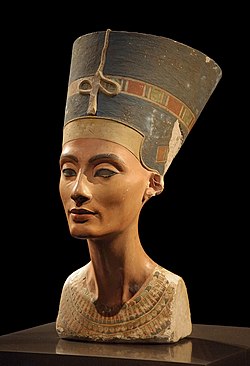 Photo: Philip PikartThe Nefertiti Bust is a 3300-year-old painted limestone bust of Nefertiti, the Great Royal Wife of the Pharaoh Akhenaten and one of the most copied works of Ancient Egypt. It is believed to have been crafted in 1345 BC by the sculptor Thutmose, in whose workshop it was discovered in 1912 by a German archaeological team led by Ludwig Borchardt. It is part of the Egyptian Museum of Berlin collection, currently on display in the Neues Museum and has been the subject of an intense argument between Egypt and Germany over the Egyptian demands for its repatriation.
 A Chola dynasty sculpture depicting Shiva. In Hinduism, Shiva is the deity of destruction and one of the most important gods; in this sculpture he is dancing as Nataraja, the divine dancer who unravels the world in preparation for it being remade by Brahma.
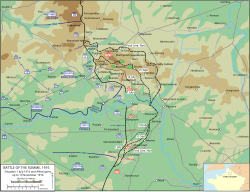 The Battle of the Somme was a battle of the First World War fought between 1 July and 18 November 1916 by the armies of the British and French empires against the German Empire. The largest battle of World War I on the Western Front, it was fought on both sides of upper reaches of the River Somme in France. More than one million men were wounded or killed, making it one of the bloodiest battles in human history.
This map shows the situation on the first day on the Somme, as well as Allied gains up to 19 November 1916. Ivan the Terrible Showing His Treasury to Jerome HorseyArtist: Alexander LitovchenkoAlexander Litovchenko's 1875 painting depicting Ivan IV of Russia seated in the Kremlin Armoury, his half-witted heir Fyodor standing behind, a group of distrustful boyars whispering at a distance, and the Tsar's jester in a skomorokh cap addressing the English diplomat Jerome Horsey. Horsey was a resident of the Russia Company in Moscow from 1572 to 1585.
 Painting credit: John TrumbullJohn Trumbull's Declaration of Independence, a 12 by 18 feet (3.7 by 5.5 m) oil painting depicting the presentation of a draft of the United States Declaration of Independence to the Second Continental Congress. While this event did take place, it was not actually in the presence of all the people in the picture. The painting can be found in the rotunda of the United States Capitol.
 Photo credit: Frank HurleyA group of Australian infantry wearing Small Box Respirators (SBRs) at the Third Battle of Ypres in September 1917. After the introduction of poison gas in World War I, countermeasures were developed. SBRs represented the pinnacle of gas mask development during the war, a mouthpiece connected via a hose to a box filter (hanging around the wearer's neck in this picture), which in turn contained granules of chemicals that neutralised the gas. The SBR was the prized possession of the ordinary infantryman; when the British were forced to retreat during the German Spring Offensive of 1918, it was found that while some troops had discarded their rifles, hardly any had left behind their respirators.
 Artist: Unknown, after Johann ZahnA drawing of the Vegetable Lamb of Tartary (Agnus scythicus), a zoophyte of Central Asia. Botanist Henry Lee described it as both a true animal and a living plant, although he did allow for the possibility that the lamb was the fruit of the plant. The lamb was believed to have blood, bones, and flesh like that of a normal lamb. It was connected to the earth by a stem similar to an umbilical cord that propped the lamb up above ground. The cord could flex downward allowing the lamb to feed on the grass and plants surrounding it. Once the plants within reach were eaten, the lamb died, at which point its cotton-like wool would be harvested and used to make textiles.
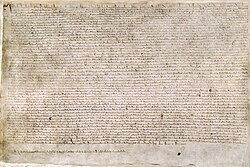 Document: John, King of England, his barons and Stephen LangtonCotton MS Augustus II.106, one of four surviving exemplifications of Magna Carta. This document, sealed by King John of England on 15 June 1215 (O.S.), was drafted by the Archbishop of Canterbury to make peace between the unpopular king and a group of rebel barons. The charter promised the protection of church rights, protection for the barons from illegal imprisonment, access to swift justice, and limitations on feudal payments to the Crown.
The document was reissued and renewed several times over the centuries, though its political impact decreased as later laws were passed. The charter was significant because the king had agreed to limit his power, so that although it dealt predominantly with the king and the barons, since the late 16th century it has been considered a symbol of liberty and the freedom of the individual.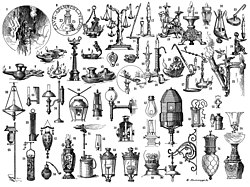 Illustration: Maurice Dessertenne
Restoration: Michel VuijlstekeAn illustration from Volume IV (E–G) of the encyclopedia Nouveau Larousse illustré showing various methods of lighting through the ages, starting from prehistoric times in the upper left (No. 1) to carbide lamps at the beginning of the 20th century (No. 54, lower right), with a separate section for Japanese lighting (No. 55–58, lower left). Artist: William Simpson; Restoration: Adam CuerdenOn October 25, 1854, during the Battle of Balaclava in the Crimean War, British cavalry units charged heavily fortified Russian opposition, an action known as the Charge of the Light Brigade. By mischance, they attacked the wrong target, as the orders were unclear, and as a result suffered great casualties. Alfred, Lord Tennyson's famous poem made the charge a symbol of warfare at both its most courageous and its most tragic.
 Lithography: Day & Son; Restoration: Jake WartenbergAn 1856 lithograph of the Selimiye Barracks, located in Istanbul, Turkey, being used as a hospital during the Crimean War. Florence Nightingale's experiences here during this time helped her develop the foundations of modern nursing. As such, the barracks now contain a museum dedicated to her and her staff.
 Graphic: Arne NordmannA color visual interpretation of the digital signal in the Arecibo message, sent in 1974 from the Arecibo Observatory. Broadcast into space via frequency modulated radio waves at a ceremony to mark the remodeling of the Arecibo radio telescope in Puerto Rico, the message consisted of 1,679 binary digits, approximately 210 bytes, transmitted at a frequency of 2,380 MHz. It was aimed at the Great Globular Cluster in Hercules, some 25,000 light-years away, and contains information related to mathematics, chemistry, and astronomy.
 De Magere Compagnie (completed 1637), which depicts a company of schutterij, a voluntary city guard or citizen militia in the medieval and early modern Netherlands. Frans Hals was commissioned to create this, but he was unable to complete it after three years, and the company hired Pieter Codde to finish it. Group portraits such as this of schutterij were known as schuttersstuk, and were popular among the guards themselves.
 Mosaic: UnknownAlexander the Great (356–323 BC), the King of Macedonia, as depicted in a detail from the Alexander Mosaic. Originally from the House of the Faun in Pompeii and dated to c. 100 BC, the mosaic depicts a battle between the armies of Alexander the Great and Darius III of Persia. It is believed to be a copy of an early 3rd century BC Hellenistic painting, probably by Philoxenos of Eretria. The whole mosaic measures 2.72 × 5.13 m (8 ft 11 in × 16 ft 9 in).


,_by_John_Trumbull.jpg)

.jpg)
.jpg)


Did you know (auto generated)

- ... that Carla Williams got into self-portraits in part due to the poor representation of Black women in her photography history class?
- ... that the Rani of Jhansi has been described as "the greatest heroine of Indian history"?
- ... that history has a history?
- ... that Scholastique Dianzinga edited a post-independence history of women in the Republic of the Congo that discussed why women's emancipation has been hindered?
- ... that Richard Lee Morton became the head of the College of William & Mary's history department after two years of teaching?
- ... that according to the official history of the Song dynasty, Zhao Kuangyin's soldiers stormed his bedroom and proclaimed him emperor, to his surprise?
Featured biography –

Laurence Kerr Olivier, Baron Olivier (/əˈlɪvieɪ/ ə-LIV-ee-ay; 22 May 1907 – 11 July 1989) was an English actor and director. He and his contemporaries John Gielgud, Michael Redgrave and Ralph Richardson made up a quartet of male actors who dominated the British stage of the mid-20th century. He also worked in films throughout his career, playing more than fifty cinema roles. Late in his career he had considerable success in television roles.
Olivier's family had no theatrical connections, but his father, a clergyman, decided that his son should become an actor. After attending a drama school in London, Olivier learned his craft in a succession of acting jobs during the late 1920s. In 1930 he had his first important West End success in Noël Coward's Private Lives, and he appeared in his first film. In 1935 he played in a celebrated production of Romeo and Juliet alongside Gielgud and Peggy Ashcroft, and by the end of the decade he was an established star. In the 1940s, together with Richardson and John Burrell, Olivier was the co-director of the Old Vic, building it into a highly respected company. There his most celebrated roles included Shakespeare's Richard III and Sophocles's Oedipus. (Full article...)
On this day
May 22: National Maritime Day in the United States; Harvey Milk Day in some parts of the United States; Unity Day in Yemen; First day of Shavuot, (Judaism, 2026)

- 1629 – Albrecht von Wallenstein and King Christian IV of Denmark signed the Treaty of Lübeck to end Danish intervention in the Thirty Years' War.
- 1826 – HMS Beagle (pictured) departed on her first voyage from Plymouth for a hydrographic survey of the Patagonia and Tierra del Fuego regions of South America.
- 1960 – The most powerful earthquake ever recorded, registering approximately 9.5 Mw, struck near Valdivia, Chile, generating tsunamis that reached Hawaii and Japan.
- 2002 – Police announced that the skeletal remains of Federal Bureau of Prisons intern Chandra Levy, who had been missing for a year, had been found in Rock Creek Park in Washington, D.C.
- Itzam Kʼan Ahk I (b. 626)
- Rita Cetina Gutiérrez (b. 1846)
- Sun Ra (b. 1914)
- Joshua Zirkzee (b. 2001)
Selected quote
Truth alone will endure, all the rest will be swept away before the tide of time. I must continue to bear testimony to truth even if I am forsaken by all. Mine may today be a voice in the wilderness, but it will be heard when all other voices are silenced, if it is the voice of Truth.
— Gandhi, Indian political and spiritual leader
Related portals


More Did you know...

- ... that the underground Fortress of Mimoyecques (pictured) was built by Nazi Germany to bombard London with 10 shells a minute using the V-3 supergun?
- ... that Howard P. Perry was the first African American recruit in the United States Marine Corps?
- ... that the Chester city walls form the most complete circuit of Roman and medieval defensive town walls in Britain?
- ... that China's first female director was adopted by the first Premier of the People's Republic of China?
- ... that the Medieval Merchant's House in Southampton was being used as a brothel when bomb damage during the Blitz revealed the building's important medieval architecture?
- ... that the Sumerian "river of paradise", the Hubur, derived partly from real geography before becoming a demonic fantasy?
- ... that Bill Foley's photograph "The Last Smile" shows Anwar Sadat only moments before his assassination?
- ... that the 1911 Sarez earthquake triggered a huge landslide, forming the tallest dam in the world?
Topics
| Primary | |
|---|---|
| Interdisciplinary |
|
| List | |
| Other categorizations | |

| Key concepts | |||||||||
|---|---|---|---|---|---|---|---|---|---|
| Measurement and standards |
| ||||||||
| Philosophy of time | |||||||||
| Human experience and use of time | |||||||||
| Time in science |
| ||||||||
| Related | |||||||||

Categories

History • By period • By region • By topic • By ethnic group • Historiography • Archaeology • Books • Maps • Images • Magazines • Organizations • Fictional • Museums • Pseudohistory • Stubs • Timelines • Chronology • People • Wikipedia historians
WikiProjects
 WikiProject History •
Ancient Near East • Australian History • Classical Greece and Rome • Dacia • Former countries • History of Canada • Chinese history • European history • Heraldry and vexillology • Indian history • Jewish history • Medieval Scotland • Mesoamerica • Military history • Middle Ages • History of Science
WikiProject History •
Ancient Near East • Australian History • Classical Greece and Rome • Dacia • Former countries • History of Canada • Chinese history • European history • Heraldry and vexillology • Indian history • Jewish history • Medieval Scotland • Mesoamerica • Military history • Middle Ages • History of Science
WikiProject Time • Days of the Year • Years
WikiProject Biography • Composers • Political figures • Saints • United States Presidents
Things you can do
 |
Here are some tasks awaiting attention:
|
Associated Wikimedia
The following Wikimedia Foundation sister projects provide more on this subject:
-
 Commons
Free media repository -
 Wikidata
Free knowledge base -
 Wikiquote
Collection of quotations -
 Wikisource
Free-content library -
 Wikiversity
Free learning tools -
 Wiktionary
Dictionary and thesaurus