At Dognosis, we combine the unparalleled olfactory capabilities of dogs with advanced BCI and ML technology to digitise scent perception, unlocking ground breaking possibilities in the world of science.
Every Disease Has A Scent. We’re On A Mission to Detect It.
Our symbiotic synthesis of canine and artificial intelligence allows us to detect diseases when it matters most, such as cancer where 80% of cases are detected too late.
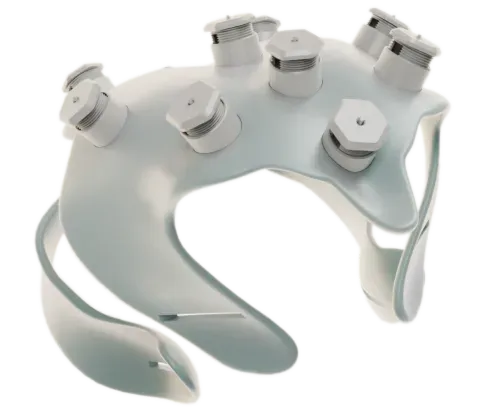
DogSense
World’s most functional canine BCI. Custom to an individual dog’s head, capturing high quality EEG data in a fully non-invasive and comfortable way.
Turning Biological Signals into Digital Predictions
Our patented DogSense brain-computer interface is a real-time translator of the canine perception of smell to a digital data signature. This signature is analyzed and interpreted by our DogOS suite of ML models to predict the scent of disease.

DogSense

DogOS
Fully integrated software platform running signal processing algorithms and multimodal machine learning models providing real-time predictions based on canine neurobehavioral data.
SniffSpace
World’s most advanced olfactory workstation for biomedical detection dogs. Automated and algorithmic sample presentation in VOC maximization pods enabling curated sessions in a replicable and scalable environment.
"Relations are constitutive; dogs and people are emergent as historical beings, as subjects and objects to each other, precisely through the verbs of their relating."
Our Collaborators


BACKED BY









As Featured By





.webp)

FAQs
Everything you need know about Dognosis.
We're building olfaction AI to detect disease signals at scale. Our current product, BreathEasy, is a non-invasive, breath-based health monitoring tool that generates a VOC risk score for clinicians. Patients breathe into a mask for 10 minutes, which is shipped to our labs and analysed in a controlled setting using our canine-AI system. BreathEasy’s MCED application is currently being validated in large-scale trials.
No, we don't bring dogs directly to people. Our system uses breath samples collected in face masks, which are then presented to the trained dogs in a controlled laboratory setting. Once sealed in a bag, masks can retain potency for up to 3 months, and potentially even longer. Samples can be transported hundreds or thousands of kilometers away and sniffed by our team of highly trained dogs in a sensor-rich environment.
Actually, 40+ double-blind trials published in peer-reviewed journals have demonstrated that dogs can detect various diseases, including different types of cancer, with high accuracy. This ability is due to their extraordinary sense of smell, which can detect subtle changes in the body's volatile organic compounds (VOCs).
Our Phase-2 data published in the Journal of Clinical Oncology, the top cancer journal, showcases 91% accuracy in detecting cancer-associated VOC breath signals across 7 cancer groups, with accuracy stable across types as well as in early stages, when detecting early matters the most.
The dogs are detecting changes in volatile organic compounds (VOCs) that are produced by the body when certain diseases, like cancer, are present. These VOCs create a unique "odor signature" or volatilome that trained dogs can identify, just like they can be trained to detect bombs and drugs.
While certain breeds like Beagles and Labradors are often used for scent work due to their strong olfactory abilities, breeds are ultimately just a distribution of personality traits, which is what truly matters for this work. In fact, one of our dogs is a Lab-Indie mix from a shelter. Many breeds can be trained for this purpose, with the most important factors being the individual dog's temperament, trainability, and passion for sniffing.
Our current dogs are adopted from reputable and ethical breeders and shelters. They are specially selected and trained with purely positive reinforcement for this work. Our dogs receive care from, a dedicated caretaker team, go on sunrise and sunset walks, spend hours playing with each other in our expansive grassy yard and go on the occasional swim in a pool/lake. We strive to ensure they live comfortable and happy lives filled with purpose and doggy joy.
We make an important distinction from cosmetics and pharma - we work with dogs as collaborators, not test subjects. Our dogs receive purposeful work combined with enrichment activities, extensive play, and excellent care. We address concerns through complete transparency about their living conditions - and they're genuinely thriving, as evidenced by their enthusiasm for everything from detection work to yard time. We welcome animal-rights groups and dog-lovers as allies on our mission towards uplifting human-canine well-being.
While there was initial skepticism, the growing body of scientific evidence has led to increased acceptance in the medical community. Many clinicians now recognize the potential of canine olfaction in disease detection, especially when combined with advanced technology. It helps that there is a rich literature published in reputable journals like Nature, The Lancet, and now, the Journal of Clinical Oncology. Many understand that we already trust dogs in life-and-death scenarios like detecting explosives, and that the challenge for biomedical detection dogs was standardization and scale, not their innate capability.
We're actively working with regulators, in India, the USA, and elsewhere.
Several key trends have converged to make our approach particularly compelling right now:
- The rise of Multi-Cancer Early Detection (MCED) tests and AI-powered imaging has created an acute need for effective first-tier screening, which breath-based testing is uniquely positioned to fulfill. This is reflected in recent policy moves - there's even a bill in Congress to mandate Medicare coverage for FDA-approved MCED tests.
- Wearable brain-computer interfaces (BCIs) have become technically and commercially feasible since 2020, allowing us to transform dogs' binary signals into rich digital data streams. This technological breakthrough enables standardization and scalability that wasn't possible before.
- Machine learning advances now allow for powerful multi-modal real-time inference, helping us combine and analyze complex data from multiple sources (brain activity, behavior, video) to create more accurate and reliable detection models.
- The post-COVID world has demonstrated the power of canine detection at scale - dogs were successfully deployed across 60 countries for COVID screening, creating a major shift in public consciousness about their diagnostic capabilities.

