Badengzhuite
A valid IMA mineral species
This page is currently not sponsored. Click here to sponsor this page.

About Badengzhuite
Formula:
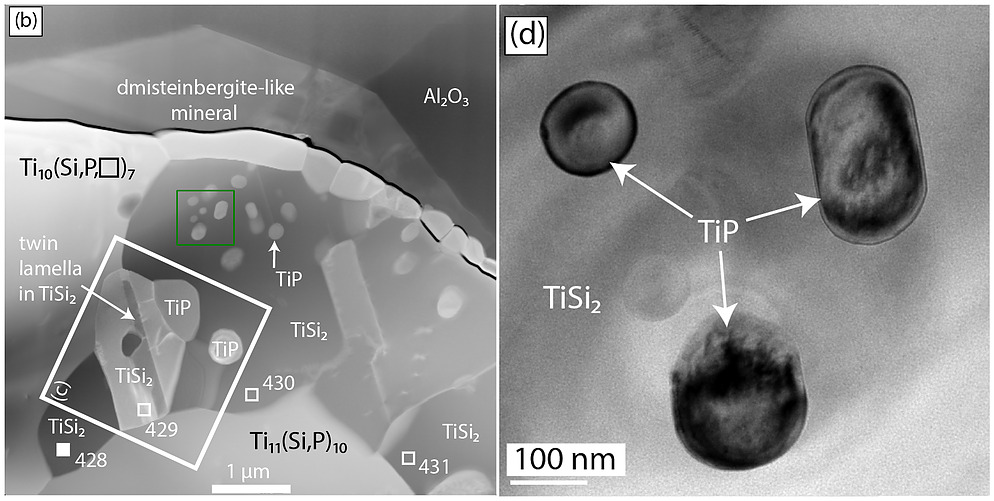
TiP
Crystal System:
Hexagonal
Name:
Named in honor of Badengzhu (b. 28 January 1939), Tibetan geologist of the Tibet Ore Industry Co., Ltd., Lhasa. In the literature, his name is sometimes written with “Ba” as his surname and “Dengzhu” as his given name. He discovered the chromite ore bodies in the Luobusa ophiolite in 1966. Starting from 2012, he presided over the deep prospecting work of Luobusa and discovered the Cr-80 ore body.
Known synthetic analogue. Second phosphide mineral with essential Ti after florenskyite.
Some have suggested this is an anthropogenic material.
Most likely synonymous with 'UM1986-25-P:Ti'.
Some have suggested this is an anthropogenic material.
Most likely synonymous with 'UM1986-25-P:Ti'.
Unique Identifiers
Mindat ID:
54038
Long-form identifier:
mindat:1:1:54038:2
IMA Classification of Badengzhuite
Approved
First published:
2020
Type description reference:
Xiong, Fahui, Xu, Xiangzhen, Mugnaioli, Enrico, Gemmi, Mauro, Wirth, Richard, Grew, Edward S., Robinson, Paul T., Yang, Jingsui (2020) Two new minerals, badengzhuite, TiP, and zhiqinite, TiSi2, from the Cr-11 chromitite orebody, Luobusa ophiolite, Tibet, China: is this evidence for super-reduced mantle-derived fluids?. European Journal of Mineralogy, 32 (6) 557-574 doi:10.5194/ejm-32-557-2020
Classification of Badengzhuite
1.BD.60
1 : ELEMENTS (Metals and intermetallic alloys; metalloids and nonmetals; carbides, silicides, nitrides, phosphides)
B : Metallic Carbides, Silicides, Nitrides, Phosphides and Hydrides
D : Phosphides
1 : ELEMENTS (Metals and intermetallic alloys; metalloids and nonmetals; carbides, silicides, nitrides, phosphides)
B : Metallic Carbides, Silicides, Nitrides, Phosphides and Hydrides
D : Phosphides
Mineral Symbols
As of 2021 there are now IMA–CNMNC approved mineral symbols (abbreviations) for each mineral species, useful for tables and diagrams.
| Symbol | Source | Reference |
|---|---|---|
| Bdz | IMA–CNMNC | Warr, L.N. (2021). IMA–CNMNC approved mineral symbols. Mineralogical Magazine, 85(3), 291-320. doi:10.1180/mgm.2021.43 |
Chemistry of Badengzhuite
Mindat Formula:
TiP
Elements listed:
Crystallography of Badengzhuite
Crystal System:
Hexagonal
Class (H-M):
6/mmm (6/m 2/m 2/m) - Dihexagonal Dipyramidal
Space Group:
P63/mmc
Setting:
P63/mmc
Cell Parameters:
a = 3.49(7) Å, c = 11.76(24) Å
Ratio:
a:c = 1 : 3.37
Unit Cell V:
124.05 ų (Calculated from Unit Cell)
X-Ray Powder Diffraction
Powder Diffraction Data:
| d-spacing | Intensity |
|---|---|
| 3.022 Å | (14) |
| 2.927 Å | (26) |
| 2.688 Å | (31) |
| 2.394 Å | (100) |
| 2.107 Å | (33) |
| 1.856 Å | (26) |
| 1.745 Å | (44) |
| 1.410 Å | (11) |
Reference:
Xiong, Fahui, Xu, Xiangzhen, Mugnaioli, Enrico, Gemmi, Mauro, Wirth, Richard, Grew, Edward S., Robinson, Paul T., Yang, Jingsui (2020) Two new minerals, badengzhuite, TiP, and zhiqinite, TiSi2, from the Cr-11 chromitite orebody, Luobusa ophiolite, Tibet, China: is this evidence for super-reduced mantle-derived fluids?. European Journal of Mineralogy, 32 (6) 557-574 doi:10.5194/ejm-32-557-2020
Geological Environment
Paragenetic Mode(s):
| Paragenetic Mode | Earliest Age (Ga) |
|---|---|
| Stage 4b: Highly evolved igneous rocks | >3.0 |
| 36 : Carbonatites, kimberlites, and related igneous rocks | |
| Stage 5: Initiation of plate tectonics | <3.5-2.5 |
| 38 : Ophiolites |
Type Occurrence of Badengzhuite
Place of Conservation of Type Material:
mineralogical collections of the Chinese Geological Museum, Xisiyangrouhutong 15th, Xicheng district, Beijing, China, specimen number M13817
Associated Minerals at Type Locality:
Reference:
Xiong, Fahui, Xu, Xiangzhen, Mugnaioli, Enrico, Gemmi, Mauro, Wirth, Richard, Grew, Edward S., Robinson, Paul T., Yang, Jingsui (2020) Two new minerals, badengzhuite, TiP, and zhiqinite, TiSi2, from the Cr-11 chromitite orebody, Luobusa ophiolite, Tibet, China: is this evidence for super-reduced mantle-derived fluids?. European Journal of Mineralogy, 32 (6) 557-574 doi:10.5194/ejm-32-557-2020
Other Language Names for Badengzhuite
Common Associates
Associated Minerals Based on Photo Data:
Related Minerals - Strunz-mindat Grouping
| 1.BD. | Murashkoite | FeP |
| 1.BD. | Orishchinite | Ni2P |
| 1.BD. | Nickolayite | FeMoP |
| 1.BD. | Grammatikopoulosite | NiVP |
| 1.BD. | Negevite | NiP2 |
| 1.BD. | Halamishite | Ni5P4 |
| 1.BD. | Transjordanite | Ni2P |
| 1.BD. | Zuktamrurite | FeP2 |
| 1.BD.05 | Nickelphosphide | (Ni,Fe)3P |
| 1.BD.05 | Schreibersite | (Fe,Ni)3P |
| 1.BD.10 | Barringerite | (Fe,Ni)2P |
| 1.BD.10 | Monipite | MoNiP |
| 1.BD.15 | Allabogdanite | (Fe,Ni)2P |
| 1.BD.15 | Florenskyite | FeTiP |
| 1.BD.15 | Andreyivanovite | FeCrP |
| 1.BD.20 | Melliniite | (Ni,Fe)4P |
| 1.BD.35 | Nazarovite | Ni12P5 |
| 1.BD.45 | Polekhovskyite | MoNiP2 |
| 1.BD.50 | Tsikourasite | Mo3Ni2P1+x |
Other Information
Health Risks:
No information on health risks for this material has been entered into the database. You should always treat mineral specimens with care.
Internet Links for Badengzhuite
mindat.org URL:
https://www.mindat.org/min-54038.html
Please feel free to link to this page.
Please feel free to link to this page.
Search Engines:
External Links:
References for Badengzhuite
Reference List:
Miyawaki, Ritsuro, Hatert, Frédéric, Pasero, Marco, Mills, Stuart J. (2020) IMA Commission on New Minerals, Nomenclature and Classification (CNMNC) - Newsletter 52. European Journal of Mineralogy, 32 (1) 1-11 doi:10.5194/ejm-32-1-2020
Xiong, Fahui, Xu, Xiangzhen, Mugnaioli, Enrico, Gemmi, Mauro, Wirth, Richard, Grew, Edward S., Robinson, Paul T., Yang, Jingsui (2020) Two new minerals, badengzhuite, TiP, and zhiqinite, TiSi2, from the Cr-11 chromitite orebody, Luobusa ophiolite, Tibet, China: is this evidence for super-reduced mantle-derived fluids?. European Journal of Mineralogy, 32 (6) 557-574 doi:10.5194/ejm-32-557-2020
Localities for Badengzhuite
 symbol to view information about a locality.
The
symbol to view information about a locality.
The Locality List
 - This locality has map coordinates listed.
- This locality has estimated coordinates.
ⓘ - Click for references and further information on this occurrence.
? - Indicates mineral may be doubtful at this locality.
- This locality has map coordinates listed.
- This locality has estimated coordinates.
ⓘ - Click for references and further information on this occurrence.
? - Indicates mineral may be doubtful at this locality.
 - Good crystals or important locality for species.
 - World class for species or very significant.
(TL) - Type Locality for a valid mineral species.
(FRL) - First Recorded Locality for everything else (eg varieties).
- World class for species or very significant.
(TL) - Type Locality for a valid mineral species.
(FRL) - First Recorded Locality for everything else (eg varieties).
All localities listed without proper references should be considered as questionable.
China (TL) | |
| Miyawaki et al. (2020) +1 other reference |
Orebody CR-11, Kangjinla Cr deposit, Luobusha ophiolite, Qusum Co., Shannan Prefecture, Tibet, China