Bandylite
A valid IMA mineral species - grandfathered
This page is currently not sponsored. Click here to sponsor this page.
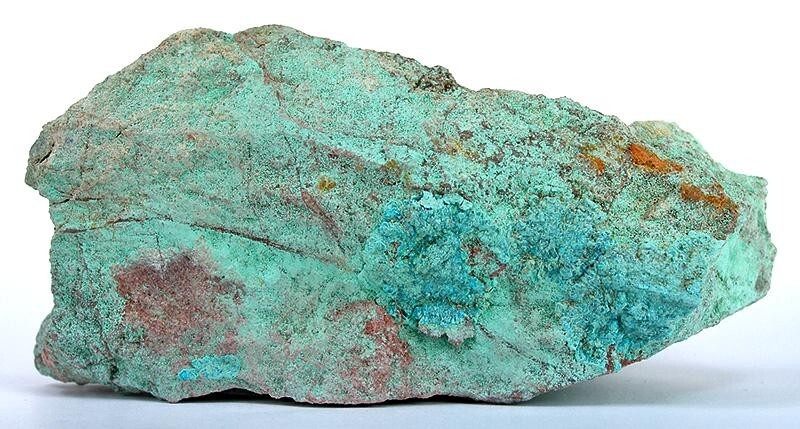
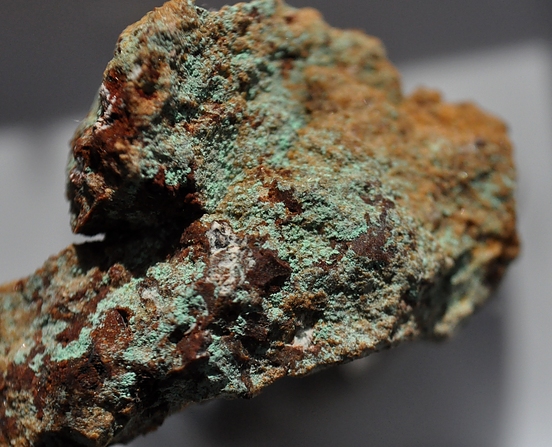

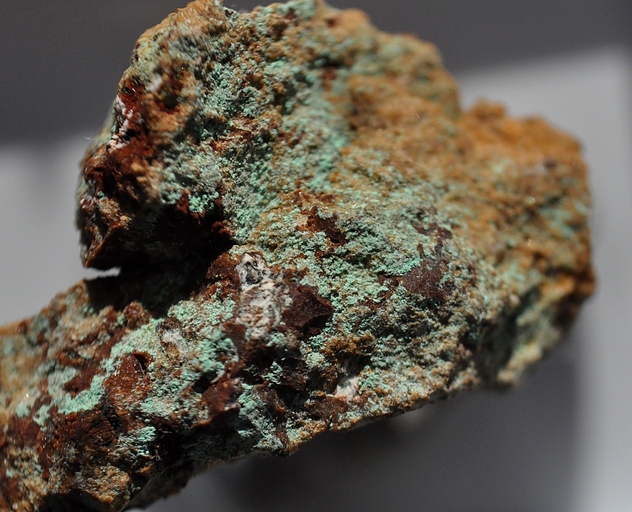
About Bandylite

Mark C. Bandy
Formula:
Cu[B(OH)4]Cl
Colour:
Deep blue with greenish portions; cendre blue to Italian blue, becoming greener with atacamite inclusions; blue in transmitted light.
Lustre:
Vitreous, Pearly
Hardness:
2½
Specific Gravity:
2.81
Crystal System:
Tetragonal
Name:
Named in honor of Mark Chance Bandy (22 July 1900, Redfield, Iowa, USA - 3 June 1963), American mining engineer, mineralogist and mineral collector, who first collected the mineral. He worked at many different places over his career, especially in South America. The mineral jeanbandyite is named for his wife.
Unique Identifiers
Mindat ID:
506
Long-form identifier:
mindat:1:1:506:5
IMA Classification of Bandylite
Approved, 'Grandfathered' (first described prior to 1959)
IMA Formula:
CuB(OH)4Cl
First published:
1938
Classification of Bandylite
6.AC.35
6 : BORATES
A : Monoborates
C : B(O,OH)4, without and with additional anions; 1(T), 1(T)+OH, etc
6 : BORATES
A : Monoborates
C : B(O,OH)4, without and with additional anions; 1(T), 1(T)+OH, etc
25.1.4.2
25 : ANHYDROUS BORATES CONTAINING HYDROXYL OR HALOGEN
1 : Monoborates
25 : ANHYDROUS BORATES CONTAINING HYDROXYL OR HALOGEN
1 : Monoborates
10.1.2
10 : Borates with other anions
1 : Borates with halide
10 : Borates with other anions
1 : Borates with halide
Mineral Symbols
As of 2021 there are now IMA–CNMNC approved mineral symbols (abbreviations) for each mineral species, useful for tables and diagrams.
| Symbol | Source | Reference |
|---|---|---|
| Bny | IMA–CNMNC | Warr, L.N. (2021). IMA–CNMNC approved mineral symbols. Mineralogical Magazine, 85(3), 291-320. doi:10.1180/mgm.2021.43 |
Physical Properties of Bandylite
Vitreous, Pearly
Transparency:
Transparent
Colour:
Deep blue with greenish portions; cendre blue to Italian blue, becoming greener with atacamite inclusions; blue in transmitted light.
Streak:
Pale blue
Hardness:
2½ on Mohs scale
Tenacity:
Elastic
Cleavage:
Perfect
on {001}.
on {001}.
Density:
2.81 g/cm3 (Measured) 2.81 g/cm3 (Calculated)
Optical Data of Bandylite
Type:
Uniaxial (-)
RI values:
nω = 1.691 - 1.692 nε = 1.64 - 1.641
Max. Birefringence:
δ = 0.051
Based on recorded range of RI values above.
Based on recorded range of RI values above.
Interference Colours:
The colours simulate birefringence patterns seen in thin section under crossed polars. They do not take into account mineral colouration or opacity.
Michel-Levy Bar The default colours simulate the birefringence range for a 30 µm thin-section thickness. Adjust the slider to simulate a different thickness.
Grain Simulation You can rotate the grain simulation to show how this range might look as you rotated a sample under crossed polars.
The colours simulate birefringence patterns seen in thin section under crossed polars. They do not take into account mineral colouration or opacity.
Michel-Levy Bar The default colours simulate the birefringence range for a 30 µm thin-section thickness. Adjust the slider to simulate a different thickness.
Grain Simulation You can rotate the grain simulation to show how this range might look as you rotated a sample under crossed polars.
Surface Relief:
Moderate
Pleochroism:
Strong
Comments:
O = Deep cendre blue
E = Light greenish yellow
E = Light greenish yellow
Chemistry of Bandylite
Mindat Formula:
Cu[B(OH)4]Cl
Element Weights:
Common Impurities:
Fe
Crystallography of Bandylite
Crystal System:
Tetragonal
Class (H-M):
4/mmm (4/m 2/m 2/m) - Ditetragonal Dipyramidal
Space Group:
P4/nmm
Cell Parameters:
a = 6.19 Å, c = 5.61 Å
Ratio:
a:c = 1 : 0.906
Unit Cell V:
214.95 ų (Calculated from Unit Cell)
Z:
2
Morphology:
Crystals typically tabular on {001} or equant with large {001}, {201}, and {110}, having quadrangular terraces on {001}. dominant forms are {001}, {111}, {201} and {110}. Occurs as subparallel clusters forming lichen-like groups with the individual crystals flattened on the base or on a pyramidal face.
Crystal Structure
Load
Unit Cell | Unit Cell Packed
2x2x2 | 3x3x3 | 4x4x4
Unit Cell | Unit Cell Packed
2x2x2 | 3x3x3 | 4x4x4
Show
Big Balls | Small Balls | Just Balls | Spacefill
Polyhedra Off | Si Polyhedra | All Polyhedra
Remove metal-metal sticks
Big Balls | Small Balls | Just Balls | Spacefill
Polyhedra Off | Si Polyhedra | All Polyhedra
Remove metal-metal sticks
Display Options
Black Background | White Background
Perspective On | Perspective Off
2D | Stereo | Red-Blue | Red-Cyan
Black Background | White Background
Perspective On | Perspective Off
2D | Stereo | Red-Blue | Red-Cyan
View
CIF File Best | x | y | z | a | b | c
CIF File Best | x | y | z | a | b | c
Rotation
Stop | Start
Stop | Start
Labels
Console Off | On | Grey | Yellow
Console Off | On | Grey | Yellow
Data courtesy of the American Mineralogist Crystal Structure Database. Click on an AMCSD ID to view structure
| ID | Species | Reference | Link | Year | Locality | Pressure (GPa) | Temp (K) |
|---|---|---|---|---|---|---|---|
| 0005654 | Bandylite | Li Y, Burns P C (2000) Refinement of the structure of bandylite The Canadian Mineralogist 38 713-715 |  | 2000 | 0 | 293 | |
| 0009143 | Bandylite | Collin R L (1951) The crystal structure of bandylite, CuCl2*CuB2O4*(H2O)4 Acta Crystallographica 4 204-209 |  | 1951 | 0 | 293 |
CIF Raw Data - click here to close
X-Ray Powder Diffraction
Powder Diffraction Data:
| d-spacing | Intensity |
|---|---|
| 5.59 Å | (10) |
| 3.08 Å | (8) |
| 2.54 Å | (8) |
| 1.952 Å | (7) |
| 4.35 Å | (6) |
| 1.655 Å | (6) |
| 4.13 Å | (5.5) |
Reference:
Comments:
Recorded on material from Queténa Mine, Chile
Geological Environment
Paragenetic Mode(s):
| Paragenetic Mode | Earliest Age (Ga) |
|---|---|
| Stage 7: Great Oxidation Event | <2.4 |
| 47a : [Near-surface hydration of prior minerals] | |
| 47c : [Carbonates, phosphates, borates, nitrates] | |
| 47g : [Halogen-bearing surface weathering minerals] |
Type Occurrence of Bandylite
General Appearance of Type Material:
Tabular or pyramidal crystals to 5 mm and almost lichen-like radial clusters in joints in the rock.
Place of Conservation of Type Material:
National Museum of Natural History, Washington, D.C., USA (No. C5459)
Geological Setting of Type Material:
In a leached zone above massive iron sulphates
Associated Minerals at Type Locality:
Other Language Names for Bandylite
Common Associates
Associated Minerals Based on Photo Data:
| 7 photos of Bandylite associated with Betpakdalite-NaCa | [Na2(H2O)17Ca(H2O)6][Mo6+8As5+2Fe3+3O34(OH)3] |
| 6 photos of Bandylite associated with Hexahydrite | MgSO4 · 6H2O |
| 6 photos of Bandylite associated with Nitratine | NaNO3 |
| 6 photos of Bandylite associated with Blödite | Na2Mg(SO4)2 · 4H2O |
| 3 photos of Bandylite associated with Eriochalcite | CuCl2 · 2H2O |
| 3 photos of Bandylite associated with Atacamite | Cu2(OH)3Cl |
Related Minerals - Strunz-mindat Grouping
| 6.AC.05 | Sinhalite | MgAl(BO4) |
| 6.AC.10 | Pseudosinhalite | Mg2Al3(BO3)2(OH)O3 |
| 6.AC.15 | Béhierite | Ta(BO4) |
| 6.AC.15 | Schiavinatoite | Nb(BO4) |
| 6.AC.20 | Frolovite | Ca[B(OH)4]2 |
| 6.AC.25 | Hexahydroborite | Ca[B(OH)4]2 · 2H2O or CaB2O4 · 6H2O |
| 6.AC.30 | Henmilite | Ca2Cu[B(OH)4]2(OH)4 |
| 6.AC.40 | Teepleite | Na2[B(OH)4]Cl |
| 6.AC.45 | Moydite-(Y) | Y[B(OH)4](CO3) |
| 6.AC.50 | Carboborite | Ca2Mg[B(OH)4]2(CO3)2 · 4H2O |
| 6.AC.55 | Sulfoborite | Mg3[B(OH)4]2(SO4)(OH,F)2 |
| 6.AC.60 | Lüneburgite | Mg3[B2(OH)6](PO4)2 · 6H2O |
| 6.AC.65 | Seamanite | Mn2+3[B(OH)4](PO4)(OH)2 |
| 6.AC.70 | Cahnite | Ca2[B(OH)4](AsO4) |
Other Information
IR Spectrum:
Cerro Palestina material [cm-1]: 3430sh, 3395s, 3310sh, 1257s, 1078, 912s, 636, 601, 504, 402w
Notes:
Decomposed by water, leaving a residue of green copper borate. Readily soluble in NH4OH, to an intense blue solution. Less readily soluble in HCl or HNO3.
Health Risks:
No information on health risks for this material has been entered into the database. You should always treat mineral specimens with care.
Internet Links for Bandylite
mindat.org URL:
https://www.mindat.org/min-506.html
Please feel free to link to this page.
Please feel free to link to this page.
Search Engines:
External Links:
References for Bandylite
Reference List:
Palache, Charles, Foshag, W. F. (1938) Antofagastite and bandylite, two new copper minerals from Chile. American Mineralogist, 23 (2) 85-90
Bandy, Mark C. (1938) Mineralogy of three sulphate deposits of northern Chile. American Mineralogist, 23 (11) 669-760
Collin, R. L. (1951) The crystal structure of bandylite, CuCl2.CuB2O4.4H2O. Acta Crystallographica, 4 (3) 204-209 doi:10.1107/s0365110x51000726
Ross, V., Edwards, J. O. (1959) Notes and News: Tetrahedral boron in teepleite and bandylite. American Mineralogist, 44 (7-8). 875-877
Localities for Bandylite
 symbol to view information about a locality.
The
symbol to view information about a locality.
The Locality List
 - This locality has map coordinates listed.
- This locality has estimated coordinates.
ⓘ - Click for references and further information on this occurrence.
? - Indicates mineral may be doubtful at this locality.
- This locality has map coordinates listed.
- This locality has estimated coordinates.
ⓘ - Click for references and further information on this occurrence.
? - Indicates mineral may be doubtful at this locality.
 - Good crystals or important locality for species.
 - World class for species or very significant.
(TL) - Type Locality for a valid mineral species.
(FRL) - First Recorded Locality for everything else (eg varieties).
- World class for species or very significant.
(TL) - Type Locality for a valid mineral species.
(FRL) - First Recorded Locality for everything else (eg varieties).
All localities listed without proper references should be considered as questionable.
Canada | |
| Liverton et al. (eds.) |
Chile | |
| Łukasz Kruszewski |
| Anthony (1997) | |
| Palache et al. (1938) +2 other references |
Quick NavTopAbout BandyliteUnique IdentifiersIMA Classification Classification Mineral SymbolsPhysical Properties Optical Data Chemistry Crystallography Crystal StructureX-Ray Powder DiffractionGeological EnvironmentType Occurrence Other LanguagesCommon AssociatesStrunz-MindatOther InformationInternet Links References Localities Locality List
Queténa Mine, Toki Cu deposit, Chuquicamata District, Calama, El Loa Province, Antofagasta, Chile