Falottaite
A valid IMA mineral species
This page is currently not sponsored. Click here to sponsor this page.
About Falottaite
Formula:
MnC2O4 · 3H2O
Colour:
Colorless
Lustre:
Vitreous
Hardness:
2½
Specific Gravity:
1.924 (Calculated)
Crystal System:
Orthorhombic
Name:
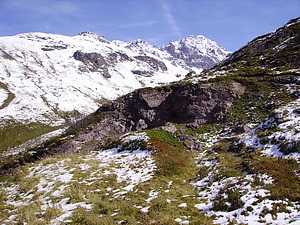
Named for the type locality, Falotta mine, Switzerland.
Dehydrates slowly (over several months) under ambient conditions to form the dihydrate lindbergite (Gröbner & Nikoleizig, 2009; Graeser & Gabriel, 2016). The originally colourless and transparent crystals turn white and opaque during the dehydration process. Stability studies of synthetic Mn oxalates indicate a dehydration temperature of about 30°C (Huizing et al., 1977).
Can also be created by fungi (A. niger) grown with hausmannite.
Known as a synthetic compound.
Can also be created by fungi (A. niger) grown with hausmannite.
Known as a synthetic compound.
Unique Identifiers
Mindat ID:
43915
Long-form identifier:
mindat:1:1:43915:6
IMA Classification of Falottaite
Approved
Approval year:
2013
First published:
2016
Classification of Falottaite
10.AB.X
10 : ORGANIC COMPOUNDS
A : Salts of organic acids
B : Oxalates
10 : ORGANIC COMPOUNDS
A : Salts of organic acids
B : Oxalates
Mineral Symbols
As of 2021 there are now IMA–CNMNC approved mineral symbols (abbreviations) for each mineral species, useful for tables and diagrams.
| Symbol | Source | Reference |
|---|---|---|
| Flt | IMA–CNMNC | Warr, L.N. (2021). IMA–CNMNC approved mineral symbols. Mineralogical Magazine, 85(3), 291-320. doi:10.1180/mgm.2021.43 |
Physical Properties of Falottaite
Vitreous
Transparency:
Transparent
Colour:
Colorless
Streak:
White
Hardness:
2½ on Mohs scale
Cleavage:
None Observed
Density:
1.924 g/cm3 (Calculated)
Optical Data of Falottaite
Type:
Biaxial
RI values:
nα = 1.460 nγ = 1.560
Max. Birefringence:
δ = 0.100
Based on recorded range of RI values above.
Based on recorded range of RI values above.
Interference Colours:
The colours simulate birefringence patterns seen in thin section under crossed polars. They do not take into account mineral colouration or opacity.
Michel-Levy Bar The default colours simulate the birefringence range for a 30 µm thin-section thickness. Adjust the slider to simulate a different thickness.
Grain Simulation You can rotate the grain simulation to show how this range might look as you rotated a sample under crossed polars.
The colours simulate birefringence patterns seen in thin section under crossed polars. They do not take into account mineral colouration or opacity.
Michel-Levy Bar The default colours simulate the birefringence range for a 30 µm thin-section thickness. Adjust the slider to simulate a different thickness.
Grain Simulation You can rotate the grain simulation to show how this range might look as you rotated a sample under crossed polars.
Surface Relief:
Moderate
Pleochroism:
Non-pleochroic
Chemistry of Falottaite
Mindat Formula:
MnC2O4 · 3H2O
Element Weights:
Elements listed:
Crystallography of Falottaite
Crystal System:
Orthorhombic
Class (H-M):
mmm (2/m 2/m 2/m) - Dipyramidal
Cell Parameters:
a = 10.527(5) Å, b = 6.626(2) Å, c = 9.783(6) Å
Ratio:
a:b:c = 1.589 : 1 : 1.476
Unit Cell V:
682.4 ų
Z:
4
Morphology:
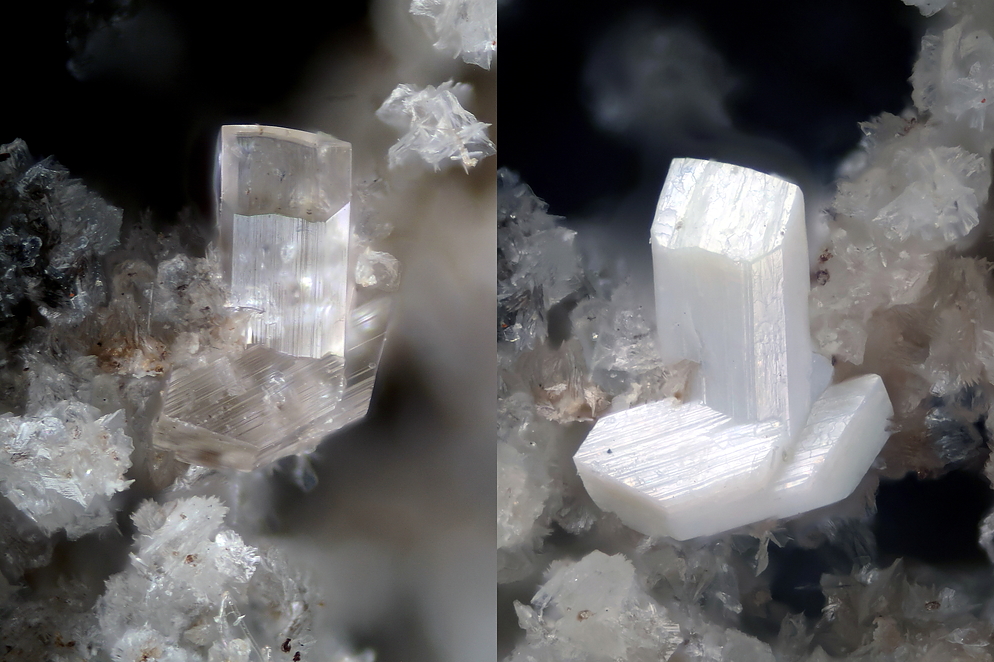
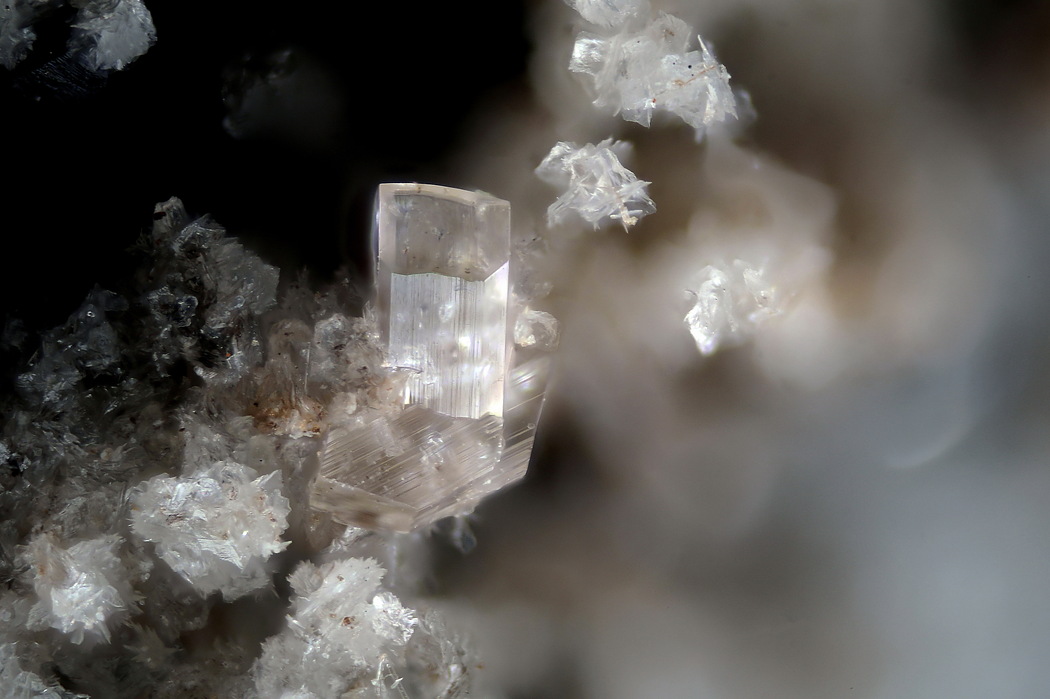
Elongated along c and flattened on b with main forms {010}, {100}, and {101} modified by minor {210} and {10.1.10}.
Twinning:
Common, unknown law.
Comment:
Space Group: Pcaa.
X-Ray Powder Diffraction
Powder Diffraction Data:
| d-spacing | Intensity |
|---|---|
| 6.630 Å | (100) |
| 6.630 Å | (60) |
| 3.801 Å | (90) |
| 3.153 Å | (80) |
| 2.959 Å | (60) |
| 2.697 Å | (60) |
| 2.622 Å | (70) |
| 2.122 Å | (60) |
Comments:
From Type Description.
Geological Environment
Paragenetic Mode(s):
| Paragenetic Mode | Earliest Age (Ga) |
|---|---|
| Stage 7: Great Oxidation Event | <2.4 |
| 47e : [Vanadates, chromates, manganates] | |
| Stage 10a: Neoproterozoic oxygenation/terrestrial biosphere | <0.6 |
| 53 : Other minerals with taphonomic origins | <0.4 |
Type Occurrence of Falottaite
General Appearance of Type Material:
Well formed colorless ship-like crystals up to 1 × 0.5 mm, on quartz crystals.
Place of Conservation of Type Material:
Type material is deposited in the collections of the Natural History Museum Basel, Basel, Switzerland, specimen number S69
Geological Setting of Type Material:
Alpine metamorphism of manganese ores. Then, presumably reaction of humus and oxalic acids (from plants) with those manganese minerals.
Synonyms of Falottaite
Other Language Names for Falottaite
Dutch:Falottaiet
German:Falottait
Common Associates
Associated Minerals Based on Photo Data:
| 3 photos of Falottaite associated with Lindbergite | Mn2+(C2O4) · 2H2O |
Related Minerals - Strunz-mindat Grouping
| 10.AB. | Deveroite-(Ce) | Ce2(C2O4)3 · 10H2O |
| 10.AB. | Edwindavisite | Cu(C2O4)(NH3) |
| 10.AB. | Uroxite | [(UO2)2(C2O4)(OH)2(H2O)2] · H2O |
| 10.AB.05 | Katsarosite | Zn(C2O4) · 2H2O |
| 10.AB.05 | Andreybulakhite | Ni(C2O4) · 2H2O |
| 10.AB.05 | Humboldtine | Fe2+(C2O4) · 2H2O |
| 10.AB.05 | Lindbergite | Mn2+(C2O4) · 2H2O |
| 10.AB.10 | Glushinskite | Mg(C2O4) · 2H2O |
| 10.AB.15 | Moolooite | Cu(C2O4) · nH2O |
| 10.AB.20 | Stepanovite | NaMgFe3+(C2O4)3 · 8-9H2O |
| 10.AB.25 | Minguzzite | K3Fe3+(C2O4)3 · 3H2O |
| 10.AB.30 | Wheatleyite | Na2Cu(C2O4)2 · 2H2O |
| 10.AB.35 | Zhemchuzhnikovite | NaMgAl(C2O4)3 · 8H2O |
| 10.AB.40 | Weddellite | Ca(C2O4) · (2.5-x)H2O |
| 10.AB.45 | Whewellite | Ca(C2O4) · H2O |
| 10.AB.47 | Fiemmeite | Cu2(C2O4)(OH)2 · 2H2O |
| 10.AB.50 | Caoxite | Ca(C2O4) · 3H2O |
| 10.AB.50 | Middlebackite | Cu2C2O4(OH)2 |
| 10.AB.52 | Metauroxite | (UO2)2(C2O4)(OH)2(H2O)2 |
| 10.AB.55 | Oxammite | (NH4)2(C2O4) · H2O |
| 10.AB.60 | Natroxalate | Na2(C2O4) |
| 10.AB.60 | Phoxite | (NH4)2Mg2(C2O4)(PO3OH)2(H2O)4 |
| 10.AB.60 | Carboferriphoxite | [(NH4)K(H2CO3)][Fe3+(HPO4)(H2PO4)(C2O4)] |
| 10.AB.60 | Ferriphoxite | [(NH4)2K(H2O)][Fe3+(HPO4)2(C2O4)] |
| 10.AB.65 | Coskrenite-(Ce) | Ce2(SO4)2(C2O4) · 8H2O |
| 10.AB.70 | Levinsonite-(Y) | (Y,Nd,La)Al(C2O4)(SO4)2 · 12H2O |
| 10.AB.75 | Zugshunstite-(Ce) | (Ce,Nd,La)Al(C2O4)(SO4)2 · 12H2O |
| 10.AB.80 | Novgorodovaite | Ca2(C2O4)Cl2 · 2H2O |
Fluorescence of Falottaite
None
Other Information
Special Storage/
Display Requirements:
Display Requirements:
Without protection, crystals become milky white and opaque in a few months, dehydrating into lindbergite.
Health Risks:
No information on health risks for this material has been entered into the database. You should always treat mineral specimens with care.
Internet Links for Falottaite
mindat.org URL:
https://www.mindat.org/min-43915.html
Please feel free to link to this page.
Please feel free to link to this page.
Search Engines:
External Links:
References for Falottaite
Reference List:
Huizing, A., van Hal, H.A.M., Kwestroo, W., Langereis, C., van Loosdregt, P.C. (1977) Hydrates of manganese (II) oxalate. Materials Research Bulletin, 12 (6). 605-611 doi:10.1016/0025-5408(77)90069-1
Atencio, Daniel, Coutinho, José M.V., Graeser, Stefan, Matioli, Paulo A., Menezes Filho, Luiz A.D. (2004) Lindbergite, a new Mn oxalate dihydrate from Boca Rica mine, Galiléia, Minas Gerais, Brazil, and other occurrences. American Mineralogist, 89 (7) 1087-1091 doi:10.2138/am-2004-0721
Fu, Xucheng; Wang, Chenggang; Li, Mingtian (2005) catena-Poly[[[diaquamanganese(II)]-μ-oxalato] monohydrate]. Acta Crystallographica Section E Structure Reports Online, 61 (7). m1348-m1349 doi:10.1107/s1600536805018805
Wu, Wen-Yuan, Song, You, Li, Yi-Zhi, You, Xiao-Zeng (2005) One-dimensional structure and long-range antiferromagnetic behaviour of manganese (II) oxalate trihydrate: {[Mn(μ-ox)(H2O)2]·H2O}n. Inorganic Chemistry Communications, 8 (8). 732-736 doi:10.1016/j.inoche.2005.05.007
Williams, P. A., Hatert, F., Pasero, M., Mills, S. J. (2013) New minerals and nomenclature modifications approved in 2013. CNMNC Newsletter No.17. Mineralogical Magazine, 77 (7) 2997-3005 doi:10.1180/minmag.2013.077.7.09
Piro, Oscar Enrique, Baran, Enrique José (2018) Crystal chemistry of organic minerals – salts of organic acids: the synthetic approach. Crystallography Reviews, 24 (3) 149-175 doi:10.1080/0889311x.2018.1445239
Localities for Falottaite
 symbol to view information about a locality.
The
symbol to view information about a locality.
The Locality List
 - This locality has map coordinates listed.
- This locality has estimated coordinates.
ⓘ - Click for references and further information on this occurrence.
? - Indicates mineral may be doubtful at this locality.
- This locality has map coordinates listed.
- This locality has estimated coordinates.
ⓘ - Click for references and further information on this occurrence.
? - Indicates mineral may be doubtful at this locality.
 - Good crystals or important locality for species.
 - World class for species or very significant.
(TL) - Type Locality for a valid mineral species.
(FRL) - First Recorded Locality for everything else (eg varieties).
- World class for species or very significant.
(TL) - Type Locality for a valid mineral species.
(FRL) - First Recorded Locality for everything else (eg varieties).
All localities listed without proper references should be considered as questionable.
Germany | |
| Gröbner et al. (2009) |
Italy | |
| Franco Luca Bonino et al. (2023) |
Switzerland (TL) | |
| Atencio et al. (2004) +3 other references |
Quick NavTopAbout FalottaiteUnique IdentifiersIMA Classification Classification Mineral SymbolsPhysical Properties Optical Data Chemistry Crystallography X-Ray Powder DiffractionGeological EnvironmentType Occurrence SynonymsOther LanguagesCommon AssociatesStrunz-MindatFluorescence Other InformationInternet Links References Localities Locality List
Varenche Mine, Saint-Barthélemy, Nus, Aosta Valley, Italy