Raite
A valid IMA mineral species
This page is currently not sponsored. Click here to sponsor this page.

About Raite
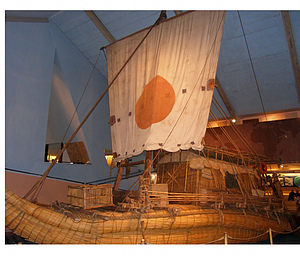
Ra II
Formula:
Mn2+Mn2+2Na2(◻1.75Ti0.25)Si8O20(OH)2(H2O)4 · Na(H2O)6
Colour:
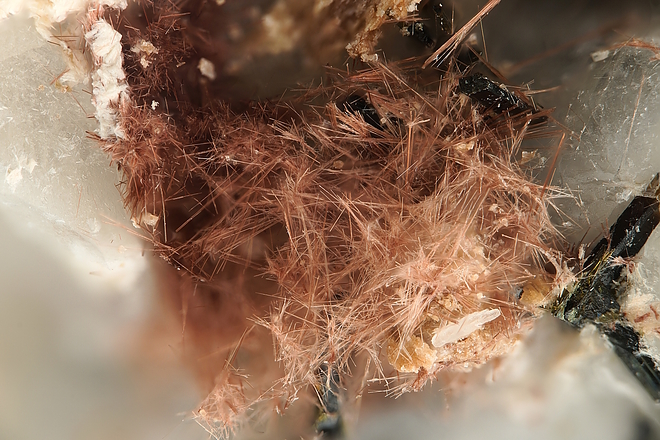
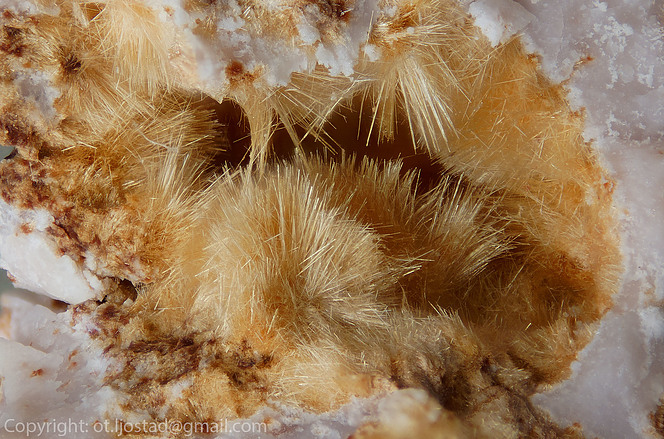
Pale brown to golden-yellow, reddish brown, tan, rose, lavender, bronze
Lustre:
Vitreous, Silky
Hardness:
3
Specific Gravity:
2.32 - 2.39
Crystal System:
Orthorhombic
Member of:
Name:
Named after the international group of scientists on the 1969-1970 voyage of the papyrus ship, Ra.
Structurally related to tuperssuatsiaite and windhoekite. May be polymorphous with UM1990-92-SiO:FeHMnNaTi.
Unique Identifiers
Mindat ID:
3352
Long-form identifier:
mindat:1:1:3352:3
IMA Classification of Raite
Approved
IMA Formula:
Na3Mn2+3Ti0.25(Si8O20)(OH)2 · 10H2O
First published:
1973
Classification of Raite
9.EE.55
9 : SILICATES (Germanates)
E : Phyllosilicates
E : Single tetrahedral nets of 6-membered rings connected by octahedral nets or octahedral bands
9 : SILICATES (Germanates)
E : Phyllosilicates
E : Single tetrahedral nets of 6-membered rings connected by octahedral nets or octahedral bands
78.5.8.1
78 : Unclassified Silicates
5 :
78 : Unclassified Silicates
5 :
14.18.30
14 : Silicates not Containing Aluminum
18 : Silicates of Mn and Na, K, Mg, Ca or Fe
14 : Silicates not Containing Aluminum
18 : Silicates of Mn and Na, K, Mg, Ca or Fe
Mineral Symbols
As of 2021 there are now IMA–CNMNC approved mineral symbols (abbreviations) for each mineral species, useful for tables and diagrams.
Please only use the official IMA–CNMNC symbol. Older variants are listed for historical use only.
Please only use the official IMA–CNMNC symbol. Older variants are listed for historical use only.
| Symbol | Source | Reference |
|---|---|---|
| Rai | IMA–CNMNC | Warr, L.N. (2021). IMA–CNMNC approved mineral symbols. Mineralogical Magazine, 85(3), 291-320. doi:10.1180/mgm.2021.43 |
| Rai | Warr (2020) | Warr, L.N. (2020) Recommended abbreviations for the names of clay minerals and associated phases. Clay Minerals, 55, 261–264 doi:10.1180/clm.2020.30 |
Physical Properties of Raite
Vitreous, Silky
Transparency:
Transparent
Colour:
Pale brown to golden-yellow, reddish brown, tan, rose, lavender, bronze
Streak:
Yellow
Hardness:
3 on Mohs scale
Tenacity:
Brittle
Cleavage:
Perfect
on {100} {010} {001}
on {100} {010} {001}
Density:
2.32 - 2.39 g/cm3 (Measured) 2.51 g/cm3 (Calculated)
Optical Data of Raite
Type:
Biaxial (+)
RI values:
nα = 1.540(2) nβ = 1.542(2) nγ = 1.550(2)
2V:
Measured: 53° , Calculated: 54°
Max. Birefringence:
δ = 0.010
Based on recorded range of RI values above.
Based on recorded range of RI values above.
Interference Colours:
The colours simulate birefringence patterns seen in thin section under crossed polars. They do not take into account mineral colouration or opacity.
Michel-Levy Bar The default colours simulate the birefringence range for a 30 µm thin-section thickness. Adjust the slider to simulate a different thickness.
Grain Simulation You can rotate the grain simulation to show how this range might look as you rotated a sample under crossed polars.
The colours simulate birefringence patterns seen in thin section under crossed polars. They do not take into account mineral colouration or opacity.
Michel-Levy Bar The default colours simulate the birefringence range for a 30 µm thin-section thickness. Adjust the slider to simulate a different thickness.
Grain Simulation You can rotate the grain simulation to show how this range might look as you rotated a sample under crossed polars.
Surface Relief:
Moderate
Dispersion:
weak
Optical Extinction:
Z ∧ c = 0-30°.
Pleochroism:
Visible
Comments:
X = nearly colorless; Y = yellowish; Z = golden brown.
Chemistry of Raite
Mindat Formula:
Mn2+Mn2+2Na2(◻1.75Ti0.25)Si8O20(OH)2(H2O)4 · Na(H2O)6
Element Weights:
Common Impurities:
Ca,Ti,Fe,Zr,Al,Nb,Ta,Mg,K,C
Crystallography of Raite
Crystal System:
Orthorhombic
Class (H-M):
2 2 2 - Disphenoidal
Space Group:
C2 2 2
Cell Parameters:
a = 30.6 Å, b = 5.31 Å, c = 18.2 Å
Ratio:
a:b:c = 5.763 : 1 : 3.427
Unit Cell V:
2,957.25 ų (Calculated from Unit Cell)
Z:
4
Morphology:
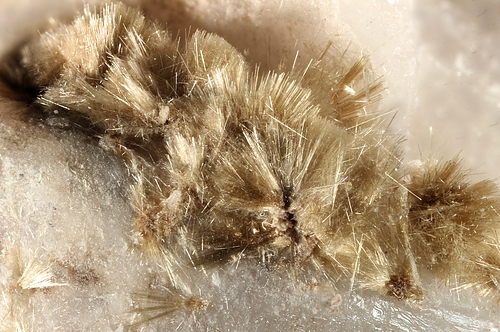
Acicular in radiating masses
X-Ray Powder Diffraction
Powder Diffraction Data:
| d-spacing | Intensity |
|---|---|
| 11.4 Å | (100) |
| 4.5 Å | (80) |
| 3.8 Å | (60b) |
| 2.939 Å | (100) |
| 2.650 Å | (100) |
| 2.482 Å | (60) |
| 1.640 Å | (60) |
| 1.575 Å | (60) |
Geological Environment
Paragenetic Mode(s):
| Paragenetic Mode | Earliest Age (Ga) |
|---|---|
| Stage 4b: Highly evolved igneous rocks | >3.0 |
| 35 : Ultra-alkali and agpaitic igneous rocks | |
| Stage 7: Great Oxidation Event | <2.4 |
| 47a : [Near-surface hydration of prior minerals] |
Geological Setting:
Nepheline rocks
Type Occurrence of Raite
General Appearance of Type Material:
Acicular crystals 1-2 mm long, 0.02-0.04 mm thick.
Place of Conservation of Type Material:
Institute of Geology, Kola Science Center, Apatity, Russia, numbers 3206, 3271 (type).
Mining Museum, St. Petersburg, Russia, number 1060/1-4 (type).
Fersman Mineralogical Museum, Moscow, Russia, number 74489 (type).
St. Petersburg State University, Department of Geology, St. Petersburg, Russia, number 19047 (type).
Mining Museum, St. Petersburg, Russia, number 1060/1-4 (type).
Fersman Mineralogical Museum, Moscow, Russia, number 74489 (type).
St. Petersburg State University, Department of Geology, St. Petersburg, Russia, number 19047 (type).
Geological Setting of Type Material:
Alkalic pegmatite on walls of fractures and cavities filled by nepheline.
Associated Minerals at Type Locality:
Synonyms of Raite
Other Language Names for Raite
Relationship of Raite to other Species
Member of:
Other Members of Palygorskite Group:
| Ikorskyite | KMn3+(Si4O10) · 3H2O | Mon. 2/m : P21/b |
| Palygorskite | ◻Al2Mg2◻2Si8O20(OH)2(H2O)4 · 4H2O | Mon. 2/m : B2/m |
| Tuperssuatsiaite | Fe3+Fe3+2(Na◻)◻2Si8O20(OH)2(H2O)4 · 2H2O | Mon. 2/m : B2/m |
| Unnamed (Na-Ca-Fe-Silicate-Hydrate) | NaCa(Fe2+,Al,Mn)5[Si8O19(OH)](OH)7 · 5H2O | Tric. 1 : P1 |
| Windhoekite | Fe3+(Fe3+1.67◻0.33)Ca2◻2Si8O20(OH)2(H2O)4(OH)2 · 6H2O | Mon. 2/m : B2/m |
| Windmountainite | ◻Fe3+2Mg2◻2Si8O20(OH)2(H2O)4 · 4H2O | Mon. 2/m : B2/m |
| Yofortierite | Mn2+Mn2+2Mn2+2◻2Si8O20(OH)2(H2O)4 · 4H2O | Mon. 2/m : B2/m |
Common Associates
Associated Minerals Based on Photo Data:
| 27 photos of Raite associated with Zorite | Na8(Ti,Nb)5(Si6O17)2(OH,O)5 · 14H2O |
| 21 photos of Raite associated with Aegirine | NaFe3+Si2O6 |
| 13 photos of Raite associated with Natrolite | Na2Al2Si3O10 · 2H2O |
| 13 photos of Raite associated with Epistolite | (Na◻)Nb2Na3Ti(Si2O7)2O2(OH)2(H2O)4 |
| 13 photos of Raite associated with Hydroterskite | Na2ZrSi6O12(OH)6 |
| 13 photos of Raite associated with Serandite | NaMn2+2Si3O8(OH) |
| 12 photos of Raite associated with Terskite | Na4ZrSi6O16 · 2H2O |
| 10 photos of Raite associated with Gmelinite-Na | Na4(Si8Al4)O24 · 11H2O |
| 9 photos of Raite associated with Leucosphenite | BaNa4Ti2B2Si10O30 |
| 8 photos of Raite associated with Penkvilksite | Na4Ti2Si8O22 · 4H2O |
Related Minerals - Strunz-mindat Grouping
| 9.EE. | Cairncrossite | Sr2Ca7-xNa2x(Si4O10)4(OH)2(H2O)15-x |
| 9.EE.05 | Bementite | Mn7Si6O15(OH)8 |
| 9.EE.07 | Innsbruckite | Mn33(Si2O5)14(OH)38 |
| 9.EE.10 | Brokenhillite | Mn8Si6O15(OH)10 |
| 9.EE.10 | Mcgillite | (Mn,Fe)8Si6O15(OH)8Cl2 |
| 9.EE.10 | Friedelite | Mn2+8Si6O15(OH,Cl)10 |
| 9.EE.10 | Pyrosmalite-(Mn) | Mn2+8Si6O15(OH,Cl)10 |
| 9.EE.10 | Pyrosmalite-(Fe) | Fe2+8Si6O15(OH,Cl)10 |
| 9.EE.15 | Nelenite | (Mn,Fe)16(Si12O30)(OH)14[As3+3O6(OH)3] |
| 9.EE.15 | Schallerite | Mn2+16As3Si12O36(OH)17 |
| 9.EE.20 | Palygorskite | ◻Al2Mg2◻2Si8O20(OH)2(H2O)4 · 4H2O |
| 9.EE.20 | Yofortierite | Mn2+Mn2+2Mn2+2◻2Si8O20(OH)2(H2O)4 · 4H2O |
| 9.EE.20 | Windhoekite | Fe3+(Fe3+1.67◻0.33)Ca2◻2Si8O20(OH)2(H2O)4(OH)2 · 6H2O |
| 9.EE.20 | Windmountainite | ◻Fe3+2Mg2◻2Si8O20(OH)2(H2O)4 · 4H2O |
| 9.EE.20 | Ikorskyite | KMn3+(Si4O10) · 3H2O |
| 9.EE.20 | Tuperssuatsiaite | Fe3+Fe3+2(Na◻)◻2Si8O20(OH)2(H2O)4 · 2H2O |
| 9.EE.20 | Unnamed (Na-Ca-Fe-Silicate-Hydrate) | NaCa(Fe2+,Al,Mn)5[Si8O19(OH)](OH)7 · 5H2O |
| 9.EE.25 | Sepiolite | Mg4(Si6O15)(OH)2 · 6H2O |
| 9.EE.25 | Loughlinite | Na2Mg3Si6O16 · 8H2O |
| 9.EE.25 | Falcondoite | (Ni,Mg)4Si6O15(OH)2 · 6H2O |
| 9.EE.25 | Kalifersite | (K,Na)5Fe3+7Si20O50(OH)6 · 12H2O |
| 9.EE.30 | Orlymanite | Ca4Mn3Si8O20(OH)6 · 2H2O |
| 9.EE.30 | Tungusite | Ca4Fe2Si6O15(OH)6 |
| 9.EE.30 | Gyrolite | NaCa16Si23AlO60(OH)8 · 14H2O |
| 9.EE.35 | Reyerite | (Na,K)2Ca14(Si,Al)24O58(OH)8 · 6H2O |
| 9.EE.35 | Kodamaite | Na3(Ca5Na)Si16O36(OH)4F2 · (14-x)H2O |
| 9.EE.35 | Truscottite | (Ca,Mn)14Si24O58(OH)8 · 2H2O |
| 9.EE.40 | Natrosilite | Na2Si2O5 |
| 9.EE.45 | Makatite | Na2Si4O8(OH)2 · 4H2O |
| 9.EE.50 | Varennesite | Na8Mn2Si10O25(OH,Cl)2 · 12H2O |
| 9.EE.60 | Intersilite | Na6Mn2+Ti[Si10O24(OH)](OH)3 · 4H2O |
| 9.EE.65 | Zakharovite | Na4Mn5Si10O24(OH)6 · 6H2O |
| 9.EE.65 | Shafranovskite | Na3K2(Mn,Fe,Na)4[Si9(O,OH)27](OH)2 · nH2O |
| 9.EE.70 | Zeophyllite | Ca13Si10O28(OH)2F8 · 6H2O |
| 9.EE.75 | Minehillite | (K,Na)2-3Ca28Zn4Al4Si40O112(OH)16 |
| 9.EE.80 | Fedorite | (Na,K)2-3(Ca4Na3)Si16O38(OH,F)2 · 3.5H2O |
| 9.EE.80 | Martinite | (Na,◻,Ca)12Ca4(Si,S,B)14B2O38(OH,Cl)2F2 · 4H2O |
| 9.EE.80 | Ellingsenite | Na5Ca6Si18O38(OH)13 · 6H2O |
| 9.EE.85 | Lalondeite | (Na,Ca)6(Ca,Na)3Si16O38(F,OH)2 · 3H2O |
Other Information
Thermal Behaviour:
Before the blowpipe sinters to a gray, bubbly mass, melts at 745° to a gray-brown glass with n = 1.623.
The mineral loses 11.9% to 160°, 13.4% to 300°, 15.5% to 340°. The DTA curve shows an endothermic effect at 160°, and a slight exothermic effect at 700°.
The mineral loses 11.9% to 160°, 13.4% to 300°, 15.5% to 340°. The DTA curve shows an endothermic effect at 160°, and a slight exothermic effect at 700°.
Notes:
Insoluble in H2O. Slowly decomposed by dilute HCl or HNO3 giving skeletal silica.
Health Risks:
No information on health risks for this material has been entered into the database. You should always treat mineral specimens with care.
Internet Links for Raite
mindat.org URL:
https://www.mindat.org/min-3352.html
Please feel free to link to this page.
Please feel free to link to this page.
Search Engines:
External Links:
References for Raite
Reference List:
Pluth, J. J., Smith, J. V., Pushcharovsky, D. Y., Semenov, E. I., Bram, A., Riekel, C., Weber, H.-P., Broach, R. W. (1997) Third-generation synchrotron x-ray diffraction of 6- m crystal of raite, Na3Mn3Ti0.25Si8O20(OH)2*10H2O, opens up new chemistry and physics of low-temperature minerals. Proceedings of the National Academy of Sciences, 94 (23) 12263-12267 doi:10.1073/pnas.94.23.12263
Localities for Raite
 symbol to view information about a locality.
The
symbol to view information about a locality.
The Locality List
 - This locality has map coordinates listed.
- This locality has estimated coordinates.
ⓘ - Click for references and further information on this occurrence.
? - Indicates mineral may be doubtful at this locality.
- This locality has map coordinates listed.
- This locality has estimated coordinates.
ⓘ - Click for references and further information on this occurrence.
? - Indicates mineral may be doubtful at this locality.
 - Good crystals or important locality for species.
 - World class for species or very significant.
(TL) - Type Locality for a valid mineral species.
(FRL) - First Recorded Locality for everything else (eg varieties).
- World class for species or very significant.
(TL) - Type Locality for a valid mineral species.
(FRL) - First Recorded Locality for everything else (eg varieties).
All localities listed without proper references should be considered as questionable.
Canada | |
| Grice (1989) +1 other reference |
| Horváth collection XRD & WDS confirmed |
Russia | |
| Ivanov et al. (2020, July) |
| Yakovenchuk et al. (2005) | |
| Pavel.M. Kartashov (n.d.) |
| Kasatkin (2019) |
| Mer'kov et al. (1973) +4 other references |
Quick NavTopAbout RaiteUnique IdentifiersIMA Classification Classification Mineral SymbolsPhysical Properties Optical Data Chemistry Crystallography X-Ray Powder DiffractionGeological EnvironmentType Occurrence SynonymsOther LanguagesRelationshipsCommon AssociatesStrunz-MindatOther InformationInternet Links References Localities Locality List
Yubileinaya pegmatite, Karnasurt Mountain, Lovozersky District, Murmansk Oblast, Russia