Phoenicochroite
A valid IMA mineral species - grandfathered
This page is currently not sponsored. Click here to sponsor this page.

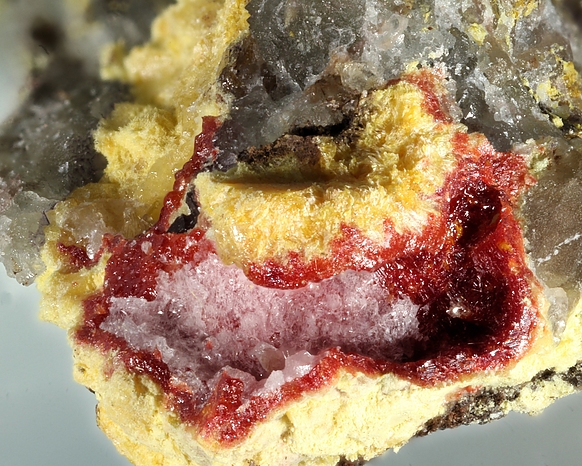
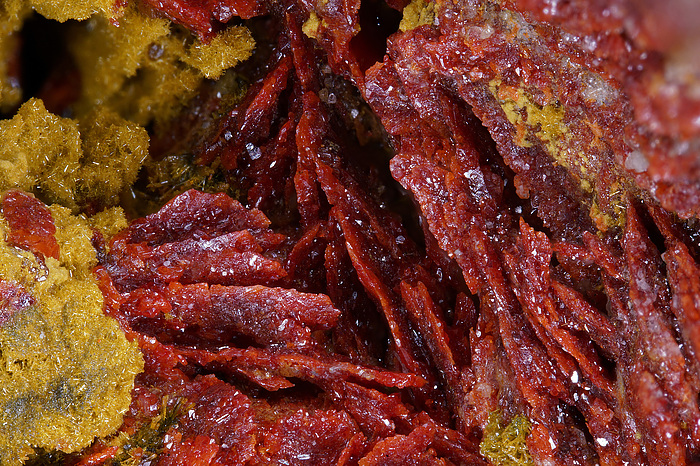
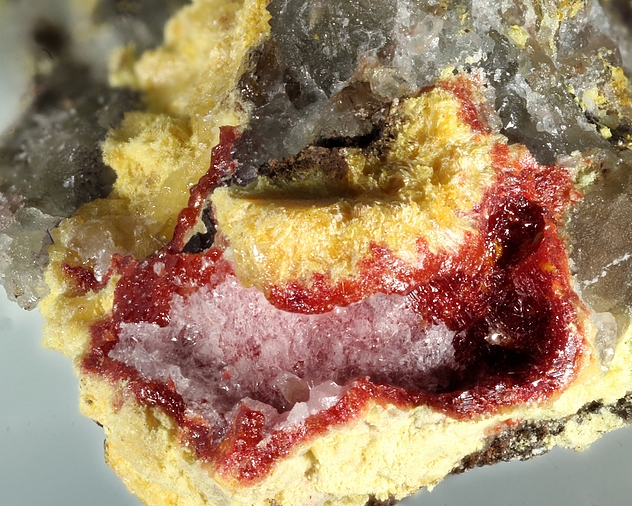
About Phoenicochroite
Formula:
Pb2(CrO4)O
Colour:
Dark red, bright red
Lustre:
Adamantine, Resinous
Hardness:
2½ - 3½
Specific Gravity:
7.01
Crystal System:
Monoclinic
Name:
From the Greek φοίυικος for "deep red" and χρόα for "colour," in allusion to its colour.
Type Locality:
Isostructural with:
This page provides mineralogical data about Phoenicochroite.
Unique Identifiers
Mindat ID:
3194
Long-form identifier:
mindat:1:1:3194:9
IMA Classification of Phoenicochroite
Approved, 'Grandfathered' (first described prior to 1959)
IMA Formula:
Pb2O(CrO4)
Approval year:
1980
Classification of Phoenicochroite
7.FB.05
7 : SULFATES (selenates, tellurates, chromates, molybdates, wolframates)
F : Chromates
B : With additional O,V, S, Cl
7 : SULFATES (selenates, tellurates, chromates, molybdates, wolframates)
F : Chromates
B : With additional O,V, S, Cl
Dana 7th ed.:
35.1.2.1
35.1.2.1
35 : ANHYDROUS CHROMATES
1 : A2XO4
35 : ANHYDROUS CHROMATES
1 : A2XO4
27.2.6
27 : Sulphites, Chromates, Molybdates and Tungstates
2 : Chromates
27 : Sulphites, Chromates, Molybdates and Tungstates
2 : Chromates
Mineral Symbols
As of 2021 there are now IMA–CNMNC approved mineral symbols (abbreviations) for each mineral species, useful for tables and diagrams.
| Symbol | Source | Reference |
|---|---|---|
| Phc | IMA–CNMNC | Warr, L.N. (2021). IMA–CNMNC approved mineral symbols. Mineralogical Magazine, 85(3), 291-320. doi:10.1180/mgm.2021.43 |
Physical Properties of Phoenicochroite
Adamantine, Resinous
Transparency:
Translucent
Comment:
Glimmering
Colour:
Dark red, bright red
Comment:
Turns lemon-yellow on exposure.
Streak:
Brick-red to yellowish orange
Hardness:
2½ - 3½ on Mohs scale
Tenacity:
Sectile
Cleavage:
Perfect
Perfect on {201}; poor on {001}, {010}, {011}.
Perfect on {201}; poor on {001}, {010}, {011}.
Density:
7.01 g/cm3 (Measured) 7.075 g/cm3 (Calculated)
Optical Data of Phoenicochroite
Type:
Biaxial (+)
RI values:
nα = 2.34 - 2.38 nβ = 2.38 - 2.44 nγ = 2.65
2V:
Measured: 58° , Calculated: 60°
Max. Birefringence:
δ = 0.270 - 0.310
Based on recorded range of RI values above.
Based on recorded range of RI values above.
Interference Colours:
The colours simulate birefringence patterns seen in thin section under crossed polars. They do not take into account mineral colouration or opacity.
Michel-Levy Bar The default colours simulate the birefringence range for a 30 µm thin-section thickness. Adjust the slider to simulate a different thickness.
Grain Simulation You can rotate the grain simulation to show how this range might look as you rotated a sample under crossed polars.
The colours simulate birefringence patterns seen in thin section under crossed polars. They do not take into account mineral colouration or opacity.
Michel-Levy Bar The default colours simulate the birefringence range for a 30 µm thin-section thickness. Adjust the slider to simulate a different thickness.
Grain Simulation You can rotate the grain simulation to show how this range might look as you rotated a sample under crossed polars.
Surface Relief:
Moderate
Dispersion:
r > v, moderately strong to strong
Optical Extinction:
X = b; Y ∧ c = –2°; Z ∧ c = 88°.
Pleochroism:
Weak
Comments:
Absorption: X < Y < Z.
Chemistry of Phoenicochroite
Mindat Formula:
Pb2(CrO4)O
Element Weights:
Elements listed:
Crystallography of Phoenicochroite
Crystal System:
Monoclinic
Class (H-M):
2/m - Prismatic
Space Group:
B2/m
Setting:
C2/m
Cell Parameters:
a = 14.001(7) Å, b = 5.675(3) Å, c = 7.137(5) Å
β = 115.22°
β = 115.22°
Ratio:
a:b:c = 2.467 : 1 : 1.258
Unit Cell V:
513.02 ų (Calculated from Unit Cell)
Z:
4
Morphology:
Crystals tabular and imperfect, often reticularly intergrown. Massive; thin coatings.
Tabular on {100} or {201}, elongated along [010] or [001], showing {010}, {100}, {110}, {201}, {211}, {310}.
Tabular on {100} or {201}, elongated along [010] or [001], showing {010}, {100}, {110}, {201}, {211}, {310}.
Crystal Structure
Load
Unit Cell | Unit Cell Packed
2x2x2 | 3x3x3 | 4x4x4
Unit Cell | Unit Cell Packed
2x2x2 | 3x3x3 | 4x4x4
Show
Big Balls | Small Balls | Just Balls | Spacefill
Polyhedra Off | Si Polyhedra | All Polyhedra
Remove metal-metal sticks
Big Balls | Small Balls | Just Balls | Spacefill
Polyhedra Off | Si Polyhedra | All Polyhedra
Remove metal-metal sticks
Display Options
Black Background | White Background
Perspective On | Perspective Off
2D | Stereo | Red-Blue | Red-Cyan
Black Background | White Background
Perspective On | Perspective Off
2D | Stereo | Red-Blue | Red-Cyan
View
CIF File Best | x | y | z | a | b | c
CIF File Best | x | y | z | a | b | c
Rotation
Stop | Start
Stop | Start
Labels
Console Off | On | Grey | Yellow
Console Off | On | Grey | Yellow
Data courtesy of the American Mineralogist Crystal Structure Database. Click on an AMCSD ID to view structure
| ID | Species | Reference | Link | Year | Locality | Pressure (GPa) | Temp (K) |
|---|---|---|---|---|---|---|---|
| 0000204 | Phoenicochroite | Williams S A, McLean W J, Anthony J W (1970) A study of phoenicochroite - its structure and properties American Mineralogist 55 784-792 |  | 1970 | 0 | 293 |
CIF Raw Data - click here to close
X-Ray Powder Diffraction
Powder Diffraction Data:
| d-spacing | Intensity |
|---|---|
| 3.39 Å | (100) |
| 2.989 Å | (100) |
| 3.60 Å | (70) |
| 6.40 Å | (40) |
| 3.26 Å | (40) |
| 4.42 Å | (30) |
| 2.840 Å | (30) |
Geological Environment
Paragenetic Mode(s):
| Paragenetic Mode | Earliest Age (Ga) |
|---|---|
| Stage 7: Great Oxidation Event | <2.4 |
| 45b : [Other oxidized fumarolic minerals] | |
| 47h : [Near-surface oxidized, dehydrated minerals] |
Type Occurrence of Phoenicochroite
Associated Minerals at Type Locality:
Synonyms of Phoenicochroite
Other Language Names for Phoenicochroite
Varieties of Phoenicochroite
| Berezovite | Discredited - shown to be altered phoenicochroite by S.A. Williams (1974). |
Common Associates
Associated Minerals Based on Photo Data:
| 38 photos of Phoenicochroite associated with Hemihedrite | Pb10Zn(CrO4)6(SiO4)2(OH)2 |
| 29 photos of Phoenicochroite associated with Schwartzembergite | Pb5H2(IO2)O4Cl3 |
| 26 photos of Phoenicochroite associated with Wulfenite | Pb(MoO4) |
| 15 photos of Phoenicochroite associated with Mimetite | Pb5(AsO4)3Cl |
| 14 photos of Phoenicochroite associated with Seeligerite | Pb3(IO3)OCl3 |
| 14 photos of Phoenicochroite associated with Pyromorphite | Pb5(PO4)3Cl |
| 12 photos of Phoenicochroite associated with Iranite | Pb10Cu(CrO4)6(SiO4)2(OH)2 |
| 8 photos of Phoenicochroite associated with Crocoite | PbCr6+O4 |
| 8 photos of Phoenicochroite associated with Vauquelinite | Pb2Cu(CrO4)(PO4)(OH) |
| 6 photos of Phoenicochroite associated with Wickenburgite | CaPb3Al2Si10O24(OH)6 |
Related Minerals - Strunz-mindat Grouping
| 7.FB.05 | Georgerobinsonite | Pb4(CrO4)2(OH)2FCl |
| 7.FB.10 | Santanaite | Pb11(CrO4)O12 |
| 7.FB.15 | Wattersite | [Hg2]2+2Hg2+[CrO4]O2 |
| 7.FB.20 | Deanesmithite | [Hg2]2+Hg2+3[CrO4]S2O |
| 7.FB.25 | Edoylerite | Hg2+3(CrO4)S2 |
| 7.FB.30 | Reynoldsite | Pb2Mn4+2O5(CrO4) |
Other Information
Notes:
Soluble in HCl with separation of lead chloride.
Health Risks:
Chromate minerals contain the carcinogenic and mutagenic chromate ion. Always wash hands after handling. Avoid inhaling dust when handling or breaking. Never lick or ingest. Do not pour chromate-containing solutions down the drain.
Internet Links for Phoenicochroite
mindat.org URL:
https://www.mindat.org/min-3194.html
Please feel free to link to this page.
Please feel free to link to this page.
Search Engines:
External Links:
References for Phoenicochroite
Reference List:
Hermann, R. (1833) Ueber den Melanochroït, ein neues Mineral. Annalen der Physik und Chemie, 104. 162-164 doi:10.1002/andp.18331040516(as Melanochroit)
Larsen, Esper S. (1921) The microscopic determination of the nonopaque minerals. Bulletin 679. US Geological Survey doi:10.3133/b679 p.119
Williams, Sidney A., McLean, W. John, Anthony, John W. (1970) A study of phoenicochroite - its structure and properties. American Mineralogist, 55 (5-6) 784-792
Cesbron, Fabien, Williams, Sydney A. (1980) Iranite˗hémihédrite, bellite, phoenicochroite, vauquelinite et fornacite : synthèse et nouvelles données. Bulletin de Minéralogie, 103 (5) 469-477 doi:10.3406/bulmi.1980.7409
Localities for Phoenicochroite
 symbol to view information about a locality.
The
symbol to view information about a locality.
The Locality List
 - This locality has map coordinates listed.
- This locality has estimated coordinates.
ⓘ - Click for references and further information on this occurrence.
? - Indicates mineral may be doubtful at this locality.
- This locality has map coordinates listed.
- This locality has estimated coordinates.
ⓘ - Click for references and further information on this occurrence.
? - Indicates mineral may be doubtful at this locality.
 - Good crystals or important locality for species.
 - World class for species or very significant.
(TL) - Type Locality for a valid mineral species.
(FRL) - First Recorded Locality for everything else (eg varieties).
- World class for species or very significant.
(TL) - Type Locality for a valid mineral species.
(FRL) - First Recorded Locality for everything else (eg varieties).
All localities listed without proper references should be considered as questionable.
Austria | |
| Kolitsch (2013) |
Chile | |
| Samples analysed by Dr. Jochen Schlüter (Hamburg University) |
| "Yacimientos Metalíferos de Chile" +1 other reference | |
| In the collections of Brent Thorne |
| Mücke (1972) | |
| Samples analysed by Dr. Jochen Schlüter (Hamburg University) | |
| "Yacimientos Metalíferos de Chile" +1 other reference |
| Maurizio Dini collection |
| T. Kampf analysis |
| M.Dini & A.Molina collection |
Germany | |
| Gerhard Möhn collection |
| Leonhardt et al. (1991) |
Iran | |
| Adib et al. (1970) |
| Bariand et al. (1980) |
Italy | |
| Russo M. et al. (2014) |
| Demartin et al. (2014) +1 other reference |
| Demartin et al. (2014) +1 other reference | |
Namibia | |
| von Bezing (2007) |
Russia | |
| Pekov et al. (2025) |
| Palache et al. (1951) +2 other references |
South Africa | |
| Cairncross et al. (1995) |
| SAMS (South African Micromount Society) |
| SAMS (South African Micromount Society) | |
UK | |
| Temple (1955) +1 other reference |
USA | |
| Raman analyzed at the University of ... |
| |
| C. Lemanski |
| Galbraith (1959) | |
| Anthony et al. (1995) | |
| Michael D. Cline collection (Raman-analysed) |
| Williams (1968) +3 other references |
| collected by and in the collection of ... |
| Collected in the presence of & verified ... |
| Ron Layton | |
| Minerals identified by the mine owners (2024) |
| Silliman (1881) +2 other references | |
| Williams (1968) +3 other references | |
| Galbraith (1959) +1 other reference |
| |
| Williams et al. (1970) +1 other reference |
| Anthony et al. (1995) |
| MarekC collection 2016 |
| Castor et al. (2004) |
| Castor et al. (2004) |
| Robert E.Walstrom Collection +1 other reference | |
| Castor et al. (2004) |
Quick NavTopAbout PhoenicochroiteUnique IdentifiersIMA Classification Classification Mineral SymbolsPhysical Properties Optical Data Chemistry Crystallography Crystal StructureX-Ray Powder DiffractionGeological EnvironmentType Occurrence SynonymsOther LanguagesVarietiesCommon AssociatesStrunz-MindatOther InformationInternet Links References Localities Locality List
Unión Minera mine, Caracoles, Caracoles mining district, Sierra Gorda, Antofagasta Province, Antofagasta, Chile