Haycockite
A valid IMA mineral species
This page is currently not sponsored. Click here to sponsor this page.


About Haycockite
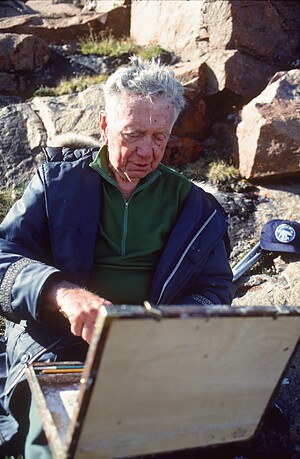
Maurice H. Haycock
Formula:
Cu4Fe5S8
Colour:
Brass yellow
Hardness:
4½
Specific Gravity:
4.33 (Calculated)
Crystal System:
Orthorhombic
Member of:
Name:
Named in honor of Maurice Hall Haycock (1 September 1900, Wolfville, Nova Scotia, Canada - 23 December 1988, Ottawa, Ontario, Canada), mineralogist and former head of the Mineralogy Section, Department of Energy, Mines and Resources, Ottawa, Ontario. Haycock gave a brief description of the mineral, in an unpublished report, as a graduate student at Princeton in 1931.
This page provides mineralogical data about Haycockite.
Unique Identifiers
Mindat ID:
1837
Long-form identifier:
mindat:1:1:1837:7
IMA Classification of Haycockite
Approved
Approval year:
1971
First published:
1972
Classification of Haycockite
2.CB.10b
2 : SULFIDES and SULFOSALTS (sulfides, selenides, tellurides; arsenides, antimonides, bismuthides; sulfarsenites, sulfantimonites, sulfbismuthites, etc.)
C : Metal Sulfides, M: S = 1: 1 (and similar)
B : With Zn, Fe, Cu, Ag, etc.
2 : SULFIDES and SULFOSALTS (sulfides, selenides, tellurides; arsenides, antimonides, bismuthides; sulfarsenites, sulfantimonites, sulfbismuthites, etc.)
C : Metal Sulfides, M: S = 1: 1 (and similar)
B : With Zn, Fe, Cu, Ag, etc.
2.9.8.2
2 : SULFIDES
9 : AmBnXp, with (m+n):p = 1:1
2 : SULFIDES
9 : AmBnXp, with (m+n):p = 1:1
3.1.27
3 : Sulphides, Selenides, Tellurides, Arsenides and Bismuthides (except the arsenides, antimonides and bismuthides of Cu, Ag and Au, which are included in Section 1)
1 : Sulphides etc. of Cu
3 : Sulphides, Selenides, Tellurides, Arsenides and Bismuthides (except the arsenides, antimonides and bismuthides of Cu, Ag and Au, which are included in Section 1)
1 : Sulphides etc. of Cu
Mineral Symbols
As of 2021 there are now IMA–CNMNC approved mineral symbols (abbreviations) for each mineral species, useful for tables and diagrams.
| Symbol | Source | Reference |
|---|---|---|
| Hyc | IMA–CNMNC | Warr, L.N. (2021). IMA–CNMNC approved mineral symbols. Mineralogical Magazine, 85(3), 291-320. doi:10.1180/mgm.2021.43 |
Pronunciation of Haycockite
Pronunciation:
| Play | Recorded by | Country |
|---|---|---|
| Jolyon Ralph | United Kingdom |
Physical Properties of Haycockite
Transparency:
Opaque
Colour:
Brass yellow
Comment:
Does not easily tarnish
Streak:
Black
Hardness:
4½ on Mohs scale
Hardness:
VHN100=206 - 231 kg/mm2 - Vickers
Density:
4.33 g/cm3 (Calculated)
Optical Data of Haycockite
Anisotropism:
Weak to moderate
Reflectivity:
| Wavelength | R1 (%) | R2 (%) |
|---|---|---|
| 400nm | 13.9% | 13.5% |
| 440nm | 18.3% | 19.4% |
| 480nm | 25.1% | 26.8% |
| 520nm | 31.0% | 32.5% |
| 560nm | 35.1% | 36.1% |
| 600nm | 37.8% | 38.3% |
| 640nm | 39.2% | 39.4% |
| 680nm | 39.8% | 39.7% |
| 700nm | 40.0% | 39.8% |
Graph shows reflectance levels at different wavelengths (in nm). Peak reflectance is 40.0%.
R1 shown in black, R2 shown in red
Colour in reflected light:
Brass-yellow, Similar to chalcopyrite
Chemistry of Haycockite
Mindat Formula:
Cu4Fe5S8
Element Weights:
Elements listed:
Common Impurities:
Ni
Crystallography of Haycockite
Crystal System:
Orthorhombic
Class (H-M):
2 2 2 - Disphenoidal
Cell Parameters:
a = 10.705(5) Å, b = 10.734(5) Å, c = 31.630(15) Å
Ratio:
a:b:c = 0.997 : 1 : 2.947
Unit Cell V:
3,634.52 ų (Calculated from Unit Cell)
Z:
12
Morphology:
Grains to 500 microns
Twinning:
On {103} polysynthetic
Comment:
Space Group: P222, P2221, P21212, or P212121.
Crystal Structure
Load
Unit Cell | Unit Cell Packed
2x2x2 | 3x3x3 | 4x4x4
Unit Cell | Unit Cell Packed
2x2x2 | 3x3x3 | 4x4x4
Show
Big Balls | Small Balls | Just Balls | Spacefill
Polyhedra Off | Si Polyhedra | All Polyhedra
Remove metal-metal sticks
Big Balls | Small Balls | Just Balls | Spacefill
Polyhedra Off | Si Polyhedra | All Polyhedra
Remove metal-metal sticks
Display Options
Black Background | White Background
Perspective On | Perspective Off
2D | Stereo | Red-Blue | Red-Cyan
Black Background | White Background
Perspective On | Perspective Off
2D | Stereo | Red-Blue | Red-Cyan
View
CIF File Best | x | y | z | a | b | c
CIF File Best | x | y | z | a | b | c
Rotation
Stop | Start
Stop | Start
Labels
Console Off | On | Grey | Yellow
Console Off | On | Grey | Yellow
Data courtesy of the American Mineralogist Crystal Structure Database. Click on an AMCSD ID to view structure
| ID | Species | Reference | Link | Year | Locality | Pressure (GPa) | Temp (K) |
|---|---|---|---|---|---|---|---|
| 0009539 | Haycockite | Rowland J F, Hall S R (1975) Haycockite, Cu4Fe5S8: a superstructure in the chalcopyrite series Acta Crystallographica B31 2105-2112 |  | 1975 | Lydenburg District, Transvaal, South Africa | 0 | 293 |
CIF Raw Data - click here to close
X-Ray Powder Diffraction
Powder Diffraction Data:
| d-spacing | Intensity |
|---|---|
| 3.07 Å | (100) |
| 1.876 Å | (80) |
| 1.889 Å | (60) |
| 1.612 Å | (60) |
| 1.089 Å | (60) |
| 0.937 Å | (60) |
| 1.214 Å | (50) |
Geological Environment
Paragenetic Mode(s):
| Paragenetic Mode | Earliest Age (Ga) |
|---|---|
| Stage 3b: Earth’s earliest hydrosphere | >4.45 |
| 15 : Black/white smoker minerals and other seafloor hydrothermal minerals | |
| High-? alteration and/or metamorphism | |
| 33 : Minerals deposited by hydrothermal metal-rich fluids (see also [#12]) | |
| Stage 4b: Highly evolved igneous rocks | >3.0 |
| 37 : Layered igneous intrusions and related PGE minerals |
Type Occurrence of Haycockite
General Appearance of Type Material:
Massive, to 0.5 mm.
Place of Conservation of Type Material:
National Mineral Collection (10397), Ottawa, Ontario, Canada.
Royal Ontario Museum (M30992), Toronto, Ontario, Canada.
Princeton University, Princeton, N.J., USA.
Smithsonian Institution, Washington, D.C., USA.
Heidelberg University (No. 2313a), Tiffi
Royal Ontario Museum (M30992), Toronto, Ontario, Canada.
Princeton University, Princeton, N.J., USA.
Smithsonian Institution, Washington, D.C., USA.
Heidelberg University (No. 2313a), Tiffi
Geological Setting of Type Material:
Sulfide-poor hortonolite dunite
Synonyms of Haycockite
Other Language Names for Haycockite
Relationship of Haycockite to other Species
Member of:
Other Members of Talnakhite Group:
| Mooihoekite | Cu9Fe9S16 | Tet. 4 2m : P4 2m |
| Putoranite | Cu1.1Fe1.2S2 | Iso. m3m (4/m 3 2/m) : Pn3m |
| Talnakhite | Cu9(Fe,Ni)8S16 | Iso. 4 3m : I4 3m |
Common Associates
Associated Minerals Based on Photo Data:
| 1 photo of Haycockite associated with Calcite | CaCO3 |
| 1 photo of Haycockite associated with Mooihoekite | Cu9Fe9S16 |
Related Minerals - Strunz-mindat Grouping
| 2.CB. | Richardsite | Zn2CuGaS4 |
| 2.CB. | Okruginite | Cu2SnSe3 |
| 2.CB. | Hanswilkeite | KFeS2 |
| 2.CB. | Auroselenide | AuSe |
| 2.CB. | Ruizhongite | (Ag2◻)Pb3Ge2S8 |
| 2.CB. | Agmantinite | Ag2MnSnS4 |
| 2.CB. | Tolstykhite | Au3S4Te6 |
| 2.CB. | Gachingite | Au(Te1-xSex) |
| 2.CB.05a | Hawleyite | CdS |
| 2.CB.05 | UM1998-15-S:CuFeZn | Cu2Fe3Zn5S10 |
| 2.CB.05a | Coloradoite | HgTe |
| 2.CB.05a | Metacinnabar | HgS |
| 2.CB.05a | Tiemannite | HgSe |
| 2.CB.05a | Sphalerite | ZnS |
| 2.CB.05b | Sakuraiite | (Cu,Zn,Fe)3(In,Sn)S4 |
| 2.CB.05c | Polhemusite | (Zn,Hg)S |
| 2.CB.05a | Rudashevskyite | (Fe,Zn)S |
| 2.CB.05a | Stilleite | ZnSe |
| 2.CB.05a | Ishiharaite | (Cu,Ga,Fe,In,Zn)S |
| 2.CB.07a | Unnamed (Cu-Mn-Sn Sulphide) | Cu2MnSnS4 |
| 2.CB.07a | Shenzhuangite | NiFeS2 |
| 2.CB.10b | Talnakhite | Cu9(Fe,Ni)8S16 |
| 2.CB.10a | Lenaite | AgFeS2 |
| 2.CB.10a | Gallite | CuGaS2 |
| 2.CB.10a | Roquesite | CuInS2 |
| 2.CB.10a | Eskebornite | CuFeSe2 |
| 2.CB.10a | UM1984-30-S:CuFeSn | Cu2Fe2Sn3S7 |
| 2.CB.10c | Omariniite | Cu8Fe2ZnGe2S12 |
| 2.CB.10a | Chalcopyrite | CuFeS2 |
| 2.CB.10a | Unnamed (Cu-Zn-In Sulphide) | CuZn2InS4 |
| 2.CB.10b | Mooihoekite | Cu9Fe9S16 |
| 2.CB.10a | Laforêtite | AgInS2 |
| 2.CB.10b | Putoranite | Cu1.1Fe1.2S2 |
| 2.CB.15a | Velikite | Cu2HgSnS4 |
| 2.CB.15c | UM2006-11-S:CuFeGeZn | Cu8(Fe,Zn)3Ge2S12 (?) |
| 2.CB.15a | Hocartite | Ag2(Fe2+,Zn)SnS4 |
| 2.CB.15a | Kësterite | Cu2ZnSnS4 |
| 2.CB.15a | Pirquitasite | Ag2ZnSnS4 |
| 2.CB.15a | Stannite | Cu2FeSnS4 |
| 2.CB.15c | Stannoidite | Cu+6Cu2+2(Fe2+,Zn)3Sn2S12 |
| 2.CB.15b | Mohite | Cu2SnS3 |
| 2.CB.15a | Černýite | Cu2(Cd,Zn,Fe)SnS4 |
| 2.CB.15a | Idaite | Cu5FeS6 |
| 2.CB.15a | Ferrokësterite | Cu2FeSnS4 |
| 2.CB.15a | Kuramite | Cu3SnS4 |
| 2.CB.17a v | Arsenic-bearing Renierite | Cu11GeAsFe4S16 |
| 2.CB.20 | Mawsonite | Cu6Fe2SnS8 |
| 2.CB.20 | Chatkalite | Cu6FeSn2S8 |
| 2.CB.30 | Frieseite | Ag2Fe5S8 (?) |
| 2.CB.30 | Nekrasovite | Cu26V2(Sn,As,Sb)6S32 |
| 2.CB.30 | Argyropyrite | near Ag2Fe7S11 |
| 2.CB.30 | Maikainite | Cu20(Fe,Cu)6Mo2Ge6S32 |
| 2.CB.30 | Colusite | Cu13VAs3S16 |
| 2.CB.30 | Germanite | Cu13Fe2Ge2S16 |
| 2.CB.30 | Germanocolusite | Cu26V2(Ge,As)6S32 |
| 2.CB.30 | Stibiocolusite | Cu13V(Sb,Sn,As)3S16 |
| 2.CB.30 | Ovamboite | Cu20(Fe,Cu,Zn)6W2Ge6S32 |
| 2.CB.35a | Morozeviczite | (Pb,Fe)3Ge1-xS4 |
| 2.CB.35a | Renierite | (Cu1+,Zn)11Fe4(Ge4+,As5+)2S16 |
| 2.CB.35a | Hemusite | Cu6SnMoS8 |
| 2.CB.35b | Catamarcaite | Cu6GeWS8 |
| 2.CB.35a | Vinciennite | Cu+7Cu2+3Fe2+2Fe3+2Sn(As,Sb)S16 |
| 2.CB.35a | Kiddcreekite | Cu6SnWS8 |
| 2.CB.35a | Polkovicite | (Fe,Pb)3(Ge,Fe)1-xS4 |
| 2.CB.40 | Lautite | CuAsS |
| 2.CB.42 | Lingbaoite | AgTe3 |
| 2.CB.45 | Cadmoselite | CdSe |
| 2.CB.45 | Rambergite | MnS |
| 2.CB.45 | Buseckite | (Fe,Zn,Mn)S |
| 2.CB.45 | Maletoyvayamite | Au3Se4Te6 |
| 2.CB.45 | Greenockite | CdS |
| 2.CB.45 | Wurtzite | (Zn,Fe)S |
| 2.CB.47 | Murchisite | Cr5S6 |
| 2.CB.50 | Zincselenide | ZnSe |
| 2.CB.50 | Wassonite | TiS |
| 2.CB.52 | Dzhezkazganite | ReMoCu2PbS6 ? |
| 2.CB.55b | Isocubanite | CuFe2S3 |
| 2.CB.55a | Cubanite | CuFe2S3 |
| 2.CB.60 | Raguinite | TlFeS2 |
| 2.CB.60 | Picotpaulite | TlFe2S3 |
| 2.CB.65 | Argentopyrite | AgFe2S3 |
| 2.CB.65 | Sternbergite | AgFe2S3 |
| 2.CB.70 | Sulvanite | Cu3VS4 |
| 2.CB.75 | Vulcanite | CuTe |
| 2.CB.80 | Empressite | AgTe |
| 2.CB.85 | Muthmannite | AuAgTe2 |
Other Information
Health Risks:
No information on health risks for this material has been entered into the database. You should always treat mineral specimens with care.
Internet Links for Haycockite
mindat.org URL:
https://www.mindat.org/min-1837.html
Please feel free to link to this page.
Please feel free to link to this page.
Search Engines:
External Links:
References for Haycockite
Reference List:
Cabri, Louis J., Hall, Sydney R. (1972) Mooihoekite and haycockite, two new copper-iron sulfides, and their relationship to chalcopyrite and talnakhite. American Mineralogist, 57 (5-6) 689-708
Rowland, J. F., Hall, S. R. (1975) Haycockite, Cu4Fe5S8: a superstructure in the chalcopyrite series. Acta Crystallographica Section B Structural Crystallography and Crystal Chemistry, 31 (8) 2105-2112 doi:10.1107/s0567740875006929
Localities for Haycockite
 symbol to view information about a locality.
The
symbol to view information about a locality.
The Locality List
 - This locality has map coordinates listed.
- This locality has estimated coordinates.
ⓘ - Click for references and further information on this occurrence.
? - Indicates mineral may be doubtful at this locality.
- This locality has map coordinates listed.
- This locality has estimated coordinates.
ⓘ - Click for references and further information on this occurrence.
? - Indicates mineral may be doubtful at this locality.
 - Good crystals or important locality for species.
 - World class for species or very significant.
(TL) - Type Locality for a valid mineral species.
(FRL) - First Recorded Locality for everything else (eg varieties).
- World class for species or very significant.
(TL) - Type Locality for a valid mineral species.
(FRL) - First Recorded Locality for everything else (eg varieties).
All localities listed without proper references should be considered as questionable.
Atlantic Ocean | |
| Bonatti et al. (1976) |
Chile | |
| Schira et al. (1990) |
Cyprus | |
| Antivachis (2015) |
Iceland | |
| Lévy et al. (2019) |
India | |
| Khan et al. (2021) |
| Ahmed et al. (2018) |
Iran | |
| Nezafati et al. (2017) |
Japan | |
| Onuki et al (1981) |
Mexico | |
| Lapis 2001 (1) |
Poland | |
| Piestrzyński A. et al. (1999) |
| Piestrzyński et al. (2012) |
| Kucha H. 2007: Mineralogia kruszcowa i ... |
| Nejbert K. 2008: Mineralogy of ... |
| Kucha H. 1982: Haycockite and ... | |
Russia | |
| Shvedov et al. (2015) |
| Grokhovskaya et al. (2005) |
| Kovalev et al. (2019) |
South Africa (TL) | |
| Cabri et al. (1972) +3 other references |
| Oberthür et al. (2021) |
| Kinloch et al. (1990) +1 other reference |
USA | |
| Anthony et al. (1990) |
| Good et al. (2010) |
Quick NavTopAbout HaycockiteUnique IdentifiersIMA Classification Classification Mineral SymbolsPronunciation Physical Properties Optical Data Chemistry Crystallography Crystal StructureX-Ray Powder DiffractionGeological EnvironmentType Occurrence SynonymsOther LanguagesRelationshipsCommon AssociatesStrunz-MindatOther InformationInternet Links References Localities Locality List
Duluth Complex, Minnesota, USA