Fernandinite
A valid IMA mineral species - grandfathered
This page is currently not sponsored. Click here to sponsor this page.
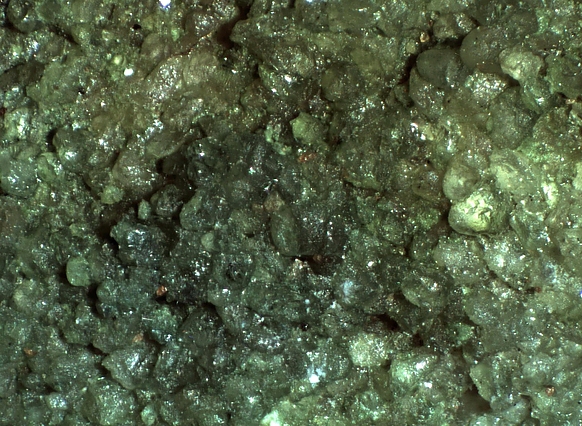
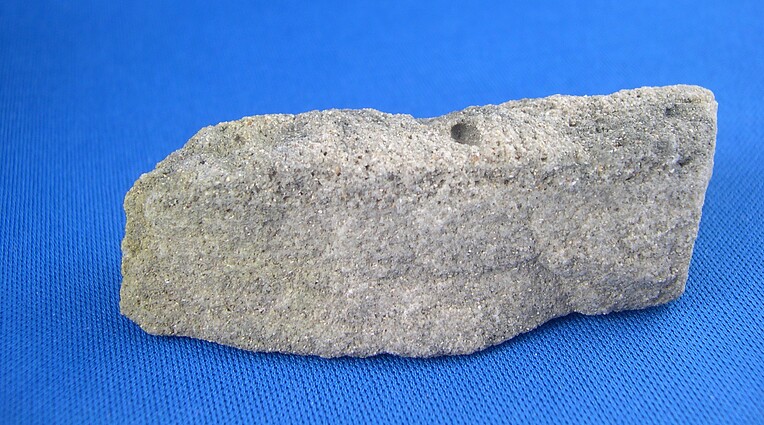

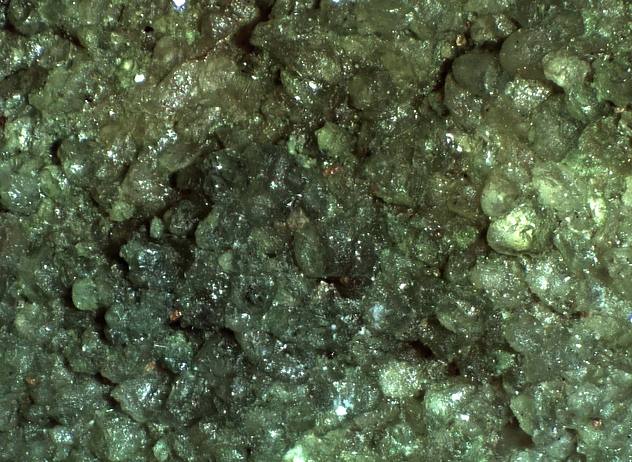
About Fernandinite
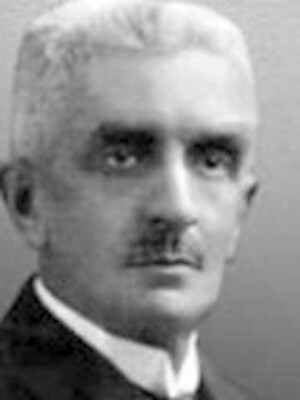
Eulogio E. Fernandini
Formula:
(Ca,K)(V5+,V4+,Fe2+)8O20 · 10H2O
Colour:
Dull green; light green, dark olive-green, brownish green in transmitted light
Lustre:
Sub-Metallic
Hardness:
2 - 3
Specific Gravity:
2.78
Crystal System:
Monoclinic
Member of:
Name:
Named in 1915 by Waldemar Theodore Schaller in honor of Eulogio Erasmo Fernandini de la Quintana (13 September 1860, Ica Peru - 24 December 1947, Lima, Peru), who was formerly an owner of the Minasragra deposit (the type locality). The name was discredited in 1989 and revalidated in 1994.
Type Locality:
Unique Identifiers
Mindat ID:
1483
Long-form identifier:
mindat:1:1:1483:6
IMA Classification of Fernandinite
Approved, 'Grandfathered' (first described prior to 1959)
IMA Formula:
(Ca,Na,K)0.9(V5+,V4+,Fe2+,Ti)8O20 · 4H2O
First published:
1915
Approval history:
Discredited in 1989. Redescribed in 1994.
Type description reference:
Classification of Fernandinite
4.HE.20
4 : OXIDES (Hydroxides, V[5,6] vanadates, arsenites, antimonites, bismuthites, sulfites, selenites, tellurites, iodates)
H : V[5,6] Vanadates
E : Phyllovanadates
4 : OXIDES (Hydroxides, V[5,6] vanadates, arsenites, antimonites, bismuthites, sulfites, selenites, tellurites, iodates)
H : V[5,6] Vanadates
E : Phyllovanadates
47.3.2.3
47 : VANADIUM OXYSALTS
3 : Hydrated Normal Vanadium Oxysalts
47 : VANADIUM OXYSALTS
3 : Hydrated Normal Vanadium Oxysalts
21.2.7
21 : Vanadates (and vanadates with arsenate or phosphate)
2 : Vanadates of Mg, Ca, Sr or Ba
21 : Vanadates (and vanadates with arsenate or phosphate)
2 : Vanadates of Mg, Ca, Sr or Ba
Mineral Symbols
As of 2021 there are now IMA–CNMNC approved mineral symbols (abbreviations) for each mineral species, useful for tables and diagrams.
| Symbol | Source | Reference |
|---|---|---|
| Frn | IMA–CNMNC | Warr, L.N. (2021). IMA–CNMNC approved mineral symbols. Mineralogical Magazine, 85(3), 291-320. doi:10.1180/mgm.2021.43 |
Physical Properties of Fernandinite
Sub-Metallic
Transparency:
Translucent, Opaque
Colour:
Dull green; light green, dark olive-green, brownish green in transmitted light
Streak:
Dark green
Hardness:
2 - 3 on Mohs scale
Tenacity:
Waxy
Cleavage:
None Observed
Fracture:
Sub-Conchoidal, Micaceous
Density:
2.78 g/cm3 (Measured) 3.07 g/cm3 (Calculated)
Optical Data of Fernandinite
Type:
Biaxial
RI values:
n = 2.05
Birefringence:
Strong
Max. Birefringence:
δ = 0.000
Based on recorded range of RI values above.
Based on recorded range of RI values above.
Interference Colours:
The colours simulate birefringence patterns seen in thin section under crossed polars. They do not take into account mineral colouration or opacity.
Michel-Levy Bar The default colours simulate the birefringence range for a 30 µm thin-section thickness. Adjust the slider to simulate a different thickness.
Grain Simulation You can rotate the grain simulation to show how this range might look as you rotated a sample under crossed polars.
The colours simulate birefringence patterns seen in thin section under crossed polars. They do not take into account mineral colouration or opacity.
Michel-Levy Bar The default colours simulate the birefringence range for a 30 µm thin-section thickness. Adjust the slider to simulate a different thickness.
Grain Simulation You can rotate the grain simulation to show how this range might look as you rotated a sample under crossed polars.
Surface Relief:
Very High
Comments:
2V measured value not determined.
Chemistry of Fernandinite
Mindat Formula:
(Ca,K)(V5+,V4+,Fe2+)8O20 · 10H2O
Element Weights:
Crystallography of Fernandinite
Crystal System:
Monoclinic
Class (H-M):
2/m - Prismatic
Space Group:
B2/m
Setting:
C2/m
Cell Parameters:
a = 11.680 Å, b = 3.6537 Å, c = 11.023 Å
β = 105.00°
β = 105.00°
Ratio:
a:b:c = 3.197 : 1 : 3.017
Unit Cell V:
454.38 ų (Calculated from Unit Cell)
Z:
1
Morphology:
Crystals rare, platy and rectangular. Fibrous, cryptocrystalline, porous masses.
Crystal Structure
Load
Unit Cell | Unit Cell Packed
2x2x2 | 3x3x3 | 4x4x4
Unit Cell | Unit Cell Packed
2x2x2 | 3x3x3 | 4x4x4
Show
Big Balls | Small Balls | Just Balls | Spacefill
Polyhedra Off | Si Polyhedra | All Polyhedra
Remove metal-metal sticks
Big Balls | Small Balls | Just Balls | Spacefill
Polyhedra Off | Si Polyhedra | All Polyhedra
Remove metal-metal sticks
Display Options
Black Background | White Background
Perspective On | Perspective Off
2D | Stereo | Red-Blue | Red-Cyan
Black Background | White Background
Perspective On | Perspective Off
2D | Stereo | Red-Blue | Red-Cyan
View
CIF File Best | x | y | z | a | b | c
CIF File Best | x | y | z | a | b | c
Rotation
Stop | Start
Stop | Start
Labels
Console Off | On | Grey | Yellow
Console Off | On | Grey | Yellow
Data courtesy of the American Mineralogist Crystal Structure Database. Click on an AMCSD ID to view structure
| ID | Species | Reference | Link | Year | Locality | Pressure (GPa) | Temp (K) |
|---|---|---|---|---|---|---|---|
| 0005363 | Fernandinite | Evans H T, Post J E, Ross D R, Nelen J A (1994) The crystal structure and crystal chemistry of fernandinite and corvusite Minasragu, Peru, with general formula (Ca,Na,K)x(V,Fe,Ti)8O20.4H2O The Canadian Mineralogist 32 339-351 |  | 1994 | Minasragu, Peru | 0 | 293 |
CIF Raw Data - click here to close
X-Ray Powder Diffraction
Powder Diffraction Data:
| d-spacing | Intensity |
|---|---|
| 10.68 Å | (100) |
| 5.65 Å | (10) |
| 3.545 Å | (4) |
| 3.483 Å | (26) |
| 2.826 Å | (7) |
| 2.549 Å | (4) |
| 1.949 Å | (6) |
| 1.836 Å | (8) |
Comments:
Very similar to the data for corvusite.
Geological Environment
Paragenetic Mode(s):
| Paragenetic Mode | Earliest Age (Ga) |
|---|---|
| Stage 7: Great Oxidation Event | <2.4 |
| 47a : [Near-surface hydration of prior minerals] | |
| 47e : [Vanadates, chromates, manganates] | |
| 47h : [Near-surface oxidized, dehydrated minerals] | |
| Stage 10a: Neoproterozoic oxygenation/terrestrial biosphere | <0.6 |
| 53 : Other minerals with taphonomic origins | <0.4 |
Type Occurrence of Fernandinite
Place of Conservation of Type Material:
Harvard University, Cambridge, Massachusetts, USA: #101718. U.S. National Museum of Natural History, Washington, D.C., USA: #87661, R5706.
Geological Setting of Type Material:
A rich vanadium deposit in fissures that cut red shales
Associated Minerals at Type Locality:
Other Language Names for Fernandinite
Relationship of Fernandinite to other Species
Member of:
Other Members of Straczekite Group:
| Bariandite | Al0.6(V5+,V4+)8O20 · 9H2O | Mon. |
| Bokite | (Al,Fe)1.3(V5+,V4+,Fe3+)8O20 · 7.5H2O | Mon. |
| Corvusite | (Na,K,Ca,Mg)2(V5+,V4+,Fe2+)8O20 · 6-10H2O | Mon. 2/m : B2/m |
| Straczekite | (Ca,K,Ba)(V5+,V4+)8O20 · 3H2O | Mon. 2/m : B2/m |
Common Associates
Associated Minerals Based on Photo Data:
| 7 photos of Fernandinite associated with Pintadoite | Ca2(V2O7) · 9H2O |
| 3 photos of Fernandinite associated with Patrónite | VS4 |
| 2 photos of Fernandinite associated with Sincosite | Ca(VO)2(PO4)2 · 5H2O |
| 2 photos of Fernandinite associated with Native Selenium | Se |
| 1 photo of Fernandinite associated with Melanovanadite | Ca(V5+,V4+)4O10 · 5H2O |
Related Minerals - Strunz-mindat Grouping
| 4.HE.05 | Melanovanadite | Ca(V5+,V4+)4O10 · 5H2O |
| 4.HE.10 | Shcherbinaite | V5+2O5 |
| 4.HE.15 | Hewettite | CaV6O16 · 9H2O |
| 4.HE.15 | Metahewettite | CaV6O16 · 3H2O |
| 4.HE.20 | Bariandite | Al0.6(V5+,V4+)8O20 · 9H2O |
| 4.HE.20 | Corvusite | (Na,K,Ca,Mg)2(V5+,V4+,Fe2+)8O20 · 6-10H2O |
| 4.HE.20 | Bokite | (Al,Fe)1.3(V5+,V4+,Fe3+)8O20 · 7.5H2O |
| 4.HE.20 | Straczekite | (Ca,K,Ba)(V5+,V4+)8O20 · 3H2O |
| 4.HE.25 | Häggite | V3+V4+O2(OH)3 |
| 4.HE.30 | Doloresite | V4+3O4(OH)4 |
| 4.HE.35 | Duttonite | V4+O(OH)2 |
| 4.HE.40 | Cavoite | CaV4+3O7 |
Fluorescence of Fernandinite
Not fluorescent in UV
Other Information
Notes:
Readily soluble in acids to a green solution.
Somewhat soluble in cold H2O, yielding a yellow solution.
Somewhat soluble in cold H2O, yielding a yellow solution.
Health Risks:
No information on health risks for this material has been entered into the database. You should always treat mineral specimens with care.
Internet Links for Fernandinite
mindat.org URL:
https://www.mindat.org/min-1483.html
Please feel free to link to this page.
Please feel free to link to this page.
Search Engines:
External Links:
References for Fernandinite
Reference List:
Larsen, Esper S. (1921) The microscopic determination of the nonopaque minerals. Bulletin 679. US Geological Survey doi:10.3133/b679 p.74
Bayliss, Peter, Freeman, Kim J. (1989) Mineral nomenclature: fernandinite. Mineralogical Magazine, 53 (372) 511 doi:10.1180/minmag.1989.053.372.12
Evans, Howard T., Jr.,, Hughes, John M. (1990) Crystal chemistry of the natural vanadium bronzes. American Mineralogist, 75 (5-6) 508-521
Jambor, John L., Puziewicz, Jacek (1990) New Mineral Names. American Mineralogist, 75 (9-10) 1209-1215
Localities for Fernandinite
 symbol to view information about a locality.
The
symbol to view information about a locality.
The Locality List
 - This locality has map coordinates listed.
- This locality has estimated coordinates.
ⓘ - Click for references and further information on this occurrence.
? - Indicates mineral may be doubtful at this locality.
- This locality has map coordinates listed.
- This locality has estimated coordinates.
ⓘ - Click for references and further information on this occurrence.
? - Indicates mineral may be doubtful at this locality.
 - Good crystals or important locality for species.
 - World class for species or very significant.
(TL) - Type Locality for a valid mineral species.
(FRL) - First Recorded Locality for everything else (eg varieties).
- World class for species or very significant.
(TL) - Type Locality for a valid mineral species.
(FRL) - First Recorded Locality for everything else (eg varieties).
All localities listed without proper references should be considered as questionable.
Peru (TL) | |
| Schaller (1915) +3 other references |
Spain | |
| Dill et al. (2023) |
| Dill et al. (2023) | |
USA | |
| Galbraith (1959) +2 other references |
| Eckel et al. (1997) |
| Excalibur Mineral Co. sample and ... |
| Min News (1987) |
| Collected by and in the collection of ... | |
| Dakota Matrix Minerals |
| Edward J.C. Orbock III (2017) |
| Bullock (1981) |
| Observed on the ore pile |
| King (n.d.) |
Quick NavTopAbout FernandiniteUnique IdentifiersIMA Classification Classification Mineral SymbolsPhysical Properties Optical Data Chemistry Crystallography Crystal StructureX-Ray Powder DiffractionGeological EnvironmentType Occurrence Other LanguagesRelationshipsCommon AssociatesStrunz-MindatFluorescence Other InformationInternet Links References Localities Locality List
Sunday Mine, Slick Rock Mining District, Colorado, USA