Diamond
A valid IMA mineral species - grandfathered
This page kindly sponsored by reserved



About Diamond
Formula:
C
As a Commodity:
Colour:
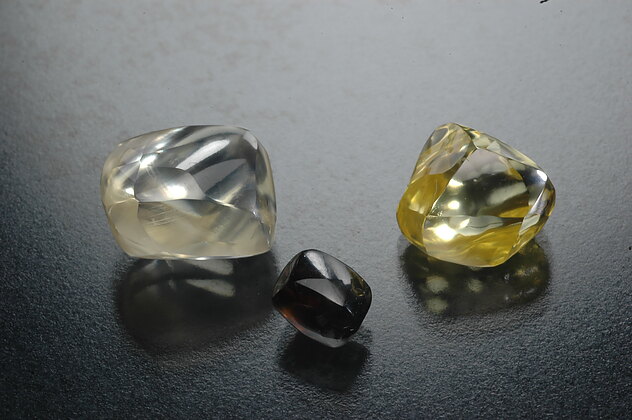
Colourless, yellowish to yellow, brown, black, blue, green or red, pink, champagne-tan, cognac-brown, lilac (very rare)
Lustre:
Adamantine, Greasy
Hardness:
10
Specific Gravity:
3.5 - 3.53
Crystal System:
Isometric
Name:
From Greek "adamas", 'invincible'. First known use by Manlius (A.D. 16) and Pliny (A.D. 100).
Polymorph of:
Diamond is the hardest natural substance known. It is formed deep in the mantle and is only brought to the surface via kimberlite pipes, lamprophyres, eclogites and other rocks that originate deep within the mantle. It is also found in alluvial deposits, along with quartz, corundum, zircon and other minerals, derived from such rocks, and in certain meteorites.
The formation processes of the variety carbonado are unclear.
The ballas variety is spherical and has a number of modes of formation (Pavlushin et al. 2021).
The coexistence of diamond and carbonate minerals in mantle eclogites is explained by the reaction: dolomite + 2(coesite) <-> diopside + 2(diamond) + 2O2 (Luth, 1993).
Micro- and nanodiamonds in ureilites are shown to be created due to impact shock phenomena taking place on some small planetesimals.
 Visit gemdat.org for gemological information about Diamond.
The formation processes of the variety carbonado are unclear.
The ballas variety is spherical and has a number of modes of formation (Pavlushin et al. 2021).
The coexistence of diamond and carbonate minerals in mantle eclogites is explained by the reaction: dolomite + 2(coesite) <-> diopside + 2(diamond) + 2O2 (Luth, 1993).
Micro- and nanodiamonds in ureilites are shown to be created due to impact shock phenomena taking place on some small planetesimals.
Visit gemdat.org for gemological information about Diamond.Unique Identifiers
Mindat ID:
1282
Long-form identifier:
mindat:1:1:1282:5
IMA Classification of Diamond
Approved, 'Grandfathered' (first described prior to 1959)
Classification of Diamond
1.CB.10a
1 : ELEMENTS (Metals and intermetallic alloys; metalloids and nonmetals; carbides, silicides, nitrides, phosphides)
C : Metalloids and Nonmetals
B : Carbon-silicon family
1 : ELEMENTS (Metals and intermetallic alloys; metalloids and nonmetals; carbides, silicides, nitrides, phosphides)
C : Metalloids and Nonmetals
B : Carbon-silicon family
Dana 7th ed.:
1.3.5.1
1.3.6.1
1 : NATIVE ELEMENTS AND ALLOYS
3 : Semi-metals and non-metals
1 : NATIVE ELEMENTS AND ALLOYS
3 : Semi-metals and non-metals
1.24
1 : Elements and Alloys (including the arsenides, antimonides and bismuthides of Cu, Ag and Au)
1 : Elements and Alloys (including the arsenides, antimonides and bismuthides of Cu, Ag and Au)
Mineral Symbols
As of 2021 there are now IMA–CNMNC approved mineral symbols (abbreviations) for each mineral species, useful for tables and diagrams.
Please only use the official IMA–CNMNC symbol. Older variants are listed for historical use only.
Please only use the official IMA–CNMNC symbol. Older variants are listed for historical use only.
| Symbol | Source | Reference |
|---|---|---|
| Dia | IMA–CNMNC | Warr, L.N. (2021). IMA–CNMNC approved mineral symbols. Mineralogical Magazine, 85(3), 291-320. doi:10.1180/mgm.2021.43 |
| Dia | Whitney & Evans (2010) | Whitney, D.L. and Evans, B.W. (2010) Abbreviations for names of rock-forming minerals. American Mineralogist, 95, 185–187 doi:10.2138/am.2010.3371 |
| Dmd | The Canadian Mineralogist (2019) | The Canadian Mineralogist (2019) The Canadian Mineralogist list of symbols for rock- and ore-forming minerals (December 30, 2019). download |
Pronunciation of Diamond
Pronunciation:
| Play | Recorded by | Country |
|---|---|---|
| Jolyon Ralph | United Kingdom |
Physical Properties of Diamond
Adamantine, Greasy
Transparency:
Transparent, Translucent, Opaque
Colour:
Colourless, yellowish to yellow, brown, black, blue, green or red, pink, champagne-tan, cognac-brown, lilac (very rare)
Comment:
Eaton-Magaña, S., Ardon, T., Smit, K. V., Breeding, C. M., & Shigley, J. E. (2018). Natural-color Pink, Purple, Red, and Brown Diamonds: Band of Many Colors. Gems & Gemology, 54(4).
The spectroscopic data show that the yellow color of this diamond is due to N3 and N2 defects, although other kind of defects were detected, i.e., N3VH0 defects and platelets. The incorporation of H and defects resulting from the nitrogen aggregation are related to high-temperature formation, supporting the hypothesis that growth started at depths compatible with mantle conditions. [[1]]
Streak:
None
Hardness:
10 on Mohs scale
Hardness Data:
Mohs hardness reference species
Tenacity:
Brittle
Cleavage:
Perfect
Perfect octahedral {111}
Perfect octahedral {111}
Fracture:
Irregular/Uneven
Density:
3.5 - 3.53 g/cm3 (Measured) 3.515 g/cm3 (Calculated)
Optical Data of Diamond
Type:
Isotropic
RI values:
n = 2.4354
Birefringence:
Strain birefringence common (Raman and Rendall, 1944; Lang 1967; Howell, 2012).
Surface Relief:
Very High
Dispersion:
Strong
Pleochroism:
Non-pleochroic
Comments:
n = 2.4354 (486), 2.4175 (589), 2.4076 (687)
Chemistry of Diamond
Mindat Formula:
C
Element Weights:
| Element | % weight |
|---|---|
| C | 100.000 % |
Calculated from ideal end-member formula.
Elements listed:
CAS Registry number:
Crystallography of Diamond
Crystal System:
Isometric
Class (H-M):
m3m (4/m 3 2/m) - Hexoctahedral
Space Group:
Fd3m
Setting:
Fd3m
Cell Parameters:
a = 3.5595 Å
Unit Cell V:
45.10 ų (Calculated from Unit Cell)
Z:
8
Morphology:
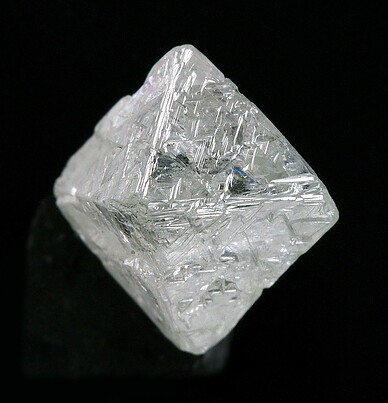
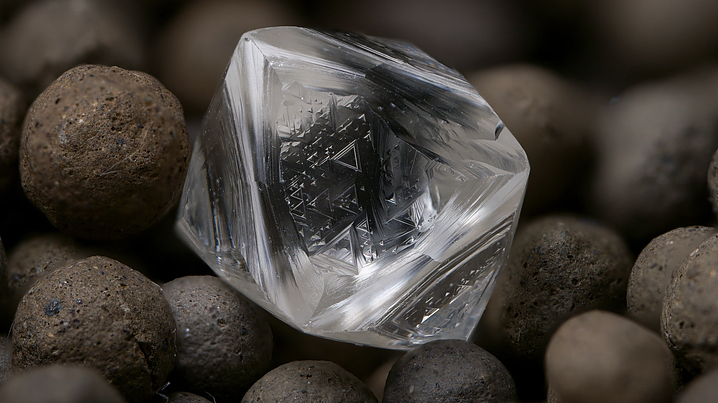
Octahedral crystals, also dodecahedrons, cubes, tetrahedral. Often has curved faces.
Twinning:
Spinel-type twinning on {111} (Slawson, 1950).
Crystallographic forms of Diamond
Crystal Atlas:
Image Loading
Click on an icon to view

Diamond no.15 - Goldschmidt (1913-1926)
Diamond no.107 - Goldschmidt (1913-1926)
Diamond no.108 - Goldschmidt (1913-1926)
Diamond no.124 - Goldschmidt (1913-1926)
3d models and HTML5 code kindly provided by
www.smorf.nl.
Toggle
Edge Lines | Miller Indices | Axes
Transparency
Opaque | Translucent | Transparent
View
Along a-axis | Along b-axis | Along c-axis | Start rotation | Stop rotation
Toggle
Edge Lines | Miller Indices | Axes
Transparency
Opaque | Translucent | Transparent
View
Along a-axis | Along b-axis | Along c-axis | Start rotation | Stop rotation
Crystal Structure
Load
Unit Cell | Unit Cell Packed
2x2x2 | 3x3x3 | 4x4x4
Unit Cell | Unit Cell Packed
2x2x2 | 3x3x3 | 4x4x4
Show
Big Balls | Small Balls | Just Balls | Spacefill
Polyhedra Off | Si Polyhedra | All Polyhedra
Remove metal-metal sticks
Big Balls | Small Balls | Just Balls | Spacefill
Polyhedra Off | Si Polyhedra | All Polyhedra
Remove metal-metal sticks
Display Options
Black Background | White Background
Perspective On | Perspective Off
2D | Stereo | Red-Blue | Red-Cyan
Black Background | White Background
Perspective On | Perspective Off
2D | Stereo | Red-Blue | Red-Cyan
View
CIF File Best | x | y | z | a | b | c
CIF File Best | x | y | z | a | b | c
Rotation
Stop | Start
Stop | Start
Labels
Console Off | On | Grey | Yellow
Console Off | On | Grey | Yellow
Data courtesy of the American Mineralogist Crystal Structure Database. Click on an AMCSD ID to view structure
| ID | Species | Reference | Link | Year | Locality | Pressure (GPa) | Temp (K) |
|---|---|---|---|---|---|---|---|
| 0011242 | Diamond | Wyckoff R W G (1963) Second edition. Interscience Publishers, New York, New York Crystal Structures 1 7-83 | 1963 | 0 | 293 | ||
| 0012842 | Diamond | Hom T, Kiszenick W, Post B (1975) Accurate lattice constants from multiple reflection mesurements II. lattice constants of germanium, silicon and diamond Journal of Applied Crystallography 8 457-458 | 1975 | unknown | 0 | 298 | |
| 0013983 | Diamond | Fayos J (1999) Possible 3D carbon structures as progressive intermediates in graphite to diamond phase transition Journal of Solid State Chemistry 148 278-285 | 1999 | 0 | 293 | ||
| 0013984 | Diamond | Fayos J (1999) Possible 3D carbon structures as progressive intermediates in graphite to diamond phase transition Journal of Solid State Chemistry 148 278-285 | 1999 | 0 | 293 | ||
| 0013985 | Diamond | Fayos J (1999) Possible 3D carbon structures as progressive intermediates in graphite to diamond phase transition Journal of Solid State Chemistry 148 278-285 | 1999 | 0 | 293 | ||
| 0013986 | Diamond | Fayos J (1999) Possible 3D carbon structures as progressive intermediates in graphite to diamond phase transition Journal of Solid State Chemistry 148 278-285 | 1999 | 0 | 293 | ||
| 0013987 | Diamond | Fayos J (1999) Possible 3D carbon structures as progressive intermediates in graphite to diamond phase transition VDW terms Journal of Solid State Chemistry 148 278-285 | 1999 | 0 | 293 | ||
| 0013991 | Diamond | Fayos J (1999) Possible 3D carbon structures as progressive intermediates in graphite to diamond phase transition Journal of Solid State Chemistry 148 278-285 | 1999 | 0 | 293 | ||
| 0014081 | Diamond | Straumanis M E, Aka E Z (1951) Precision determination of lattice parameter, coefficient of thermal expansion and atomic weight of carbon in diamond Journal of the American Chemical Society 73 5643-5646 | 1951 | Belgian Congo | 0 | 283 | |
| 0014082 | Diamond | Straumanis M E, Aka E Z (1951) Precision determination of lattice parameter, coefficient of thermal expansion and atomic weight of carbon in diamond Journal of the American Chemical Society 73 5643-5646 | 1951 | Belgian Congo | 0 | 293 | |
| 0014083 | Diamond | Straumanis M E, Aka E Z (1951) Precision determination of lattice parameter, coefficient of thermal expansion and atomic weight of carbon in diamond Journal of the American Chemical Society 73 5643-5646 | 1951 | Belgian Congo | 0 | 303 | |
| 0014084 | Diamond | Straumanis M E, Aka E Z (1951) Precision determination of lattice parameter, coefficient of thermal expansion and atomic weight of carbon in diamond Journal of the American Chemical Society 73 5643-5646 | 1951 | Belgian Congo | 0 | 313 | |
| 0014085 | Diamond | Straumanis M E, Aka E Z (1951) Precision determination of lattice parameter, coefficient of thermal expansion and atomic weight of carbon in diamond Journal of the American Chemical Society 73 5643-5646 | 1951 | Belgian Congo | 0 | 323 | |
| 0014086 | Diamond | Straumanis M E, Aka E Z (1951) Precision determination of lattice parameter, coefficient of thermal expansion and atomic weight of carbon in diamond Journal of the American Chemical Society 73 5643-5646 | 1951 | Belgian Congo | 0 | 283 | |
| 0014087 | Diamond | Straumanis M E, Aka E Z (1951) Precision determination of lattice parameter, coefficient of thermal expansion and atomic weight of carbon in diamond Journal of the American Chemical Society 73 5643-5646 | 1951 | Belgian Congo | 0 | 293 | |
| 0014088 | Diamond | Straumanis M E, Aka E Z (1951) Precision determination of lattice parameter, coefficient of thermal expansion and atomic weight of carbon in diamond Journal of the American Chemical Society 73 5643-5646 | 1951 | Belgian Congo | 0 | 303 | |
| 0014089 | Diamond | Straumanis M E, Aka E Z (1951) Precision determination of lattice parameter, coefficient of thermal expansion and atomic weight of carbon in diamond Journal of the American Chemical Society 73 5643-5646 | 1951 | Belgian Congo | 0 | 313 | |
| 0014090 | Diamond | Straumanis M E, Aka E Z (1951) Precision determination of lattice parameter, coefficient of thermal expansion and atomic weight of carbon in diamond Journal of the American Chemical Society 73 5643-5646 | 1951 | Belgian Congo | 0 | 323 | |
| 0014091 | Diamond | Straumanis M E, Aka E Z (1951) Precision determination of lattice parameter, coefficient of thermal expansion and atomic weight of carbon in diamond Journal of the American Chemical Society 73 5643-5646 | 1951 | Belgian Congo | 0 | 283 | |
| 0014092 | Diamond | Straumanis M E, Aka E Z (1951) Precision determination of lattice parameter, coefficient of thermal expansion and atomic weight of carbon in diamond Journal of the American Chemical Society 73 5643-5646 | 1951 | Belgian Congo | 0 | 293 | |
| 0014093 | Diamond | Straumanis M E, Aka E Z (1951) Precision determination of lattice parameter, coefficient of thermal expansion and atomic weight of carbon in diamond Journal of the American Chemical Society 73 5643-5646 | 1951 | Belgian Congo | 0 | 303 | |
| 0014094 | Diamond | Straumanis M E, Aka E Z (1951) Precision determination of lattice parameter, coefficient of thermal expansion and atomic weight of carbon in diamond Journal of the American Chemical Society 73 5643-5646 | 1951 | Belgian Congo | 0 | 313 | |
| 0014095 | Diamond | Straumanis M E, Aka E Z (1951) Precision determination of lattice parameter, coefficient of thermal expansion and atomic weight of carbon in diamond Journal of the American Chemical Society 73 5643-5646 | 1951 | Belgian Congo | 0 | 323 | |
| 0014096 | Diamond | Straumanis M E, Aka E Z (1951) Precision determination of lattice parameter, coefficient of thermal expansion and atomic weight of carbon in diamond Journal of the American Chemical Society 73 5643-5646 | 1951 | Belgian Congo | 0 | 283 | |
| 0014097 | Diamond | Straumanis M E, Aka E Z (1951) Precision determination of lattice parameter, coefficient of thermal expansion and atomic weight of carbon in diamond Journal of the American Chemical Society 73 5643-5646 | 1951 | Belgian Congo | 0 | 293 | |
| 0014098 | Diamond | Straumanis M E, Aka E Z (1951) Precision determination of lattice parameter, coefficient of thermal expansion and atomic weight of carbon in diamond Journal of the American Chemical Society 73 5643-5646 | 1951 | Belgian Congo | 0 | 303 | |
| 0014099 | Diamond | Straumanis M E, Aka E Z (1951) Precision determination of lattice parameter, coefficient of thermal expansion and atomic weight of carbon in diamond Journal of the American Chemical Society 73 5643-5646 | 1951 | Belgian Congo | 0 | 313 | |
| 0014100 | Diamond | Straumanis M E, Aka E Z (1951) Precision determination of lattice parameter, coefficient of thermal expansion and atomic weight of carbon in diamond Journal of the American Chemical Society 73 5643-5646 | 1951 | Belgian Congo | 0 | 323 | |
| 0014673 | Diamond | Riley D P (1944) Lattice constant of diamond and the C-C single bond Nature 153 587-588 | 1944 | commercial diamond dust sieved to obtain small crystals | 0 | 291 |
CIF Raw Data - click here to close
X-Ray Powder Diffraction
Powder Diffraction Data:
| d-spacing | Intensity |
|---|---|
| 2.06 Å | (100) |
| 1.261 Å | (25) |
| 1.0754 Å | (16) |
| 0.8182 Å | (16) |
| 0.8916 Å | (8) |
Geological Environment
Paragenetic Mode(s):
| Paragenetic Mode | Earliest Age (Ga) |
|---|---|
| Pre-terrestrial "Ur-minerals" | >4.57 |
| 1 : Stellar atmosphere condensates | |
| Stage 2: Planetesimal differentiation and alteration | 4.566-4.550 |
| 6 : Secondary asteroid phases | 4.566-4.560 |
| Near-surface Processes | |
| 26 : Hadean detrital minerals | |
| 30 : Terrestrial impact minerals | |
| Stage 5: Initiation of plate tectonics | <3.5-2.5 |
| 38 : Ophiolites |
Geological Setting:
Deep mantle-derived rocks such as kimberlites, lamprophyres, and others. With decreasing pressure, the diamonds dissolve back into the rock. To occur and survive in a metastable state at the surface they must arrive from depth quickly and very often crystals show dissolution features because the transport to the surface is not quick enough.
Since diamond is extremely hard, it survives in alluvia.
Since diamond is extremely hard, it survives in alluvia.
Synonyms of Diamond
Other Language Names for Diamond
Afrikaans:Diamant
Arabic:ألماس
Armenian:Ադամանդ
Basque:Diamante
Belarusian:Алмаз
Belarusian (Tarashkevitsa):Алмаз
Bishnupriya Manipuri:ডিয়ামান্টে
Bosnian:Dijamant
Bulgarian:Диамант
Catalan:Diamant
Croatian:Dijamant
Czech:Diamant
Danish:Diamant
Dutch:Diamant
Esperanto:Diamanto
Estonian:Teemant
Faroese:Diamantar
Farsi/Persian:الماس
Finnish:Timantti
French:Diamant
Galician:Diamante
Georgian:ბრილიანტი
German:Diamant
Ademant
Oesterreicher
Ademant
Oesterreicher
Greek:Διαμάντι
Hakka:Tson-sa̍k
Hebrew:יהלום
Hindi:हीरा
Hungarian:Gyémánt
Icelandic:Demantur
Indonesian:Intan
Italian:Diamante
Korean:다이아몬드
Latvian:Dimants
Lithuanian:Deimantas
Lojban:Krilytabno
Lombard:Diamaant
Macedonian:Дијамант
Malay:Berlian
Malayalam:വജ്രം
Marathi:हिरा
Min Nan:Soān-chio̍h
Mongolian:Алмааз
Norwegian:Diamant
Norwegian (Nynorsk):Diamant
Polish:Diament
Portuguese:Diamante
Quechua:Q'ispi umiña
Romanian:Diamant
Russian:Алмаз
Serbian:Дијамант
Serbo-Croatian:Dijamant
Simplified Chinese:钻石
Slovak:Diamant
Slovenian:Diamant
Spanish:Diamante
Swahili:Almasi
Swedish:Diamant
Tagalog:Diyamante
Tamil:வைரம்
Telugu:వజ్రం
Thai:เพชร
Traditional Chinese:鑽石
Turkish:Elmas
Ukrainian:Алмаз
Vietnamese:Kim cương
Varieties of Diamond
| Ballas | An old name for a variety of diamond/bort. |
| Black Diamond | A black, mostly opaque diamond. The most famous types of black diamond are the carbonado diamond, and bort. |
| Bort | A black variety of diamond. Diamond material that is unsuitable for gems because of its shape, size, or color and because of flaws or inclusions. It also occurs in finely crystalline aggregates and is usually crushed into finer material. See also ballas,... |
| Carbonado | A massive (polycrystalline), porous, opaque, gray, brown, or black variety of diamond used as an abrasive and in rock drills. Five different theories for the formation of carbonado have been discussed. 1. Meteoritic impact; 2. Growth and sintering in th... |
| Framesite | A variety of black bort from South Africa showing minute brilliant points possibly due to included diamonds. |
| Karite | Impact diamond type – diamond fossils, named by “karite”, formed about 70 Ma from unmetamorphosed organics in the giant Kara impact crater (Pay-Khoy, Russia). A full complex of the diamond fossil characteristics is described proving its nature an... |
| Nano-Polycrystalline Diamond | Nano-Polycrystalline Diamond (or NPD) is a completely transparent, polycrystalline synthetic consisting of randomly oriented, very tightly bonded nanoscale-sized diamond crystallites. Using a sintering process, the material is created in a multi-anvil p... |
| Stewartite (of Sutton) | A magnetic, ferrouginous variety of Diamond (bort) [Clark, 1993 - "Hey's Mineral Index"]. Originally reported from Kimberley pipe, Kimberley, Northern Cape Province, South Africa. |
| Type IIa Diamond | Type IIa diamonds are the purest form of natural diamonds, containing little to no nitrogen or other impurities in their crystal lattice. This exceptional purity allows them to be completely colorless or, in some cases, take on a light pink, brown, or eve... |
| Type IIb Diamond | Type IIb diamonds are a rare class of diamonds that contain trace amounts of boron, which replaces carbon atoms in the crystal lattice. This boron impurity gives Type IIb diamonds their distinctive blue or grayish-blue color and also makes them electrical... |
| Type Ia Diamond | Type Ia diamonds are the most common type of natural diamonds, characterized by the presence of nitrogen impurities aggregated in clusters. These nitrogen atoms absorb blue light, often giving the diamonds a yellow or brown tint. They are further classi... |
| Type Ib Diamond | Type Ib diamonds are relatively rare, accounting for less than 1% of natural diamonds. They contain isolated nitrogen atoms dispersed throughout the crystal lattice, which strongly absorb visible light in the blue and violet regions of the spectrum, often... |
Common Associates
Associated Minerals Based on Photo Data:
| 11 photos of Diamond associated with Kimberlite | |
| 7 photos of Diamond associated with Pyrope | Mg3Al2(SiO4)3 |
| 5 photos of Diamond associated with Pyrite | FeS2 |
| 4 photos of Diamond associated with Graphite | C |
| 3 photos of Diamond associated with Almandine | Fe2+3Al2(SiO4)3 |
| 2 photos of Diamond associated with Grossular | Ca3Al2(SiO4)3 |
| 2 photos of Diamond associated with Lonsdaleite | C |
| 2 photos of Diamond associated with Calcite | CaCO3 |
| 1 photo of Diamond associated with Clinopyroxene Subgroup | |
| 1 photo of Diamond associated with Serpentine Subgroup | D3[Si2O5](OH)4 |
Related Minerals - Strunz-mindat Grouping
| 1.CB. | Tartarosite | C |
| 1.CB.05c | Fullerite | C60 |
| 1.CB.05b | Chaoite | C |
| 1.CB.05a | Graphite | C |
| 1.CB.10b | Lonsdaleite | C |
| 1.CB.15 | Native Silicon | Si |
Fluorescence of Diamond
Some - blue, also phosphorescent
Other Information
Electrical:
Triboelectric
Thermal Behaviour:
Greatest thermal conductivity known. A sizeable stone held in the hand feels cold, hence the slang name "ice".
Health Risks:
No information on health risks for this material has been entered into the database. You should always treat mineral specimens with care.
Industrial Uses:
Cutting and grinding due to extreme hardness. Used for the windows on the Venera spacecraft to photograph Venus' surface.
Diamond in petrology
An essential component of rock names highlighted in red, an accessory component in rock names highlighted in green.
Internet Links for Diamond
mindat.org URL:
https://www.mindat.org/min-1282.html
Please feel free to link to this page.
Please feel free to link to this page.
Search Engines:
External Links:
References for Diamond
Reference List:
Palache, Charles (1932) Multiple twins of diamond and sphalerite. American Mineralogist, 17 (7) 360-361
Kraus, Edward H., Slawson, Chester B. (1939) Variation of hardness in the diamond. American Mineralogist, 24 (11) 661-676
Giardini, A. A., Hurst, V. J., Melton, C. E., Stormer, and John C. (1974) Biotite as a primary inclusion in diamond: Its nature and significance. American Mineralogist, 59 (7-8) 783-789
Lang, A.R. (1974) Glimpses into the growth history of natural diamonds. Journal of Crystal Growth, 24. 108-115 doi:10.1016/0022-0248(74)90287-5
Lang, A. R., Walmsley, J. C. (1983) Apatite inclusions in natural diamond coat. Physics and Chemistry of Minerals, 9 (1). 6-8 doi:10.1007/bf00309462
Sobolev, N. V., Shatsky, V. S. (1990) Diamond inclusions in garnets from metamorphic rocks: a new environment for diamond formation. Nature, 343 (6260). 742-746 doi:10.1038/343742a0
Walmsley, J. C., Lang, A. R. (1992) On sub-micrometre inclusions in diamond coat: crystallography and composition of ankerites and related rhombohedral carbonates. Mineralogical Magazine, 56 (385) 533-543 doi:10.1180/minmag.1992.056.385.09
Walmsley, J. C., Lang, A. R. (1992) Oriented biotite inclusions in diamond coat. Mineralogical Magazine, 56 (382) 108-111 doi:10.1180/minmag.1992.056.382.13
Zezin, R. B., Smirnova, E. P., Saparin, G. V., Obyden, S. K. (1992) New growth features of natural diamonds, revealed by color cathodoluminescence scanning electron microscope (CCL SEM) technique. Scanning, 14 (1). 3-10 doi:10.1002/sca.4950140103
Sobolev, N, Kaminsky, F., Griffin, W., Yefimova, E., Win, T., Ryan, C., Botkunov, A. (1997) Mineral inclusions in diamonds from the Sputnik kimberlite pipe, Yakutia. Lithos, 39 (3-4). 135-157 doi:10.1016/s0024-4937(96)00022-9
Machado, W. G., Moore, Moreton, Yacoot, A. (1998) Twinning in Natural Diamond. II. Interpenetrant Cubes. Journal of Applied Crystallography, 31 (5). 777-782 doi:10.1107/s0021889898005329
Izraeli, Elad S., Harris, Jeffrey W., Navon, Oded (2001) Brine inclusions in diamonds: a new upper mantle fluid. Earth and Planetary Science Letters, 187 (3) 323-332 doi:10.1016/s0012-821x(01)00291-6
Klein-BenDavid, Ofra, Izraeli, Elad S., Hauri, Erik, Navon, Oded (2004) Mantle fluid evolution—a tale of one diamond. Lithos, 77 (1) 243-253 doi:10.1016/j.lithos.2004.04.003
Izraeli, Elad S., Harris, Jeffrey W., Navon, Oded (2004) Fluid and mineral inclusions in cloudy diamonds from Koffiefontein, South Africa. Geochimica et Cosmochimica Acta, 68 (11) 2561-2575 doi:10.1016/j.gca.2003.09.005
Lu, Taijin, Ke, Jie, Qiu, Zhili (2018) Surface dissolution features and contact twinning in natural diamonds. Neues Jahrbuch für Mineralogie - Abhandlungen Journal of Mineralogy and Geochemistry, 195 (2) 145-153 doi:10.1127/njma/2018/0108
Ragozin, Alexey, Zedgenizov, Dmitry, Shatsky, Vladislav, Kuper, Konstantin, Kagi, Hiroyuki (2019) Deformation Features of Super-Deep Diamonds. Minerals, 10 (1) 18 doi:10.3390/min10010018
Eaton-Magaña, Sally; McElhenny, Garrett; Breeding, Christopher M.; Ardon, Troy (2020) Comparison of gemological and spectroscopic features in type IIa and Ia natural pink diamonds. Diamond and Related Materials, 105. 107784 doi:10.1016/j.diamond.2020.107784
Nestola, Fabrizio, Goodrich, Cyrena A., Morana, Marta, Barbaro, Anna, Jakubek, Ryan S., Christ, Oliver, Brenker, Frank E., Domeneghetti, M. Chiara, Dalconi, M. Chiara, Alvaro, Matteo, Fioretti, Anna M., Litasov, Konstantin D., Fries, Marc D., Leoni, Matteo, Casati, Nicola P. M., Jenniskens, Peter, Shaddad, Muawia H. (2020) Impact shock origin of diamonds in ureilite meteorites. Proceedings of the National Academy of Sciences, 117 (41) 25310-25318 doi:10.1073/pnas.1919067117
Pavlushin, Anton, Zedgenizov, Dmitry, Vasil’ev, Evgeny, Kuper, Konstantin (2020) Morphology and Genesis of Ballas and Ballas-Like Diamonds. Crystals, 11 (1). 17 doi:10.3390/cryst11010017
Keller, Duncan S., Ague, Jay J. (2022) Possibilities for misidentification of natural diamond and coesite in metamorphic rocks. Neues Jahrbuch für Mineralogie - Abhandlungen, 197 (3) 253-261 doi:10.1127/njma/2021/0313
Klepikov, Igor V., Vasilev, Evgeny A., Antonov, Anton V. (2022) Regeneration Growth as One of the Principal Stages of Diamond Crystallogenesis. Minerals, 12 (3) 327 doi:10.3390/min12030327
Bruno, Marco, Ghignone, Stefano, Aquilano, Dino, Nestola, Fabrizio (2023) Is the Imposition of Diamond Morphology on Mineral Inclusions a Syngenetic or Post-Genetic Process with Respect to Diamond Formation?. Crystal Growth & Design, 23 (7) 5279-5288 doi:10.1021/acs.cgd.3c00474
Bataleva, Yuliya V., Palyanov, Yuri N. (2023) Diamond Formation via Carbonate or CO2 Reduction under Pressures and Temperatures of the Lithospheric Mantle: Review of Experimental Data. Minerals, 13 (7) doi:10.3390/min13070940
Afanasiev, Valentin, Ugapeva, Sargylana, Logvinova, Alla (2024) Shape Change of Mineral Inclusions in Diamond—The Result of Diffusion Processes. Minerals, 14 (6) doi:10.3390/min14060594
Gao, Jing; Chen, Bin; Wu, Xiang; Lai, Xiaojing; Fan, Changzeng; Liu, Yun; Zhang, Junfeng (2025) Superdeep Diamond Genesis Through Fe-Mediated Carbonate Reduction. Geosciences, 15 (5). doi:10.3390/geosciences15050163
[1]Pignatelli, Isabella; Ferraris, Cristiano (2025) A Rare Yellow Diamond: Reconstruction of the Possible Geological History. Crystals, 15 (5). doi:10.3390/cryst15050461
Sun, Kaiyue; Lu, Taijin; He, Mingyue; Song, Zhonghua; Zhang, Jian; Ke, Jie (2025) Growth and crystallographic features of interpenetrant twins in natural diamonds. American Mineralogist, 110 (8). doi:10.2138/am-2024-9426
Sun, Chengyang; He, Mingyue; Lu, Taijin; Muraishi, Shinji; Deng, Yi (2025) Correlations between the structural and impurity features reveal fluctuant growth conditions of natural fibrous diamonds. American Mineralogist, 110 (7). doi:10.2138/am-2024-9503
Khokhryakov, Alexander; Kruk, Alexey; Sokol, Alexander; Nechaev, Denis (2025) Dissolution of Diamond in Water–Chloride Fluids at Mantle P-T Conditions. Minerals, 15 (9). doi:10.3390/min15090897
Wang, Xiao-Xia; Wang, Yang-Yang; Yao, Xiaodong; Chang, Tianyin; Li, Xiang; Wang, Xiaomin; Zhao, Zihao (2025) Inclusions, Nitrogen Occurrence Modes, and C-N Isotopic Compositions of Diamonds as Indicators for Exploring the Genesis Mechanism of Diamond: A Review. Minerals, 15 (7). doi:10.3390/min15070728
Localities for Diamond
 symbol to view information about a locality.
The
symbol to view information about a locality.
The Locality List
 - This locality has map coordinates listed.
- This locality has estimated coordinates.
ⓘ - Click for references and further information on this occurrence.
? - Indicates mineral may be doubtful at this locality.
- This locality has map coordinates listed.
- This locality has estimated coordinates.
ⓘ - Click for references and further information on this occurrence.
? - Indicates mineral may be doubtful at this locality.
 - Good crystals or important locality for species.
 - World class for species or very significant.
(TL) - Type Locality for a valid mineral species.
(FRL) - First Recorded Locality for everything else (eg varieties).
- World class for species or very significant.
(TL) - Type Locality for a valid mineral species.
(FRL) - First Recorded Locality for everything else (eg varieties).
All localities listed without proper references should be considered as questionable.
Quick NavTopAbout DiamondUnique IdentifiersIMA Classification Classification Mineral SymbolsPronunciation Physical Properties Optical Data Chemistry Crystallography Crystallographic forms Crystal StructureX-Ray Powder DiffractionGeological EnvironmentSynonymsOther LanguagesVarietiesCommon AssociatesStrunz-MindatFluorescence Other InformationDiamond in petrologyInternet Links References Localities Locality List
South Africa