

The Books Portal

A book is a written work of substantial length created by one or more authors. They can be distributed in various forms such as printed books, audiobooks, and electronic books (ebooks). Books are broadly classified into fiction, containing invented narrative or other imaginary content; and non-fiction, containing content intended as factual truth.
The term may also refer to the physical or electronic object containing such a work. Modern books are typically printed in a codex format, composed of many pages bound together and protected by a cover. Before the wide adoption of the modern printing press, codices were used to create handwritten manuscripts. Older writing mediums include scrolls and clay tablets.
The book publishing process is the series of steps involved in their creation and dissemination, often undertaken in modern times by a commercial publishing company. The publishing industry has recently seen major changes due to new technologies, including ebooks and audiobooks (recordings of books read aloud). Awareness of the needs of people with print disabilities has led to a rise in accessible publishing formats such as braille printing and large-print editions. Google Books estimated in 2010 that roughly 130 million total unique books have been published.
Books are sold at general retail stores and specialized bookstores, as well as online, and can be borrowed from libraries or public bookcases. The reception of books has led to a number of social consequences, including censorship.
Books are sometimes contrasted with periodical literature, such as newspapers or magazines, where new editions are published according to a regular schedule. Some objects broadly described as "books" are left empty for personal use, such as notebooks, diaries, sketchbooks, account books, and autograph books. (Full article...)
Featured articles -
 Featured articles are displayed here, which represent some of the best content on English Wikipedia.
-


Christgau's Record Guide: Rock Albums of the Seventies is a music reference book by American music journalist and essayist Robert Christgau. It was first published in October 1981 by Ticknor & Fields. The book compiles approximately 3,000 of Christgau's capsule album reviews, most of which were originally written for his "Consumer Guide" column in The Village Voice throughout the 1970s. The entries feature annotated details about each record's release and cover a variety of genres related to rock music.
Christgau's reviews are informed by an interest in the aesthetic and political dimensions of popular music, a belief that it could be consumed intelligently, and a desire to communicate his ideas to readers in an entertaining, provocative, and compact way. Many of the older reviews were rewritten for the guide to reflect his changed perspective and matured stylistic approach. He undertook an intense preparation process for the book during 1979 and 1980, which temporarily hindered both his awareness of current music and his marriage to fellow writer Carola Dibbell, whom he later credited as an influence on his work. (Full article...) -

Singin' and Swingin' and Gettin' Merry like Christmas is the third book of Maya Angelou's seven-volume autobiography series. Set between 1949 and 1955, the book spans Angelou's early twenties. In this volume, Angelou describes her struggles to support her young son, form meaningful relationships, and forge a successful career in the entertainment world. The work's 1976 publication was the first time an African-American woman had expanded her life story into a third volume. Scholar Dolly McPherson calls the book "a graphic portrait of the adult self in bloom" and critic Lyman B. Hagen calls it "a journey of discovery and rebirth".[1]
In Singin' and Swingin, Angelou examines many of the same subjects and themes in her previous autobiographies including travel, music, race, conflict, and motherhood. Angelou depicts the conflict she felt as a single mother, despite her success as a performer as she travels Europe with the musical Porgy and Bess. Her depictions of her travels, which take up 40 percent of the book, have roots in the African-American slave narrative. Angelou uses music and musical concepts throughout Singin' and Swingin'; McPherson calls it Angelou's "praisesong" to Porgy and Bess. Angelou's stereotypes about race and race relations are challenged as she interacts more with people of different races. During the course of this narrative, she changes her name from Marguerite Johnson to Maya Angelou for professional reasons. Her young son changes his name as well, from Clyde to Guy, and their relationship is strengthened as the book ends. (Full article...) -

First page of the first edition of Thoughts (1787)
Thoughts on the education of daughters: with reflections on female conduct, in the more important duties of life is the first published work of the British feminist Mary Wollstonecraft. Published in 1787 by her friend Joseph Johnson, Thoughts is a conduct book that offers advice on female education to the emerging British middle class. Although dominated by considerations of morality and etiquette, the text also contains basic child-rearing instructions, such as how to care for an infant.
An early version of the modern self-help book, the 18th-century British conduct book drew on many literary traditions, such as advice manuals and religious narratives. There was an explosion in the number of conduct books published during the second half of the 18th century, and Wollstonecraft took advantage of this burgeoning market when she published Thoughts. However, the book was only moderately successful: it was favourably reviewed, but only by one journal and it was reprinted only once. Although it was excerpted in popular contemporary magazines, it was not republished until the rise of feminist literary criticism in the 1970s. (Full article...) -
Fertilisation of Orchids is a book by English naturalist Charles Darwin published on 15 May 1862 under the full explanatory title On the Various Contrivances by Which British and Foreign Orchids Are Fertilised by Insects, and On the Good Effects of Intercrossing. Darwin's previous book, On the Origin of Species, had briefly mentioned evolutionary interactions between insects and the plants they fertilised, and this new idea was explored in detail. Field studies and practical scientific investigations that were initially a recreation for Darwin—a relief from the drudgery of writing—developed into enjoyable and challenging experiments. Aided in his work by his family, friends, and a wide circle of correspondents across Britain and worldwide, Darwin tapped into the contemporary vogue for growing exotic orchids.
The book was his first detailed demonstration of the power of natural selection, and explained how complex ecological relationships resulted in the coevolution of orchids and insects. The view has been expressed that the book led directly or indirectly to all modern work on coevolution and the evolution of extreme specialisation. It influenced botanists, and revived interest in the neglected idea that insects played a part in pollinating flowers. It opened up the new study areas of pollination research and reproductive ecology, directly related to Darwin's ideas on evolution, and supported his view that natural selection led to a variety of forms through the important benefits achieved by cross-fertilisation. Although the general public showed less interest and sales of the book were low, it established Darwin as a leading botanist. Orchids was the first in a series of books on his innovative investigations into plants. (Full article...) -
Sir Gawain and the Green Knight is a late 14th-century chivalric romance in Middle English alliterative verse. The author is unknown; the title was given centuries later. It is one of the best-known Arthurian stories, with its plot combining two types of folk motifs: the beheading game and the exchange of winnings. Written in stanzas of alliterative verse, each of which ends in a rhyming bob and wheel, it draws on Welsh, Irish, and English stories, as well as the French chivalric tradition. It is an important example of a chivalric romance, which typically involves a hero who goes on a quest that tests his prowess. It remains popular in modern English renderings from J. R. R. Tolkien, Simon Armitage, and others, as well as through film and stage adaptations.
The story describes how Sir Gawain, who was not yet a knight of King Arthur's Round Table, accepts a challenge from a mysterious "Green Knight" who dares any man to strike him with his axe if he will take a return blow in a year and a day. Gawain accepts and beheads him, after which the Green Knight stands, picks up his head, and reminds Gawain of the appointed time. In his struggles to keep his bargain, Gawain demonstrates chivalry and loyalty until his honour is called into question by a test involving the lord and the lady of the castle at which he is a guest. The poem survives in one manuscript, Cotton Nero A.x., which also includes three religious narrative poems: Pearl, Cleanness, and Patience. All four are written in a North West Midlands dialect of Middle English, and are thought to be by the same author, dubbed the "Pearl Poet" or "Gawain Poet". (Full article...) -
A Journey is a memoir by Tony Blair of his tenure as Prime Minister of the United Kingdom. Published in the UK on 1 September 2010, it covers events from when he became leader of the Labour Party in 1994 and transformed it into "New Labour", holding power for a party record three successive terms, to his resignation and replacement as prime minister by his Chancellor of the Exchequer, Gordon Brown. Blair donated his £4.6-million advance, and all subsequent royalties, to the British Armed Forces charity the Royal British Legion. It became the fastest-selling autobiography of all time at the bookstore chain Waterstones. Promotional events were marked by anti-war protests.
Two of the book's major topics are the strains in Blair's relationship with Brown after Blair allegedly reneged on the pair's 1994 agreement to step down as prime minister much earlier, and his controversial decision to participate in the 2003 invasion of Iraq. Blair discusses Labour's future following the 2010 general election, his relations with the Royal Family, and how he came to respect President of the United States George W. Bush. Reviews were mixed; some criticised Blair's writing style, but others called it candid. (Full article...) -
A Song Flung Up to Heaven is the sixth book in author Maya Angelou's series of autobiographies. Set between 1965 and 1968, it begins where Angelou's previous book All God's Children Need Traveling Shoes ends, with Angelou's trip from Accra, Ghana, where she had lived for the past four years, back to the United States. Two "calamitous events" frame the beginning and end of the book—the assassinations of Malcolm X and Martin Luther King Jr. Angelou describes how she dealt with these events and the sweeping changes in both the country and in her personal life, and how she coped with her return home to the U.S. The book ends with Angelou at "the threshold of her literary career", writing the opening lines to her first autobiography, I Know Why the Caged Bird Sings.
As she had begun to do in Caged Bird, and continued throughout her series, Angelou upheld the long tradition of African-American autobiography. At the same time she made a deliberate attempt to challenge the usual structure of the autobiography by critiquing, changing, and expanding the genre. Most reviewers agreed that the book was made up of a series of vignettes. By the time Song was written in 2002, sixteen years after her previous autobiography, Angelou had experienced great fame and recognition as an author and poet. She recited her poem "On the Pulse of Morning" at the inauguration of President Bill Clinton in 1993, becoming the first poet to make an inaugural recitation since Robert Frost at John F. Kennedy's in 1961. She had become recognized and highly respected as a spokesperson for Blacks and women. Angelou was, as scholar Joanne Braxton has stated, "without a doubt, ... America's most visible black woman autobiographer". She had also become, as reviewer Richard Long stated, "a major autobiographical voice of the time". (Full article...) -
On the Origin of Species (or, more completely, On the Origin of Species by Means of Natural Selection, or the Preservation of Favoured Races in the Struggle for Life) is a work of scientific literature by Charles Darwin that is considered to be the foundation of evolutionary biology. It was published on 24 November 1859. Darwin's book introduced the scientific theory that populations evolve over the course of generations through a process of natural selection, although Lamarckism was also included as a mechanism of lesser importance. The book presented a body of evidence that the diversity of life arose by common descent through a branching pattern of evolution. Darwin included evidence that he had collected on the Beagle expedition in the 1830s and his subsequent findings from research, correspondence, and experimentation.
Various evolutionary ideas had already been proposed to explain new findings in biology. There was growing support for such ideas among dissident anatomists and the general public, but during the first half of the 19th century the English scientific establishment was closely tied to the Church of England, while science was part of natural theology. Ideas about the transmutation of species were controversial as they conflicted with the beliefs that species were unchanging parts of a designed hierarchy and that humans were unique, unrelated to other animals. The political and theological implications were intensely debated, but transmutation was not accepted by the scientific mainstream. (Full article...) -
Mom & Me & Mom (2013) is the seventh and final book in author Maya Angelou's series of autobiographies. The book was published shortly before Mother's Day and Angelou's 85th birthday. It focuses, for the first time in her books, on Angelou's relationship with her mother, Vivian Baxter. The book explains Baxter's behavior, especially Baxter's abandonment of Angelou and Angelou's older brother when they were young children, and fills in "what are possibly the final blanks in Angelou's eventful life". The book also chronicles Angelou's reunion and reconciliation with Baxter.
Mom & Me & Mom is an overview of Angelou's life and revisits many of the same anecdotes she relates in her previous books. The first section, entitled "Mom & Me", centers on Angelou's early years, before the age of 17, and her transition from resentment and distrust of her mother to acceptance, support, and love towards her. After Baxter helps her through the birth of her son, Angelou goes from calling Baxter "Lady" to "Mom". In the book's second section, entitled "Me & Mom", Angelou chronicles the unconditional love, support, and assistance they gave to each other, as Baxter helps her through single motherhood, a failed marriage, and career ups and downs. As she had begun to do in I Know Why the Caged Bird Sings, and continued throughout her series, Angelou upheld the long traditions of African-American autobiography. At the same time she made a deliberate attempt to challenge the usual structure of the autobiography by critiquing, changing, and expanding the genre. She had become recognized and highly respected as a spokesperson for Blacks and women. Angelou was, as scholar Joanne Braxton has stated, "without a doubt, ... America's most visible black woman autobiographer". She had also become "a major autobiographical voice of the time". (Full article...) -
Sair Tjerita Siti Akbari ([ʃaˈir tʃeˈrita siˈti akˈbari]; Perfected spelling: Syair Cerita Siti Akbari, Malay for Poem on the Story of Siti Akbari; also known as Siti Akbari) is an 1884 Malay-language syair (poem) by Lie Kim Hok. Adapted indirectly from the Sjair Abdoel Moeloek, it tells of a woman who passes as a man to free her husband from the Sultan of Hindustan, who had captured him in an assault on their kingdom.
Written over a period of several years and influenced by European literature, Siti Akbari differs from earlier syairs in its use of suspense and emphasis on prose rather than form. It also incorporates European realist views to expand upon the genre, although it maintains several of the hallmarks of traditional syairs. Critical views have emphasised various aspects of its story, finding in the work an increased empathy for women's thoughts and feelings, a call for a unifying language in the Dutch East Indies (now Indonesia), and a polemic regarding the relation between tradition and modernity. (Full article...) -
Pilgrim at Tinker Creek is a 1974 nonfiction narrative book by American author Annie Dillard. Told from a first-person point of view, the book details Dillard's explorations near her home, and various contemplations on nature and life. The title refers to Tinker Creek, which is outside Roanoke in Virginia's Blue Ridge Mountains. Dillard began Pilgrim in the spring of 1973, using her personal journals as inspiration. Separated into four sections that signify each of the seasons, the narrative takes place over the period of one year.
The book records the narrator's thoughts on solitude, writing, and religion, as well as scientific observations on the flora and fauna she encounters. It touches on themes of faith, nature, and awareness, and is also noted for its study of theodicy and the cruelty of the natural world. The author has described it as a "book of theology", and she rejects the label of nature writer. Dillard considers the story a "single sustained nonfiction narrative", although several chapters have been anthologized separately in magazines and other publications. The book is analogous in design and genre to Henry David Thoreau's Walden (1854), the subject of Dillard's master's thesis at Hollins College. Critics often compare Dillard to authors from the Transcendentalist movement; Edward Abbey in particular deemed her Thoreau's "true heir". (Full article...) -
Ace Books is a publisher of science fiction (SF) and fantasy books founded in New York City in 1952 by Aaron A. Wyn. It began as a genre publisher of mysteries and westerns, and soon branched out into other genres, publishing its first science fiction title in 1953. This was successful, and science fiction titles outnumbered both mysteries and westerns within a few years. Other genres also made an appearance, including nonfiction, gothic novels, media tie-in novelizations, and romances. Ace became known for the tête-bêche binding format used for many of its early books, although it did not originate the format. Most of the early titles were published in this "Ace Double" format, and Ace continued to issue books in varied genres, bound tête-bêche, until 1973.
Ace, along with Ballantine Books, was one of the leading science fiction publishers for its first ten years of operation. The death of owner A. A. Wyn in 1967 set the stage for a later decline in the publisher's fortunes. Two leading editors, Donald A. Wollheim and Terry Carr, left in 1971, and in 1972 Ace was sold to Grosset & Dunlap. Despite financial troubles, there were further successes, particularly with the third Ace Science Fiction Specials series, for which Carr came back as editor. Further mergers and acquisitions resulted in the company becoming absorbed by Berkley Books. Ace later became an imprint of Penguin Group (USA). (Full article...) -
The World Without Us is a 2007 non-fiction book about what would happen to the natural and built environment if humans suddenly disappeared, written by American journalist Alan Weisman and published by St. Martin's Thomas Dunne Books. It is a book-length expansion of Weisman's own February 2005 Discover article "Earth Without People". Written largely as a thought experiment, it outlines, for example, how cities and houses would deteriorate, how long man-made artifacts would last, and how remaining lifeforms would evolve. Weisman concludes that residential neighborhoods would become forests within 500 years, and that radioactive waste, bronze statues, plastics and Mount Rushmore would be among the longest-lasting evidence of human presence on Earth.
The author of four previous books and numerous articles for magazines, Weisman had traveled to interview academics, scientists and other authorities. He used quotations from these interviews to explain the effects of the natural environment and to substantiate predictions. The book has been translated and published in many countries. It was successful in the U.S., reaching #6 on the New York Times Best Seller list and #1 on the San Francisco Chronicle Best-Sellers list in September 2007. It ranked #1 on Time and Entertainment Weekly's top 10 non-fiction books of 2007. (Full article...) -
Hemming's Cartulary is a manuscript cartulary, or collection of charters and other land records, collected by a monk named Hemming around the time of the Norman Conquest of England. The manuscript comprises two separate cartularies that were made at different times and later bound together; it is in the British Library as MS Cotton Tiberius A xiii. The first was composed at the end of the 10th or beginning of the 11th century. The second section was compiled by Hemming and was written around the end of the 11th or the beginning of the 12th century. The first section, traditionally titled the Liber Wigorniensis, is a collection of Anglo-Saxon charters and other land records, most of which are organized geographically. The second section, Hemming's Cartulary proper, combines charters and other land records with a narrative of deprivation of property owned by the church of Worcester.
The two works are bound together in one surviving manuscript, the earliest surviving cartulary from medieval England. A major theme is the losses suffered by Worcester at the hands of royal officials and local landowners. Included amongst the despoilers are kings such as Cnut and William the Conqueror, and nobles such as Eadric Streona and Urse d'Abetot. Also included are accounts of lawsuits waged by the Worcester monks in an effort to regain their lost lands. The two sections of the cartulary were first printed in 1723. The original manuscript was slightly damaged by fire in 1733, and required rebinding. (Full article...) -
All God's Children Need Traveling Shoes, published in 1986, is the fifth book in African-American writer and poet Maya Angelou's seven-volume autobiography series. Set between 1962 and 1965, the book begins when Angelou is 33 years old, and recounts the years she lived in Accra, Ghana. The book, deriving its title from a Negro spiritual, begins where Angelou's previous memoir, The Heart of a Woman, ends — with the traumatic car accident involving her son Guy — and closes with Angelou returning to America.
As she had started to do in her first autobiography, I Know Why the Caged Bird Sings, and continued throughout her series, Angelou upholds the long tradition of African-American autobiography. At the same time she makes a deliberate attempt to challenge the usual structure of the autobiography by critiquing, changing, and expanding the genre. Angelou had matured as a writer by the time she wrote Traveling Shoes, to the point that she was able to play with the form and structure of the work. As in her previous books, it consists of a series of anecdotes connected by theme. She depicts her struggle with being the mother of a grown son, and with her place in her new home. (Full article...)

.jpg)


Selected picture

Credit:Anonymous
More Did you know (auto generated)

- ... that 42 years after Jilly Cooper's How to Stay Married was first published, she described it as "terribly politically incorrect"?
- ... that the concept of genocide was introduced in the 1944 book Axis Rule in Occupied Europe?
- ... that comic book artist Barry Windsor-Smith wrote, drew, inked, and lettered every page of his graphic novel Monsters by himself?
- ... that diplomat Tess Johnston wrote more than two dozen books about Shanghai's Western-style architecture?
- ... that the 1748 chapbook A Spy on Mother Midnight is studied for its sex scenes with cross-dressing and a dildo?
- ... that The Old Man and the Sea was one of Saddam Hussein's favourite books?
Books topics
- For a topical guide of this subject, see Outline of books
| Production | |
|---|---|
| Consumption | |
| By country | |
| Other |
|
| Related | |


Related portals


 Good article -

-
Ethical Oil: The Case for Canada's Oil Sands is a book written by Canadian talk-show host and political activist Ezra Levant, which makes a case for exploiting the Athabasca oil sands and its sister projects in Alberta. Published in 2010 by McClelland & Stewart in Toronto, Ontario, Canada, the book became a non-fiction best seller and won the National Business Book Award for 2011.
In the 261 page book, Ezra Levant makes the case that in terms of four criteria (the environment, conflict, economic and social justice and freedom from oppression) the Canadian petroleum industry is "heads above other crude producers like Saudi Arabia, Libya, Nigeria and Venezuela". Highlighting perceived hypocrisy from Western progressive and environmental movements, the author confronts what he sees as unfair and excessive criticism of oil sands, stating that the "oil sands are not perfect, and criticizing them is fair game. But why has criticism of the oil sands been so disproportionately loud compared to criticism of other, larger, more disturbing sources of oil?". (Full article...) -
Dragons of Despair is the first in a series of 16 Dragonlance adventures published by TSR, Inc. (TSR) between 1984 and 1988. It is the start of the first major story arc in the Dragonlance series of Dungeons & Dragons (D&D) role-playing game modules, a series of ready-to-play adventures for use by Dungeon Masters in the game. This series provides a game version of the original Dragonlance storyline later told in the Dragonlance Chronicles trilogy of novels. This module corresponds to the events told in the first half of the novel Dragons of Autumn Twilight by Margaret Weis and Tracy Hickman. Its module code is DL1, which is used to designate it as the first part of the Dragonlance adventure series. (Full article...)
-
Wild Pilgrimage is the third wordless novel of American artist Lynd Ward (1905–1985), published in 1932. It was executed in 108 monochromatic wood engravings, printed alternately in black ink when representing reality and orange to represent the protagonist's fantasies. The story tells of a factory worker who abandons his workplace to seek a free life; on his travels he witnesses a lynching, assaults a farmer's wife, educates himself with a hermit, and upon returning to the factory leads an unsuccessful workers' revolt. The protagonist finds himself battling opposing dualities such as freedom versus responsibility, the individual versus society, and love versus death.
Ward simplified his approach after the more complex, novelistic story of his previous book, Madman's Drum (1930), returning to the simplicity of his first, Gods' Man (1929). Wild Pilgrimage achieves more fluid pacing and varied imagery than the first two books, incorporating the influence of art movements such as American Regionalism and Futurism. (Full article...) -
Think Big and Kick Ass: In Business and in Life is a non-fiction book by Donald Trump and Bill Zanker, first published in hardcover in 2007 by HarperCollins. Another edition was subsequently published in paperback in 2008 under the title Think Big: Make It Happen in Business and Life. Trump and Zanker had prior business ventures together before writing the book; Zanker's company helped gain Trump speaking engagements around the world with large audiences.
In Think Big and Kick Ass, Trump advises the reader to create large goals for themselves, citing his future political opponent Hillary Clinton as an example of success. Trump focuses a chapter "Revenge" on the importance of retribution, recounting his feud with Rosie O'Donnell and criticism of Mark Cuban. The book describes Trump's romantic exploits, and he muses that an unknown quality gave him success with women. Coauthor Zanker describes Trump's history with The Learning Annex, saying his business partner gave a significant amount of earnings to charity. Trump discusses his debt difficulties with banks in the 1990s, and criticizes the banks for unwisely investing with him. Trump promoted the book on Larry King Live, at a cash giveaway in New York City, and in a speech at the Wharton School. The book's 2007 printing was for 400,000 copies. Becoming a bestseller in 2007, the book was the highest selling personal finance work on Amazon.com in 2015. (Full article...) -
The English Roses is a children's picture book written by American entertainer Madonna, released on September 15, 2003, by Callaway Arts & Entertainment. Jeffrey Fulvimari illustrated the book with line drawings. A moral tale, it tells the story of four friends who are jealous of a girl called Binah. However, they come to know that Binah's life is not easy and decide to include her in their group.
Translated into 42 languages, the book was released simultaneously in more than 100 countries worldwide, becoming the first to ever do so. Promotional activities included Madonna hosting a tea party at London's Kensington Roof Gardens, as well as appearances on television talk shows and at book signings. Commercially, The English Roses debuted atop The New York Times Children's Bestseller list and sold over a million copies worldwide. It received moderate reviews from book critics who did not find the story interesting and panned the characterizations and its moralistic tone. Fulvimari's illustrations also received a mixed response. Madonna went on to release merchandise associated with The English Roses and further sequels to the book. (Full article...) -
Civilization and Barbarism: Life of Juan Facundo Quiroga (original Spanish title: Civilización i Barbarie: Vida de Juan Facundo Quiroga), later published and better known as Facundo, is a book written in 1845 by Domingo Faustino Sarmiento, a writer and journalist who became the seventh president of Argentina. It is a cornerstone of Latin American literature: a work of creative non-fiction that helped to define the parameters for thinking about the region's development, modernization, power, and culture. Subtitled Civilization and Barbarism, Facundo contrasts civilization and barbarism as seen in early 19th-century Argentina. Literary critic Roberto González Echevarría calls the work "the most important book written by a Latin American in any discipline or genre".
Facundo describes the life of Juan Facundo Quiroga, a caudillo who had terrorized provincial Argentina in the 1820s and 1830s. Kathleen Ross, one of Facundos English translators, points out that the author also published Facundo to "denounce the tyranny of the Argentine dictator Juan Manuel de Rosas". Juan Manuel de Rosas ruled Argentina from 1829 to 1832 and again from 1835 to 1852; it was because of Rosas that Sarmiento was in exile in Chile, where he wrote the book. Sarmiento sees Rosas as heir to Facundo: both are caudillos and representatives of a barbarism that derives from the nature of the Argentine countryside. As Ross explains, Sarmiento's book is therefore engaged in describing the "Argentine national character, explaining the effects of Argentina's geographical conditions on personality, the 'barbaric' nature of the countryside versus the 'civilizing' influence of the city, and the great future awaiting Argentina when it opened its doors wide to European immigration". ('Full article...) -
The Secret River is a children's fantasy novel by Marjorie Kinnan Rawlings, author of The Yearling. Published in 1955, The Secret River received a Newbery Honor Award. The first edition, illustrated by Caldecott Medal winner Leonard Weisgard, was issued after Rawlings' death. The book was revised and reissued in 2009 with illustrations by Caldecott Medalists Leo and Diane Dillon. The new edition received an international children's book design award in 2012. The Secret River is the only book Rawlings wrote specifically for children. The story of young Calpurnia, who goes on a quest to find a magical river and catch fish for her starving family and friends, it has two themes common in Rawlings' writing, the magic of childhood and the struggle of people to survive in a harsh environment. (Full article...)
-
Growing Up Absurd is a 1960 book by Paul Goodman on the relationship between American juvenile delinquency and societal opportunities to fulfill natural needs. Contrary to the then-popular view that juvenile delinquents should be led to respect societal norms, Goodman argued that young American men were justified in their disaffection because their society lacked the preconditions for growing up, such as consideration and self-respect, meaningful work, honorable community, sexual freedom, and spiritual sustenance.
Goodman's book drew from his prior works, psychotherapy practice, and personal experiences and relations in New York City. The small New York press that originally commissioned the book asked Goodman to return his advance when the resulting book, written in late 1959, focused less on the commissioned subject of city youth gangs than on the American culture and value systems in which the youth were raised. Nineteen publishers rejected Growing Up Absurd before Norman Podhoretz used selections from the book to relaunch his magazine, Commentary. After Podhoretz encouraged Random House publisher Jason Epstein to reconsider the book, Goodman had a contract the next day. Random House published Growing Up Absurd in 1960 and a Vintage Books paperback edition followed two years later. (Full article...) -

Monocrystalline solar cell
The Clean Tech Revolution: The Next Big Growth and Investment Opportunity is a 2007 book by Ron Pernick and Clint Wilder, who say that commercializing clean technologies is a profitable enterprise that is moving steadily into mainstream business. As the world economy faces challenges from energy price spikes, resource shortages, global environmental problems, and security threats, clean technologies are seen to be the next engine of economic growth.
Pernick and Wilder highlight eight major clean technology sectors: solar power, wind power, biofuels, green buildings, personal transportation, the smart grid, mobile applications, and water filtration. Six major forces, which they call the six C's, are pushing clean technology into the mainstream: costs, capital, competition, China, consumers, and climate. Very large corporations such as GE, Toyota and Sharp, and investment firms such as Goldman Sachs are making multibillion-dollar investments in clean technology. (Full article...) -
Trump Revealed: An American Journey of Ambition, Ego, Money, and Power is a biography of Donald Trump, written by Michael Kranish and Marc Fisher. It was first published in 2016 in hardcover format by Scribner. It was released in ebook format that year and paperback format in 2017 under the title Trump Revealed: The Definitive Biography of the 45th President. The book was a collaborative research project by The Washington Post, supervised by the newspaper's editor Marty Baron and consisting of contributions from thirty-eight journalists, and two fact-checkers. Trump initially refused to be interviewed for the book, then relented, and subsequently raised the possibility of a libel lawsuit against the authors. After the book was completed, Trump urged his Twitter followers not to buy it.
The biography discusses the entirety of Trump's life, from his upbringing, his time in military school, to his early experience in real estate investing under his father Fred Trump. Kranish and Fisher delve into Trump's ventures to establish himself in real estate in New York City, and his efforts to become a famous celebrity. They discuss Trump's first meeting with lawyer Roy Cohn, who advised him to always attack as a public relations strategy. The book recounts Trump's usage of pseudonyms "John Barron" and "John Miller" in order to increase his own fame and standing, and discusses his successes and failures in business, and his increased celebrity through The Apprentice. The biography provides an overview of major events from the 2016 U.S. presidential campaign, including Trump's comments about Mexican rapists, his conflict with journalist Megyn Kelly, and sexual misconduct assertions made by women against Trump. The work concludes with the 2016 Republican National Convention. (Full article...) -
Spoilt Rotten: The Toxic Cult of Sentimentality (subtitle in US editions: How Britain is Ruined by Its Children) is a non-fiction book by the British writer and retired doctor and psychiatrist Theodore Dalrymple, originally published in 2010. Polemical in nature, the book contends that sentimentality has become culturally entrenched in British society, with harmful consequences. The author uses a range of cultural, educational, political, media and literary issues—including falling standards in education, UK aid policies for African development, the death of Diana, Princess of Wales, the disappearance of Madeleine McCann, and the work and life of Sylvia Plath—to illustrate what he sees as the danger of abandoning logic in favour of sentimentality, which he describes as "the progenitor, the godparent, the midwife of brutality". Much of Dalrymple's analysis is underpinned by his experience of working with criminals and the mentally ill.
Spoilt Rotten received a mostly favourable reception in the media. Dalrymple was praised for carrying out a thought-provoking and convincing analysis of a newly emerged cultural phenomenon which sees emotion substituted for reason. Some critics, however, accused the author of cynicism and misanthropic pessimism in his approach, and the historian Noel Malcolm claimed that Dalrymple had overreached in his analysis. (Full article...) -
Philosophical Essays on Freud is a 1982 anthology of articles about Sigmund Freud and psychoanalysis edited by the philosophers Richard Wollheim and James Hopkins. Published by Cambridge University Press, it includes an introduction from Hopkins and an essay from Wollheim, as well as selections from philosophers such as Ludwig Wittgenstein, Clark Glymour, Adam Morton, Stuart Hampshire, Brian O'Shaughnessy, Jean-Paul Sartre, Thomas Nagel, and Donald Davidson. The essays deal with philosophical questions raised by the work of Freud, including topics such as materialism, intentionality, and theories of the self's structure. They represent a range of different viewpoints, most of them from within the tradition of analytic philosophy. The book received a mixture of positive, mixed, and negative reviews. Commentators found the contributions included in the book to be of uneven value. (Full article...)
-
The War on Normal People: The Truth About America's Disappearing Jobs and Why Universal Basic Income Is Our Future is a 2018 book written by Andrew Yang, an American entrepreneur and Venture for America founder, who would later run as a 2020 Democratic presidential candidate on policy strategies discussed in the book. It was published by Hachette Books in the United States on April 3, 2018. A paperback edition was released on April 2, 2019. Yang narrated an audiobook version released on YouTube in September 2018.
Focusing on domestic issues, the book discusses technological change, automation, job displacement, the U.S. economy, and what Yang describes as the need for a universal basic income (UBI). Yang argues that "as technology continues to make many jobs obsolete, the government must take concrete steps to ensure economic stability for residents of the United States," including the provision of a UBI, which is one of three central policies of Yang's 2020 presidential campaign. (Full article...) -
Bury the Chains: Prophets and Rebels in the Fight to Free an Empire's Slaves is a non-fiction book by Adam Hochschild that was first published by Houghton Mifflin on January 7, 2005. The book is a narrative history of the late 18th- and early 19th-century anti-slavery movement in the British Empire. The story centers around a group of British abolitionist campaigners and traces their campaign from its beginnings with Somerset v Stewart in 1772 until all slaves in Britain's colonies was fully emancipated by 1838. The book looks at the setbacks the abolitionists faced as well as the campaign tactics they used, and explains how they were ultimately able to abolish slavery in the British Empire.
The book came about from Hochschild's initial idea to write a biography on John Newton, a slave trader turned abolitionist. Further research into Newton's life drew Hochschild into the abolitionist movement as a whole instead and introduced him to English abolitionist Thomas Clarkson. Clarkson, whose often overlooked contributions Hochschild wanted to highlight, serves as the book's central figure. (Full article...) -
Five Days at Memorial: Life and Death in a Storm-Ravaged Hospital is a 2013 non-fiction book by the American journalist Sheri Fink. The book details the aftermath of Hurricane Katrina at Memorial Medical Center in New Orleans in August 2005, and is an expansion of a Pulitzer Prize-winning article written by Fink and published in The New York Times Magazine in 2009. It describes the events that took place at Memorial Medical Center over five days as thousands of people were trapped in the hospital without power. The triage system put into effect deprioritized critically ill patients for evacuation, and it was later alleged that a number of these patients were euthanized by medical and nursing staff shortly before the entire hospital was evacuated on the fifth day of the crisis. Fink examines the legal and political consequences of the decision to euthanize patients and the ethical issues surrounding euthanasia and health care in disaster scenarios. The book was well received by most critics and won three awards, including a National Book Critics Circle Award for non-fiction.
The book was set to be the basis of the third season of the FX anthology true crime series American Crime Story before being scrapped. It has been adapted as a miniseries by John Ridley and Carlton Cuse for Apple TV+. (Full article...)


Selected quote

| “ | Read, every day, something no one else is reading. Think, every day, something no one else is thinking. Do, every day, something no one else would be silly enough to do. It is bad for the mind to be always part of unanimity. | ” |
| — Christopher Morley | ||
Did you know
- ...that the Arabic translation of Borunsi sold one million copies in its first year of publication?
- ...that Albert Pick wrote the first modern catalog of banknotes in 1974 ?
General images
-
 Example of blind tooling a book binding with exquisite detail (from Bookbinding)
 -
 Page 49 of the Dresden Codex (from History of books)
 -

-
 Marbled book board from a book published in London in 1872 (from Bookbinding)
 -
 Page from a Jain manuscript depicting the birth of Mahavira, c. 1400 (from History of books)
 -
 Jikji, Selected Teachings of Buddhist Sages and Seon Masters, the earliest known book printed with movable metal type, 1377. Bibliothèque Nationale de France, Paris. (from History of books)
 -
 Hardbound book with half leather binding (spine and corners) and marbled boards (from Bookbinding)
 -
 European output of printed books c. 1450–1800 (from History of books)
 -
 A twentieth-century copyright imprint from McLoughlin Bros that features three rams and the copyright year, 1903 (from History of books)
 -
 Three books with different titling orientations:
ascending (left); descending (middle); upright (right) (from Bookbinding) -
 Sammelband of three alchemical treatises, bound in Strasbourg by Samuel Emmel c. 1568, showing metal clasps and leather covering of boards (from Bookbinding)
 -
 Scheme of common book design(from Bookbinding)
- Belly band
- Flap
- Endpaper
- Book cover
- Head
- Fore edge
- Tail
- Right page, recto
- Left page, verso
- Gutter
-
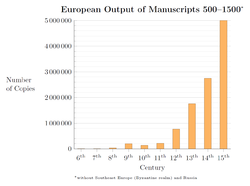 European output of manuscripts 500–1500 (from History of books)
 -
 Rebacking saving original spine, showing one volume finished and one untouched (from Bookbinding)
 -
 Early medieval bookcase containing about ten codices depicted in the Codex Amiatinus (c. 700) (from Bookbinding)
 -
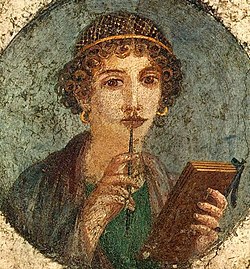 Woman holding wax tablets in the form of the codex. Wall painting from Pompeii, before 79 CE. (from History of books)
 -
 The spine of the book is an important aspect in book design, especially in the cover design. When the books are stacked up or stored in a shelf, the details on the spine is the only visible surface that contains the information about the book. In a book store, it is often the details on the spine that attract the attention first. (from Book design)
 -
 The intricate frontispiece of the Diamond Sutra from Tang dynasty China, i.e. 868 CE, the oldest known dated printed book in the world (British Library) (from History of books)
 -
 Photograph of a printing press in Egypt, c. 1922 (from History of books)
 -
Modern book spine designs (from Bookbinding)
-
 Hardbound book spine stitching (from Bookbinding)
 -
 9th-century Qur'an in Reza Abbasi Museum (from Bookbinding)
 -
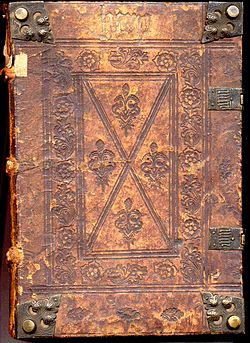 A 15th-century incunable. Notice the blind-tooled cover, corner bosses, and clasps. (from History of books)
 -
 The Book of the Dead of Hunefer, c. 1275 BCE, ink and pigments on papyrus, in the British Museum (London) (from History of books)
 -
 Modern paperback spines (from Bookbinding)
 -
 The scene in Botticelli's Madonna of the Book (1480) reflects the presence of books in the houses of richer people in his time. (from History of books)
 -
 Cloth book cover with attached paper panel, mimicking half leather binding (from Bookbinding)
 -
 A Sumerian clay tablet, currently housed in the Oriental Institute at the University of Chicago, inscribed with the text of the poem Inanna and Ebih by the priestess Enheduanna, the first author whose name is known
 -
 Chinese Bookseller, illustration, c. 1824 (from History of books)
 -
 Book conservators at the State Library of New South Wales, 1943 (from Bookbinding)
 -
 Decorative binding with figurehead of the 12th century manuscript Liber Landavensis (from Bookbinding)
 -
 Page spread with J. A. van de Graaf's construction of classical text area (print space) and margin proportions (from Book design)
 -
 Bookbinder's type holder (from Bookbinding)
 -
 Design by Hans Holbein the Younger for a metalwork book cover (or treasure binding) (from Book design)
 -
 Illustration from the Codex Manesse, a German book from the Middle Ages (from History of books)
 -
 Traditionally sewn book opened flat (from Bookbinding)
 -
 European output of books 500–1800 (from History of books)
 -
 Folio from the Shah Jahan Album, c. 1620, depicting the Mughal Emperor Shah Jahan (from History of books)
 -
 An author portrait of Jean Miélot writing his compilation of the Miracles of Our Lady, one of his many popular works. (from History of books)
 -
 A traditional bookbinder at work (from Bookbinding)
 -
 A Chinese bamboo book, The Art of War, commissioned by the Qianlong Emperor in 18th-century China (from History of books)
 -
 12-metre-high (40 ft) sculpture of a stack of books at the Berlin Walk of Ideas, commemorating the invention of modern book printing (from History of books)
 -
Three books with different titling orientations:
ascending (left); descending (middle); upright (right) (from Book design)


.jpg)


_-_Google_Art_Project.jpg)


.jpg)


Books lists
WikiProjects
Categories

Things you can do

- Find news articles regarding notable books and add them to the "In the news" section.
- Expand this portal and book-related articles: List of Jamaican books
- Create new articles: Lists of books provides a comprehensive list of notable books, many of which have no articles.
- Add references: List of CEO books, List of anonymously published works
- Make this portal more complete:
- Add {{WPBooks}} to the Talk pages of articles about notable books – but try to add an initial Assessment from the Wikipedia:WikiProject_Books
- Add
{{Portal|Books}}to appropriate articles within the subject
- Anything else you can think of doing.
Web resources
- Bookbinding and the Conservation of books, A Dictionary of Descriptive Terminology, 1982 by Matt T. Roberts and Don Etherington
- IOBA glossary of book terms
- Project Gutenberg - Free e-Books
- Words at Large: The best in books from CBC.ca
- please add more!
Associated Wikimedia
The following Wikimedia Foundation sister projects provide more on this subject:
-
 Commons
Free media repository -
 Wikibooks
Free textbooks and manuals -
 Wikidata
Free knowledge base -
 Wikinews
Free-content news -
 Wikiquote
Collection of quotations -
 Wikisource
Free-content library -
 Wikispecies
Directory of species -
 Wikiversity
Free learning tools -
 Wikivoyage
Free travel guide -
 Wiktionary
Dictionary and thesaurus


- ^ Hagen 1997, p. 95.