
In computational complexity theory, SP
2 is a complexity class, intermediate between the first and second levels of the polynomial hierarchy. A language L is in if there exists a polynomial-time predicate P such that

- If , then there exists a y such that for all z, ,
- If , then there exists a z such that for all y, ,

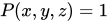

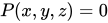
where size of y and z must be polynomial of x.
Relationship to other complexity classes
editIt is immediate from the definition that SP
2 is closed under unions, intersections, and complements. Comparing the definition with that of and , it also follows immediately that SP
2 is contained in . This inclusion can in fact be strengthened to ZPPNP.[1]
Every language in NP also belongs to SP
2. For by definition, a language L is in NP, if and only if there exists a polynomial-time verifier V(x,y), such that for every x in L there exists y for which V answers true, and such that for every x not in L, V always answers false. But such a verifier can easily be transformed into an SP
2 predicate P(x,y,z) for the same language that ignores z and otherwise behaves the same as V. By the same token, co-NP belongs to SP
2. These straightforward inclusions can be strengthened to show that the class SP
2 contains MA (by a generalization of the Sipser–Lautemann theorem) and (more generally, ).
Karp–Lipton theorem
editA version of Karp–Lipton theorem states that if every language in NP has polynomial size circuits then the polynomial time hierarchy collapses to SP
2. This result yields a strengthening of Kannan's theorem: it is known that SP
2 is not contained in SIZE(nk) for any fixed k.
Symmetric hierarchy
editAs an extension, it is possible to define as an operator on complexity classes; then . Iteration of operator yields a "symmetric hierarchy"; the union of the classes produced in this way is equal to the Polynomial hierarchy.
References
edit- Canetti, Ran (1996). "More on BPP and the polynomial-time hierarchy". Information Processing Letters. 57 (5). Elsevier: 237–241. doi:10.1016/0020-0190(96)00016-6.
- Russell, Alexander; Sundaram, Ravi (1998). "Symmetric alternation captures BPP". Computational Complexity. 7 (2). Birkhäuser Verlag: 152–162. doi:10.1007/s000370050007. ISSN 1016-3328. S2CID 15331219.
External links
edit- Complexity Zoo: S2P
- Complexity Class of the Week: S2P, Lance Fortnow, August 28, 2002.