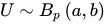
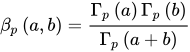
In statistics, the matrix variate beta distribution is a generalization of the beta distribution. It is also called the MANOVA ensemble and the Jacobi ensemble.
Mitra proves the following theorem which illustrates a useful property of the matrix variate beta distribution. Suppose are independent Wishart matrices . Assume that is positive definite and that . If
where , then has a matrix variate beta distribution . In particular, is independent of .
Potters, Marc; Bouchaud, Jean-Philippe (2020-11-30). "7. The Jacobi Ensemble". A First Course in Random Matrix Theory: for Physicists, Engineers and Data Scientists. Cambridge University Press. doi:10.1017/9781108768900. ISBN978-1-108-76890-0.
Forrester, Peter (2010). "3. Laguerre and Jacobi ensembles". Log-gases and random matrices. London Mathematical Society monographs. Princeton: Princeton University Press. ISBN978-0-691-12829-0.
Anderson, G.W.; Guionnet, A.; Zeitouni, O. (2010). "4. Some generalities". An introduction to random matrices. Cambridge: Cambridge University Press. ISBN978-0-521-19452-5.
Mehta, M.L. (2004). "19. Matrix ensembles and classical orthogonal polynomials". Random Matrices. Amsterdam: Elsevier/Academic Press. ISBN0-12-088409-7.
Gupta, A. K.; Nagar, D. K. (1999). Matrix Variate Distributions. Chapman and Hall. ISBN1-58488-046-5.
Khatri, C. G. (1992). "Matrix Beta Distribution with Applications to Linear Models, Testing, Skewness and Kurtosis". In Venugopal, N. (ed.). Contributions to Stochastics. John Wiley & Sons. pp. 26–34. ISBN0-470-22050-3.
Mitra, S. K. (1970). "A density-free approach to matrix variate beta distribution". The Indian Journal of Statistics. Series A (1961–2002). 32 (1): 81–88. JSTOR25049638.