A childhood memory. During my early teen years, I had the zechus of spending time with the Satmar Rebbe, Rav Yoel Teitelbaum, during summers in Sharon Springs, NY. Many tzaddikim and Holocaust survivors flocked there for the healing powers of the sulfur baths. My father seemed to be friendly with his legendary gabbai, Reb Yossel Ashkenazi, and he somehow arranged for us to have seats near the rebbe at seudah shlishis.
At one of those wonderful events, the rebbe delivered what I later heard was one of his well-known teachings. The Torah speaks of Rosh Hashanah in what appears to be contradictory ways. The posuk (Devorim 11:12) says that Eretz Yisroel is “a Land that Hashem, your G-d seeks out; the eyes of Hashem, your G-d, are always upon it, from the beginning of the year to year’s end.” The rebbe pointed out that at first, the Torah calls it “the year,” and then just “year.” He smiled and explained gently but firmly: “Many people say that ‘this year I will be different’ and ‘this will be the year that I…’ Then, Rosh Hashanah comes around, even Yom Kippur, and nothing has changed. All the plans, hopes and even promises have disappeared like the wind.” He concluded that “our goal must be to truly make this the year of absolute change.”
This year, I have already had such a moment based upon the rebbe’s admonition. There is a line from Rav Mendel Vitepsker about Erev Rosh Hashanah. Every day we ask in Shemoneh Esrei, “Bless on our behalf — O Hashem our G-d — this year…” It would seem that at some point, we should begin asking for “next year,” since the year was almost over. But this holds true most certainly on Erev Rosh Hashanah. When the previous year only has moments left, we should certainly switch to praying for the new year. Rav Mendel’s answer was that “in a brief moment of proper davening, we can be mesakein (rectify) the entire previous year.”
I must confess that in previous years, I have always shared this beautiful thought in my shul on Erev Rosh Hashanah just before Mincha. However, this year, I discovered that perhaps I have been waiting too long. Rav Meilech Biderman (Be’er Hachaim, Elul/Tishrei, page 38-39) goes much further. He quotes from several great rabbeim, including the Sar Sholom of Belz and the Ahavas Yisroel of Vizhnitz, that since yeshuas Hashem keheref ayin (Hashem can bring salvation in a split second), our mandate is to “ask Hashem for help every second of our lives.”
With this in mind, I write these words and will, G-d willing, remind my friends much earlier this year about how precious and powerful each and every second is. Perhaps this will be the year that I can make this point early in Elul rather than at the last minute.
However, there is an even deeper message in this minhag of Rav Mendel of Vitepsk. Let us begin with an important teaching from the Chofetz Chaim (Chofetz Chaim At HaTorah, ed. by Rav Shmuel Greineman). The posuk (Bamidbar 5:10) states, “A man’s kodoshov (holies) shall be his and what a man gives to the kohein shall be his.” The word “his” is somewhat ambiguous, but it means that whatever material possessions a person accumulates in this world are only his temporarily. However, what he has accomplished religiously — the Torah he has learned, the mitzvos he has performed, the tzedokah he has given — are his forever.
Rav Yosef Shalom Elyashiv, one of the prime examples of hasmodah and meticulous use of every moment, explained this mandate with a halacha (Sefer Borchi Nafshi by his son-in-law, Rav Yitzchok Zilberstein, Bamidbar, page 115). We know that a goseis, one who is imminently going to pass away, may not be moved and his eyes may not be closed while he is alive. One who does so is considered a murderer. Rav Eyashiv asks: Why is this such a severe sin? After all, the person is going to die anyway very soon!
His answer is crucial, uplifting and frightening at the same time. The goseis, he explains, can still do teshuvah and, in that moment, completely reverse all of the things that he did in his lifetime. He can pass away pure and innocent of any heavenly punishment or spiritual suffering. That is the power of a moment. As Rav Zilberstein concludes, “This should impress upon us the value of a moment in time. We may think, ‘How much can I learn during moments I am waiting in line or for a medical appointment?’ However, it is these moments that can sometimes make all the difference in this word and the next.”
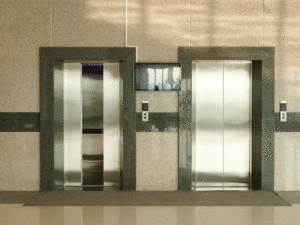
Another aspect of the Elul connection brings us to one of the most positive and productive aspects of this month. A moshol developed by Rav Chizkiyahu Mishkovsky is very helpful. A country bumpkin from the hinterlands is visiting New York for the first time, staring up at the skyscrapers he has never seen before. He enters the front door and begins running up the stairs to see how high this building goes. After several stories, he is panting and out of breath. A kindly resident asks him if he is okay, with the response that he just wants to “get to the top, but it’s impossible.” The New Yorker is shocked at the man’s ignorance, but asks, “Don’t you know what an elevator is?” When the visitor admits that he has no idea, he is shown the tiny room that will instantly transport him to the roof and the view. The nimshol is that Elul is our elevator to the top. The top of our middos, the top of our teshuvah, the top of our growth and the top, hopefully, of a wonderful verdict and judgment.
We must remember that Elul is an eis ratzon, a time propitious for getting where we want to go and to do it in the short span of a month or so. Of course, we will have to use every moment and take advantage of every opportunity. There is the sound of the shofar, the daily recitation of L’Dovid and, eventually, the uplifting words of Selichos. But above all, we can rise high above our mundane all-year selves and become something more.
What more we can become may be illustrated by an extraordinary story published in the biography of Rav Boruch Ber Lebowitz, rosh yeshivas Kamenitz and famed author of the Birkas Shmuel. One of the rosh yeshiva’s well-known traits was his adherence to kibbud av v’eim. When his aged father took seriously ill, Rav Boruch Ber held that he was obligated to attend to him personally day and night. Soon it was too much for the busy gadol and he became quite ill himself. Eventually, his father passed away and Rav Boruch Ber took it as a sign from heaven that he had failed in his mitzvah of kibbud av v’eim. After the shivah, the rosh yeshiva was still inconsolable and the family convinced him to consult with the Chofetz Chaim. Hearing the story, the Chofetz Chaim held Rav Boruch Ber’s hand tightly, repeating over and over, “A nei’er mentch —You are a new person. You are a new person.” Finally, Rav Boruch Ber breathed a sigh of relief and left the elderly sage’s presence consoled and refreshed. He would later often say that the Chofetz Chaim had given him a new lease on life.
Elul can give us all a new lease on life. When the “King is in the field,” He is extending a hand to us. It is not a hand of punishment or admonition. It is the hand of ani leDodi veDodi li. It is the hand of forgiveness and renewal. It is true that the Birkas Shmuel may have needed that hand because he did the right thing and we need it because we have been imperfect. But these are days when Hashem extends His hand in availability, love and conciliation. It is the eis ratzon we want and need, but we must take advantage and not lose the moment. The elevator is waiting. We just have to press the button. Yes, it can be the year, not just any year. This year can still be the zos that will save us and preserve us. It is the heref ayin we have been waiting for. It will be a time of lo yihiyeh, which belongs to us now and forever.
Let’s embrace Elul in all of its glory and grandeur. We will not be sorry that we did.