Post

Log inOpen app

Post

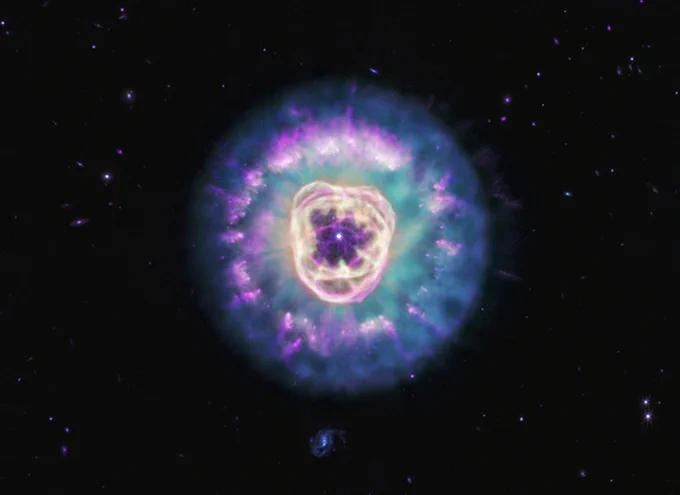
NASA Webb Telescope on X: "It's the circle of life… Webb's look at the Lion Nebula, the remains of a dying lower-mass star, is in both the mid and near-infrared. Though massive stars undergo supernova explosions at the end of their lives, lower-mass stars shed their outer layers."

  • user avatar
    NASA Webb Telescope
    NASA
    @NASAWebb
    It's the circle of life… Webb's look at the Lion Nebula, the remains of a dying lower-mass star, is in both the mid and near-infrared. Though massive stars undergo supernova explosions at the end of their lives, lower-mass stars shed their outer layers.
    Webb’s near and mid infrared combined image of planetary nebula NGC 2392, the Lion Nebula, against the black background of space. The nebula is at center, circular in shape, and looks like a male lion’s head. In the center is a small, pinkish-white circle with eight-point diffraction spikes, a white dwarf star. Surrounding the star are purple-pink cavernous bubbles and shell-like rings. The bubbles and shells collectively form an oval with two small, wide arcs near the top, reminiscent of a lion’s face and its ears. What appears to be extended outward from the lion’s face is a thick ring of purple-blue material. The width of the ring is consistent throughout and resembles a mane. The area closest to the lion’s face looks cloudy, while the edges of the mane look like there are clumps of dust with comet-like tails. In the background are distant galaxies and stars. Some galaxies are yellow and orange points of light and others have spiral structures. Some stars have diffraction spikes.
    2:15 PM · Aug 10, 2026131.7KViews
    68
    615
    3.4K
    274
  • user avatar
    NASA Webb Telescope
    NASA
    @NASAWebb
    Aug 10
    In the Lion Nebula’s case, its white dwarf is “cooking” everything from the inside and producing a bubble of ionized gas as it does. The gas bubble, which forms the lion’s face, is expanding over time and destroying dust that is in its path.
    2
    13
    208
    34K
    user avatar
    NASA Webb Telescope
    NASA
    @NASAWebb
    Aug 10
    Understanding why the swept-up gas has a complex structure of rings and shells, a common feature in nebula of this kind, is an ongoing endeavor. go.nasa.gov/4q7swQV (This view is Webb's Lion Nebula in mid-infrared light alone.)
    The Lion Nebula, against the black background of space. The nebula is in the center, circular in shape, and looks like a male lion’s head. In the very center is a small, bluish-white circle with eight-point diffraction spikes, a white dwarf star. Surrounding the star are light purple-red cavernous bubbles and shell-like rings. The bubbles and shells collectively form an oval with two small, wide arcs near the top, reminiscent of a lion’s face and its ears. What appears to be extended outward from the lion’s face is a thick ring of cyan material. The width of the ring is consistent throughout and resembles a mane. The area closest to the lion’s face looks cloudy, while the edges of the mane look like there are purple clumps of dust with comet-like tails and strands. In the background are distant galaxies and stars. Some galaxies appear as small purple points of light and others with visible blue spiral structures. A couple of the stars have diffraction spikes.
    3
    28
    283
    32K
  • user avatar
    LilHumansBigImpact
    @BigImpactHumans
    Aug 10
    Reminds me of the early stages of cellular life… a Zygote
    10
    483
Avatar

See this post in the app

Use the app to view all comments and discover more posts.

Open X