Loading...
| John Rogers is managed by the England Project. Join: England Project Discuss: england |

Contents |
Biography
Birth and Parentage

Education
John Rogers studied at Pembroke Hall (now Pembroke College), Cambridge[1], gaining a BA degree in 1525/1526.[4]
Priest
From 1532 to 1534 John Rogers was Rector of Holy Trinity the Less, London. He resigned in 1534, and became chaplain to English merchants in Antwerp.[1][4]
Matthew's Bible
In Antwerp he became a close associate of William Tyndale. When Tyndale was arrested in 1535, with his property being confiscated, John Rogers managed somehow to safeguard the manuscript of his translation of large parts of the Old Testament. He put this together with his own revision of Myles Coverdale's translation of the rest of the Old Testament and with the 1534 revised version of the Tyndale translation of the New Testament. The resulting complete Bible was printed in Antwerp in 1537. Because Tyndale was regarded as a heretic, his name could not be safely associated with it, so it was issued under the names of Thomas and Matthew, two of Jesus's disciples, and came to be known as "Matthew's Bible", which was approved for use in English churches in 1537. It was further revised by Coverdale, and became the "Great Bible" which was ordered to be placed in every church in England.[1]
Marriage and Children
John Rogers married Adriana de Weyden of Brabant[5], also known as Adriana Pratt,[3][6] in 1536 or 1537.[1][5] (Her last name at birth was de Weyden, and Weyden in Dutch meant 'meadow'; Pratt was an anglicisation as it could also mean 'meadow'.) According to John Foxe, shortly before his execution in 1555, John Rogers said he had been married eighteen years.[7]
The Visitations of Warwickshire in Harleian MS 1563[8] and the 1634 Visitation of Middlesex list eleven children. In the order given in the Warwickshire Visitations (which is probably not their birth order[9]), they are:
- Daniel[3][10]
- John[3][10][11]
- Ambrose[3][10], described in his brother Daniel's will as Daniel's youngest brother[12]
- Samuel[3][10]
- Philip[3][10]
- Bernard[3][10]
- Augustine[3][10]
- Barnaby[3][10]
- Susan[3][10][13]
- Elizabeth[3][10]
- Hester[3][10]
Germany
In 1540 John Rogers moved to Wittenberg, Germany, where he made the close acquaintance of leading Lutherans, including Philip Melanchthon. In later years he translated several works of Melanchthon. He became one of the superintendents of a church in NW Germany and then, in late 1543, pastor of the Lutheran church at Meldorf, Germany. In a letter of 1547, written from Meldorf, he advocated confining the death penalty to cases of murder.[1]
Return to England
The accession of Edward VI opened up the possibility of John Rogers returning to England, and he was back in London by August 1548. In October 1548 he was appointed Rector of St Matthew's, Friday Street, London.[1] Further church appointments followed:
- 10 May 1550: Rector of St Margaret Moyses, Friday Street, London[1]
- 13 May 1550: Vicar of St Sepulchre, London[1]
- 27 August 1551: Prebend of St Pancras, St Paul's Cathedral, London (this led to his giving up the livings in Friday Street)[1]
- Lecturer in Divinity, St Paul's Cathedral[1]
In 1552 his wife and the children who were born in Germany were naturalised.[1]
Final Years and Death
Following the accession of Mary I, he was ordered to stay confined to his house as a "seditious preacher". He was deprived of the Prebend of St Pancras, and of the income from his living at St Sepulchre.[1]
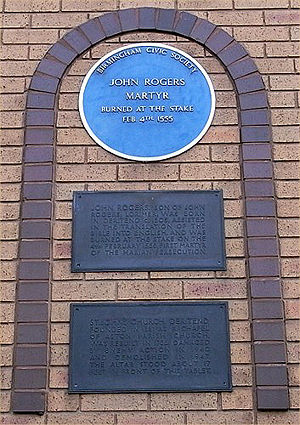
Although he had opportunities to flee to continental Europe, he did not take advantage of them. After five months of house arrest, he was sent to Newgate. After the re-enactment of laws allowing the execution of heretics, he was tried as a heretic in January 1555, and condemned on 29 January 1555. He asked to be allowed to speak to his wife but this request was denied.[1] He was burnt at the stake at Smithfield, London on 4 February 1555, becoming the first of the Protestant martyrs of the reign of Mary I.[1][4] His wife and all his children were present at his execution.[1] Henry Machyn’s diary states that there was a ”grett compene [company] of the gard” at his execution.[14]
His wife and his oldest son Daniel retrieved letters and papers from his prison cell after his death.[15]
Memorial
There is a memorial to John Rogers at the Marian Martyrs' Monument, London. [16]
Research Notes
Date of Birth
An unsourced birthdate of 4 February 1507 (is this 1506/7 or 1507/8?) is widely used in internet trees. There were no parish registers at this time and no primary source has been found to substantiate this date as either a birthdate or baptism date. This profile uses the date of "about 1500" used by the Oxford Dictionary of National Biography.
Number of Children
John Foxe's near-contemporary account of John Rogers' martyrdom says that John and Adriana had eleven children: "ten able to go [i.e. to walk], and one sucking on her breast".[17] This accords with the number of children listed in the Warwickshire and Middlesex Visitations. But John Rogers himself said shortly before his execution, "nowe haue I bene a full yere in Newgate, at great costes and charges, hauyng a wyfe and x children".[18] Joseph Lemuel Chester gives a possible explanation of this discrepancy: John Rogers mentions the pregnancy of his wife in about Christmas 1553; John was moved to Newgate on 27 January 1554; and he may well have been cut off from news of his family while there (he complained about being kept in isolation and refused family visits[18][19]): so the first time he may have known for certain that his wife had given birth while he was in prison may have been when his family saw him on his way to his execution.[17]
Misattributed Children
Besides the children listed above, three other children with Wikitree profiles are sometimes, wrongly, ascribed to John Rogers:
- Beverley Rogers. Almost certainly no such person existed; perhaps she is a misreading of "Barnaby".
- William Rogers II of Watford. This is an attempt to "fix" the discredited descent of Thomas Rogers, the Pilgrim Father from John the Martyr.
- Elizabeth Eyre née Rogers. Sometimes said to be the daughter of a John Rogers, but one from Poole (though in fact this is likely wrong).
Birthplace of Children
Joseph Lemuel Chester in his book on John Rogers says that eight of his children were born in Germany.[5]
Sources
- ↑ 1.00 1.01 1.02 1.03 1.04 1.05 1.06 1.07 1.08 1.09 1.10 1.11 1.12 1.13 1.14 1.15 1.16 Oxford Dictionary of National Biography, entry for 'Rogers, John (c. 1500–1555)', print and online 2004
- ↑ 2.0 2.1 Wikipedia: John Rogers (Bible editor and martyr)
- ↑ 3.00 3.01 3.02 3.03 3.04 3.05 3.06 3.07 3.08 3.09 3.10 3.11 3.12 Sir George John Armitage (ed.). Middlesex pedigrees as collected by Richard Mundy in Harleian MS No. 1551 (the Visitation of Middlesex, 1634), Harleian Society, Vol. LXV, 1984, pp. 84-85, pedigree for Rogers of Sunbury, Internet Archive
- ↑ 4.0 4.1 4.2 Alumni Cantabrigienses, Cambridge University Press, 1922-1954, Ancestry.co.uk
- ↑ 5.0 5.1 5.2 Joseph Lemuel Chester. John Rogers: the compiler of the first authorised English Bible ..., London: Longman, Green, Longman, and Roberts, 1861, pp.13-15, Internet Archive
- ↑ Antony à Wood (ed. Philip Bliss). Athenae Oxonienses, London and Oxford 1813, col. 570 (in entry for John Rogers' son Daniel Rogers), Internet Archive
- ↑ John Foxe. The Unabridged Acts and Monuments Online, 1563 edn., bk. 5, 1096, The Acts and Monuments Online, accessed 2 August 2019
- ↑ Harleian MS 1563, The Visitation of the County of Warwick, made in Anno 1563, by Robert Cooke, Chester Herald, for William Hervey, Clarenceux: continued and enlarged, with another Visitation of the same County, made in Anno 1619, by Sampson Leonard, Blue Mantle, and Augustine Vincent, Rouge Rose, Officers of Arms and Deputies to William Camden, Clarenceux, folio 19b, cited in Joseph Lemuel Chester, John Rogers, pp. 222-224, Internet Archive
- ↑ The daughters are listed after all the sons in the Warwickshire Visitations, and the 1634 Visitation of Middlesex has a different order
- ↑ 10.00 10.01 10.02 10.03 10.04 10.05 10.06 10.07 10.08 10.09 10.10 Joseph Lemuel Chester, John Rogers, pp. 222-224, Internet Archive
- ↑ Oxford Dictionary of National Biography, entry for 'Rogers, John (b. c. 1540, d. in or after 1603)', print 2004, revised online 2005, available online via some libraries
- ↑ Will of Daniel Rogers, proved 11 February 1590/91, the National Archives; Kew, England; Prerogative Court of Canterbury and Related Probate Jurisdictions: Will Registers; Class: PROB 11; Piece: 77, image at Ancestry.co.uk
- ↑ Susan's burial record in J M S Brooke and A W C Hallen,The Transcript of the Registers of the United Parishes of S Mary Woolnoth and S Mary Woolchurch haw, Bowles and Sons 1886, p. 188, Internet Archive: "29 September 1565. Suzanna, wief of William Shorte, Grocer, and daughter to Mr. Rogers, late burned in Smithfield"
- ↑ John Gough Nichols (ed.). The Diary of Henry Machyn, Citizen and Merchant-Taylor of London from A.D. 1550 to A.D. 1563, Camden Society, 1848, p. 81, Internet Archive
- ↑ Oxford Dictionary of National Biography, entry for 'Rogers, Daniel (c. 1538–1591)', 2004, revised online 2008, available online through some libraries
- ↑ Find a Grave, database and images (https://www.findagrave.com/memorial/254134116/john-rogers: accessed August 28, 2025), memorial page for Rev John Rogers (1507–4 Feb 1555), Find A Grave: Memorial #254134116 Maintained by Becka Cross (contributor 49775231).
- ↑ 17.0 17.1 Joseph Lemuel Chester, John Rogers, pp 231-232, Internet Archive.
- ↑ 18.0 18.1 John Foxe. The Unabridged Acts and Monuments Online, 1563 edn., bk. 5, 1096, The Acts and Monuments Online, accessed 2 August 2019
- ↑ John Foxe. The Unabridged Acts and Monuments Online, 1563 edn., bk. 5, 1099, The Acts and Monuments Online
- Oxford Dictionary of National Biography, entry for 'Rogers, John (c. 1500–1555)', print and online 2004, available online via some libraries
- Dictionary of National Biography, 1885-1900, Vol. 49, entry for 'Rogers, John (1500?-1555)', Wikisource
- Wikipedia: John Rogers (Bible editor and martyr)
- Armitage, Sir George John (ed.). Middlesex pedigrees as collected by Richard Mundy in Harleian MS No. 1551 (the Visitation of Middlesex, 1634), Harleian Society, Vol. LXV, 1984, pp. 84-85, pedigree for Rogers of Sunbury, Internet Archive
- Venn, J A. Alumni Cantabrigienses, Cambridge University Press, 1922-1954, Ancestry.co.uk
- Robert K. Dent, "John Rogers of Deritend, Scholar and Martyr," in Transactions of the Birmingham and Warwickshire Archaeological Society, Vol. 21, 1895,, Google Books
- Joseph Hill, The book makers of old Birmingham: authors, printers, and book sellers (1907).
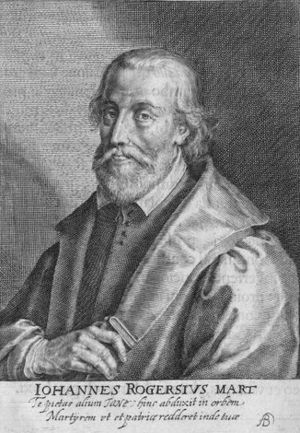
- Picture of John Rogers -Willem van de Passe
- Cutter, William Richard, A. M., Genealogy - Boston and Eastern Massachusetts (Lewis Historical Publishing Company, New York, 1908)
- Chester, Joseph Lemuel. (1861) John Rogers: the compiler of the first authorised English Bible ..., London: Longman, Green, Longman, and Roberts, 1861, Internet Archive
- Chalmers, Alexander. The General Biographical Dictionary, J Nichols and Son, London, 1812-1817, entry for John Rogers, Vol.26, pp.332-333.Ancestry.co.uk
- Frost, Josephine C, Ancestors of Amyntas Shaw and His Wife Lucy Tufts Williams, privately printed, 1920, pp. 27-28, Internet Archive
- ‘John the Martyr’, from Foxe's Acts and Monuments and Burnet's History of the Reformation, Ancestry.com, accessed 31 July 2019
- Images of pages from editions of Foxe’s Book of Martyrs:
- Ancestry.com, accessed 31 July 2019
- Ancestry.com, accessed 31 July 2019
Acknowledgements
Rogers-9689 was created by David McKnight through the import of Beadle-McKnight_2014-06-21a.ged on Jun 24, 2014.