bivalve
(redirected from Bivalves)Also found in: Thesaurus, Medical, Encyclopedia.
Related to Bivalves: Pelecypoda
bi·valve
(bī′vălv′)n.
Any of numerous freshwater and marine mollusks of the class Bivalvia, having a shell consisting of two hinged valves connected by a ligament, and including the clams, mussels, oysters, and scallops. Also called lamellibranch, pelecypod.
adj.
1. Having a shell consisting of two hinged valves.
2. Consisting of two similar separable parts.
bi′valved′ adj.
American Heritage® Dictionary of the English Language, Fifth Edition. Copyright © 2016 by Houghton Mifflin Harcourt Publishing Company. Published by Houghton Mifflin Harcourt Publishing Company. All rights reserved.
bivalve
(ˈbaɪˌvælv)n
(Zoology) Also: pelecypod or lamellibranch any marine or freshwater mollusc of the class Pelecypoda (formerly Bivalvia or Lamellibranchia), having a laterally compressed body, a shell consisting of two hinged valves, and gills for respiration. The group includes clams, cockles, oysters, and mussels
adj
1. (Zoology) Also: pelecypod or lamellibranch of, relating to, or belonging to the Pelecypoda
2. (Zoology) biology Also: bivalvate having or consisting of two valves or similar parts: a bivalve seed capsule.
biˈvalvular adj
Collins English Dictionary – Complete and Unabridged, 12th Edition 2014 © HarperCollins Publishers 1991, 1994, 1998, 2000, 2003, 2006, 2007, 2009, 2011, 2014
bi•valve
(ˈbaɪˌvælv)n.
1. any mollusk, as the oyster or mussel, of the class Bivalvia, having hinged lateral shells, a soft body enclosed by a mantle, sheetlike gills, and often a retractile foot.
adj. 2. having two shells, usu. united by a hinge.
3. having two similar parts hinged together.
[1670–80]
Random House Kernerman Webster's College Dictionary, © 2010 K Dictionaries Ltd. Copyright 2005, 1997, 1991 by Random House, Inc. All rights reserved.
bi·valve
(bī′vălv′) A mollusk, such as a clam or oyster, whose shell consists of two halves hinged together. Compare univalve.
The American Heritage® Student Science Dictionary, Second Edition. Copyright © 2014 by Houghton Mifflin Harcourt Publishing Company. Published by Houghton Mifflin Harcourt Publishing Company. All rights reserved.
ThesaurusAntonymsRelated WordsSynonymsLegend:
Switch to new thesaurus
| Noun | 1. | 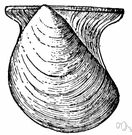 bivalve - marine or freshwater mollusks having a soft body with platelike gills enclosed within two shells hinged together bivalve - marine or freshwater mollusks having a soft body with platelike gills enclosed within two shells hinged togethermollusc, mollusk, shellfish - invertebrate having a soft unsegmented body usually enclosed in a shell Bivalvia, class Bivalvia, class Lamellibranchia, class Pelecypoda, Lamellibranchia - oysters; clams; scallops; mussels clam - burrowing marine mollusk living on sand or mud; the shell closes with viselike firmness cockle - common edible, burrowing European bivalve mollusk that has a strong, rounded shell with radiating ribs oyster - marine mollusks having a rough irregular shell; found on the sea bed mostly in coastal waters ark shell - marine bivalve mollusk having a heavy toothed shell with a deep boat-like inner surface blood clam - red-blooded clam mussel - marine or freshwater bivalve mollusk that lives attached to rocks etc. escallop, scollop, scallop - edible marine bivalve having a fluted fan-shaped shell that swim by expelling water from the shell in a series of snapping motions piddock - marine bivalve that bores into rock or clay or wood by means of saw-like shells |
| Adj. | 1. |  bivalve - used of mollusks having two shells (as clams etc.) bivalve - used of mollusks having two shells (as clams etc.)zoological science, zoology - the branch of biology that studies animals univalve - used of mollusks, especially gastropods, as snails etc. |
Based on WordNet 3.0, Farlex clipart collection. © 2003-2012 Princeton University, Farlex Inc.
Translations
Collins Spanish Dictionary - Complete and Unabridged 8th Edition 2005 © William Collins Sons & Co. Ltd. 1971, 1988 © HarperCollins Publishers 1992, 1993, 1996, 1997, 2000, 2003, 2005
Collins German Dictionary – Complete and Unabridged 7th Edition 2005. © William Collins Sons & Co. Ltd. 1980 © HarperCollins Publishers 1991, 1997, 1999, 2004, 2005, 2007