The UK employeebenefits landscape (November 2025) 1
The UK employee benefits landscape
Data and insights to inform your employee
benefits decision-making
November 2025
2.
The UK employeebenefits landscape (November 2025) 2
What’s inside?
Technology
6
The UK employee benefits landscape 2
Introduction
3 10 Health
16 Wellbeing
37 Next steps
21 Protection 27 Pensions
3.
The UK employeebenefits landscape 3
Introduction Technology Health Wellbeing Protection Pensions
What’s inside? Next steps
Introduction
What this report’s all about
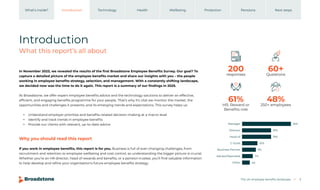
In November 2023, we revealed the results of the first Broadstone Employee Benefits Survey. Our goal? To
capture a detailed picture of the employee benefits market and share our insights with you – the people
working in employee benefits strategy, selection, and management. With a constantly shifting landscape,
we decided now was the time to do it again. This report is a summary of our findings in 2025.
At Broadstone, we offer expert employee benefits advice and the technology solutions to deliver an effective,
efficient, and engaging benefits programme for your people. That’s why it’s vital we monitor the market, the
opportunities and challenges it presents, and its emerging trends and expectations. This survey helps us:
ب Understand employer priorities and benefits-related decision-making at a macro-level
ب Identify and track trends in employee benefits
ب Provide our clients with relevant, up-to-date advice
Why you should read this report
If you work in employee benefits, this report is for you. Business is full of ever-changing challenges, from
recruitment and retention to employee wellbeing and cost control, so understanding the bigger picture is crucial.
Whether you’re an HR director, head of rewards and benefits, or a pension trustee, you’ll find valuable information
to help develop and refine your organisation’s future employee benefits strategy.
Manager
Director
Head of
C-Suite
Business Partner
Advisor/Specialist
Other
19%
32%
19%
10%
9%
7%
5%
60+
Questions
48%
250+ employees
61%
HR, Reward or
Benefits role
200
responses
4.
The UK employeebenefits landscape 4
Introduction Technology Health Wellbeing Protection Pensions
What’s inside? Next steps
Introduction
Recent challenges, future priorities
Autumn 2024 budget impacts
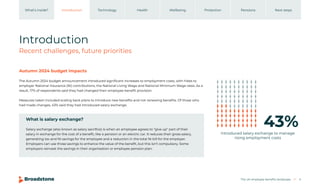
The Autumn 2024 budget announcement introduced significant increases to employment costs, with hikes to
employer National Insurance (NI) contributions, the National Living Wage and National Minimum Wage rates. As a
result, 17% of respondents said they had changed their employee benefit provision.
Measures taken included scaling back plans to introduce new benefits and not renewing benefits. Of those who
had made changes, 43% said they had introduced salary exchange.
What is salary exchange?
Salary exchange (also known as salary sacrifice) is when an employee agrees to “give up” part of their
salary in exchange for the cost of a benefit, like a pension or an electric car. It reduces their gross salary,
generating tax and NI savings for the employee and a reduction in the total NI bill for the employer.
Employers can use those savings to enhance the value of the benefit, but this isn’t compulsory. Some
employers reinvest the savings in their organisation or employee pension plan.
Introduced salary exchange to manage
rising employment costs
43%
5.
The UK employeebenefits landscape 5
Introduction Technology Health Wellbeing Protection Pensions
What’s inside? Next steps
Employers who don’t provide healthcare benefits are reliant on an NHS system where employees face huge
challenges in securing timely GP appointments, along with long waits to see specialists and receive treatment.
This all has an impact on sickness absence rates, performance, and ultimately, productivity.
According to the Office of National Statistics, sickness absence rates are at a 15-year high. Helping your people to
understand and improve their physical and emotional health reduces employee stress, improves productivity, and
therefore lowers the costs of sickness absence and presenteeism.
Looking ahead
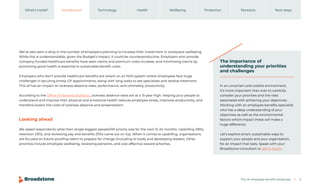
We asked respondents what their single biggest people/HR priority was for the next 12–24 months. Upskilling (18%),
retention (15%), and reviewing pay and benefits (15%) came out on top. When it comes to upskilling, organisations
are focused on future-proofing talent to prepare for change (including AI tools) and developing leaders. Other
priorities include employee wellbeing, reviewing pensions, and cost-effective reward schemes.
The importance of
understanding your priorities
and challenges
In an uncertain and volatile environment,
it’s more important than ever to carefully
consider your priorities and the risks
associated with achieving your objectives.
Working with an employee benefits specialist
who has a deep understanding of your
objectives as well as the environmental
factors which impact these will make a
huge difference.
Let’s explore smart, sustainable ways to
support your people and your organisation,
for an impact that lasts. Speak with your
Broadstone consultant or get in touch.
We’ve also seen a drop in the number of employers planning to increase their investment in workplace wellbeing.
While this is understandable, given the Budget’s impact, it could be counterproductive. Employers who provide
company-funded healthcare benefits have seen claims and premium costs increase, and minimising claims by
promoting good health is essential to sustainable benefit costs.
6.
The UK employeebenefits landscape 6
Introduction Technology Health Wellbeing Protection Pensions
What’s inside? Next steps
Technology
Benefits technology uses and trends
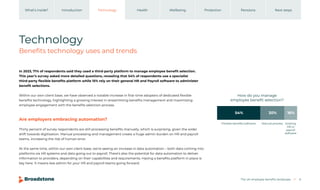
In 2023, 71% of respondents said they used a third-party platform to manage employee benefit selection.
This year’s survey asked more detailed questions, revealing that 54% of respondents use a specialist
third-party flexible benefits platform while 15% rely on their general HR and Payroll software to administer
benefit selections.
Within our own client base, we have observed a notable increase in first-time adopters of dedicated flexible
benefits technology, highlighting a growing interest in streamlining benefits management and maximising
employee engagement with the benefits selection process.
Are employers embracing automation?
Thirty percent of survey respondents are still processing benefits manually, which is surprising, given the wider
shift towards digitisation. Manual processing and management create a huge admin burden on HR and payroll
teams, increasing the risk of human error.
At the same time, within our own client base, we’re seeing an increase in data automation – both data coming into
platforms via HR systems and data going out to payroll. There’s also the potential for data automation to deliver
information to providers, depending on their capabilities and requirements. Having a benefits platform in place is
key here. It means less admin for your HR and payroll teams going forward.
How do you manage
employee benefit selection?
Flexible benefits software Manual process Existing
HR or
payroll
software
54% 30% 16%
7.
The UK employeebenefits landscape 7
Introduction Technology Health Wellbeing Protection Pensions
What’s inside? Next steps
How are organisations using benefits software?
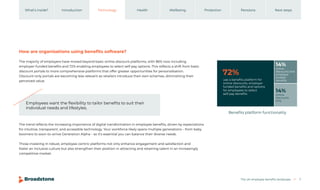
The majority of employers have moved beyond basic online discount platforms, with 86% now including
employer-funded benefits and 72% enabling employees to select self-pay options. This reflects a shift from basic
discount portals to more comprehensive platforms that offer greater opportunities for personalisation.
Discount-only portals are becoming less relevant as retailers introduce their own schemes, diminishing their
perceived value.
The trend reflects the increasing importance of digital transformation in employee benefits, driven by expectations
for intuitive, transparent, and accessible technology. Your workforce likely spans multiple generations – from baby
boomers to soon-to-arrive Generation Alpha – so it’s essential you can balance their diverse needs.
Those investing in robust, employee-centric platforms not only enhance engagement and satisfaction and
foster an inclusive culture but also strengthen their position in attracting and retaining talent in an increasingly
competitive market.
Employees want the flexibility to tailor benefits to suit their
individual needs and lifestyles.
5
Benefits platform functionality
72%
14%
14%
use a benefits platform for
online discounts, employer
funded benefits and options
for employees to select
self-pay benefits
online
discounts and
employer
funded
benefits
online
discounts
only
8.
The UK employeebenefits landscape 8
Introduction Technology Health Wellbeing Protection Pensions
What’s inside? Next steps
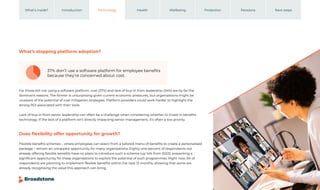
What’s stopping platform adoption?
Does flexibility offer opportunity for growth?
For those still not using a software platform, cost (37%) and lack of buy-in from leadership (34%) are by far the
dominant reasons. The former is unsurprising given current economic pressures, but organisations might be
unaware of the potential of cost mitigation strategies. Platform providers could work harder to highlight the
strong ROI associated with their tools.
Lack of buy-in from senior leadership can often be a challenge when considering whether to invest in benefits
technology. If the lack of a platform isn’t directly impacting senior management, it’s often a low priority.
Flexible benefits schemes – where employees can select from a tailored menu of benefits to create a personalised
package – remain an untapped opportunity for many organisations. Eighty-one percent of respondents not
already offering flexible benefits have no plans to introduce such a scheme (up 14% from 2023), presenting a
significant opportunity for these organisations to explore the potential of such programmes. Right now, 5% of
respondents are planning to implement flexible benefits within the next 12 months, showing that some are
already recognising the value this approach can bring.
37% don’t use a software platform for employee benefits
because they’re concerned about cost.
9.
The UK employeebenefits landscape 9
Introduction Technology Health Wellbeing Protection Pensions
What’s inside? Next steps
Although rising employer costs, such as National Insurance contributions, may be influencing decisions,
this could also be a moment to re-evaluate how the case for flexible benefits is being presented to senior
leaders. Highlighting the advantages of personalisation – where employees can choose benefits that align
with their individual needs and lifestyles – could unlock new engagement and retention opportunities for
forward-thinking organisations.
What do your employees really think?
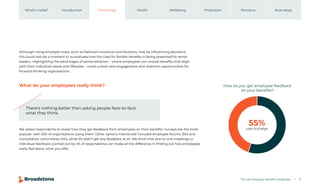
We asked respondents to reveal how they get feedback from employees on their benefits. Surveys are the most
popular, with 55% of organisations using them. Other options mentioned included employee forums (5%) and
consultation committees (4%), while 5% didn’t get any feedback at all. We think that one-to-one meetings or
individual feedback (carried out by 4% of respondents) can make all the difference in finding out how employees
really feel about what you offer.
There’s nothing better than asking people face-to-face
what they think.
How do you get employee feedback
on your benefits?
55%
use surveys
10.
The UK employeebenefits landscape 10
Introduction Technology Health Wellbeing Protection Pensions
What’s inside? Next steps
Health
Healthy benefits, healthy employees
Healthcare benefits, such as private medical insurance (PMI), health cash plans, and dental insurance, are
becoming an essential part of benefits packages – especially in competitive industry sectors – despite fewer
employees receiving company-funded healthcare compared to core benefits like pensions. PMI remains
highly valued as NHS pressures rise, and 4 in 5 survey respondents now offer it.
Is private medical insurance a priority?
Given the relatively small size of the company-funded PMI market compared to pensions or group life, some
volatility in survey findings over time is expected. And this year we’ve seen a slight drop in employers providing
PMI (from 85% in 2023 to 80% in 2025). While many employers are facing cost constraints, the answer may not be
to cut off benefits but rather to optimise them (or redesign them), given that PMI remains a valued benefit for
supporting employee wellbeing and timely healthcare access.
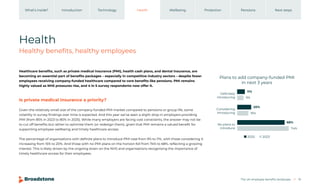
The percentage of organisations with definite plans to introduce PMI rose from 9% to 11%, with those considering it
increasing from 15% to 20%. And those with no PMI plans on the horizon fell from 74% to 68%, reflecting a growing
interest. This is likely driven by the ongoing strain on the NHS and organisations recognising the importance of
timely healthcare access for their employees.
Definitely
introducing
Considering
introducing
No plans to
introduce
Plans to add company-funded PMI
in next 3 years
11%
9%
20%
16%
68%
74%
2025 2023
11.
The UK employeebenefits landscape 11
Introduction Technology Health Wellbeing Protection Pensions
What’s inside? Next steps
How much cover?
Many employers who provide company-funded PMI have seen premiums rise in
recent years, prompting some to consider whether they can afford to continue
funding the benefits. Instead of turning off the tap completely, you could simply
adjust the flow of water by increasing the excess.
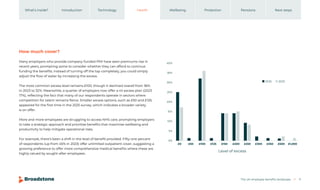
The most common excess level remains £100, though it declined overall from 36%
in 2023 to 32%. Meanwhile, a quarter of employers now offer a nil excess plan (2023:
17%), reflecting the fact that many of our respondents operate in sectors where
competition for talent remains fierce. Smaller excess options, such as £50 and £125,
appeared for the first time in the 2025 survey, which indicates a broader variety
is on offer.
More and more employees are struggling to access NHS care, prompting employers
to take a strategic approach and prioritise benefits that maximise wellbeing and
productivity to help mitigate operational risks.
For example, there’s been a shift in the level of benefit provided. Fifty-one percent
of respondents (up from 45% in 2023) offer unlimited outpatient cover, suggesting a
growing preference to offer more comprehensive medical benefits where these are
highly valued by sought-after employees.
40%
35%
30%
25%
20%
15%
10%
5%
0%
2025 2023
£0 £50 £100 £125 £150 £250 £300 £350 £500 £1,000
£200
Level of excess
12.
The UK employeebenefits landscape 12
Introduction Technology Health Wellbeing Protection Pensions
What’s inside? Next steps
So, what other paid-for health benefits are employers offering?
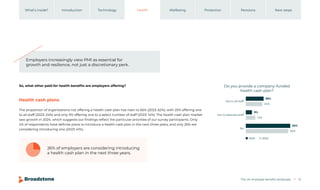
The proportion of organisations not offering a health cash plan has risen to 65% (2023: 62%), with 25% offering one
to all staff (2023: 24%) and only 9% offering one to a select number of staff (2023: 14%). The health cash plan market
saw growth in 2024, which suggests our findings reflect the particular priorities of our survey participants. Only
4% of respondents have definite plans to introduce a health cash plan in the next three years, and only 26% are
considering introducing one (2023: 41%).
Health cash plans
26% of employers are considering introducing
a health cash plan in the next three years.
Yes to all staff
Yes to selected staff
No
Do you provide a company-funded
health cash plan?
26%
24%
9%
14%
65%
62%
2025 2023
Employers increasingly view PMI as essential for
growth and resilience, not just a discretionary perk.
13.
The UK employeebenefits landscape 13
Introduction Technology Health Wellbeing Protection Pensions
What’s inside? Next steps
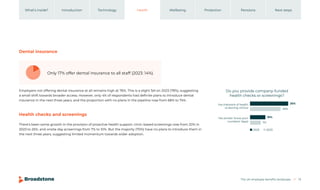
There’s been some growth in the provision of proactive health support: clinic-based screenings rose from 20% in
2023 to 25%, and onsite day screenings from 7% to 10%. But the majority (70%) have no plans to introduce them in
the next three years, suggesting limited momentum towards wider adoption.
Health checks and screenings
Employers not offering dental insurance at all remains high at 76%. This is a slight fall on 2023 (78%), suggesting
a small shift towards broader access. However, only 4% of respondents had definite plans to introduce dental
insurance in the next three years, and the proportion with no plans in the pipeline rose from 68% to 74%.
Dental insurance
Only 17% offer dental insurance to all staff (2023: 14%).
Yes (network of health
screening clinics)
Yes (onsite ‘know your
numbers’ days)
Do you provide company-funded
health checks or screenings?
25%
20%
10%
7%
2025 2023
14.
The UK employeebenefits landscape 14
Introduction Technology Health Wellbeing Protection Pensions
What’s inside? Next steps
Health
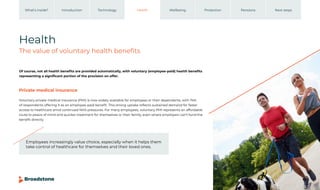
The value of voluntary health benefits
Of course, not all health benefits are provided automatically, with voluntary (employee-paid) health benefits
representing a significant portion of the provision on offer.
Voluntary private medical insurance (PMI) is now widely available for employees or their dependants, with 74%
of respondents offering it as an employee-paid benefit. This strong uptake reflects sustained demand for faster
access to healthcare amid continued NHS pressures. For many employees, voluntary PMI represents an affordable
route to peace of mind and quicker treatment for themselves or their family, even where employers can’t fund the
benefit directly.
Private medical insurance
Employees increasingly value choice, especially when it helps them
take control of healthcare for themselves and their loved ones.
15.
The UK employeebenefits landscape 15
Introduction Technology Health Wellbeing Protection Pensions
What’s inside? Next steps
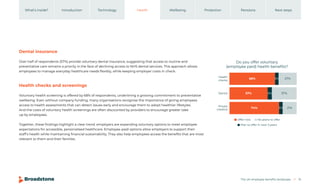
Over half of respondents (57%) provide voluntary dental insurance, suggesting that access to routine and
preventative care remains a priority in the face of declining access to NHS dental services. This approach allows
employees to manage everyday healthcare needs flexibly, while keeping employer costs in check.
Voluntary health screening is offered by 68% of respondents, underlining a growing commitment to preventative
wellbeing. Even without company funding, many organisations recognise the importance of giving employees
access to health assessments that can detect issues early and encourage them to adopt healthier lifestyles.
And the costs of voluntary health screenings are often discounted by providers to encourage greater take
up by employees.
Together, these findings highlight a clear trend: employers are expanding voluntary options to meet employee
expectations for accessible, personalised healthcare. Employee-paid options allow employers to support their
staff’s health while maintaining financial sustainability. They also help employees access the benefits that are most
relevant to them and their families.
Dental insurance
Health checks and screenings
11
Health
checks
68% 27%
5%
Do you offer voluntary
(employee paid) health benefits?
Dental 57% 37%
6%
Private
medical
74% 21%
5%
Offer now No plans to offer
Plan to offer in next 3 years
16.
The UK employeebenefits landscape 16
Introduction Technology Health Wellbeing Protection Pensions
What’s inside? Next steps
Wellbeing
Looking after your employees’ wellbeing
Mental health and emotional resilience training
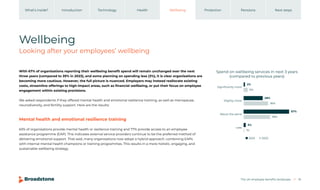
63% of organisations provide mental health or resilience training and 77% provide access to an employee
assistance programme (EAP). This indicates external service providers continue to be the preferred method of
delivering emotional support. That said, many organisations now adopt a hybrid approach, combining EAPs
with internal mental health champions or training programmes. This results in a more holistic, engaging, and
sustainable wellbeing strategy.
With 67% of organisations reporting their wellbeing benefit spend will remain unchanged over the next
three years (compared to 39% in 2023), and some planning on spending less (3%), it is clear organisations are
becoming more cautious. However, the full picture is nuanced. Employers may instead reallocate existing
costs, streamline offerings to high-impact areas, such as financial wellbeing, or put their focus on employee
engagement within existing provisions.
We asked respondents if they offered mental health and emotional resilience training, as well as menopause,
neurodiversity, and fertility support. Here are the results:
Significantly more
Slightly more
About the same
Spend on wellbeing services in next 3 years
(compared to previous years)
2%
6%
28%
36%
67%
39%
Less
3%
1%
2025 2023
17.
The UK employeebenefits landscape 17
Introduction Technology Health Wellbeing Protection Pensions
What’s inside? Next steps
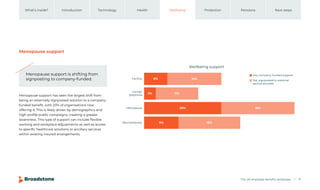
Menopause support is shifting from
signposting to company-funded.
Menopause support
Menopause support has seen the largest shift from
being an externally signposted solution to a company-
funded benefit, with 20% of organisations now
offering it. This is likely driven by demographics and
high profile public campaigns, creating a greater
awareness. This type of support can include flexible
working and workplace adjustments as well as access
to specific healthcare solutions or ancillary services
within existing insured arrangements.
Fertility 6% 14%
Wellbeing support
Gender
dysphoria
3% 11%
Menopause 20% 19%
Neurodiversity 9% 16%
Yes, company funded support
Yes, signposted to external
service provider
18.
The UK employeebenefits landscape 18
Introduction Technology Health Wellbeing Protection Pensions
What’s inside? Next steps
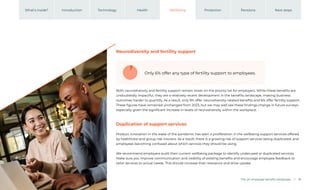
Both neurodiversity and fertility support remain lower on the priority list for employers. While these benefits are
undoubtedly impactful, they are a relatively recent development in the benefits landscape, making business
outcomes harder to quantify. As a result, only 9% offer neurodiversity-related benefits and 6% offer fertility support.
These figures have remained unchanged from 2023, but we may well see these findings change in future surveys,
especially given the significant increase in levels of neurodiversity within the workplace.
Duplication of support services
Product innovation in the wake of the pandemic has seen a proliferation in the wellbeing support services offered
by healthcare and group risk insurers. As a result, there is a growing risk of support services being duplicated, and
employees becoming confused about which services they should be using.
We recommend employers audit their current wellbeing package to identify underused or duplicated services.
Make sure you improve communication and visibility of existing benefits and encourage employee feedback to
tailor services to actual needs. This should increase their relevance and drive uptake.
Neurodiversity and fertility support
Only 6% offer any type of fertility support to employees.
19.
The UK employeebenefits landscape 19
Introduction Technology Health Wellbeing Protection Pensions
What’s inside? Next steps
Wellbeing
Supporting your employees’ financial wellbeing
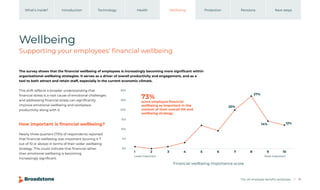
How important is financial wellbeing?
Nearly three quarters (73%) of respondents reported
that financial wellbeing was important (scoring it 7
out of 10 or above) in terms of their wider wellbeing
strategy. This could indicate that financial rather
than emotional wellbeing is becoming
increasingly significant.
The survey shows that the financial wellbeing of employees is increasingly becoming more significant within
organisational wellbeing strategies. It serves as a driver of overall productivity and engagement, and as a
tool to both attract and retain staff, especially in the current economic climate.
This shift reflects a broader understanding that
financial stress is a root cause of emotional challenges
and addressing financial stress can significantly
improve emotional wellbeing and workplace
productivity along with it.
30%
25%
20%
15%
10%
5%
0%
1 2 3 4 5 6 7
27%
14% 12%
20%
8 9 10
Financial wellbeing importance score
Most important
Least important
73%
score employee financial
wellbeing as important in the
context of their overall HR and
wellbeing strategy
20.
The UK employeebenefits landscape 20
Introduction Technology Health Wellbeing Protection Pensions
What’s inside? Next steps
Pathways to support financial wellbeing
The road ahead
But what about the ways organisations support their employees’ financial wellbeing? Although respondents
recognise its importance, there’s been a decline in what they offer since our 2023 survey. That includes one-to-one
meetings, webinars, online calculators, and other online tools. This decrease might be due to organisations relying
more heavily on existing solutions with external service providers, such as employee assistance programmes, due
to budget constraints.
Although many organisations clearly see financial wellbeing solutions as an important part of their wider
wellbeing strategy, implementation is lagging. The gap between intention and access means employees may
continue to struggle with financial stress, which in turn can affect their emotional wellbeing.
Employers should adopt cost-efficient but high-value solutions, such as digital platforms for scalable support,
flexible on-demand services, and group-wide initiatives, such as workshops and webinars.
Webinars, used by 48% of organisations, are the most popular
way employers support employees’ financial wellbeing.
Personal financial planning
services for your people
Every employee deserves to know their
financial future is in safe hands. But
whether they’re just starting out, growing
their savings, or planning for retirement,
navigating today’s financial landscape can
feel overwhelming.
That’s why we offer expert, personalised
advice, from one-off consultations to ongoing
support. We take the time to understand
an individual’s circumstances, goals, and
priorities, and then create an actionable plan
that evolves with their needs.
Providing your employees with access to the
right financial planning support (whether
company-funded or employee-paid) isn’t
just good for them – it’s good for your
organisation. Financial wellbeing boosts
morale, productivity, and retention. It shows
your people that you care, and that you’re
invested in their future.
21.
The UK employeebenefits landscape 21
Introduction Technology Health Wellbeing Protection Pensions
What’s inside? Next steps
Protection
Protecting them for life
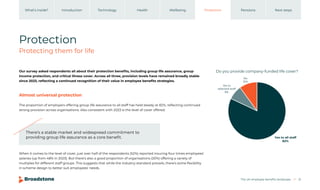
Our survey asked respondents all about their protection benefits, including group life assurance, group
income protection, and critical illness cover. Across all three, provision levels have remained broadly stable
since 2023, reflecting a continued recognition of their value in employee benefits strategies.
Almost universal protection
The proportion of employers offering group life assurance to all staff has held steady at 82%, reflecting continued
strong provision across organisations. Also consistent with 2023 is the level of cover offered.
When it comes to the level of cover, just over half of the respondents (52%) reported insuring four times employees’
salaries (up from 48% in 2023). But there’s also a good proportion of organisations (20%) offering a variety of
multiples for different staff groups. This suggests that while the industry-standard prevails, there’s some flexibility
in scheme design to better suit employees’ needs.
There’s a stable market and widespread commitment to
providing group life assurance as a core benefit.
Do you provide company-funded life cover?
Yes to all staff
82%
No
10%
Yes to
selected staff
8%
22.
The UK employeebenefits landscape 22
Introduction Technology Health Wellbeing Protection Pensions
What’s inside? Next steps
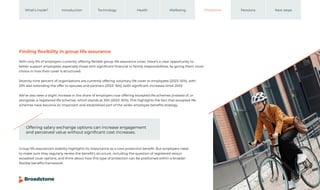
Finding flexibility in group life assurance
With only 9% of employers currently offering flexible group life assurance cover, there’s a clear opportunity to
better support employees, especially those with significant financial or family responsibilities, by giving them more
choice in how their cover is structured.
Seventy-nine percent of organisations are currently offering voluntary life cover to employees (2023: 55%), with
33% also extending the offer to spouses and partners (2023: 16%), both significant increases since 2023.
We’ve also seen a slight increase in the share of employers now offering excepted life schemes (instead of, or
alongside, a registered life scheme), which stands at 33% (2023: 30%). This highlights the fact that excepted life
schemes have become an important and established part of the wider employee benefits strategy.
Group life assurance’s stability highlights its importance as a core protection benefit. But employers need
to make sure they regularly review the benefit’s structure, including the question of registered versus
excepted cover options, and think about how this type of protection can be positioned within a broader
flexible benefits framework.
Offering salary exchange options can increase engagement
and perceived value without significant cost increases.
23.
The UK employeebenefits landscape 23
Introduction Technology Health Wellbeing Protection Pensions
What’s inside? Next steps
Protection
Protecting the future for families
The proportion of employers offering group income protection remains steady at 47%, with the same
number of respondents offering it to all staff (32%) and a select group of staff (15%) as in 2023. A 26-week
deferment period remains the most common approach, as in previous years, and was reported by almost
three quarters of respondents.
While overall provision has not significantly changed, ongoing developments in insurer-led intervention and
rehabilitation support, together with wellbeing services, highlight the continued importance of this benefit. For
alignment and cost-effectiveness, you should review how group income protection integrates with your sick-pay
policies, absence processes, and wellbeing strategy.
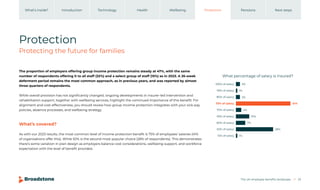
What’s covered?
As with our 2023 results, the most common level of income protection benefit is 75% of employees’ salaries (41%
of organisations offer this). While 50% is the second most popular choice (28% of respondents). This demonstrates
there’s some variation in plan design as employers balance cost considerations, wellbeing support, and workforce
expectation with the level of benefit provided
100% of salary
95% of salary
80% of salary
75% of salary
70% of salary
65% of salary
60% of salary
50% of salary
15% of salary
3%
1%
3%
41%
4%
10%
1%
7%
28%
What percentage of salary is insured?
.
24.
The UK employeebenefits landscape 24
Introduction Technology Health Wellbeing Protection Pensions
What’s inside? Next steps
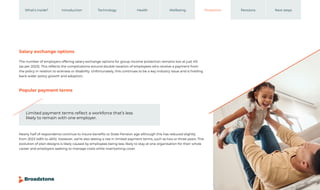
Salary exchange options
Popular payment terms
The number of employers offering salary exchange options for group income protection remains low at just 4%
(as per 2023). This reflects the complications around double taxation of employees who receive a payment from
the policy in relation to sickness or disability. Unfortunately, this continues to be a key industry issue and is holding
back wider policy growth and adoption.
Nearly half of respondents continue to insure benefits to State Pension age although this has reduced slightly
from 2023 (48% to 46%). However, we’re also seeing a rise in limited payment terms, such as two or three years. This
evolution of plan designs is likely caused by employees being less likely to stay at one organisation for their whole
career and employers seeking to manage costs while maintaining cover.
Limited payment terms reflect a workforce that’s less
likely to remain with one employer.
25.
The UK employeebenefits landscape 25
Introduction Technology Health Wellbeing Protection Pensions
What’s inside? Next steps
Protection
Protecting employees when sickness strikes
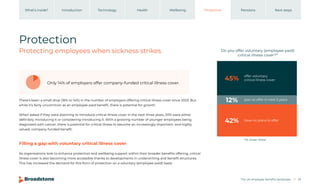
There’s been a small drop (16% to 14%) in the number of employers offering critical illness cover since 2023. But
while it’s fairly uncommon as an employee-paid benefit, there is potential for growth.
When asked if they were planning to introduce critical illness cover in the next three years, 20% were either
definitely introducing it or considering introducing it. With a growing number of younger employees being
diagnosed with cancer, there is potential for critical illness to become an increasingly important, and highly
valued, company-funded benefit.
Only 14% of employers offer company-funded critical illness cover.
Filling a gap with voluntary critical illness cover
As organisations look to enhance protection and wellbeing support within their broader benefits offering, critical
illness cover is also becoming more accessible thanks to developments in underwriting and benefit structures.
This has increased the demand for this form of protection on a voluntary (employee-paid) basis.
Do you offer voluntary (employee paid)
critical illness cover?*
have no plans to offer
plan to offer in next 3 years
offer voluntary
critical illness cover
12%
45%
42%
*1% chose ‘Other’
26.
The UK employeebenefits landscape 26
Introduction Technology Health Wellbeing Protection Pensions
What’s inside? Next steps
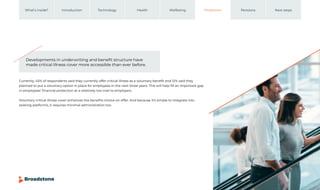
Currently, 45% of respondents said they currently offer critical illness as a voluntary benefit and 12% said they
planned to put a voluntary option in place for employees in the next three years. This will help fill an important gap
in employees’ financial protection at a relatively low cost to employers.
Voluntary critical illness cover enhances the benefits choice on offer. And because it’s simple to integrate into
existing platforms, it requires minimal administration too.
Developments in underwriting and benefit structure have
made critical illness cover more accessible than ever before.
27.
The UK employeebenefits landscape 27
Introduction Technology Health Wellbeing Protection Pensions
What’s inside? Next steps
Pensions
What type of pension scheme are you providing?
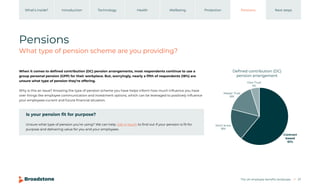
When it comes to defined contribution (DC) pension arrangements, most respondents continue to use a
group personal pension (GPP) for their workplace. But, worryingly, nearly a fifth of respondents (18%) are
unsure what type of pension they’re offering.
Why is this an issue? Knowing the type of pension scheme you have helps inform how much influence you have
over things like employee communication and investment options, which can be leveraged to positively influence
your employees current and future financial situation.
Is your pension fit for purpose?
Unsure what type of pension you’re using? We can help. Get in touch to find out if your pension is fit for
purpose and delivering value for you and your employees.
Defined contribution (DC)
pension arrangement
Contract
based
61%
Own Trust
5%
Master Trust
16%
Don’t know
18%
28.
The UK employeebenefits landscape 28
Introduction Technology Health Wellbeing Protection Pensions
What’s inside? Next steps
Why do you provide a pension?
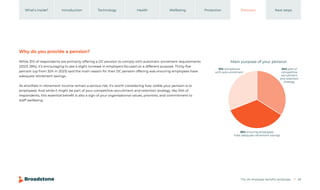
While 31% of respondents are primarily offering a DC pension to comply with automatic enrolment requirements
(2023: 28%), it’s encouraging to see a slight increase in employers focused on a different purpose. Thirty-five
percent (up from 32% in 2023) said the main reason for their DC pension offering was ensuring employees have
adequate retirement savings.
As shortfalls in retirement income remain a serious risk, it’s worth considering how visible your pension is to
employees. And while it might be part of your competitive recruitment and retention strategy, like 34% of
respondents, this essential benefit is also a sign of your organisational values, priorities, and commitment to
staff wellbeing.
Main purpose of your pension
34% part of
competitive
recruitment
and retention
strategy
31% compliance
with auto-enrolment
35% ensuring employees
have adequate retirement savings
29.
The UK employeebenefits landscape 29
Introduction Technology Health Wellbeing Protection Pensions
What’s inside? Next steps
Pensions
Contributing to your employees’ pension pots
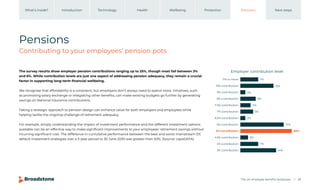
The survey results show employer pension contributions ranging up to 25%, though most fall between 3%
and 6%. While contribution levels are just one aspect of addressing pension adequacy, they remain a crucial
factor in supporting long-term financial wellbeing.
We recognise that affordability is a constraint, but employers don’t always need to spend more. Initiatives, such
as promoting salary exchange or integrating other benefits, can make existing budgets go further by generating
savings on National Insurance contributions.
Taking a strategic approach to pension design can enhance value for both employers and employees while
helping tackle the ongoing challenge of retirement adequacy.
For example, simply understanding the impact of investment performance and the different investment options
available can be an effective way to make significant improvements to your employees’ retirement savings without
incurring significant cost. The difference in cumulative performance between the best and worst mainstream DC
default investment strategies over a 5-year period to 30 June 2025 was greater than 50%. (Source: capaDATA).
11% or more
10% contribution
9% contribution
8% contribution
7.5% contribution
7% contribution
6.5% contribution
6% contribution
5% contribution
4.5% contribution
4% contribution
3% contribution
7%
20%
2%
13%
6%
4%
5%
2%
17%
14%
3%
7%
Employer contribution level
30.
The UK employeebenefits landscape 30
Introduction Technology Health Wellbeing Protection Pensions
What’s inside? Next steps
What do employees have to put in?
Who’s opting out?
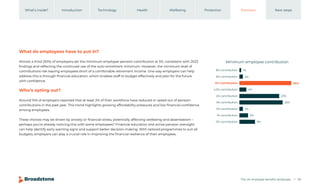
Almost a third (30%) of employers set the minimum employee pension contribution at 5%, consistent with 2023
findings and reflecting the continued use of the auto-enrolment minimum. However, the minimum level of
contributions risk leaving employees short of a comfortable retirement income. One way employers can help
address this is through financial education, which enables staff to budget effectively and plan for the future
with confidence.
Around 15% of employers reported that at least 2% of their workforce have reduced or opted out of pension
contributions in the past year. This trend highlights growing affordability pressures and low financial confidence
among employees.
These choices may be driven by anxiety or financial stress, potentially affecting wellbeing and absenteeism –
perhaps you’re already noticing this with some employees? Financial education and active pension oversight
can help identify early warning signs and support better decision-making. With tailored programmes to suit all
budgets, employers can play a crucial role in improving the financial resilience of their employees.
8% contribution
6% contribution
5% contribution
4.5% contribution
4% contribution
3% contribution
2% contribution
1% contribution
0% contribution
1%
9%
30%
2%
4%
23%
25%
2%
5%
Minimum employee contribution
31.
The UK employeebenefits landscape 31
Introduction Technology Health Wellbeing Protection Pensions
What’s inside? Next steps
Pensions
How salary exchange for pensions is a win-win
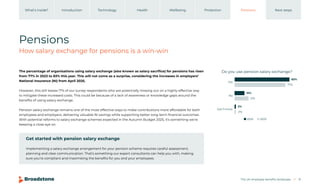
The percentage of organisations using salary exchange (also known as salary sacrifice) for pensions has risen
from 77% in 2023 to 83% this year. This will not come as a surprise, considering the increases in employers’
National Insurance (NI) from April 2025.
However, this still leaves 17% of our survey respondents who are potentially missing out on a highly effective way
to mitigate these increased costs. This could be because of a lack of awareness or knowledge gaps around the
benefits of using salary exchange.
Pension salary exchange remains one of the most effective ways to make contributions more affordable for both
employees and employers, delivering valuable NI savings while supporting better long-term financial outcomes.
With potential reforms to salary exchange schemes expected in the Autumn Budget 2025, it’s something we’re
keeping a close eye on.
Get started with pension salary exchange
Implementing a salary exchange arrangement for your pension scheme requires careful assessment,
planning and clear communication. That’s something our expert consultants can help you with, making
sure you’re compliant and maximising the benefits for you and your employees.
Yes
No
Don’t know
Do you use pension salary exchange?
83%
77%
15%
21%
2%
2%
2025 2023
32.
The UK employeebenefits landscape 32
Introduction Technology Health Wellbeing Protection Pensions
What’s inside? Next steps
Putting employees’ financial futures first
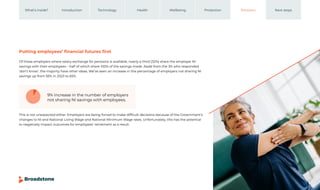
Of those employers where salary exchange for pensions is available, nearly a third (32%) share the employer NI
savings with their employees – half of which share 100% of the savings made. Aside from the 3% who responded
‘don’t know’, the majority have other ideas. We’ve seen an increase in the percentage of employers not sharing NI
savings up from 56% in 2023 to 65%.
This is not unexpected either. Employers are being forced to make difficult decisions because of the Government’s
changes to NI and National Living Wage and National Minimum Wage rates. Unfortunately, this has the potential
to negatively impact outcomes for employees’ retirement as a result.
9% increase in the number of employers
not sharing NI savings with employees.
33.
The UK employeebenefits landscape 33
Introduction Technology Health Wellbeing Protection Pensions
What’s inside? Next steps
Pensions
Supporting your employees to understand pensions
What are your employees’ expected retirement outcomes?
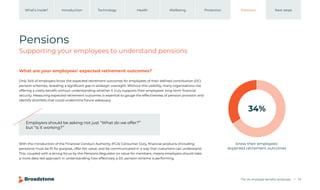
Only 34% of employers know the expected retirement outcomes for employees of their defined contribution (DC)
pension schemes, revealing a significant gap in strategic oversight. Without this visibility, many organisations risk
offering a costly benefit without understanding whether it truly supports their employees’ long-term financial
security. Measuring expected retirement outcomes is essential to gauge the effectiveness of pension provision and
identify shortfalls that could undermine future adequacy.
With the introduction of the Financial Conduct Authority (FCA) Consumer Duty, financial products (including
pensions) must be fit for purpose, offer fair value, and be communicated in a way that customers can understand.
This, coupled with a strong focus by the Pensions Regulator on value for members, means employers should take
a more data-led approach in understanding how effectively a DC pension scheme is performing.
Employers should be asking not just “What do we offer?”
but “Is it working?”
know their employees’
expected retirement outcomes
34%
23
34.
The UK employeebenefits landscape 34
Introduction Technology Health Wellbeing Protection Pensions
What’s inside? Next steps
Those with insight into their employees’ expected outcomes are better positioned to make informed changes,
which improve retirement outcomes and demonstrate tangible value. This ensures pensions remain both a vital
employee benefit and a driver of long-term financial security.
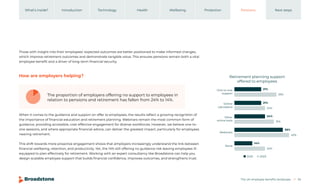
When it comes to the guidance and support on offer to employees, the results reflect a growing recognition of
the importance of financial education and retirement planning. Webinars remain the most common form of
guidance, providing accessible, cost-effective engagement for diverse workforces. However, we believe one-to-
one sessions, and where appropriate financial advice, can deliver the greatest impact, particularly for employees
nearing retirement.
This shift towards more proactive engagement shows that employers increasingly understand the link between
financial wellbeing, retention, and productivity. Yet, the 14% still offering no guidance risk leaving employees ill-
equipped to plan effectively for retirement. Working with an expert consultancy like Broadstone can help you
design scalable employee support that builds financial confidence, improves outcomes, and strengthens trust.
How are employers helping?
The proportion of employers offering no support to employees in
relation to pensions and retirement has fallen from 24% to 14%.
One-to-one
support
Online
calculators
Other
online tools
Retirement planning support
offered to employees
21%
33%
21%
24%
24%
31%
None
14%
24%
Webinars
38%
43%
2025 2023
35.
The UK employeebenefits landscape 35
Introduction Technology Health Wellbeing Protection Pensions
What’s inside? Next steps
Pensions
Review, revise and optimise your pension scheme
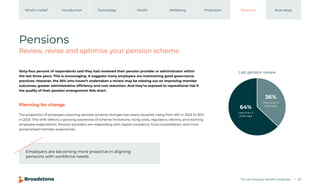
Sixty-four percent of respondents said they had reviewed their pension provider or administrator within
the last three years. This is encouraging. It suggests many employers are maintaining good governance
practices. However, the 36% who haven’t undertaken a review may be missing out on improving member
outcomes, greater administrative efficiency and cost reduction. And they’re exposed to reputational risk if
the quality of their pension arrangement falls short.
The proportion of employers planning pension scheme changes has nearly doubled, rising from 16% in 2023 to 30%
in 2025. This shift reflects a growing awareness of scheme limitations, rising costs, regulatory reforms, and evolving
employee expectations. Pension providers are responding with digital innovation, fund consolidation, and more
personalised member experiences.
Planning for change
Employers are becoming more proactive in aligning
pensions with workforce needs.
Last pension review
More than 3
years ago
Less than 3
years ago
36%
64%
36.
The UK employeebenefits landscape 36
Introduction Technology Health Wellbeing Protection Pensions
What’s inside? Next steps
The drivers for change
Cost remains the primary motivator for reviewing pension schemes, with 6% of employers citing rising
administration, platform, and investment fees. They’re focused on achieving better value for money and ensuring
strong employee outcomes.
A further 3% cited regulatory compliance, likely linked to upcoming Mansion House reforms, while 11% referenced
“other” reasons, such as poor provider service; environmental, social and governance (ESG) integration; digital
engagement; or better default fund performance. These responses suggest a growing focus on strategic
alignment to make sure pensions meet both organisational and employee goals.
With the Mansion House reforms driving consolidation, scale, and increased UK investment, employers need to
assess whether their current provider is aligned with future expectations. Consider scheduling a provider review
every three years and benchmarking against market standards, including ESG credentials, digital capabilities,
member engagement tools, and legislation.
If service levels or digital engagement are lacking, consider alternative providers that better align with your
strategic goals. And don’t forget to refresh training materials and governance frameworks to reflect current
standards and new initiatives.
Employers are committed to supporting retirement savings –
only 3% of respondents are considering reducing contributions.
37.
Introduction Technology HealthWellbeing Protection Pensions
What’s inside? Next steps
Next steps
Want to know more?
Our 2025 survey and analysis highlight key shifts in employer priorities.
We’ve seen organisations leveraging technology thoughtfully to streamline administration and promote inclusivity
through tailored messaging. Employee communication continues to be a challenge for stretched HR teams,
who are also tackling the issues posed by increasing economic pressures, such as the rise in employer National
Insurance contributions.
In healthcare, the value of private medical cover is being realised, particularly as NHS pressures continue to rise.
And there’s been an expansion of added-value benefit options to meet employee expectations. While across
employee protection benefits – group life assurance, group income protection, and critical illness cover – we’re
seeing continued stability in the main.
There’s been a rise in the number of employers using salary exchange for pensions, but employers have limited
knowledge of the expected retirement outcomes of their people. That said, there is a growing awareness of
pension scheme limitations, rising costs, regulatory reforms, and evolving employee expectations.
However, even with technological innovation, strategic benefit reviews, and a growing focus on wellbeing,
many organisations still struggle to balance affordability, effectiveness, and employee expectations.
That’s where we come in.
38.
The UK employeebenefits landscape 38
Introduction Technology Health Wellbeing Protection Pensions
What’s inside? Next steps
Expertise and experience
Strategic and flexible
With over 40 years’ experience, we know the employee benefits landscape inside-out. As a people-first
consultancy, we bring clarity, independence, and insight to every stage of your benefits provision – from design
and provider assessment to implementation and communication.
We’ll consider your strategy and priorities over the short and medium term, help you review your current
approach, identify efficiencies, and ensure your benefits deliver real impact and value for money. And we take an
agile approach, anticipating and responding to your needs, regardless of your size or resources.
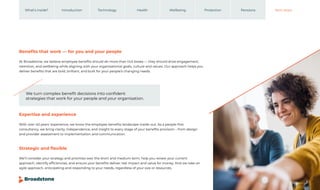
We turn complex benefit decisions into confident
strategies that work for your people and your organisation.
Benefits that work — for you and your people
At Broadstone, we believe employee benefits should do more than tick boxes — they should drive engagement,
retention, and wellbeing while aligning with your organisational goals, culture and values. Our approach helps you
deliver benefits that are bold, brilliant, and built for your people’s changing needs.
39.
The UK employeebenefits landscape 39
Introduction Technology Health Wellbeing Protection Pensions
What’s inside? Next steps
Thanks to our contributors
We’d like to thank the 200 organisations who took part in this survey – without them, we wouldn’t have this report.
To mark their contribution, we’ve donated £2,000 to Macmillan Cancer Support (£10 for every completed survey).
And thank you to our consultants whose expertise was key in delivering this report:
Benefits technology
Ruth Empson-Ridge
Andrew Mobberley
Craig Williams
Health
James Lang
Wellbeing
Jamie Burdess
Kelly Parsons
Protection
Richard Pringle
Pensions
Jeremy Brown
Matt Dorrington
Chloe Griffiths
Kelly Parsons
Ian Roylance
40.
The UK employeebenefits landscape (November 2025) 40
Broadstone is a trademark owned by Broadstone Corporate Benefits Limited and used by companies in the Broadstone group.
Broadstone Financial Solutions Limited is authorised and regulated by the Financial Conduct Authority.
Registered in England and Wales under no. 02131269. Registered office 100 Wood Street, London EC2V 7AN.
EBSURVEY NOV25
Discover how our consultants can help you
create an employee benefits strategy that
truly makes an impact – for your organisation
and your people.
Contact us
broadstone.co.uk/employee-benefits-wellbeing/
corporate@broadstone.co.uk