
History of Disc Golf and the PDGA

1967
"Steady" Ed patents the Frisbee
Steady Ed patented the Frisbee (U.S. Patent #3359678) in 1967 as an employee at Wham-O.
Frisbee patent image courtesy of the Disc Golf Association.
1974
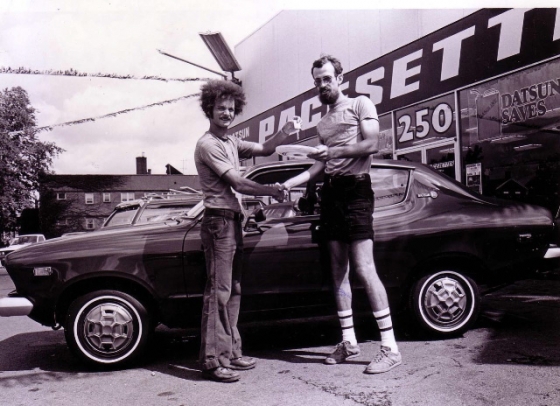
Stork wins a brand new 1974 Datsun B210 at the American Flying Disc Open
Despite having never heard of the International Frisbee Association (IFA) that Ed and Wham-O had put together, or ever seeing a copy of the IFA Newsletter, Jim Palmeri, his brother, and a small group of people from Rochester, NY, had been playing disc golf as a competitive sport on a regular basis since August of 1970, including tournaments and weekly league play. By 1973, they had even promoted two City of Rochester Disc Frisbee Championship events which featured disc golf as the main event.
In 1973, this avid group of disc golfers first happened upon a copy of the IFA newsletter. They were amazed to hear of the Frisbee culture that existed well beyond their little sphere of activity. They decided to make the 1974 City of Rochester Disc Golf Championship a national tournament to find out just how many other people around the country were playing disc golf. They called the event the American Flying Disc Open (AFDO), and to attract the attention of the Frisbee community, they put up a brand new 1974 Datsun B210 to be awarded to the winner.
The burgeoning interest in the game of disc golf that grew rapidly among Frisbee players and IFA members during the rest of 1974, and in the summer of 1975, grabbed “Steady” Ed’s attention. As an executive at Wham-O, he began to reassess the value that disc golf might hold for their business.
Ed created a new Sports Promotion Department at Wham-O and hired the winner of that 1974 AFDO, Dan “Stork” Roddick, to be its director. With feedback from Stork, George Sappenfield, and the fledgling but rapidly growing disc golf community in general, Ed decided to include disc golf as an event in Wham-O’s upcoming 1975 World Frisbee Championships.
Jim Palmeri #23 (left) handing Dan "Stork" Roddick #003 (right) the keys to his prize for winning the 1974 American Flying Disc Open.
1975
The first official disc golf course: Oak Grove Park
In 1975, “Steady” Ed installed the first official disc golf course at Oak Grove Park in Pasadena, Los Angeles County, California, with the targets being nothing more than permanent poles placed into the ground for targets. Disc Golf Pole Hole replaced the poles in the ground in 1976, causing a massive increase in disc golf traffic on the property.
Video from the Oak Grove 50th Anniversary Jubilee

1977
"Steady" Ed patents the Disc Golf Pole Hole
“Steady” Ed is considered the Father of Disc Golf. Of his dozens of patented inventions, two of them hold infinite importance to our sport. The first was the Frisbee (U.S. Patent #3359678) in 1966 as an employee at Wham-O. The second was the basis of all disc golf targets today, the Disc Golf Pole Hole (U.S. Patent #4039189) in 1977.
The concept of disc golf itself however has a long and blurry history. Even a question as simple as “Who first played disc golf?” has no clear and concise answer. In his Brief History of Disc Golf on PDGA.com, Disc Golf Hall of Fame member Jim Palmeri #23 responds to that question as follows:
“Sorry, but this turns out to be impossible to answer. There are many historical accounts of people playing golf with a flying disc, some of which pre-date the advent of the plastic flying discs by many years. Each account was an isolated instance of recreational disc golf play, and none of the participants knew of anyone else playing disc golf. Indeed, most of these instances were isolated not only geographically, but also isolated in time, so they couldn't have known about each other.”
Disc Golf Pole Hole Patent image courtesy of the Disc Golf Association.

April 1976
Disc Golf’s First Start Up: DGA
Due to the overwhelming success of the 1975 World Frisbee Championships, and subsequent positive reinforcement from the players, Ed became convinced that disc golf could be something big. With a growing family to feed and a mortgage to pay, Ed abruptly resigned his VP position at Wham-O and started the Disc Golf Association business in April 1976, a business that continues to be a leader in the sport to this day, now commonly referred to as simply DGA.
This pivot by the man we now call the Father of Disc Golf was truly astounding in retrospect: here we see Ed giving up a secure, well-paying job at one of the top toy companies in the world to start a new company and promote a new sport that 99.9999% of America had never even heard of! That took guts and vision.
One of Dan Roddick's first moves as director of the Sports Promotion Department at Wham-O was to incorporate disc golf as an event in the national tour of qualifying tournaments for the World Frisbee Championship event that Wham-O was continuing to sponsor on a yearly basis. This move introduced disc golf to thousands of Frisbee players around the country and in Canada as well. It also opened up big markets for Ed Headrick's DGA to sell and install courses all over the country.
Ed was truly a master marketer and salesperson. He traveled all over the country promoting disc golf, selling baskets at trade shows, and designing courses (some of which are still being played today). The popularity of disc golf grew rapidly. Each new course spawned more players and more courses in nearby towns and cities. Similar to today, new players got bit by the disc golf bug and shared the dream of national tournaments and organized play.

Summer 1976
“Steady” Ed sends 100 letters
In the summer of 1976, Ed sent out a letter to roughly 100 of the top players in the country, inviting them to join the PDGA. The cost would be $10 (about $45 in today’s money) for a lifetime membership.
Ed then began directly selling memberships to the players at tournaments all over the country, starting with the Boulder Flying Disc Festival in July of 1976. Joe Feidt and Jim Palmeri were in Boulder for the event ready to compete, not knowing they were about to witness a great little piece of disc golf history. "That weekend I remember very clearly Ed sitting on the steps of a Colorado University campus building explaining/marketing/selling his new players' organization to a curious group of players," recalls Feidt. "He was taking cash, checks, IOUs, whatever he could for a $10 lifetime PDGA membership. Guys were writing down their names and addresses on scraps of paper and paper-clipping cash to it. I was short on cash and decided to wait to join. One of my few regrets. I joined a year later and was disappointed to get #362. Three digits looks pretty good now though!"
Palmeri remembers, "Ed was pitching the PDGA for $10 a pop! I remember having very little cash flow back then, but unlike Joe, I didn’t wait. I scraped nickels, dimes, and quarters together to come up with the $10, and I was rewarded with PDGA #23!"
Becoming a member in those days was a way for players to feel as if they were part of something bigger than just their local clubs. The PDGA was a players organization in which local clubs provided a feeder program of new players and money to build new courses for this new sport of disc golf. It was all brand new, and nobody—probably not even Ed—knew exactly where it was going but the PDGA generated a steady source of income and gave Ed a way to pay for mailing newsletters and other costs of running a growing organization.
Photo: One of the 100 original letters sent to potential PDGA members around the country. Originally sent to Lyle Jensen #102, who also provided the images. Click on the thumbnail to view it in full size.

1979
Wham-O’s $50,000 Disc Golf Tournament
Another significant turning point for disc golf was an event organized by, you guessed it, “Steady” Ed in 1979. Held in Huntington Beach, California, Ed named the event the $50,000 Disc Golf Tournament, boasting its massive payout right in the title. The tournament was groundbreaking, first and foremost because of the cash involved, but also because the competitors had to qualify for an invitation. 72 qualifying events were established around the country, bringing in the best disc golfers from across the United States.
Dan “Stork” Roddick recalls Ed’s thought process for the disc golf events he was planning. “Ed was very dedicated to the idea that his events should be ‘pro’. That was part of the reason the word Professional was in the name of the association. He wanted to make them a big, big, big deal. I remember him saying, ‘I want their palms to be sweaty’.”
DGHOF member David Greenwell #962, the one and only PDGA member that has competed in every single Disc Golf World Championships, was new to the sport at the time, but that didn’t stop him from earning an invitation. One of the oldest courses in the country was installed near his hometown, and thus began what would eventually become a legendary disc golf career.
“Otter Creek went in the ground in 78’. I found out about the $50,000 Tournament early in 79’ and the first tournament that I ever played was a qualifier for it. I won the qualifier having only played disc golf for a few months. The $50,000 tournament ended up being my second tournament ever, and I finished 37th out of 144,” said Greenwell.
“Now let me tell you, I felt like 37th wasn’t horrible by any means, but here’s the kicker: 36th place took home $500. 37th place….zero. I missed the cash by one stroke! I’ll never forget it, for the rest of my life. I was putting on the 17th, and this was back when we were using big, giant discs and throwing into single chain DGA baskets. Somehow my putter went right through center of the chains, hit the back rim, flopped out and wobbled right into the middle of a bicycle path that played as OB. It was a two-stroke swing on the 17th. I mean, I had to try hard to stay out of the cash.”
Tom Kennedy #87 went on to win the $50,000 Disc Golf Tournament. 34 years later in 2013, Tom auctioned off several historic items from the event for charity. You can read more about the auction in the digital version of DiscGolfer Magazine’s Summer 2013 edition.
1982
Seeds of Change Sown at First Disc Golf World Championships
Ed was a control freak. He liked being the man in control of the PDGA and resented attempts by players to control the direction of the organization. It’s important to remember that, until 1982, he was doing essentially everything by himself. Considering how active he was—running a start-up company, traveling the country promoting a new sport, selling discs and baskets, installing courses—it’s amazing he had any time at all to process memberships, write newsletters, and keep the PDGA going.
By 1980, a growing number of players began to challenge Ed’s control of the PDGA. In 1981, a group of players started a new organization to be run by the players and invited Ed to be #001 of the new club. Ed declined the invitation, lashed out at the organizers in a flaming letter, and used his clout to extinguish the fledgling organization before it had time to grow. This particular incident alienated many people and his popularity suffered.
The next year, Ed decided to hold the first Disc Golf World Championships in Los Angeles. It was there before the event started at a meeting of his regional reps that Ed decreed players could throw only Wham-O discs (the brand he was selling at the time). This was another unpopular decision, as players had been lobbying Ed to allow other discs such as Jan Sobel’s popular Super Puppy but he stood firm on his decision.
It was here at this raucous meeting that the first seeds of the present day PDGA were sown. Ed asked if anyone wanted to put together a pro tour for the next year. Future Disc Golf Hall of Fame (DGHOF) member Ted Smethers #1159, then a little known pro from Little Rock, Arkansas, volunteered.
Ted, using a map of the USA with push pins where courses existed, assembled a database of courses and matched up course pros with many of the courses. He then called each pro—this was before email existed—to schedule tournaments and by winter he had a PDGA pro tour scheduled for 1983. This tour would serve as a qualifier for the second Disc Golf World Championships to be held in Huntsville, Alabama.
Coincidentally, 1983 was also the year a new disc company called Champion Discs (now known as Innova) debuted with its new proto Aero, then called the Eagle. The Eagle, designed by another future DGHOF member Dave Dunipace #987, represented a quantum leap in technology and instantly became the hot new driver that everyone was throwing.
Later that year in Hunstville, before the tournament started, Tournament Directors Tom Monroe #33 and Lavone Wolfe #580 didn’t ask Ed—they told Ed—that any legal-weight disc, including Eagles and Puppies, could be thrown. This was the first time the players prevailed in a contest of wills with Ed. It was this Huntsville controversy more than anything else that persuaded Ed to decide to slowly relinquish control of the PDGA to the players.
1984
Steady Ed Hands Over a Bottle of Genesee Cream Ale
It was at the next Disc Golf World Championships in 1984 at Rochester, New York (site of the seminal AFDO a decade earlier) that Ed handed over control of the PDGA to a group of players led by Ted Smethers #1159. At the players meeting, Ed ceremoniously handed Ted a glistening green bottle of Genesee Cream Ale as if bestowing the keys to his disc golf kingdom. This was a key moment in PDGA and disc golf history alike; the players would now begin to assume the leadership roles in the organization.
Ted, and other players who wanted to help, spent two years working on various projects including several drafts of a constitution. During this time Ted, Ed and the team butted heads but they made progress. According to Rick Rothstein’s Disc Golf World News (the source of accurate informative disc golf news for decades), the players approved a steering committee of Ted Smethers, Ed Headrick, Lavone Wolfe #580, Patti Kunkle #283, and Roy Culbertson #1814 at the 1985 Disc Golf World Championships in Tulsa, Oklahoma.
The first formal all-member election for the first PDGA board of directors was held in late 1986. The first board—Ted Smethers, Rick Rothstein, Tom Monroe, Steve Wisecup #1467, Darrell Lynn #784, and Joe Feidt—began to chart a course through fits and starts that would gradually allow the PDGA to grow into the juggernaut it is today.
1993
All You Need is a Frisbee - Interview with “Steady” Ed
A candid interview with "Steady" Ed Headrick during the 1993 PDGA World Championships.
1997
Elaine King wins her fifth World title
Elaine King won the FPO PDGA World championship in 1991, 1992, 1993, 1995, and 1997. She was the first woman to win more than two world titles and with this win, has held the record for the most FPO world titles.

1998
PDGA Player Ratings: A Game Changer
The PDGA has seen dozens of Commissioners and Executive Directors come and go over the years. From “Steady” Ed to DGHOF members like Elaine King #3090 and John Houck #1688. One of those was DGHOF member, Jim Challas #160, serving as Commissioner in the late 90s.
In 1998, Jim forwarded some information that he received from the Statistics Committee over to yet another future DGHOF member, Chuck Kennedy #4949. As an avid ball golfer, Jim believed that the PDGA needed some sort of handicapping system similar to the one he had become so familiar with.
After reviewing the stats, Chuck had a slightly different idea. “My thought was that our members might be better served with a system that promoted fair and competitive divisions, without having to adjust the scores like a traditional handicapping system,” said Chuck. “The problem was, there wasn’t a uniform way to move someone from one Amateur division to another. That was the basis driving my thoughts, twisting a handicap system into a ratings system that could help fix this problem.”
In many regions of the country, clubs were already taking on this issue on their own. Several larger clubs had come up with their own version of what is now referred to as a “bump rule”, forcing players that won in certain divisions or won a certain amount of events in a series in a specific division to be “bumped” to the next highest division.
At the time, the now current PDGA International Director, Brian Hoeniger #4022, was serving under Challas as the PDGA Administrator. Chuck flew to Toronto to talk with him about the Player Ratings concept, and Hoeniger was on board. Hoeniger paired Chuck with one of the members of the Statistics Committee, computer buff Roger Smith #9581.
Smith developed the code to produce Chuck’s ratings system against tournament statistics, with the 1998 PDGA Disc Golf World Championships being the guinea pig. Eight rounds were played on four courses during the ‘98 Worlds, the reason that to this day Player Ratings Propagators have to have at least eight rated rounds.
A push in 2002 by then Commissioner Pat Govang< /a> #13902 to have the ratings implemented across all divisions in all events was made, and eventually accepted. Theo Pozzy #14166 agreed to help get the PDGA's Player Ratings system implemented into the PDGA database. 2003 would become the first year that Player Ratings were used to define which divisions amateurs could compete in, and the Player Ratings system has been in place ever since.
Today, the Player Ratings system is run by PDGA staff and powered by ever-improving PDGA technology and statistical analysis.
Photo: Chuck Kennedy #4949 (right) and “Steady” Ed #001 (left) in 1997 at Ed's workshop in Watsonville, CA.
2000
Reached over 1,000 courses in the course directory
2003
Introduction of the PDGA National Tour
The inaugural PDGA National Tour in 2003 consisted of 11 events across the country at a lot of tournaments and venues still recognizable today. The PDGA National Tour, which held 146 events since 2003, until the DGPT became the official pro tour of the PDGA.
2003
Juliana Korver gets her fifth FPO title, tying Elaine King's record
Juliana Korver won her fifth FPO world title in at the 2003 PDGA Professional World Championship. She also won in 1998, 1999, 2000, 2001. With this win, Juliana ties Elaine King's 5x record
2006
Ken Climo wins his 12th World title
Ken Climo won his 12th World title at the 2006 PDGA Professional World Championships. His first nine titles were in a row from 1990-1998, then he won another in 2000 and another in 2002, followed by a couple wins by Barry Schultz and one from Nate Doss until finally in 2006 he took his 12th and final title.
April 2007
The International Disc Golf Center Opens
“When people would ask where the PDGA was located, I always told them it’s in half of a room in a house on an island in Canada,” said current PDGA Executive Director Brian Graham #5861 with a chuckle. It might sound like a joke, but Graham wasn’t kidding when he responded that way.
For decades, the PDGA “headquarters” was simply the home of whoever was running the organization. Graham would have been referring to then PDGA Executive Director Brian Hoeniger’s home in Toronto, where the PDGA was “headquartered” for many years.
In 2002, as more staff positions were added, Hoeniger was promoted to Executive Director. With the sport getting bigger and bigger at the turn of the millennium, Hoeniger and the Board of Directors agreed that the PDGA should return to the USA. But…to where?
Cut to 2002, Brian Graham is working with the Greater Augusta Sports Council and Columbia County Parks on a series of land development projects. The Director of Columbia County Parks, knowing of Graham’s interest in disc golf, presents Graham with a 90-acre piece of land in Wildwood Park to see if he thinks it has good course potential.
It definitely did. But Graham knew it could be so much more. Why have one course when there is room for three? What if there was a clubhouse, and a pro shop? Or a disc golf museum? A hall of fame? A new home for the PDGA, which was already in need of relocation?
The gears started turning and everything started falling into place. The county and the parks department approved. Graham then presented the proposal to the PDGA Board of Directors at the 2003 summit and they approved. Discraft and Innova were on board. DGA was on board. The Disc Golf Hall of Fame was on board. Everyone was in, and construction began.
Graham later realized that everything he was describing and working towards at the time came from an article he read in Disc Golf World News, written by none other than Dan “Stork” Roddick, in which Stork detailed a mythical disc golf mecca with all the amenities of a high-end golf clubhouse plus championship courses. It was a “wouldn’t it be great if” type of piece, and with a bit of luck and a ton of helpful partners, Graham was making it happen.
The International Disc Golf Center officially opened its doors in April of 2007. The facility eventually boasted three championship courses, a pro shop, office space for the PDGA staff, the “Steady” Ed Headrick Memorial Museum, the Disc Golf Hall of Fame, picnic pavilions, and more.
2009
Reached over 3,000 courses in the course directory
2009
First year with over 1,000 events
2014
First year with over 2,000 events
2015
Nate Doss ' Ace makes ESPN Top 10
Nate Doss smashed an ace in hole 1 of the final round at the Fountain Hills Disc Golf Course at the 2015 Memorial Championship presented by Discraft, making disc golf's debut into the ESPN Top 10.
2015
Reached over 5,000 courses in the course directory

June 2016
Philo's Albatross makes disc golf go viral
With roughly 450 feet between him and the basket on the 850-foot, par-5 6th at Milo McIver State Park’s West course during round three of the Beaver State Fling, Southern California native and veteran touring pro Philo Brathwaite simply wanted to get around the corner with his second throw and maybe have a look for eagle as he tried to keep pace with Ricky Wysocki. With a stable Innova Destroyer in his hand, he needed some magic on a shot he’d struggled throughout his career to execute.
“The target wasn’t really in my peripheral at the moment,” Brathwaite recalled last week as he traveled to Chicago for the holidays. “I just remember I was in a really heated battle with Rick and those guys up at the top of the leaderboard, and Rick was starting to pull away earlier that round.
“I remember I’ve thrown this shot so many times before,” Brathwaite continued “...My intentions most of the time were to make a 4 on that hole, because I’d never pulled that shot off to make it flex back.”
This time, it did flex back. But instead of dropping to the earth to give him a chance at the eagle, it crashed the lower left side of the chainset, then ricocheted off the backside of the basket and stayed in for an albatross.
The shot was blind, though, and several other players on his card still needed to play their approaches up the long fairway. So Brathwaite didn’t even get a visual confirmation for more than 10 minutes. Instead, he got word of the feat from Central Coast Disc Golf’s Ian Anderson, whose crew was filming the round and had caught the throw in all of its glory.

August 2016
Inaugural PDGA/WFDF Team Disc Golf World Championships
The first ever PDGA-WFDF Team Disc Golf World Championships presented by DGA took place in beautiful Vancouver, British Columbia. Six countries from the Americas, East Asia, and Oceania including Japan, USA, Brasil, Australia, New Zealand, and the hosts, Canada, competed for the medals and the honor of being crowned the inaugural Team World Champions.
The USA-New Zealand battle for glory had all the makings of a classic championship match. Not only had the 2 squads tied in regulation match play and match play holes won, they had also finished in a dead tie in the Total Team Score round. But USA’s cruise to gold was not to be denied as they shrugged off an early Kiwi lead to win convincingly by seven points to one (three wins and a draw in the four matches). Japan took the bronze medal.
Learn more about the first Team Disc Golf World Championships

2016
Explosive Growth - PDGA Membership & Events
As pointed out by PDGA Ratings guru Chuck Kennedy, the number of PDGA members and the rate at which membership is expanding is far different today than it was in the early days. As of 11:00am EDT on July 6th, 2016, the PDGA’s newest member was assigned the number 87248 with nearly 31,000 active members. But let’s take a look at how we’ve come to that number in the last 40 years. The charts below are updated through the end of 2015.

Following the same trend as our member numbers, the number of PDGA-sactioned disc golf events has grown immensely over the last few years. 2015 ended with a total of 2,590 events, including seven that were on the PDGA National Tour, 12 PDGA Majors, and 100+ A-Tiers. As with every year, we are on pace to easily surpass that number, with 3,000+ events already sanctioned for 2016.
2017
Reached over 7,500 courses in the course directory

October 2017
PDGA Hits 100,000 Members
October is always a hectic month for the PDGA when it comes to memberships, as hundreds of people are either signing up to become a member for the first time or renewing their already existing membership. October 2017, however, specifically Monday, October 2nd, marked a moment in PDGA history; the race for PDGA member #100000.
As 2017 progressed and the latest membership number crept closer and closer to #100000, it seemed that almost every day a request would come in to reserve it (by someone that did not know that is not an option). By the time we hit #99000, we knew a storm was brewing; a new membership click-race the likes of which we had never seen.
There is essentially only one way to attempt to get a specific PDGA number and that is to open up the Player Search page on PDGA.com, sort it by PDGA number, and refresh the page over and over to see the most recently assigned member number. So, for example, if someone wanted to be PDGA #99500, they could refresh the page continuously until member #99499 appeared and then attempt to snag #99500 by signing up immediately after.
On the morning of Monday, October 2nd, hundreds of people were waiting, refreshing, and waiting some more as the coveted #100000 grew nearer and nearer. By 11:35am the latest number assigned was #99801. By 4:00pm it was up to #99905. Less than an hour later, at 4:50pm, #99950 was assigned and the click-race began.
17 minutes later (5:07pm); #99970. Seven more minutes (5:14pm); #99980. ONE MINUTE LATER; #99993. That was the moment. Everyone that had been waiting by that point had already clicked the last button in the sign-up process, and all they could do was wait while the page loaded. In a flash, the latest membership number assigned was up to #100050.
1,066 new memberships were processed that week, setting a new one-week record and crushing the old one, which was set one year prior at 474. October 2nd alone finished with a single day total of just under 500 new memberships, a new record.

July 2018
McBeth shoots a perfect round
McBeth was nearly perfect on the scoresheet, offsetting his lone par with an early eagle on the Toboggan's par 5 2nd, and that extra shot under par helped him to an 1108-rated effort that shattered the Kensington Metropark track record and found him taking an eight-throw lead with one round left to play in Michigan. McBeth's two-round total now sits at a 29-under par 97, while Nikko Locastro, who tossed his own 11-under par 52 Saturday, is in second place with a 21-under par 105. Dave Feldberg's 7-under par 56 puts him in third place at 20-under, while James Conrad, Willie Prince, and Cale Leiviska are tied for fourth place at 17-down.
The performance signified a seven-shot correction over McBeth’s course record-setting opener on Friday, one he knew he could clean up.

2019
Pierce Joins King, Korver in 5x Club
Paige Pierce ties up with Elaine King and Juliana Korver with the most world championship titles in the FPO division.

2020
Record PDGA Growth in 2020
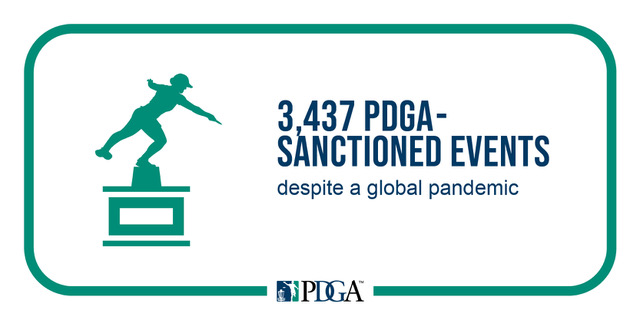
Despite the unprecedented challenges of a global pandemic, disc golf thrived as a safe, socially distanced outdoor activity, and this in turn attracted a stunning influx of new players to the sport.
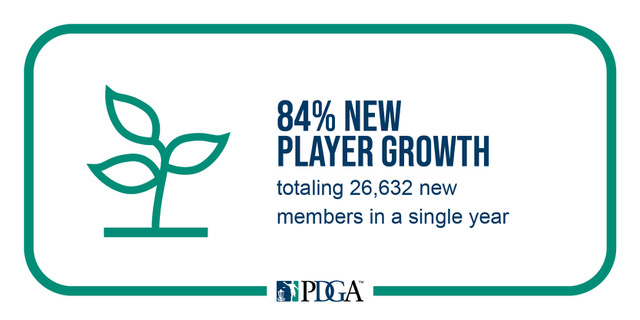
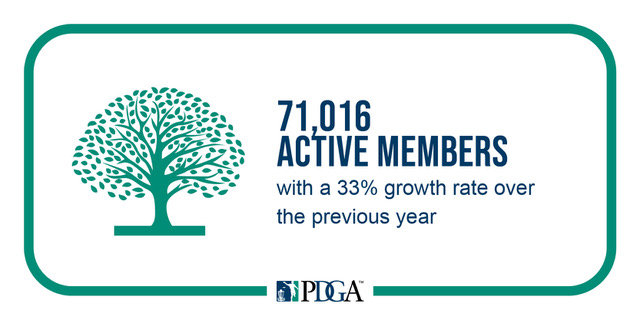
26,632 new members joined the PDGA in 2020, an 84% increase over 2019. This fueled a 33% increase in the overall growth of active members, the largest year over year increase in the organization's history, and more than double the 15% average annual growth in the six preceding years. The 71,016 active members at the end of 2020 was up from 53,366 in 2019, and is now double what it was just four years ago.
“2020 was a rollercoaster from a membership perspective,” PDGA Memberships Manager Vic Allen reflected. “In March, we had to shut everything down, and by June we were breaking monthly membership records. Seeing the numbers come out in this demographics report is great because it lets us see on paper what we’ve been witnessing all year—disc golf has been making an incredible impact in people’s lives at a time when it is sorely needed.”
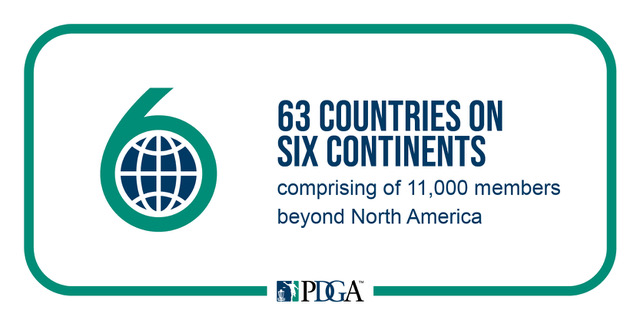
International growth has also hit new highs as PDGA Europe added more than 2,000 members, a 22% increase over 2019, and Canadian PDGA members increased by more than 30%.
The total number of PDGA Tour events worldwide was limited by a two month stretch without any sanctioned competition and was down 26% from 2019. But the total number of players at events was down only 20%, indicating an increase in participation rates.
PDGA Tour Manager Andrew "Big Dog" Sweeton, said, “From the PDGA tour perspective, 2020 was a real challenge due to the global pandemic, our subsequent shutdown for several months, and some areas not being able to play for even longer.

2021
PDGA Staffs Up to Meet Membership Growth
Growth has defined disc golf over the past 18 months, and the Professional Disc Golf Association is no exception. We continue to break records in active memberships and sanctioned events month over month. To keep up with this surge, we are happy to announce that we have made some changes to the organization and staff to better serve our members while also continuing to fulfill our obligations as the global governing body of disc golf.

2021 active membership figures as of April 2021
Read more about the 2021 changes and additions to PDGA Staff to improve member, TD support

June 2021
300! How Elaine and Schwebby Stacked Up the Wins
For the past year or two, those of us that are interested in disc golf history have watched two of the disc golf greats battle it out for who would be the first to reach the milestone of 300 career wins. On June 19, 2021 Elaine King got there first. The following weekend Brian “Schwebby” Schweberger won two separate events for his 300th, and then 301st win, making him the winningest player in the world. To mark their accomplishments I have created a few graphs that show how they got there as well as a short interview with Elaine and Schwebby.
July 2021
The Holy Shot
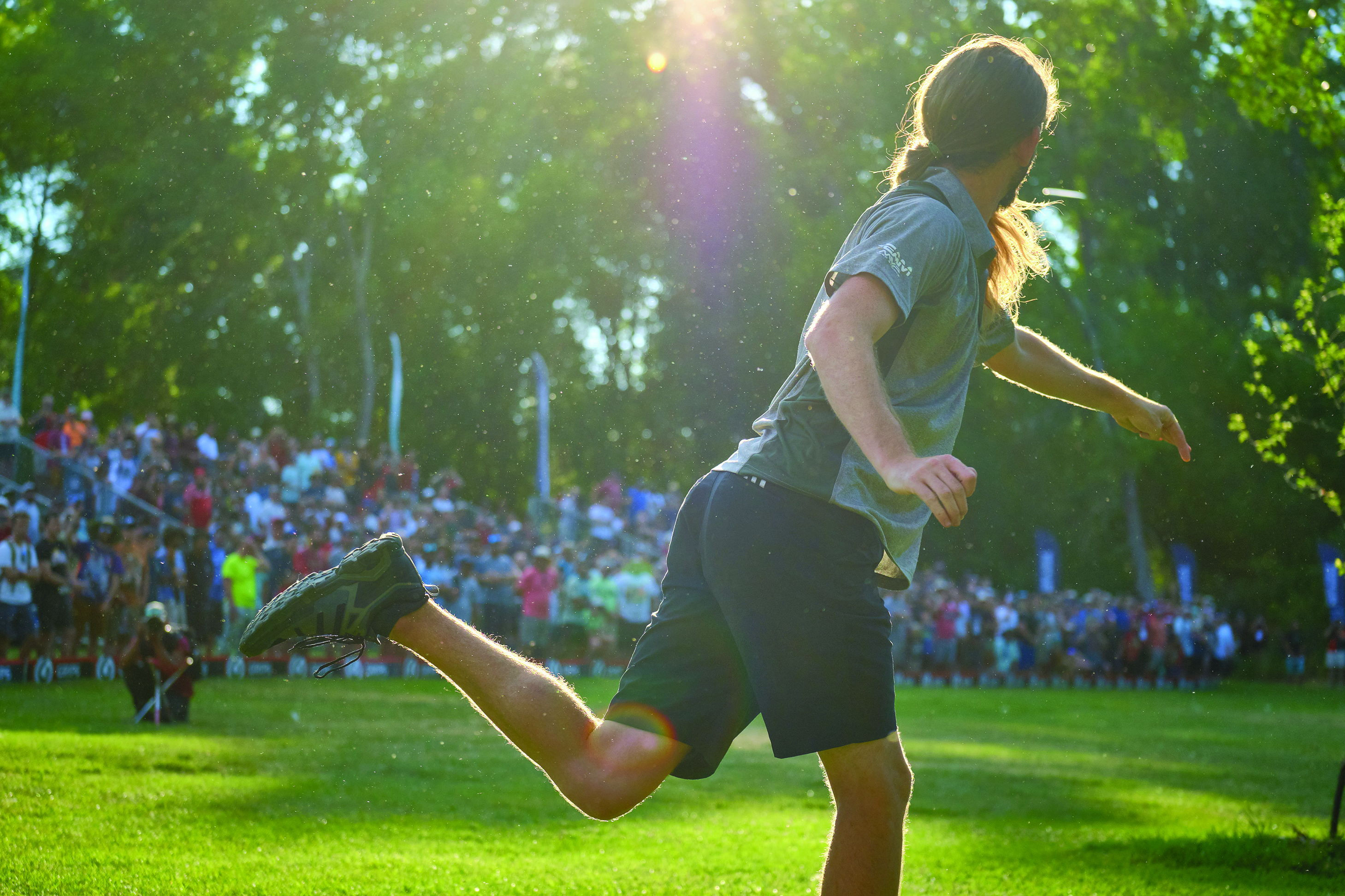
Conrad’s throw-in birdie from 247 feet to force a playoff and ultimately defeat Paul McBeth is one of those moments whose historical importance was immediately apparent to anyone who witnessed it.
Images were seen around the world by millions within hours. Comparisons to some of the great moments in sporting history abounded, but all of them fell short. There was nothing quite like this.
It was the perfect shot, at the perfect moment to consummate disc golf’s coming out party. It said, in the loudest way possible, “Disc golf has arrived.”
Other great moments followed through the back half of the season—none quite as blockbuster as the “Holy Shot”, but then again, how could they be?

December 2021
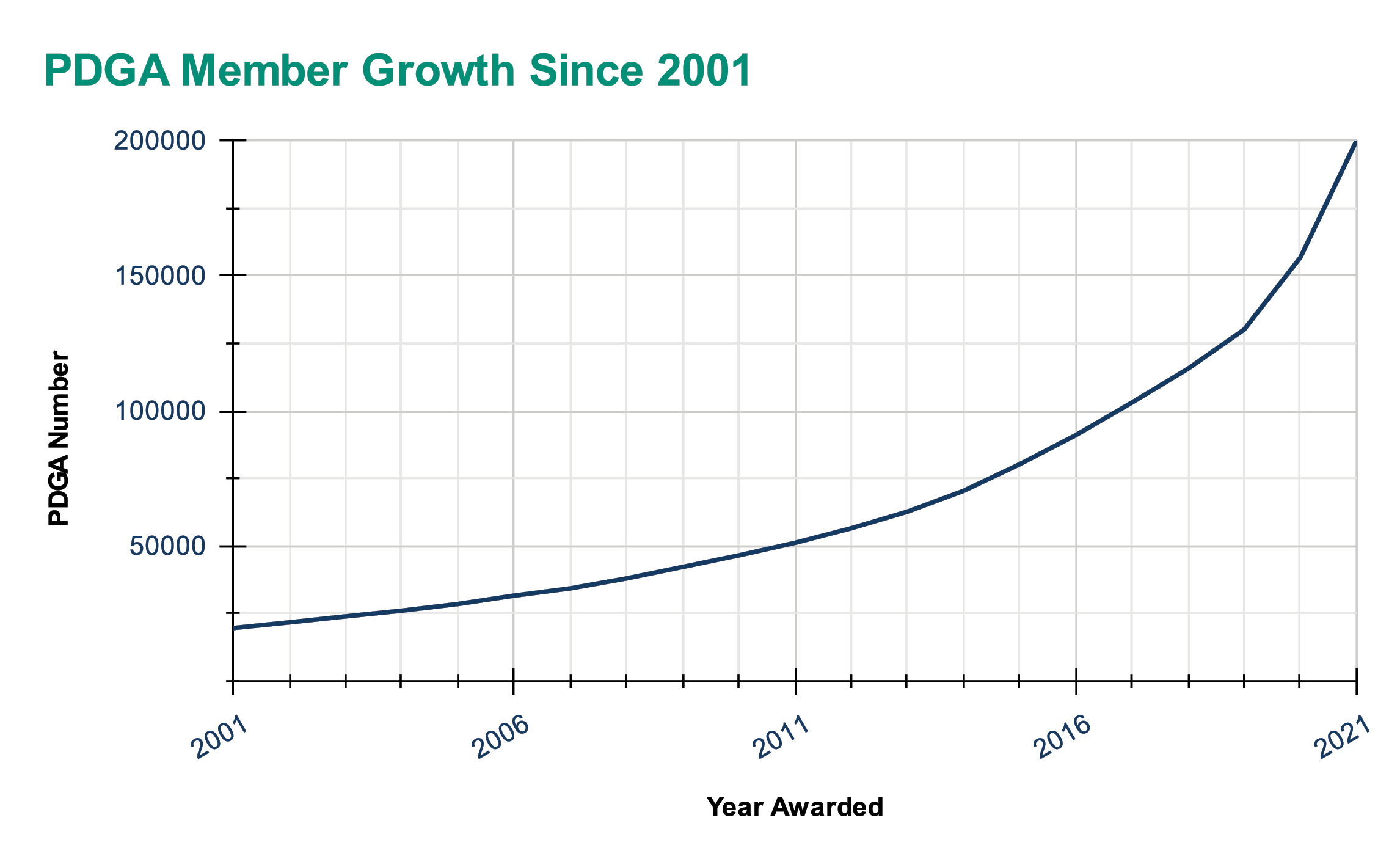
PDGA Member #200,000
PDGA #200,000: Another milestone in disc golf's most explosive year for growth.
41 years passed between the PDGA issuing #001 in 1976 and #100,000 in 2017.
Four years after that six-digit milestone, PDGA #200,000 was awarded on December 24, 2021.
#001 - 1976 | #100,000 - 2017 | #200,000 - 2021
A look back over the past 20 years illustrates just how much the PDGA and our membership has grown; a representation of the momentum we have all contributed to the sport of disc golf.
2021
First year with over 5,000 events
2022
Reached over 10,000 courses in the course directory

2022
Disc Golf Pro Tour Becomes the Official Pro Tour of the PDGA
Under the new agreement, the PDGA National Tour and DGPT Elite Series were be merged into a single cohesive tour - The Disc Golf Pro Tour: “The Official Pro Tour of the PDGA.” This marked the start of a potent partnership that further amplified the growth of elite professional disc golf.
Over the past 18 years, the PDGA has allocated resources, staff, and volunteers, developed rules and competition standards, and provided the technical backbone that made a pro tour possible, starting with the National Tour (NT) in 2003. In 2016, the DGPT created a new premier tour, elevating the top tier of the game to a new level. The PDGA has been in discussions with the DGPT for more than five years to ensure that this partnership creates the best possible outcomes for the PDGA and our members as well as the DGPT.
Mike Downes, Director of Operations for the PDGA, notes that this relationship will have profound impacts for disc golf, from top-tier touring professionals to the weekend warriors participating in local sanctioned leagues and regional tournaments.
“DGPT will have the opportunity to continue to grow the prestige and visibility of the elite touring professionals, bringing new pros on the scene and new fans into the sport,” said Downes. “Meanwhile, the PDGA is committed to furthering event and tournament director support to enrich the tournament experience for athletes competing in everything from PDGA sanctioned leagues up to premier events like our PDGA World Championships.”
“The PDGA’s support has allowed the DGPT to grow and thrive, period. Our experience working with Joe Chargualaf, Mike Downes, and the PDGA staff has been entirely supportive,” said DGPT CEO & Director Jeff Spring. “Since the very start, the PDGA has encouraged us, worked collaboratively with us, and strived towards this moment as a partner. I’m extremely proud to be taking this monumental step forward with them as meaningful partners to usher in the true new age of professional disc golf.”
As part of the deal, the PDGA will gain a minority ownership stake in DGPT, which remains independent, with Todd Rainwater as the majority owner. The agreement will also secure new member benefits including an exclusive new subscription tier on the Disc Golf Network (DGN) just for PDGA members.

February 2023
First PDGA brand update since 1997
The new mark combines lettering with negative space – where the magic happens. Within the arc spanning the width of the graphic, the eye may pick out several images:
- The profile of a flying disc
- The horizon of the earth
- The dawn of a new day
And in the touching “DG”:
- The links of a basket’s chains
- The connection of the disc golf community
The blues and greens that will accompany the new logo remain familiar, but brightened. Green symbolizes nature, health, optimism and growth. Blue is professional, stable, sincere and trustworthy.
2023
First year with over 10,000 events

January 2025
PDGA Member #300,000
PDGA membership hits another major milestone: #300,000!