


Red-necked Stint Bécasseau à col roux
Systematics
- Order Charadriiformes
- FamilyScolopacidés
- GenusCalidris
- Speciesruficollis
Statut de conservation
NTQuasi menacéeGeographic range

Other names
- Bécasseau à cou roux,
- Correlimos cuellirrojo,
- pilrito-de-pescoço-ruivo,
- Rotkehl-Strandläufer,
- rozsdástorkú partfutó,
- Roodkeelstrandloper,
- Gambecchio collorosso,
- rödhalsad snäppa,
- Rødstrupesnipe,
- pobrežník červenokrký,
- jespák rudokrký,
- Rødhalset Ryle,
- rusokaulasirri,
- Rooinekstrandloper,
- territ de gola roja,
- Roðatíta,
- biegus rdzawoszyi,
- sarkankakla šņibītis,
- rdečevrati prodnik,
- Песочник-красношейка,
- Kedidi leher-merah,
- トウネン,
- 红颈滨鹬,
- นกสติ๊นท์คอแดง,
- 紅胸濱鷸〔穉鷸、紅頸濱鷸〕,
Identification
sp. Calidris ruficollis

sp. Calidris ruficollis
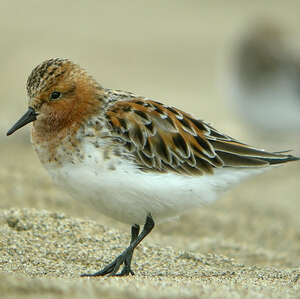
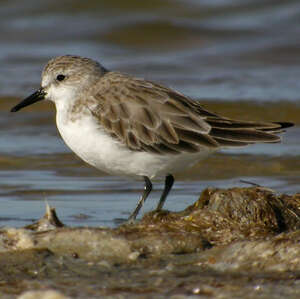
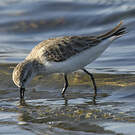
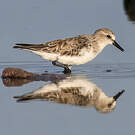
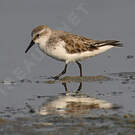
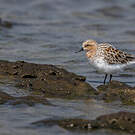
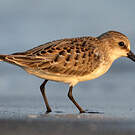
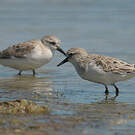
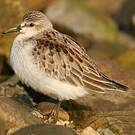
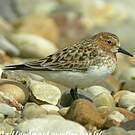
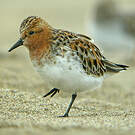
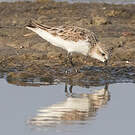
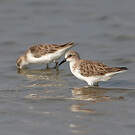
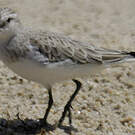
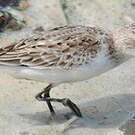
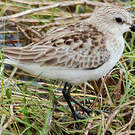
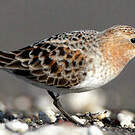
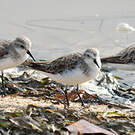
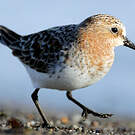
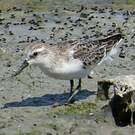
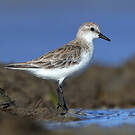
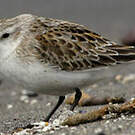
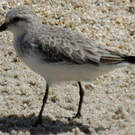
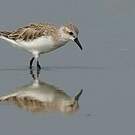
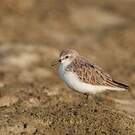
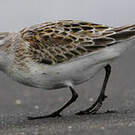
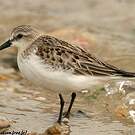
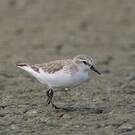
The Red-necked Stint is a small sandpiper close to the Little Stint. It is unmistakable in nuptial plumage with its intense red cheeks, neck and breast. The upper part feathers (back, scapulars, upper coverts) are black largely bordered with red. Both young and adults out of the breeding season have almost similar plumage. Dark grey on top (with the feathers bordered with brown in young ones), white underneath. A brownish spot at the side of the chest, barely marked with slight black (grey and barely visible in young ones) spots. The upper part of the head has a finely rayed, long white eyebrow that widens at the base of the beak. The beak is short, black and straight, somewhat wider at the tip. Can easily be confused with almost all little sandpipers with black legs (Little Stint, Semipalmated Sandpiper, Baird's Sandpiper). Young birds on coast are very difficult to differentiate from the Young Little Stint.
In flight, this sandpiper is highly contrasted (dark on top, light underneath); the very dark primary coverts create a characteristic spot on the wrist of adult in winter plumage. This spot contrasts with the clear base of the primary remiges. This wing design is only seen in the much larger Sanderling.
Similar species
Distribution

sp. Calidris ruficollis

sp. Calidris ruficollis
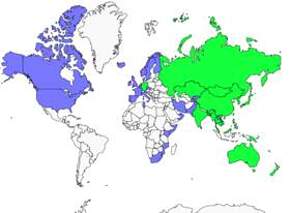
The Red-necked Stint breeds in the Far East of Russia in a narrow range extending from the Taymyr Peninsula to the north of Kamchatka. It occasionally nests in northern Alaska. It is an over-wintering bird from India to New Zealand (southern China, Papua New Guinea, Indonesia, Indo-China).
It is abundant in Australia during the northern winter and a large number remain there during the southern winter. Its migration takes place along both Asian coastlines and inland (regularly in Kazakhstan, for example). Its distribution and its migration pattern explain why the species is very rare in Europe where there have only been 15 observed sightings. An adult was present in the Pas-de-Calais from the 15th to 21st July 1994. It was also seen in Belgium on 16th August 1988. At least six sightings have been recorded in Great Britain.
Additional data
| Migration | Full Migrant | Migratory | Bird et al. 2020, Tobias et al. 2021 |
|---|---|---|
| Domaine biogéographique | Palearctic | Pigot et al. 2020 |
| Aire | 971179.99 km² | Bird et al. 2020, Tobias et al. 2021 |
| Latitudes de reproduction | 59,9 à 77,5 ° | Tobias et al. 2021 |
| Aire restreinte | N | Birdlife's Worldbird Database |
Voice song and calls


sp. Calidris ruficollis
The flight calls are sequences of more or less spaced criiip sounds, slightly bisyllabic and quite similar to that of the Red-necked Stint.
Flight and movements

sp. Calidris ruficollis
The flight is similar to that of other small stints, fast, with sudden changes of direction that alternately show the dark and light parts of the plumage. It seems that this behaviour is meant to disorient potential predators.
Capacité de vol : HWI = 54,5 (vol soutenu, migrateur)
Behaviour and character

sp. Calidris ruficollis
Red-necked Stints gather in great numbers during migration.
Habitat
sp. Calidris ruficollis
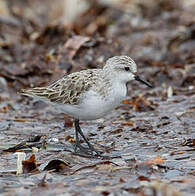
During breeding season, Red-necked Stints inhabit the most northern tundra. They are more eclectic in migration and wintering. They prefer to frequent coastal pools, the edges of fresh water marshes, salines and sometimes even the rocky coastlines.
Additional data
| Habitat | Marshy or mossy tundra and nearby rivers (breeding); tidal mudflats, beaches, and marshes (nonbreeding). | Marine | tundra, migrn beaches, mudflats | Grassland | AOU Checklist, Bird et al. 2020, Tobias et al. 2021, http://www.noord.bart.nl/~edcolijn/bird.html |
|---|---|---|
| Densité | Open habitats | Tobias et al. 2021 |
| Mode de vie | DIURNAL | Terrestrial | Bird et al. 2020 |
Diet - feeding behaviour
sp. Calidris ruficollis
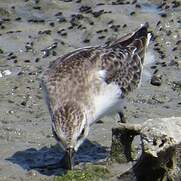
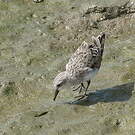
Most of the food is taken directly from the ground, however, like the Red-necked Stint, it can be taken from the mud up to a depth of about 2cm. The main diet consists of invertebrates, with some seeds added. On breeding sites, mainly terrestrial invertebrates are eaten, while in migration and wintering, the basis of the diet consists of aquatic invertebrates.
Additional data
| Niveau trophique | Carnivore | Pigot et al. 2020, Tobias et al. 2021 |
|---|---|---|
| Niche trophique | Aquatic predator | Pigot et al. 2020, Tobias et al. 2021 |
| Niche de recherche | Aquatic ground | Pigot et al. 2020 |
| Alimentation | Invertebrate | Bird et al. 2020 |
Breeding and nesting

sp. Calidris ruficollis

sp. Calidris ruficollis
These birds are monogamous. The nest, made of vegetal debris, is placed in a depression of the ground dug out by the male. The laying is generally of 4 eggs, incubated by both sexes. The incubation lasts about three weeks and the female starts its migration towards the south one or two days later. The male accompanies the young (who feed themselves) until their flight, at the age of 17 days. There is only one laying, but the female can make a replacement laying if the first one is destroyed early.
Additional data
| âge première reproduction | 1,4 ans | Bird et al. 2020 |
|---|---|---|
| Ponte | 3,5 à 4 oeufs | Bird et al. 2020, Myhrvold et al. 2015, http://www.birdzilla.com |
| Tentatives par an | 1,5 | Myhrvold et al. 2015 |
| Masse de l’oeuf | 8,3 g | Lisleland et al. 2007, Myhrvold et al. 2015 |
Threats and conservation
sp. Calidris ruficollis
Statut de conservation IUCN
mineure
à l'état sauvage
menacé
évalué
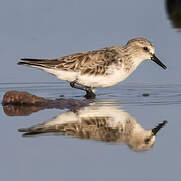
This non-threatened species has a global population of around 315,000 individuals. On wintering spots, a decrease in population has been observed in Japan, whereas numbers have increased in Australia, suggesting a shift in the distribution of the Red-necked Stints.


Data sources
- AOU Checklist
- Bird et al. 2020
- Birdlife's Worldbird Database
- Lisleland et al. 2007
- Myhrvold et al. 2015
- Peter's Checklist of the Birds of the World
- Pigot et al. 2020
- S. M. Billerman, B. K. Keeney, P. G. Rodewald, & T. S. Schulenberg (Eds.). (2022). Birds of the World. Cornell Laboratory of Ornithology. https://birdsoftheworld.org/bow/home
- Tobias et al. 2021
- africanbirdclub.org
- http://www.birdzilla.com
- http://www.noord.bart.nl/~edcolijn/bird.html
- www.birdsofmelanesia.net
Further references
- Birdlife
- IUCN Red List — IUCN Red List of Threatened species, IUCN
- GBIF — GBIF - Global Biodiversity Information Facility, GBIF Secretariat
- Wikidata — Wikidata, la base de connaissances libre, Wikimedia Foundation
- Encyclopedia of Life — Encyclopedia of life, Encyclopedia of Life
- NCBI Taxonomy — NCBI Taxonomy Database, National Center for Biotechnology Information
- eBird — eBird, Cornell Lab of Ornithology et National Audubon Society
- Birds of the World — Birds of the World, The Cornell Lab of Ornithology
- TaxRef (INPN) — Inventaire national du patrimoine naturel (INPN), MNHN - INPN
- Xeno-Canto
 Fiche créée le 29/07/2023 par Georges Olioso
Texte traduit par IA Oiseaux.net
© 1996-2026 Oiseaux.net