


Eurasian Hobby
Systematics
- Order Falconiformes
- FamilyFalconidés
- GenusFalco
- Speciessubbuteo
Statut de conservation
LCPréoccupation mineureGeographic range

Other names
- Faucon hobereau,
- Alcotán europeo,
- ógea-eurasiática,
- Baumfalke,
- kabasólyom,
- Boomvalk,
- Lodolaio,
- lärkfalk,
- Lerkefalk,
- sokol lastovičiar,
- ostříž lesní,
- Lærkefalk,
- nuolihaukka,
- Europese Boomvalk,
- falcó mostatxut europeu,
- Gunnfálki,
- kobuz,
- bezdelīgu piekūns,
- škrjančar,
- Чеглок,
- Alap-alap walet,
- チゴハヤブサ,
- 燕隼,
- เหยี่ยวฮอบบี้ยุโรป,
- 燕隼,
Identification
sp. Falco subbuteo

sp. Falco subbuteo
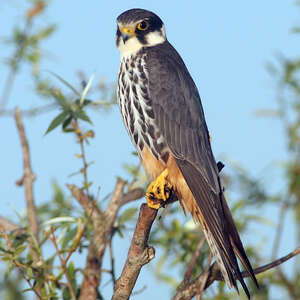
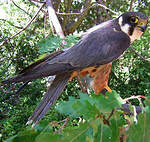
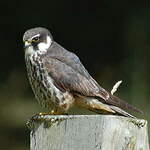
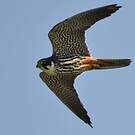
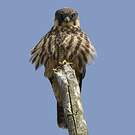
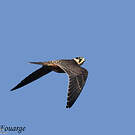
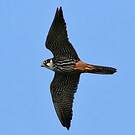
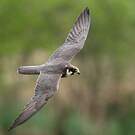
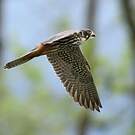
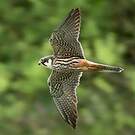
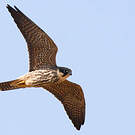
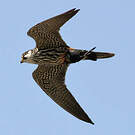
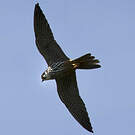
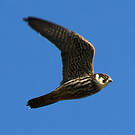
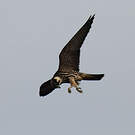
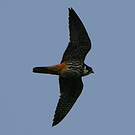
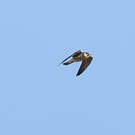
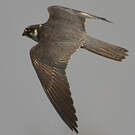
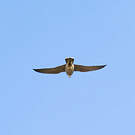
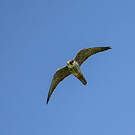
The Eurasian Hobby is a small raptor of the same size of a Kestrel. It is more slender, with shorter tail and longer Irealis wings, giving it a bigger martin's silhouette while flying. This morphology is very well adapted for quick aerial pursuits. At rest, the tips of the wings slightly surpass the tail. The female is slightly larger than the male.
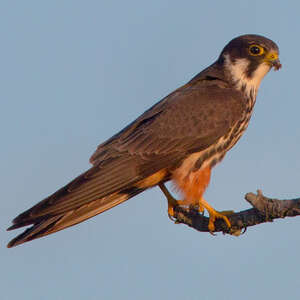
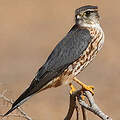
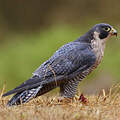
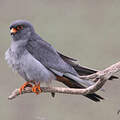
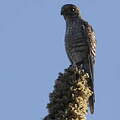
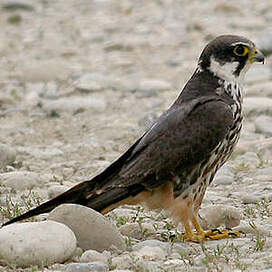
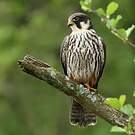
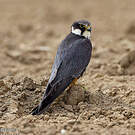
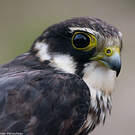
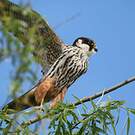
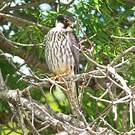
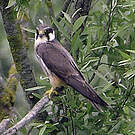
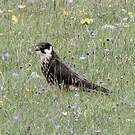
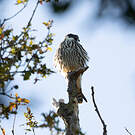
The adult has upper parts of steel-bluegray color, with the remiges a bit darker. The head is hooded with black, immaculately contrasted with white cheeks and throat. Between the latter, a narrow black moustache goes below the eye, like a cloak's clasp. A lateral elevation of the white cheeks towards the nape restricts the width of the black at this level. A thin white eyebrow usually tops the dark eye circled with yellow. The cere of the beak is bright yellow.
The lower parts are white, strikingly and abundantly striped with black, except for the throat, un-striped. The culottes, the feathers covering the thighs and the legs, are of a bright red color, and the undertail rufous. From a distance, the underside of the wings and tail looks uniformly gray, but from a closer view, it is seen that this gray comes from the combination of white and blackish vermiculations. Tarses and digits are yellow.
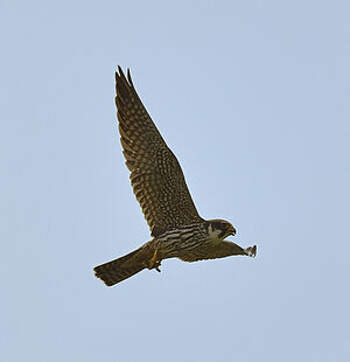
The juvenile has a plumage less gray and more brown above, with the tectrices ruffled of rusty brown color. Below, the background color is more cream-like, and especially so the rufous culottes, which lack the intense coloration of the adult's. The immature acquires the adult plumage in its third year.
Distribution
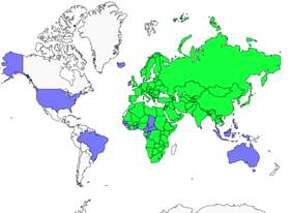
sp. Falco subbuteo
Additional data
| Migration | Full Migrant | Migratory | Bird et al. 2020, Tobias et al. 2021 |
|---|---|---|
| Domaine biogéographique | Palearctic | Pigot et al. 2020 |
| Aire | 28255832.68 km² | Bird et al. 2020, Tobias et al. 2021 |
| Latitudes de reproduction | 20,2 à 66,7 ° | Tobias et al. 2021 |
| Aire restreinte | N | Birdlife's Worldbird Database |
Voice song and calls

sp. Falco subbuteo
The Eurasian Hobby is very noisy during the breeding season. Near the nest site, or to warn of the approach of an intruder, the couple emit repeated cries. When they land and are calmer, they give off softer sounds.
When approaching the nest, the male makes a shrill cry, sometimes one, sometimes repeated, to which the female responds with a whistle. When hunting, it gives off a short, harsh cry.
Flight and movements
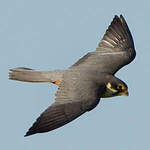
sp. Falco subbuteo
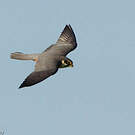
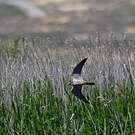
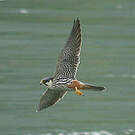
Their long, sharp wings allow for powerful, fast and agile flight at the same time.
Capacité de vol : HWI = 57,8 (vol soutenu, migrateur)
Behaviour and character
sp. Falco subbuteo

sp. Falco subbuteo
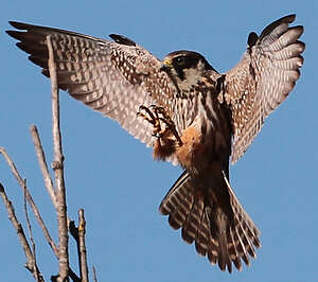
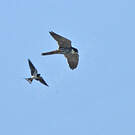
It is a very discreet and very mobile raptor. We can see it chasing dragonflies over ponds, sparrows or swallows at their roost which it often shreds in mid-flight. It also pursues martins and hunts larks in our countryside. This migratory bird returns to us in April from its winter quarters in South African wooded savannas. The post-nuptial migration begins in August, peaking in September. The last may be observed in October. It is present over the whole territory.
Small mammals and small birds are also part of its diet. It suddenly appears from behind a hedge or a building. It hunts in open spaces and at any time of day, but it is more active on misty days and at dusk.
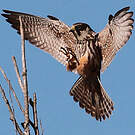
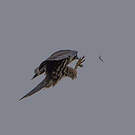
In the spring, about one month before the laying, Eurasian Hobbies occupy their territory and perform nuptial flights just above it. The male's are spectacular. He plunges downwards towards the top of a tree, repeating this operation several times effortlessly. The female sitting in the branches seems to watch these maneuvers with indifference.
The couple describes long circular ascendant flights, during which the male dives towards the female as if to attack her. After catching a bird, he rises very high to better dive down towards the female, passing on the prey in mid-flight.
Eurasian Hobbies defend the area around the nest with great energy. If an intruder approaches, the couple makes rapid passages accompanied by strident cries.
Habitat
sp. Falco subbuteo
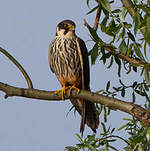
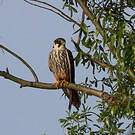
Its favorite habitat consists of wood or copse edges, preferably in wet areas. It also frequents open grounds, especially heaths and cultivated land with trees.
Additional data
| Habitat | Woodland and partly open country. | Freshwater | wooded tundra, cultivation, open areas, steppe, farmland, moors | Woodland | AOU Checklist, Bird et al. 2020, Tobias et al. 2021, http://www.noord.bart.nl/~edcolijn/bird.html |
|---|---|---|
| Densité | Open habitats | Tobias et al. 2021 |
| Mode de vie | DIURNAL | Terrestrial | Bird et al. 2020 |
Diet - feeding behaviour
sp. Falco subbuteo
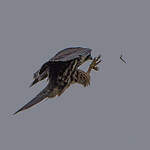
The Eurasian Hobby feeds on small birds (particularly swallows and martins) and large insects (dragonflies and moths) captured in the air, or walking on the ground for other species.
Additional data
| Niveau trophique | Carnivore | Pigot et al. 2020, Tobias et al. 2021 |
|---|---|---|
| Niche trophique | Invertivore | Pigot et al. 2020, Tobias et al. 2021 |
| Niche de recherche | Invertivore aerial | Pigot et al. 2020 |
| Alimentation | Invertebrate | Bird et al. 2020 |
Breeding and nesting
sp. Falco subbuteo

sp. Falco subbuteo
In the first days of June, the Eurasian Hobby chose a nest, an old nest of crow, buzzard or sparrowhawk. It never builds a nest, but often changes the interior of the one it has chosen, throwing or carrying away part of the materials that line it. Then it digs and scratches a hollow where the female will lay the eggs.
The female lays 2 to 3 eggs in June, at an interval of every two days. Incubation lasts around 28 days, carried out by the female. She is fed by the male who brings in prey, sometimes at the nest, but also at the couple's usual perch. He then calls the female and gives her the prey, and then he goes to brood the eggs for a short moment, giving the female time to feed. It also happens that he passes the prey to her in mid-flight, and the female quickly grabs it.
The chicks hatch two days apart. The female broods the chicks constantly during the first week, while being fed by the male. He also goes to the nest with prey, usually small plucked and decapitated birds. The young can feed themselves alone at 18-20 days with the prey brought to the nest by the parents. They leave the nest at the age of 28 to 31 days, and fly quite well, but they stay around, still being fed by the adults.
The family group stays together for 20 to 30 days, before leaving the area around mid-September.
Additional data
| âge première reproduction | 2 ans | Bird et al. 2020 |
|---|---|---|
| Ponte | 3 oeufs | Bird et al. 2020, Lisleland et al. 2007, Myhrvold et al. 2015 |
| Incubation | 29,5 jours | Myhrvold et al. 2015 |
| Envol | 31 jours | Myhrvold et al. 2015 |
| Tentatives par an | 1 | Myhrvold et al. 2015 |
| Parade | mainly aerial displays, acrobatic | Lisleland et al. 2007 |
| Masse de l’oeuf | 24,2 g | Lisleland et al. 2007, Myhrvold et al. 2015 |
Threats and conservation
sp. Falco subbuteo
Statut de conservation IUCN
mineure
à l'état sauvage
menacé
évalué
Eurasian Hobby populations seem to be fairly stable now, after many declines in the later part of the 20th century due to habitat modifications and use of pesticides.
Data sources
- AOU Checklist
- Bird et al. 2020
- Birdlife's Worldbird Database
- IOC 12.1
- Lisleland et al. 2007
- Myhrvold et al. 2015
- Pigot et al. 2020
- S. M. Billerman, B. K. Keeney, P. G. Rodewald, & T. S. Schulenberg (Eds.). (2022). Birds of the World. Cornell Laboratory of Ornithology. https://birdsoftheworld.org/bow/home
- Tobias et al. 2021
- africanbirdclub.org
- http://www.noord.bart.nl/~edcolijn/bird.html
Further references
- Birdlife
- IUCN Red List — IUCN Red List of Threatened species, IUCN
- GBIF — GBIF - Global Biodiversity Information Facility, GBIF Secretariat
- Wikidata — Wikidata, la base de connaissances libre, Wikimedia Foundation
- Encyclopedia of Life — Encyclopedia of life, Encyclopedia of Life
- NCBI Taxonomy — NCBI Taxonomy Database, National Center for Biotechnology Information
- eBird — eBird, Cornell Lab of Ornithology et National Audubon Society
- Birds of the World — Birds of the World, The Cornell Lab of Ornithology
- TaxRef (INPN) — Inventaire national du patrimoine naturel (INPN), MNHN - INPN
- Xeno-Canto
 Fiche créée le 28/10/2023 par Didier Collin avec la participation de Jean François
Texte traduit par IA Oiseaux.net
© 1996-2026 Oiseaux.net