Riversideite
A valid IMA mineral species - questionable
This page is currently not sponsored. Click here to sponsor this page.
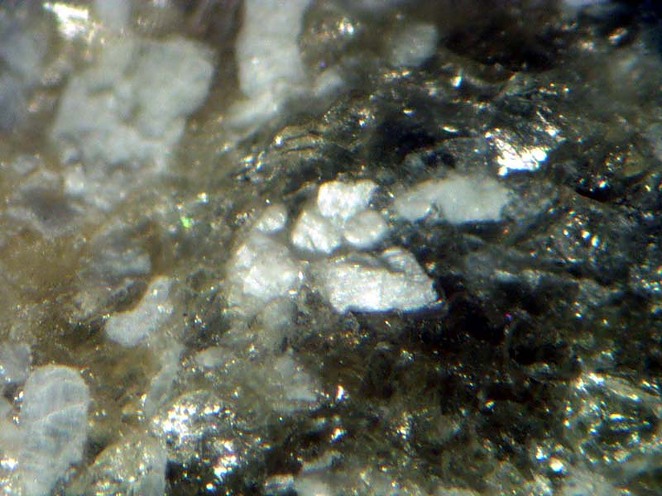

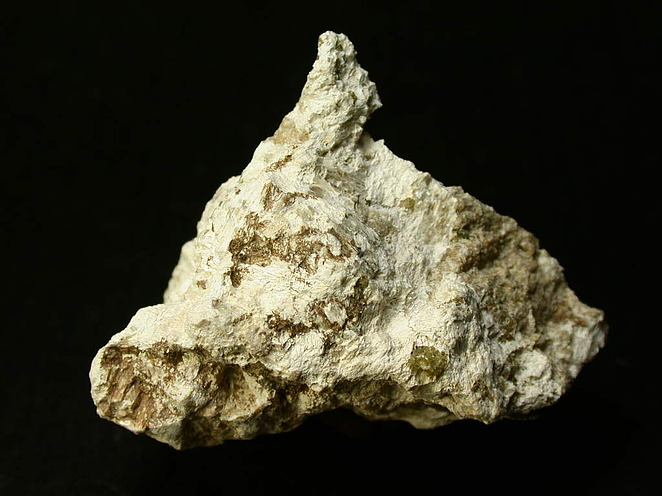
About Riversideite
Formula:
Ca5Si6O16(OH)2 · 2H2O
Alternative: Ca^5(HSi^3O^9)^2.2H^2O
Colour:
White
Lustre:
Silky
Hardness:
3
Specific Gravity:
2.65 (Calculated)
Crystal System:
Orthorhombic
Member of:
Name:
Named after its discovery locality.
A natural occurrence of riversideite is not yet demonstrated unequivocally and its status should be considered as “questionable” (Biagioni et al., 2015).
The exact structure of riversideite is not known, but a reliable model can be derived from the structures of Tobermorite and Clinotobermorite. In this model, the riversideite structure contains composite layers, consisting of infinite sheets of (CaO7) polyhedra, to both sides of which dreier single chains of (SiO4) tetrahedra are attached, running along the b axis. Those layers are stacked along the c axis and linked by additional calcium ions and water molecules which occupy cavities between the layers (Ferraris et al., 2004).
A very similar structure is found in plombièrite.
Previously known as Tobermorite-9 Å.
The exact structure of riversideite is not known, but a reliable model can be derived from the structures of Tobermorite and Clinotobermorite. In this model, the riversideite structure contains composite layers, consisting of infinite sheets of (CaO7) polyhedra, to both sides of which dreier single chains of (SiO4) tetrahedra are attached, running along the b axis. Those layers are stacked along the c axis and linked by additional calcium ions and water molecules which occupy cavities between the layers (Ferraris et al., 2004).
A very similar structure is found in plombièrite.
Previously known as Tobermorite-9 Å.
Unique Identifiers
Mindat ID:
3427
Long-form identifier:
mindat:1:1:3427:8
IMA Classification of Riversideite
Approved, Questionable
IMA Formula:
Ca5Si6O16(OH)2 · 2H2O
Classification of Riversideite
9.DG.10
9 : SILICATES (Germanates)
D : Inosilicates
G : Inosilicates with 3-periodic single and multiple chains
9 : SILICATES (Germanates)
D : Inosilicates
G : Inosilicates with 3-periodic single and multiple chains
72.3.2.4
72 : PHYLLOSILICATES Two-Dimensional Infinite Sheets with Other Than Six-Membered Rings
3 : Two-Dimensional Infinite Sheets with Other Than Six-Membered Rings with 3-, 4-, or 5-membered rings and 8-membered rings
72 : PHYLLOSILICATES Two-Dimensional Infinite Sheets with Other Than Six-Membered Rings
3 : Two-Dimensional Infinite Sheets with Other Than Six-Membered Rings with 3-, 4-, or 5-membered rings and 8-membered rings
14.5.19
14 : Silicates not Containing Aluminum
5 : Silicates of Ca
14 : Silicates not Containing Aluminum
5 : Silicates of Ca
Mineral Symbols
As of 2021 there are now IMA–CNMNC approved mineral symbols (abbreviations) for each mineral species, useful for tables and diagrams.
| Symbol | Source | Reference for Standard |
|---|---|---|
| Rsd | IMA–CNMNC | Warr, L.N. (2021). IMA–CNMNC approved mineral symbols. Mineralogical Magazine, 85(3), 291-320. doi:10.1180/mgm.2021.43 |
Physical Properties of Riversideite
Silky
Transparency:
Translucent, Opaque
Colour:
White
Hardness:
3 on Mohs scale
Cleavage:
Perfect
{001}, perfect; {100}, secondary
{001}, perfect; {100}, secondary
Density:
2.65(5) g/cm3 (Calculated)
Optical Data of Riversideite
Type:
Biaxial (+)
RI values:
nα = 1.600(2) nβ = 1.601(2) nγ = 1.605(2)
Max. Birefringence:
δ = 0.005
Based on recorded range of RI values above.
Based on recorded range of RI values above.
Interference Colours:
The colours simulate birefringence patterns seen in thin section under crossed polars. They do not take into account mineral colouration or opacity.
Michel-Levy Bar The default colours simulate the birefringence range for a 30 µm thin-section thickness. Adjust the slider to simulate a different thickness.
Grain Simulation You can rotate the grain simulation to show how this range might look as you rotated a sample under crossed polars.
The colours simulate birefringence patterns seen in thin section under crossed polars. They do not take into account mineral colouration or opacity.
Michel-Levy Bar The default colours simulate the birefringence range for a 30 µm thin-section thickness. Adjust the slider to simulate a different thickness.
Grain Simulation You can rotate the grain simulation to show how this range might look as you rotated a sample under crossed polars.
Surface Relief:
Moderate
Dispersion:
r < v weak
Comments:
2V(meas.) = Small.
Chemistry of Riversideite
Mindat Formula:
Ca5Si6O16(OH)2 · 2H2O
Alternative: Ca^5(HSi^3O^9)^2.2H^2O
Alternative: Ca^5(HSi^3O^9)^2.2H^2O
Element Weights:
Elements listed:
Common Impurities:
Ti,Al,Fe,Mg
Crystallography of Riversideite
Crystal System:
Orthorhombic
Cell Parameters:
a = 11.3 Å, b = 7.30 Å, c = 18.79 Å
Ratio:
a:b:c = 1.548 : 1 : 2.574
Unit Cell V:
1,549.99 ų (Calculated from Unit Cell)
Z:
4
Comment:
Point Group: n.d.; Space Group: n.d.
X-Ray Powder Diffraction
Powder Diffraction Data:
| d-spacing | Intensity |
|---|---|
| 3.03 Å | (vs) |
| 2.33 Å | (s) |
| 1.83 Å | (s) |
| 9.3 Å | (m) |
| 3.59 Å | (m) |
| 2.78 Å | (m) |
| 1.66 Å | (m) |
Comments:
from 9.3 ºA product of dehydrated tobermorite.
Geological Environment
Paragenetic Mode(s):
| Paragenetic Mode | Earliest Age (Ga) |
|---|---|
| High-? alteration and/or metamorphism | |
| 31 : Thermally altered carbonate, phosphate, and iron formations | |
| Stage 10a: Neoproterozoic oxygenation/terrestrial biosphere | <0.6 |
| 51 : Pyrometamorphic minerals (see also #54 and #56) | <0.36 |
Type Occurrence of Riversideite
General Appearance of Type Material:
Cross-veinlet fibrous
Place of Conservation of Type Material:
National Museum of Natural History, Washington, D.C., USA, 93416
Associated Minerals at Type Locality:
Synonyms of Riversideite
Other Language Names for Riversideite
Relationship of Riversideite to other Species
Member of:
Other Members of Tobermorite Supergroup:
| Clinotobermorite | Ca5Si6O17 · 5H2O | Mon. |
| Paratobermorite | Ca5AlSi5O16(OH) · 5H2O | Mon. 2/m |
| Plombièrite | Ca5Si6O16(OH)2 · 7H2O | Orth. |
| Tobermorite Group | Ca4+x(AlySi6-y)O15+2x-y · 5H2O |
Common Associates
Associations Based on Photo Data:
| 8 photos of Riversideite associated with Calcite | CaCO3 |
| 8 photos of Riversideite associated with Tobermorite | Ca5Si6O17 · 5H2O |
| 6 photos of Riversideite associated with Vesuvianite | Ca19Fe3+Al4(Al6Mg2)(◻4)◻[Si2O7]4[(SiO4)10]O(OH)9 |
| 4 photos of Riversideite associated with Datolite | CaB(SiO4)(OH) |
| 4 photos of Riversideite associated with 'Ellestadite' | |
| 1 photo of Riversideite associated with Harkerite | Ca48Mg16[AlSi4O15(OH)]4(BO3)16(CO3)16 · 2(H2O,HCl) |
Related Minerals - Strunz-mindat Grouping
| 9.DG. | Barrydawsonite-(Y) | Na1.5Y0.5CaSi3O8(OH) |
| 9.DG. | Paratobermorite | Ca5AlSi5O16(OH) · 5H2O |
| 9.DG. | Calcinaksite | KNaCa(Si4O10) · H2O |
| 9.DG. | Alvesite | NaKZrSi6O15 · 2H2O |
| 9.DG.02 | Steedeite | NaMn2[Si3BO9](OH)2 |
| 9.DG.02 | Nolzeite | NaMn2[Si3BO9](OH)2 · 2H2O |
| 9.DG.05 | Murakamiite | LiCa2Si3O8(OH) |
| 9.DG.05 | Serandite | NaMn2+2Si3O8(OH) |
| 9.DG.05 | Bustamite | CaMn2+(Si2O6) |
| 9.DG.05 | Pectolite | NaCa2Si3O8(OH) |
| 9.DG.05 | Tanohataite | LiMn2Si3O8(OH) |
| 9.DG.05 | Dalnegorskite | Ca5Mn(Si3O9)2 |
| 9.DG.05 | 'Wollastonite-1A' | CaSiO3 |
| 9.DG.05 | Wollastonite | Ca3(Si3O9) |
| 9.DG.05 | Ferrobustamite | CaFe2+(Si2O6) |
| 9.DG.05 | Schizolite | NaCaMnSi3O8(OH) |
| 9.DG.07 | Cascandite | CaScSi3O8(OH) |
| 9.DG.08 | Plombièrite | Ca5Si6O16(OH)2 · 7H2O |
| 9.DG.10 | Clinotobermorite | Ca5Si6O17 · 5H2O |
| 9.DG.10 | Tobermorite | Ca5Si6O17 · 5H2O |
| 9.DG.12 | Jusite | Na2Ca15Al4Si16O54 · 17H2O |
| 9.DG.12 | Kenotobermorite | Ca4Si6O15(OH)2 · 5H2O |
| 9.DG.15 | Foshagite | Ca4(Si3O9)(OH)2 |
| 9.DG.20 | Jennite | Ca9(Si3O9)2(OH)8 · 8H2O |
| 9.DG.20 | Kamenevite | K2TiSi3O9 · H2O |
| 9.DG.25 | Paraumbite | K3Zr2H(Si3O9)2 · nH2O |
| 9.DG.25 | Umbite | K2(Zr,Ti)Si3O9 · H2O |
| 9.DG.30 | Sørensenite | Na4SnBe2Si6O16(OH)4 |
| 9.DG.32 | Escheite | Ca2NaMnTi5[Si12O34]O2(OH)3 · 12H2O |
| 9.DG.35 | Xonotlite | Ca6(Si6O17)(OH)2 |
| 9.DG.40 | Hillebrandite | Ca2(SiO3)(OH)2 |
| 9.DG.45 | Zorite | Na8(Ti,Nb)5(Si6O17)2(OH,O)5 · 14H2O |
| 9.DG.45 | Chivruaiite | Ca4(Ti,Nb)5(Si6O17)2(OH,O)5 · 13-14H2O |
| 9.DG.50 | Haineaultite | (Na,Ca)5Ca(Ti,Nb)5(Si6O17)2(OH,F)8 · 5H2O |
| 9.DG.55 | Epididymite | Na2Be2Si6O15 · H2O |
| 9.DG.60 | Eudidymite | Na2Be2Si6O15 · H2O |
| 9.DG.65 | Elpidite | Na2ZrSi6O15 · 3H2O |
| 9.DG.65 | Patynite | NaKCa4[Si9O23] |
| 9.DG.67 | Whelanite | Cu2+2Ca6[Si6O17(OH)](CO3)(OH)3 · 2H2O |
| 9.DG.70 | Enricofrancoite | KNaCaSi4O10 |
| 9.DG.70 | Yusupovite | Na2Zr(Si6O15) · 2.5H2O |
| 9.DG.70 | Litidionite | KNaCuSi4O10 |
| 9.DG.70 | Fenaksite | (K,Na)4(Fe,Mn)2(Si4O10)2(OH,F) |
| 9.DG.70 | Manaksite | KNaMnSi4O10 |
| 9.DG.75 | Senkevichite | CsKNaCa2TiO[Si7O18](OH) |
| 9.DG.75 | Tinaksite | K2Na(Ca,Mn2+)2TiO[Si7O18(OH)] |
| 9.DG.75 | Tokkoite | K2Ca4[Si7O18(OH)](OH,F) |
| 9.DG.80 | Fluorcanasite | K3Na3Ca5Si12O30F4 · H2O |
| 9.DG.80 | Canasite | K3Na3Ca5Si12O30(OH)4 |
| 9.DG.85 | Miserite | K1.5-x(Ca,Y,REE)5(Si6O15)(Si2O7)(OH,F)2 · yH2O |
| 9.DG.90 | Frankamenite | K3Na3Ca5(Si12O30)(F,OH)4 · H2O |
| 9.DG.92 | Charoite | (K,Sr)15-16(Ca,Na)32[Si6O11(O,OH)6]2[Si12O18(O,OH)12]2[Si17O25(O,OH)18]2(OH,F)4 · ~3H2O |
| 9.DG.95 | Yuksporite | K4(Ca,Na)14(Sr,Ba)2(◻,Mn,Fe)(Ti,Nb)4(O,OH)4(Si6O17)2(Si2O7)3(H2O,OH)3 |
| 9.DG.97 | Eveslogite | (Na,K,Ca,Sr,Ba)48 [(Ti,Nb,Mn,Fe2+)12Si48O144(OH)12](F,OH,Cl)14 |
Other Information
Health Risks:
No information on health risks for this material has been entered into the database. You should always treat mineral specimens with care.
Internet Links for Riversideite
mindat.org URL:
https://www.mindat.org/min-3427.html
Please feel free to link to this page.
Please feel free to link to this page.
Search Engines:
External Links:
Mineral Dealers:
References for Riversideite
Reference List:
Taylor, H. F. W. (1953) Crestmoreite and Riversideite. Clay Minerals, 30 (222) 155-165 doi:10.1180/minmag.1953.030.222.01
McConnell, J. D. C. (1954) The hydrated calcium silicates riversideite, tobermorite, and plombierite. Mineralogical Magazine and Journal of the Mineralogical Society, 30 (224) 293-305 doi:10.1180/minmag.1954.030.224.02
Localities for Riversideite
Showing 7 localities.
 symbol to view information about a locality.
The
symbol to view information about a locality.
The Locality List
 - This locality has map coordinates listed.
- This locality has estimated coordinates.
ⓘ - Click for references and further information on this occurrence.
? - Indicates mineral may be doubtful at this locality.
- This locality has map coordinates listed.
- This locality has estimated coordinates.
ⓘ - Click for references and further information on this occurrence.
? - Indicates mineral may be doubtful at this locality.
 - Good crystals or important locality for species.
 - World class for species or very significant.
(TL) - Type Locality for a valid mineral species.
(FRL) - First Recorded Locality for everything else (eg varieties).
- World class for species or very significant.
(TL) - Type Locality for a valid mineral species.
(FRL) - First Recorded Locality for everything else (eg varieties).
All localities listed without proper references should be considered as questionable.
Austria | |
| Postl et al. (2012) |
Germany | |
| Wittern (2001) |
| Schnorrer et al. (2001) |
Middle East | |
| Gross (1977) | |
Romania | |
| Marincea +2 other references |
USA (TL) | |
| [Bull.Dept.Geol.Univ. California (1917) |
| Woodford et al. (1941) +4 other references |
Quick NavTopAbout RiversideiteUnique IdentifiersIMA Classification Classification Mineral SymbolsPhysical Properties Optical Data Chemistry Crystallography X-Ray Powder DiffractionGeological EnvironmentType Occurrence SynonymsOther LanguagesRelationshipsCommon AssociatesStrunz-MindatOther InformationInternet Links References Localities Locality List
Crestmore, Jurupa Valley, Riverside County, California, USA