Goedkenite
A valid IMA mineral species
This page is currently not sponsored. Click here to sponsor this page.
About Goedkenite
Formula:
Sr2Al(PO4)2(OH)
May contain minor Ca replacing Sr.
Colour:
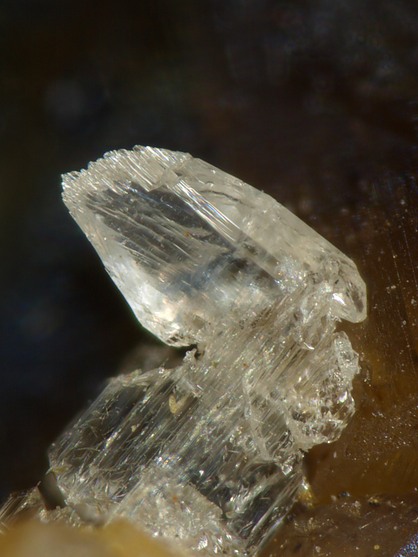
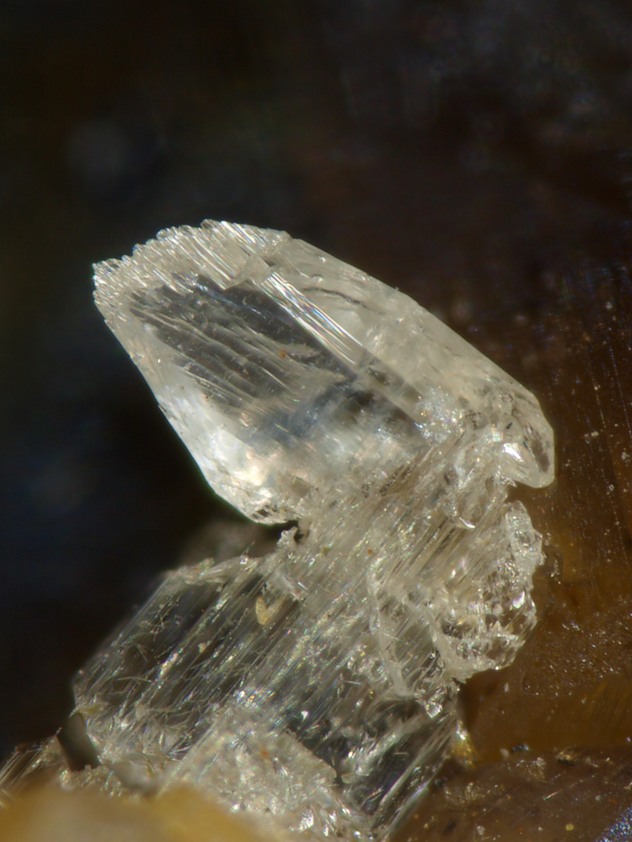
Colorless
Lustre:
Vitreous, Sub-Vitreous
Hardness:
5
Specific Gravity:
3.83 (Calculated)
Crystal System:
Monoclinic
Member of:
Name:
Named in 1975 by Paul Brian Moore, Anthony J. Irving, and Anthony R. Kampf in honor of Virgil Linus Goedken [29 November 1940 Lamont, Buchanan County, Iowa, USA - 22 December 1992 Tallahassee, Leon County, Florida, USA]. He was an inorganic chemist and crystallographer at University of Chicago and Florida State University. He made many important advances in the study of chemical bonding in organo-metallic structures.
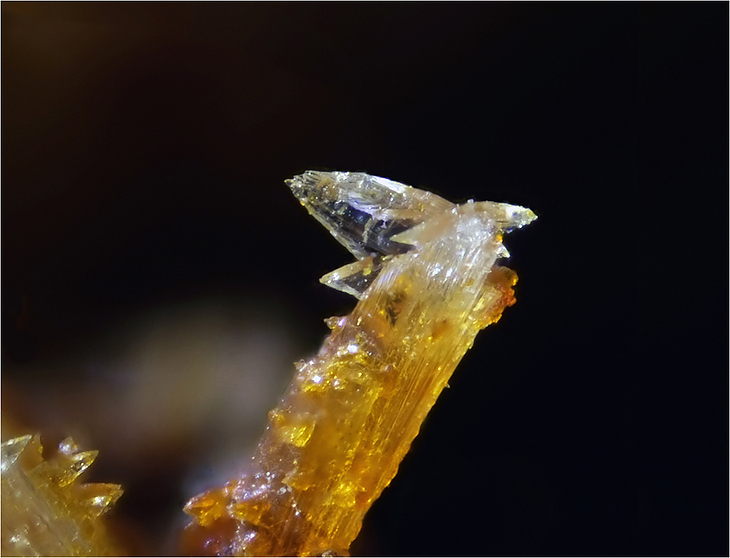
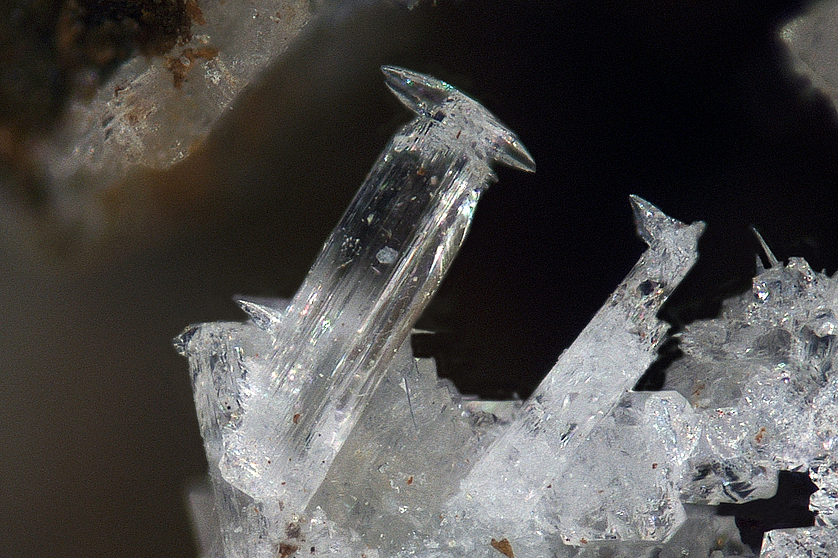
Originally found as small (< 1 mm) colorless crystals growing epitaxially and perpendicularly on palermoite crystals.
The PO4 analogue of Grandaite.
The PO4 analogue of Grandaite.
Unique Identifiers
Mindat ID:
1718
Long-form identifier:
mindat:1:1:1718:9
IMA Classification of Goedkenite
Approved
First published:
1975
Type description reference:
Moore, Paul B., Irving, Anthony J., Kampf, Anthony R. (1975) Foggite, CaAl(OH)2(H2O)[PO4]; goedkenite, (Sr,Ca)2Al(OH)[PO4]2; and samuelsonite, (Ca,Ba)Fe2+2Mn2+2Ca8Al2(OH)2[PO4]10: Three new species from the Palermo No. I pegmatite, North Groton, New Hampshire. American Mineralogist, 60 (11-12) 957-964
Classification of Goedkenite
8.BG.05
8 : PHOSPHATES, ARSENATES, VANADATES
B : Phosphates, etc., with additional anions, without H2O
G : With medium-sized and large cations, (OH, etc.):RO4 = 0.5:1
8 : PHOSPHATES, ARSENATES, VANADATES
B : Phosphates, etc., with additional anions, without H2O
G : With medium-sized and large cations, (OH, etc.):RO4 = 0.5:1
41.10.4.1
41 : ANHYDROUS PHOSPHATES, ETC.CONTAINING HYDROXYL OR HALOGEN
10 : (AB)3(XO4)2Zq
41 : ANHYDROUS PHOSPHATES, ETC.CONTAINING HYDROXYL OR HALOGEN
10 : (AB)3(XO4)2Zq
19.5.4
19 : Phosphates
5 : Phosphates of Sr and Ba
19 : Phosphates
5 : Phosphates of Sr and Ba
Mineral Symbols
As of 2021 there are now IMA–CNMNC approved mineral symbols (abbreviations) for each mineral species, useful for tables and diagrams.
| Symbol | Source | Reference for Standard |
|---|---|---|
| Goe | IMA–CNMNC | Warr, L.N. (2021). IMA–CNMNC approved mineral symbols. Mineralogical Magazine, 85(3), 291-320. doi:10.1180/mgm.2021.43 |
Physical Properties of Goedkenite
Vitreous, Sub-Vitreous
Transparency:
Transparent
Colour:
Colorless
Comment:
May be pale yellow due to staining
Streak:
White
Hardness:
5 on Mohs scale
Tenacity:
Brittle
Density:
3.83 g/cm3 (Calculated)
Optical Data of Goedkenite
Type:
Biaxial (+)
RI values:
nα = 1.669 nβ = 1.673 nγ = 1.692
2V:
Measured: 45° to 50°, Calculated: 50°
Birefringence:
0.023
Max. Birefringence:
δ = 0.023
Based on recorded range of RI values above.
Based on recorded range of RI values above.
Interference Colours:
The colours simulate birefringence patterns seen in thin section under crossed polars. They do not take into account mineral colouration or opacity.
Michel-Levy Bar The default colours simulate the birefringence range for a 30 µm thin-section thickness. Adjust the slider to simulate a different thickness.
Grain Simulation You can rotate the grain simulation to show how this range might look as you rotated a sample under crossed polars.
The colours simulate birefringence patterns seen in thin section under crossed polars. They do not take into account mineral colouration or opacity.
Michel-Levy Bar The default colours simulate the birefringence range for a 30 µm thin-section thickness. Adjust the slider to simulate a different thickness.
Grain Simulation You can rotate the grain simulation to show how this range might look as you rotated a sample under crossed polars.
Surface Relief:
Moderate
Dispersion:
r > v or r < v
Pleochroism:
Non-pleochroic
Chemistry of Goedkenite
Mindat Formula:
Sr2Al(PO4)2(OH)
May contain minor Ca replacing Sr.
May contain minor Ca replacing Sr.
Element Weights:
Crystallography of Goedkenite
Crystal System:
Monoclinic
Class (H-M):
2/m - Prismatic
Space Group:
P21/m
Setting:
P21/m
Cell Parameters:
a = 8.45 Å, b = 5.74 Å, c = 7.26 Å
β = 113.7°
β = 113.7°
Ratio:
a:b:c = 1.472 : 1 : 1.265
Unit Cell V:
322.43 ų (Calculated from Unit Cell)
Z:
2
Epitaxial Relationships of Goedkenite
Epitaxial Minerals:
| 'Palermoite' | Li2SrAl4(PO4)4(OH)4 |
X-Ray Powder Diffraction
Powder Diffraction Data:
| d-spacing | Intensity |
|---|---|
| 7.76 Å | (50) |
| 6.46 Å | (30) |
| 4.60 Å | (10) |
| 4.33 Å | (40) |
| 3.61 Å | (10) |
| 3.42 Å | (40) |
| 3.32 Å | (30) |
| 3.21 Å | (20) |
| 3.06 Å | (100) |
| 2.841 Å | (60) |
| 2.813 Å | (40) |
| 2.696 Å | (20) |
| 2.675 Å | (30) |
| 2.626 Å | (10) |
| 2.585 Å | (70) |
| 2.428 Å | (30) |
| 2.474 Å | (20) |
| 2.351 Å | (20) |
| 2.223 Å | (10) |
| 2.167 Å | (40) |
| 2.149 Å | (30) |
| 2.074 Å | (30) |
| 2.008 Å | (40) |
| 1.977 Å | (20) |
| 1.950 Å | (20) |
| 1.928 Å | (20) |
| 1.844 Å | (20) |
| 1.820 Å | (20) |
| 1.785 Å | (30) |
| 1.760 Å | (10) |
| 1.685 Å | (20) |
| 1.658 Å | (10) |
| 1.609 Å | (50) |
| 1.592 Å | (30) |
| 1.534 Å | (20) |
| 1.444 Å | (10) |
| 1.428 Å | (30) |
| 1.338 Å | (10) |
| 1.295 Å | (30) |
| 1.206 Å | (20) |
| 1.186 Å | (20) |
Comments:
ICDD 29-383
Geological Environment
Paragenetic Mode(s):
| Paragenetic Mode | Earliest Age (Ga) |
|---|---|
| Stage 7: Great Oxidation Event | <2.4 |
| 47a : [Near-surface hydration of prior minerals] | |
| 47c : [Carbonates, phosphates, borates, nitrates] |
Type Occurrence of Goedkenite
Place of Conservation of Type Material:
National Museum of Natural History (Smithsonian), Washington, D.C., USA, 128070.
Geological Setting of Type Material:
Found in late-stage phosphate mineralization in granite pegmatites. At the original occurrence, the host material was usually found in pods of siderite that had replaced triphylite giant crystals.
Associated Minerals at Type Locality:
Reference:
Moore, Paul B., Irving, Anthony J., Kampf, Anthony R. (1975) Foggite, CaAl(OH)2(H2O)[PO4]; goedkenite, (Sr,Ca)2Al(OH)[PO4]2; and samuelsonite, (Ca,Ba)Fe2+2Mn2+2Ca8Al2(OH)2[PO4]10: Three new species from the Palermo No. I pegmatite, North Groton, New Hampshire. American Mineralogist, 60 (11-12) 957-964
Synonyms of Goedkenite
Other Language Names for Goedkenite
Relationship of Goedkenite to other Species
Member of:
Other Members of Brackebuschite Supergroup:
| Aldomarinoite | Sr2Mn3+(AsO4)2(OH) | Mon. 2/m : P21/m |
| Arsenbrackebuschite | Pb2Fe3+(AsO4)2(OH) | Mon. 2/m : P2/m |
| Arsentsumebite | Pb2Cu(AsO4)(SO4)(OH) | Mon. 2/m : P21/m |
| Bearthite | Ca2Al(PO4)2(OH) | Mon. 2/m : P21/m |
| Brackebuschite | Pb2Mn3+(VO4)2(OH) | Mon. 2/m : P21/m |
| Bushmakinite | Pb2Al(PO4)(VO4)(OH) | Mon. 2/m : P21/m |
| Calderónite | Pb2Fe3+(VO4)2(OH) | Mon. 2/m : P21/m |
| Canosioite | Ba2Fe3+(AsO4)2(OH) | Mon. 2/m : P21/m |
| Feinglosite | Pb2Zn(AsO4)2 · H2O | Mon. 2/m |
| Ferribushmakinite | Pb2Fe3+(PO4)(VO4)(OH) | Mon. 2/m : P21/m |
| Gamagarite | Ba2Fe3+(VO4)2(OH) | Mon. 2/m : P21/m |
| Grandaite | Sr2Al(AsO4)2(OH) | Mon. 2/m : P21/m |
| Lombardoite | Ba2Mn3+(AsO4)2(OH) | Mon. 2/m : P21/m |
| Tokyoite | Ba2Mn3+(VO4)2(OH) | Mon. 2/m : P21/m |
| Tsumebite | Pb2Cu(PO4)(SO4)(OH) | Mon. 2/m : P21/m |
| 'Unnamed (possible ordered As-analogue of Tokyoite)' | Ba2Mn[(As,V)O4]2(OH) | Mon. 2/m : P21/m |
Common Associates
Associations Based on Photo Data:
Related Minerals - Strunz-mindat Grouping
| 8.BG. | Aldomarinoite | Sr2Mn3+(AsO4)2(OH) |
| 8.BG. | Dongchuanite | Pb4ZnZn2(PO4)4(OH)2 |
| 8.BG. | Cuprodongchuanite | Pb4CuZn2(PO4)4(OH)2 |
| 8.BG. | Canosioite | Ba2Fe3+(AsO4)2(OH) |
| 8.BG.05 | Feinglosite | Pb2Zn(AsO4)2 · H2O |
| 8.BG.05 | Tokyoite | Ba2Mn3+(VO4)2(OH) |
| 8.BG.05 | Lombardoite | Ba2Mn3+(AsO4)2(OH) |
| 8.BG.05 | Bearthite | Ca2Al(PO4)2(OH) |
| 8.BG.05 | 'Unnamed (possible ordered As-analogue of Tokyoite)' | Ba2Mn[(As,V)O4]2(OH) |
| 8.BG.05 | Gamagarite | Ba2Fe3+(VO4)2(OH) |
| 8.BG.05 | Arsentsumebite | Pb2Cu(AsO4)(SO4)(OH) |
| 8.BG.05 | 'UM1994-19-PO:CuHMoPb' | Pb2Cu(PO4)(MoO4,AsO4,CrO4,GaO4)(OH) |
| 8.BG.05 | Ferribushmakinite | Pb2Fe3+(PO4)(VO4)(OH) |
| 8.BG.05 | Arsenbrackebuschite | Pb2Fe3+(AsO4)2(OH) |
| 8.BG.05 | Tsumebite | Pb2Cu(PO4)(SO4)(OH) |
| 8.BG.05 | Brackebuschite | Pb2Mn3+(VO4)2(OH) |
| 8.BG.05 | Bushmakinite | Pb2Al(PO4)(VO4)(OH) |
| 8.BG.05 | Calderónite | Pb2Fe3+(VO4)2(OH) |
| 8.BG.10 | Mélonjosephite | CaFe2+Fe3+(PO4)2(OH) |
| 8.BG.15 | Tancoite | LiNa2Al(PO4)(PO3OH)(OH) |
| 8.BG.20 | Dmisokolovite | K3Cu5AlO2(AsO4)4 |
| 8.BG.25 | Shchurovskyite | K2CaCu6O2(AsO4)4 |
| 8.BG.30 | Wrightite | K2Al2O(AsO4)2 |
| 8.BG.35 | Polyarsite | Na7CaMgCu2(AsO4)4F2Cl |
Other Information
Health Risks:
No information on health risks for this material has been entered into the database. You should always treat mineral specimens with care.
Internet Links for Goedkenite
mindat.org URL:
https://www.mindat.org/min-1718.html
Please feel free to link to this page.
Please feel free to link to this page.
Search Engines:
External Links:
Mineral Dealers:
References for Goedkenite
Reference List:
Moore, Paul B., Irving, Anthony J., Kampf, Anthony R. (1975) Foggite, CaAl(OH)2(H2O)[PO4]; goedkenite, (Sr,Ca)2Al(OH)[PO4]2; and samuelsonite, (Ca,Ba)Fe2+2Mn2+2Ca8Al2(OH)2[PO4]10: Three new species from the Palermo No. I pegmatite, North Groton, New Hampshire. American Mineralogist, 60 (11-12) 957-964
Localities for Goedkenite
Showing 4 localities.
 symbol to view information about a locality.
The
symbol to view information about a locality.
The Locality List
 - This locality has map coordinates listed.
- This locality has estimated coordinates.
ⓘ - Click for references and further information on this occurrence.
? - Indicates mineral may be doubtful at this locality.
- This locality has map coordinates listed.
- This locality has estimated coordinates.
ⓘ - Click for references and further information on this occurrence.
? - Indicates mineral may be doubtful at this locality.
 - Good crystals or important locality for species.
 - World class for species or very significant.
(TL) - Type Locality for a valid mineral species.
(FRL) - First Recorded Locality for everything else (eg varieties).
- World class for species or very significant.
(TL) - Type Locality for a valid mineral species.
(FRL) - First Recorded Locality for everything else (eg varieties).
All localities listed without proper references should be considered as questionable.
Italy | |
| Castellaro-Kampf |
Slovakia | |
| Uher P. et al. (2009) |
| Uher P. et al. (2009) |
USA (TL) | |
| Moore et al. (1975) |
Quick NavTopAbout GoedkeniteUnique IdentifiersIMA Classification Classification Mineral SymbolsPhysical Properties Optical Data Chemistry Crystallography Epitaxial Relationships X-Ray Powder DiffractionGeological EnvironmentType Occurrence SynonymsOther LanguagesRelationshipsCommon AssociatesStrunz-MindatOther InformationInternet Links References Localities Locality List
Palermo No. 1 Mine, Groton, Grafton County, New Hampshire, USA