Jamieson Mercury mine, Quicksilver creek, Jamieson, Mansfield Shire, Victoria, Australiai
| Regional Level Types | |
|---|---|
| Jamieson Mercury mine | Mine |
| Quicksilver creek | Creek |
| Jamieson | - not defined - |
| Mansfield Shire | Shire |
| Victoria | State |
| Australia | Country |
This page is currently not sponsored. Click here to sponsor this page.
Latitude & Longitude (WGS84):
37° 19' 14'' South , 146° 18' 15'' East
Latitude & Longitude (decimal):
Type:
Köppen climate type:
Nearest Settlements:
| Place | Population | Distance |
|---|---|---|
| Mount Buller | 251 (2009) | 22.7km |
| Mansfield | 4,052 (2012) | 35.5km |
| McMahons Creek | 220 (2015) | 60.5km |
The Mercury Mine is approx. 13 km E of Jamieson, 200 metres south of the junction of Quicksilver Creek and the Jamieson River.
The occurrence was first reported in the Bendigo Independent newspaper on Friday March 16th, 1894. "The deposit was discovered when a miner, working a near-dry riverbed for gold, panned off a quantity of 'quicksilver'. Working up the stream he discovered that the mercury cut out at a type of 'dyke' forming a bar across the stream. Breaking into the rock he found it impregnated with fine globules of mercury".
Initially they had exposed the deposit by means of a trench 6 metres long and 1.3 metres deep below the water line. The load could be traced for 40 metres in the creek bed but not beyond.
By 1901, a shaft 43 metres deep had been sunk in the bed of the creek with a drive of 35 metres from the 24 metre level. Despite sporadic attempts to mine the deposit, ore had not been found in payable quantities.
"The deposit itself is within a near vertical fissure striking across the general strike of the sediments of the Donnelley Creek Siltstone. The load consisted of crushed grey talcose country rock intersected by sporadic small quartz veins. Well defined, it varied in thickness between 30 cm and 1.9 metres. Mineralisation, in the form of native mercury, was concentrated within the 30 cm thick zone along both walls of the wider parts of the lode, but distributed evenly where the lode was narrow".
Select Mineral List Type
Standard Detailed Gallery Strunz Chemical ElementsCommodity List
This is a list of exploitable or exploited mineral commodities recorded at this locality.Mineral List
11 valid minerals.
Rock Types Recorded
Note: data is currently VERY limited. Please bear with us while we work towards adding this information!
Select Rock List Type
Alphabetical List Tree DiagramDetailed Mineral List:
| ⓘ Calcite Formula: CaCO3 |
| ⓘ Chalcopyrite Formula: CuFeS2 Description: In 1942 a report by Stillwell recorded that chalcopyrite occurred rarely in a small quartz sample.
|
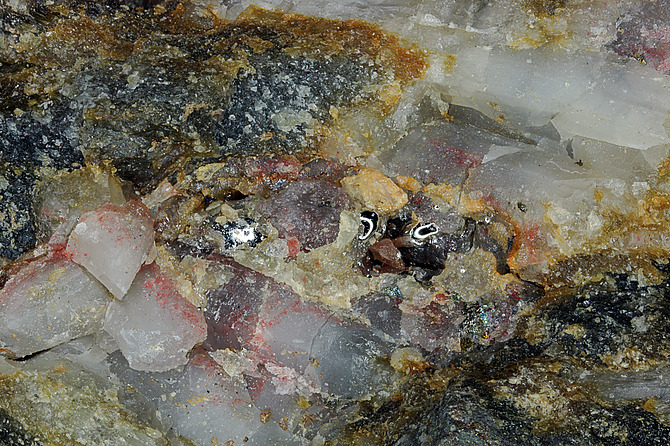
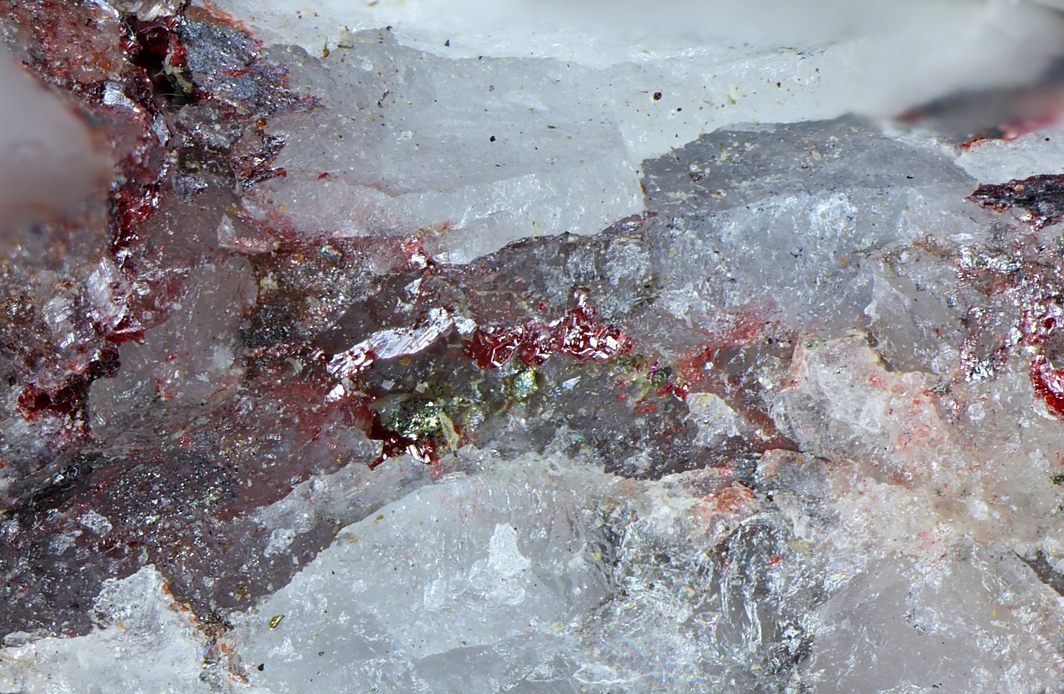
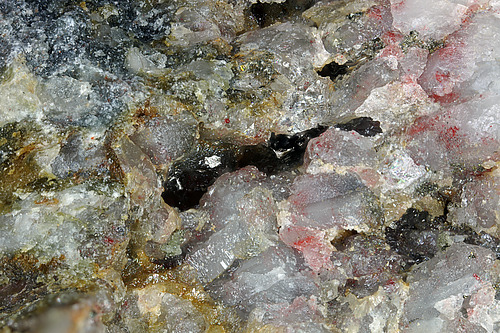
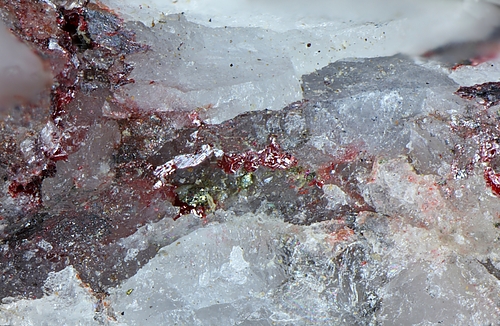
| ⓘ Cinnabar Formula: HgS Description: "Well forrmed crystals of cinnabar are uncommon and rarely exceed 0.5mm. However, drusy patches and cavity linings of bright red, striated crystals occur on some ore specimens. Cinnabar more commonly occurs as bright to dull red scaly coatings on fractures within quartz veins." |
| ⓘ Dolomite Formula: CaMg(CO3)2 |
| ⓘ Galena Formula: PbS Description: "Several sub-millimetric euhedral galena crystals, showing simple cube-octahedral forms, were detected in small cavities in quartz, accompanied by mercury globules." |
| ⓘ Graphite Formula: C |
| ⓘ Metacinnabar Formula: HgS Description: "Dark grey varieties of cinnabar have been recorded and it is possible that these incorporate very thin alteration films of metacinnabar that may be very difficult to detect optically or by X-ray defraction." |
| ⓘ Native Gold Formula: Au |
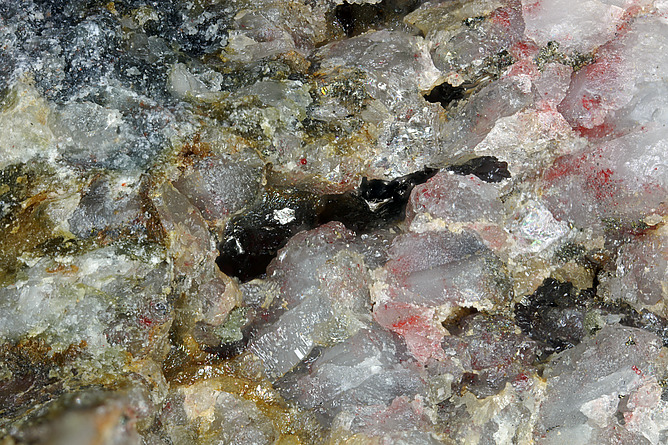
| ⓘ Native Mercury Formula: Hg Description: "Ore samples shows that mercury almost always occurs associated with the quart-dolomite veins and patches. Within the veins these are small cavities, from a few millimetres up to about 15mm across, that commonly contain globules of mercury. Those globules less than about 0.5mm across are generally spherical but larger globules up to 3mm across, are irregular. One cavity contained a continuous film up to 10mm across. As well, mercury may infill gaps between quartz crystals. Tiny spherical globules may also be found scattered across the surface of fractures along very thin quartz veinlets." |
| ⓘ Pyrite Formula: FeS2 Description: "It occurs as single crystals up to about 1mm in some cavities and as aggregates and stringers enclosed in quartz-dolomite veins. In places pyrite crystals are present in the surrounding phyllite." |
| ⓘ Quartz Formula: SiO2 |
Gallery:

List of minerals arranged by Strunz 10th Edition classification
| Group 1 - Elements | |||
|---|---|---|---|
| ⓘ | Native Gold | 1.AA.05 | Au |
| ⓘ | Native Mercury | 1.AD.05 | Hg |
| ⓘ | Graphite | 1.CB.05a | C |
| Group 2 - Sulphides and Sulfosalts | |||
| ⓘ | Metacinnabar | 2.CB.05a | HgS |
| ⓘ | Chalcopyrite | 2.CB.10a | CuFeS2 |
| ⓘ | Galena | 2.CD.10 | PbS |
| ⓘ | Cinnabar | 2.CD.15a | HgS |
| ⓘ | Pyrite | 2.EB.05a | FeS2 |
| Group 4 - Oxides and Hydroxides | |||
| ⓘ | Quartz | 4.DA.05 | SiO2 |
| Group 5 - Nitrates and Carbonates | |||
| ⓘ | Calcite | 5.AB.05 | CaCO3 |
| ⓘ | Dolomite | 5.AB.10 | CaMg(CO3)2 |
List of minerals for each chemical element
| C | Carbon | |
|---|---|---|
| C | ⓘ Calcite | CaCO3 |
| C | ⓘ Dolomite | CaMg(CO3)2 |
| C | ⓘ Graphite | C |
| O | Oxygen | |
| O | ⓘ Calcite | CaCO3 |
| O | ⓘ Dolomite | CaMg(CO3)2 |
| O | ⓘ Quartz | SiO2 |
| Mg | Magnesium | |
| Mg | ⓘ Dolomite | CaMg(CO3)2 |
| Si | Silicon | |
| Si | ⓘ Quartz | SiO2 |
| S | Sulfur | |
| S | ⓘ Chalcopyrite | CuFeS2 |
| S | ⓘ Cinnabar | HgS |
| S | ⓘ Galena | PbS |
| S | ⓘ Metacinnabar | HgS |
| S | ⓘ Pyrite | FeS2 |
| Ca | Calcium | |
| Ca | ⓘ Calcite | CaCO3 |
| Ca | ⓘ Dolomite | CaMg(CO3)2 |
| Fe | Iron | |
| Fe | ⓘ Chalcopyrite | CuFeS2 |
| Fe | ⓘ Pyrite | FeS2 |
| Cu | Copper | |
| Cu | ⓘ Chalcopyrite | CuFeS2 |
| Au | Gold | |
| Au | ⓘ Native Gold | Au |
| Hg | Mercury | |
| Hg | ⓘ Cinnabar | HgS |
| Hg | ⓘ Native Mercury | Hg |
| Hg | ⓘ Metacinnabar | HgS |
| Pb | Lead | |
| Pb | ⓘ Galena | PbS |
Other Regions, Features and Areas containing this locality
Australia
- Great Dividing RangeMountain Range
- Lachlan OrogenOrogen
- Melbourne-Mathinna ZoneZone (Tectonic)
- Victoria
- Selwyn ProvinceGeologic Province
Australian PlateTectonic Plate
- Lachlan Fold BeltOrogenic Belt
This page contains all mineral locality references listed on mindat.org. This does not claim to be a complete list. If you know of more minerals from this site, please register so you can add to our database. This locality information is for reference purposes only. You should never attempt to
visit any sites listed in mindat.org without first ensuring that you have the permission of the land and/or mineral rights holders
for access and that you are aware of all safety precautions necessary.
Jamieson Mercury mine, Quicksilver creek, Jamieson, Mansfield Shire, Victoria, Australia