





Key Findings on AI Coding Agent Deployment and Adoption
-
AI coding agents are developer-assist tools that generate or modify code, but without structured rollout and governance, they introduce risks and uncertain value.
-
Adoption often fails when governance, security, and training lag behind experimentation, leading to inconsistent practices, unclear accountability, and eroded trust.
-
The Deployment Maturity Model framework outlines four stages from individual exploration to full-scale adoption, with each stage requiring defined metrics, policies, and training before progressing.
-
Successful rollouts depend on choosing collaborative teams with strong review cultures and low-risk environments, which help refine prompts, enforce standards, and build repeatable patterns.
-
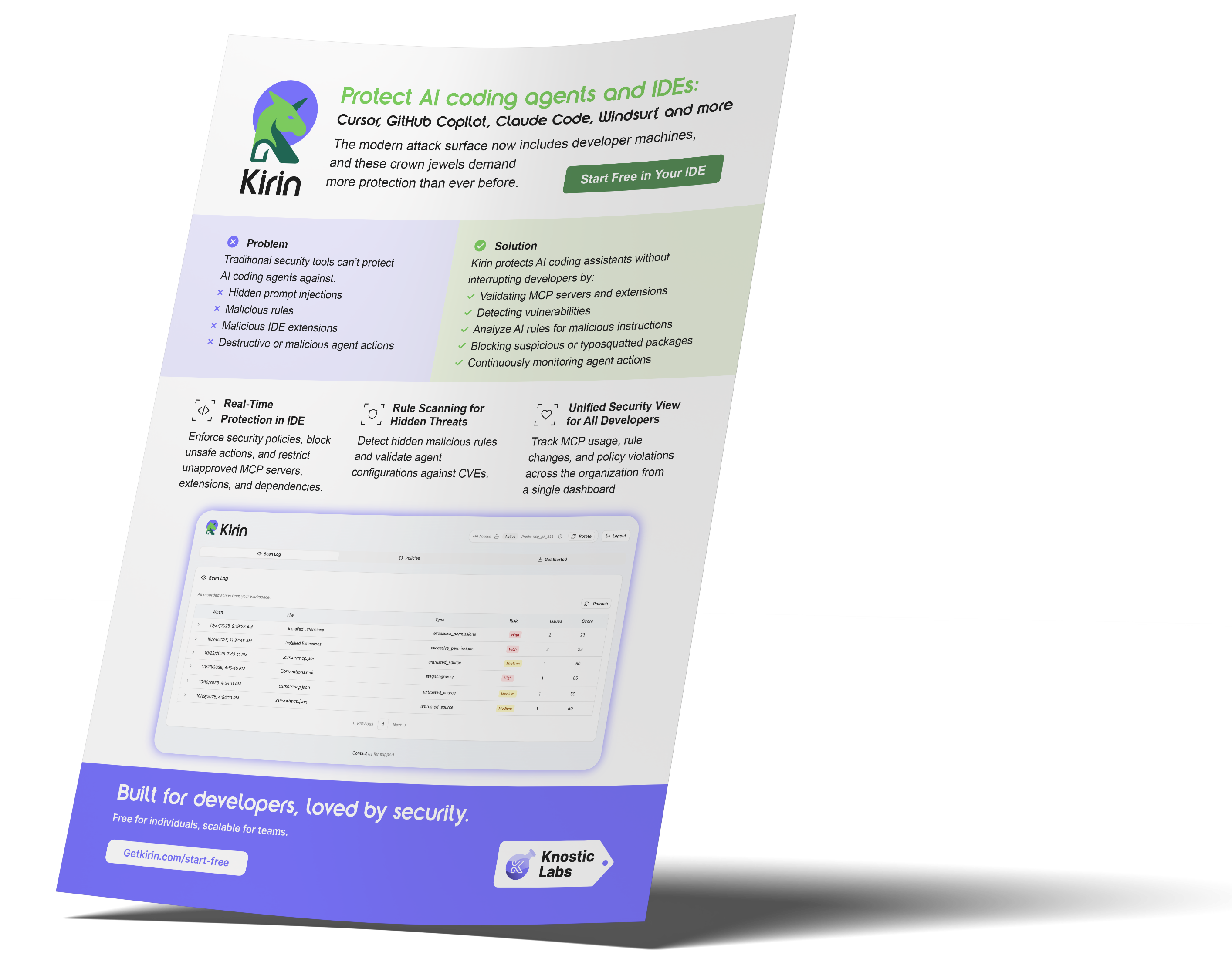
Kirin by Knostic supports safe deployment by embedding real-time governance directly into developer workflows, enabling proactive policy enforcement and secure, scalable adoption.
Why Adoption Fails if Governance Comes Too Late
AI coding agent deployment and adoption break down when policy and enablement lag behind experiments. Teams rush to try new tools before leaders define scope and accountability. Developers then form habits that are difficult to correct later. Security steps in after incidents, but not before value is proven. Decision rights are unclear, so approvals stretch and workarounds appear. And then, trust falls when output quality varies and there is no standard of review. This becomes a pattern reflected in developer surveys, which show that confidence in the accuracy of AI-generated code remains mixed.
Alarmingly, according to the Stack Overflow 2024 Developer Survey, only about one-third of developers report receiving formal training for AI workflows. Leadership assumes that pilots are equal in production readiness, but the reality is that the governance fabric is still missing.
According to a McKinsey 2024 Global Survey, AI adoption surged to 72% of organizations worldwide, up from approximately 50% in previous years. However, only 18% reported having an enterprise-wide governance council with decision-making authority for responsible AI. This gap highlights a growing imbalance between enthusiasm and oversight, as most organizations rush to implement generative AI. At the same time, few invest in the governance infrastructure necessary to manage risk, ensure accountability, and consistently measure value across teams.
Without proper training on when to accept or reject an agent’s change, rework increases, and the perceived benefit decreases. Only about one-third of developers report receiving formal training on AI-assisted workflows, despite 62% stating they already use AI tools in their daily coding tasks. This gap leaves teams to self-learn safety and accuracy practices through trial and error, according to the Stack Overflow survey.
The Deployment Maturity Model
A Deployment Maturity Model is a structured framework that assesses an organization's advancement in adopting deployment practices, typically moving from ad hoc to optimized, automated, and highly collaborative processes. A clear maturity model prevents chaos and accelerates outcomes. It gives leaders a shared language for scope, risk, and evidence of value.
Each of the following stages defines who participates, which workflows qualify, and which metrics prove progress.
|
Stage |
Description |
|
1. Exploration |
Individual developers experiment |
|
2. Structured Pilot |
Controlled teams evaluate utility |
|
3. Controlled Rollout |
Policies + guardrails enforced |
|
4. Organization-Wide Adoption |
Fully integrated w/ pipelines & workflows |
Movement between these stages requires proof, not optimism. Proof means meeting quantifiable exit metrics, rather than relying on perception or enthusiasm. For example, this includes a consistent reduction in cycle time of at least 15%, defect rates trending downward over multiple sprints, and review acceptance rates above 70%. These indicators confirm readiness before scaling AI adoption to the next level. Policies and controls accumulate rather than reset at each step. Training and communications scale as adoption expands. Internal platforms and optimal governance ensure that pilots do not become permanent exceptions.
Stage 1: Exploration
Exploration starts with individual learning. The goal is literacy, not quantity of output. Developers try tools in sandboxes and personal forks, away from production repos. They record impressions, friction points, and safe patterns worth codifying later. Leaders collect this input and start a lightweight inventory of tools, extensions, and model endpoints. No sensitive data is allowed, and no repository writes occur. Success looks like a curated list of candidate workflows and early guardrail ideas.
Stage 2: Structured Pilot
The structured pilot program framework moves from curiosity to evidence. A single, collaborative team tests two or three high-value workflows with defined metrics. Typical candidates include unit test generation, small refactors, and documentation updates. The pilot sets accept and reject criteria for agent diffs, as well as the required tests. Leaders conduct weekly reviews on velocity, review burden, and defect trends to capture valuable insights and learning.
A typical pilot reviews 20–30 agent-generated diffs per week, aiming for an initial rejection threshold below 40% and trending downward as prompts and models improve. Tracking these metrics ensures that teams move from experimentation to measurable reliability.
Stage 3: Controlled Rollout
A controlled enterprise AI rollout strategy is expanding to more teams under the policy. Repository permissions, IDE policies, and audit logging are enforced by default. The organization standardizes model endpoints, extensions, and approved capabilities. Change management covers training cadence and self-service documentation. At this stage, “velocity” refers specifically to cycle time, which is the total duration from code generation to review approval, rather than generic productivity speed. Monitoring cycle time trends helps confirm that agent integration reduces lead time without introducing new delays.
Leaders publish shared dashboards that display cycle time, rework, and acceptance rates for agent-generated diffs. Security audits ensure that guardrails operate in real-time in developer tools, not just in CI. The movement to an organization-wide AI tooling adoption roadmap requires stable metrics and low variance across teams.
Stage 4: Organization-Wide Adoption
Organization-wide adoption integrates agents into the SDLC. Policies and controls are productized as platform services. Procurement, legal, and security have ongoing visibility through unified reporting. Teams continuously improve prompt libraries and test templates based on incident reviews and feedback. Metrics flow to executive dashboards so value and risk are visible together. New workflows are introduced through a repeatable intake and validation process. Ultimately, training becomes part of onboarding for developers and technical leads.
How to Choose the First Pilot Team for AI Agent Deployment
Choosing the first team is a design decision with outsized effects. Start where culture and process already support safe experimentation. The team must value code review, testing discipline, and documentation. Early wins come from workflows with high repetition and low blast radius.
Leaders must have access to metrics, and the team must be willing to share lessons openly and transparently. The pilot should be closely aligned with platform engineering for faster policy and tooling changes. With the right team, you create a blueprint others can reuse rather than a one-off success.
Highly Collaborative Engineering Teams
A collaborative team shares context quickly and resolves issues faster. Standups, PR comments, and pairing are already part of the rhythm. This accelerates prompt tuning, policy tweaks, and test improvements. Collaboration reduces the risk that a single champion carries the whole pilot. It also ensures that reviewers apply consistent acceptance criteria to agent diffs. Shared norms facilitate the measurement of impact without confounding factors. The result is a signal you can trust and scale.
Strong Code Review Culture
A strong review culture is the backbone of safe adoption. Reviewers already enforce tests, style, and architectural patterns. They can apply the same standards to agent-generated diffs without lowering the bar. Teams should track the percentage of accepted versus rejected agent diffs to learn where prompts and policies need refinement. Industry guidance on measuring AI-assisted development highlights the importance of embedding metrics into existing workflows. Consistent review practices provide high-quality labels for what “good” looks like. This is essential for improving prompts, templates, and governance practices.
Low Production Blast Radius to Start
Start where mistakes are cheap and recoveries are fast. Then, target internal tools, documentation sites, or repositories with robust tests. Limit write permissions and require human approval for every agent change. Treat the pilot like a safety exercise, not a speed run. As guardrails prove effective and metrics improve, expand the scope methodically. This maintains high confidence and helps leaders effectively defend the rollout to stakeholders. It also creates a safe space to learn how policies behave under real developer pressure.
Developers Comfortable Experimenting
The first pilot needs developers who enjoy tinkering. They try multiple prompts, compare outputs, and document what works. They accept that early results can be uneven and still push for incremental improvement. Community data indicates that developers are widely adopting AI tools. However, trust grows when teams set clear expectations and establish effective review processes. Curious teams are more likely to translate experiments into repeatable patterns that others can use. They also provide clear feedback on where policy gets in the way. That loop is vital to designing controls that protect without blocking.
Measurement and Reporting
Measurement turns anecdotal success into proof. Tracking quantifiable indicators helps organizations justify the broader rollout of AI.
The first metric to monitor is cycle time reduction, which is how much faster developers can complete PRs or tasks after agent adoption. The second key measure is the defect and rework rate. Monitor how often agent-generated code requires correction during review or testing. This determines whether automation genuinely enhances quality or merely accelerates the creation of errors.
Note that organizations in McKinsey’s 2024 global survey that applied responsible AI practices were more likely to achieve revenue increases above 5%, while those without proper risk frameworks reported more frequent quality issues.
Next, track the percentage of approved versus rejected agent diffs. This metric signals whether the model’s suggestions align with team standards. High rejection rates may indicate poor prompt engineering, weak context retrieval, or a lack of trust among reviewers. Feedback loops from these rejections can inform prompt optimization and better guardrail configuration.
Finally, measure developer satisfaction throughout the rollout. The Stack Overflow survey found that 70% of professional developers do not view AI as a threat. However, productivity improvements depend on clarity and safety. Conducting regular surveys to evaluate perceived workload, trust in AI-generated output, and sense of control is essential. Combine subjective feedback with objective metrics to build a balanced adoption scorecard. Transparency in reporting builds organizational trust and supports executive decisions for scaling.
In practice, these metrics should be tracked through a unified performance dashboard refreshed on a sprint-based cadence, typically every one to two weeks, to align with agile review cycles. A well-structured dashboard includes four key KPI clusters:
-
Velocity Metrics: cycle time, PR turnaround, and throughput
-
Quality Metrics: defect density, code rework rate, and test coverage trends
-
Governance Metrics: governance policy compliance rate, number of flagged or overridden agent actions
-
Developer Sentiment Metrics: satisfaction scores and AI trust index over time
How Kirin from Knostic Accelerates Safe Agent Adoption
Kirin is Knostic’s IDE-native control layer for AI coding agents, merging real-time enforcement with developer flow to ensure that every agent action, extension, MCP server, and dependency operates within policy. It validates MCP servers and extensions, scans agent rules for hidden instructions, flags CVEs and suspicious or typosquatted packages, and restricts unapproved components, preventing unsafe activity from reaching your codebase.
Kirin continuously monitors agent interactions with files, APIs, and dependencies, blocking out-of-scope writes and other unsafe operations before they hit repositories, while surfacing inline guidance to developers. It detects policy drift as it happens, including expanded write scopes or privilege-escalation attempts, and records full audit trails tied to agent identity for accountability.
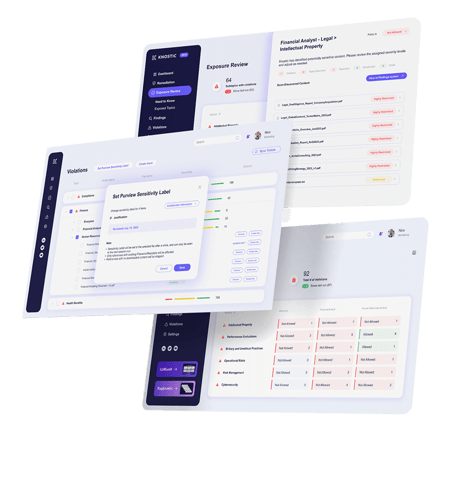
During rollout, unified dashboards provide engineering, platform, and security teams with a shared view of approved changes, blocked actions, and adherence to sandbox and policy controls, transforming agent adoption into a structured, auditable process without slowing development.
What’s Next
To continue your transformation journey, download Knostic' Cyber Defense Matrix ebook for AI. It provides a practical model for aligning AI systems with enterprise-grade defense and governance standards.
This post wraps up the current Knostic Blog series on AI coding agent adoption. In case you missed our earlier posts, check them out here:
FAQs
Q1. How do we choose the first pilot team?
Pick a collaborative team with a strong review culture and a low blast radius. Start with narrow, high-value workflows (unit tests, small refactors, docs) and enforce sandboxing and policy guardrails from day one.
Q2. What metrics prove we’re ready to scale beyond the pilot?
Require evidence, not enthusiasm. You are aiming for sustained cycle-time reduction, declining defect/rework rates across sprints, and high acceptance of agent-generated diffs (e.g., >70%), plus governance compliance on policy and audit readiness.
Q3. How do we roll out agents without slowing developers down?
Adopt a progressive rollout that defaults to sandboxed, least-privilege execution with policy-as-code enforced in the IDE and CI. Auto-approve low-risk changes via allowlists, require human review for high-risk diffs, use canary teams and time-boxed scopes, and track cycle time, acceptance rate, and rework to tune guardrails for minimal friction.
Data Leakage Detection and Response for Enterprise AI Search
Learn how to assess and remediate LLM data exposure via Copilot, Glean and other AI Chatbots with Knostic.


The Data Governance Gap in Enterprise AI
See why traditional controls fall short for LLMs, and learn how to build policies that keep AI compliant and secure.

Rethinking Cyber Defense for the Age of AI
Learn how Sounil Yu’s Cyber Defense Matrix helps teams map new AI risks, controls, and readiness strategies for modern enterprises.

Extend Microsoft Purview for AI Readiness
See how Knostic strengthens Purview by detecting overshared data, enforcing need-to-know access, and locking down AI-driven exposure.

Build Trust and Security into Enterprise AI
Explore how Knostic aligns with Gartner’s AI TRiSM framework to manage trust, risk, and security across AI deployments.

Real Prompts. Real Risks. Real Lessons.
A creative look at real-world prompt interactions that reveal how sensitive data can slip through AI conversations.

Stop AI Data Leaks Before They Spread
Learn how Knostic detects and remediates oversharing across copilots and search tools, protecting sensitive data in real time.
Accelerate Copilot Rollouts with Confidence
Equip your clients to adopt Copilot faster with Knostic's AI security layer, boosting trust, compliance, and ROI.

Reveal Oversharing Before It Becomes a Breach
See how Knostic detects sensitive data exposure across copilots and search, before compliance and privacy risks emerge.

Unlock AI Productivity Without Losing Control
Learn how Knostic helps teams harness AI assistants while keeping sensitive and regulated data protected.
Balancing Innovation and Risk in AI Adoption
A research-driven overview of LLM use cases and the security, privacy, and governance gaps enterprises must address.

Secure Your AI Coding Environment
Discover how Kirin prevents unsafe extensions, misconfigured IDE servers, and risky agent behavior from disrupting your business.