
Spike Testing is a type of performance testing that evaluates how a system behaves under sudden and extreme changes in user load. It helps identify stability issues, performance bottlenecks, and recovery capability during unexpected traffic spikes.
- Tests system response and stability during abrupt traffic surges.
- Identifies failures, bottlenecks, and scalability issues.
- Ensures quick recovery without crashes or downtime.
Types of Spike Testing
Spike testing types are based on how the system behaves under sudden changes in load. Each type checks system performance, limits, and recovery in different conditions.
- Positive Spike Testing : Tests the system with a sudden increase in valid user load and checks if the system can handle expected traffic spikes.
- Negative Spike Testing : Tests the system with a sudden increase in excessive or invalid load beyond its capacity and checks how the system handles failures.
- Incremental Spike Testing : Tests the system by increasing load in quick step-by-step spikes and checks the maximum limit the system can handle.
- Decremental Spike Testing : Tests the system by suddenly decreasing the load after a spike and checks how quickly the system recovers.
- Random Spike Testing : Tests the system with random increases and decreases in load and checks behavior under unpredictable conditions.
Spike Testing Process
It defines the steps to test how a system behaves under sudden and extreme traffic spikes.
- Set Up Test Environment: Prepare a test environment similar to production to ensure accurate results. It includes hardware, software, and network setup and simulates real-world conditions.
- Identify Peak Load: Determine the maximum expected load for the system to define spike limits. It is based on historical data, user traffic, and business requirements.
- Apply Sudden Load Spike: Instantly increase the number of users or transactions to peak level. It simulates a sudden traffic surge to test system performance under stress.
- Monitor System Behavior: Observe system performance during the spike. It tracks response time, errors, CPU, and memory usage to identify issues.
- Sudden Load Drop: Quickly reduce the load back to normal level. It checks how well the system recovers after the spike.
- Analyze Results: Evaluate system behavior before, during, and after the spike. It helps identify bottlenecks and areas for improvement.
Spike Testing Graph
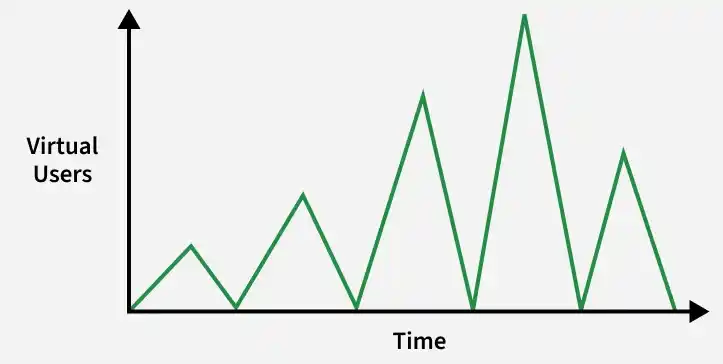
The graph illustrates how the system is tested under sudden load changes by:
- Rapidly increasing the number of users (spikes)
- Suddenly reducing the load to low levels
- Repeating this pattern multiple times to simulate real scenarios
Meaning: It shows how a system behaves under sudden traffic spikes and drops, evaluating performance, stability, and recovery.
It shows
- X-axis (Time): Represents the duration of the spike test.
- Y-axis (Virtual Users): Represents the number of users or system load during testing.
- Zig-zag Pattern: Indicates sudden increases and decreases in traffic load to simulate real-world spikes.
- Performance Observation: During these spikes, metrics like response time, server utilization, error rate, and recovery time are monitored to evaluate system stability and scalability.
Spike Testing Tools
It can be performed using various performance testing tools that simulate sudden traffic surges and monitor system behavior. Commonly used tools include:
- Micro Focus LoadRunner: Enterprise-level tool for large-scale load and spike simulations.
- Apache JMeter: Open-source tool widely used for web and API spike testing.
- Gatling: Developer-friendly tool designed for high-performance load testing.
- Locust: Python-based tool for scalable and customizable load tests.
- k6: Modern performance testing tool suitable for cloud-based applications.
Importance of Spike Testing
Spike testing helps verify whether auto-scaling and load-balancing mechanisms can efficiently manage sudden traffic spikes without downtime or performance degradation.
- Handles sudden traffic surges: Evaluates how the system performs under unexpected load increases like flash sales or viral events.
- Identifies hidden weaknesses: Detects issues in system architecture that may not appear during normal or endurance testing.
- Ensures stability and performance: Keeps the application responsive during peak demand, protecting user experience and business revenue.
- Improves recovery capability: Helps the system quickly return to normal after sudden load drops.
- Reduces risk before deployment: Minimizes chances of crashes, downtime, and performance issues in real-world scenarios.
Applications of Spike Testing
Spike testing is widely used in applications that experience sudden and unpredictable traffic surges to ensure system stability, scalability, and quick recovery.
- E-commerce Platforms: Used to test system behavior during sudden traffic surges like flash sales or promotions, ensuring the system does not crash.
- Online Ticketing & Booking Systems: Helps verify stability when many users try to book tickets simultaneously during events or seat openings.
- News & Media Websites: Ensures the system can handle sudden traffic spikes due to breaking news or viral content without downtime.
- Gaming Platforms: Tests the system’s ability to manage sudden increases in players during game launches, updates, or events.
- Financial & Trading Systems: Ensures smooth handling of sudden transaction spikes during market openings or high-volatility periods.
Load Testing Vs Spike Testing
| Feature | Load Testing | Spike Testing |
|---|---|---|
| Definition | Tests system performance under expected and gradual load | Tests system behavior under sudden and extreme load changes |
| Load Pattern | Load increases gradually over time | Load increases/decreases suddenly (spikes) |
| Purpose | Check system performance under normal/peak conditions | Check system stability under unexpected traffic surges |
| Focus | Performance, response time, throughput | Stability, failure handling, recovery |
| Risk Level | Predictable and controlled | Unpredictable and extreme |
| Example | Gradual increase in users during normal usage | Sudden surge during flash sale or viral event |
| Recovery Check | Not a primary focus | Key focus (how system recovers after spike) |