
Software Testing is a critical phase of the Software Development Life Cycle (SDLC) that ensures a software application works correctly and meets user requirements. It helps identify defects and improve the overall quality, reliability, and performance of the software.
- Ensures the application functions as expected and meets user needs.
- Helps detect bugs early and improves software quality.
- Enhances reliability, security, and performance of the system.
Classification
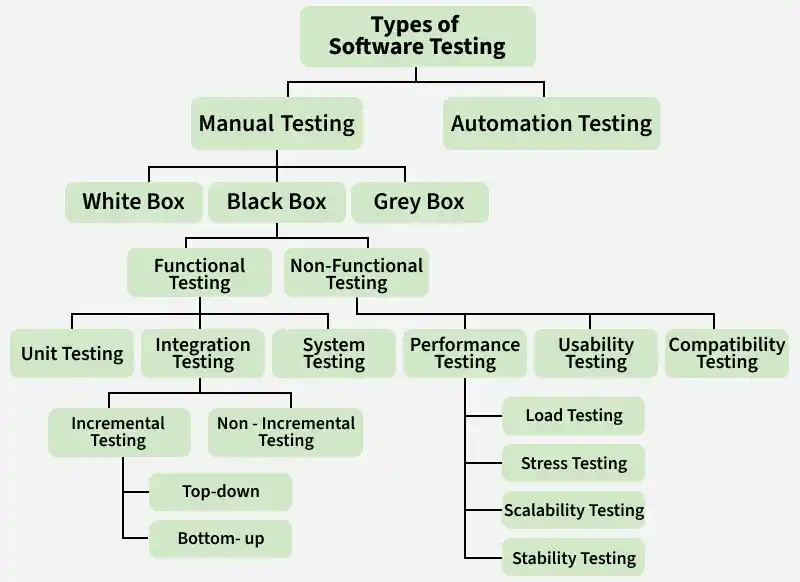
Types Based on Execution Method
Software testing can be classified based on how test cases are executed, either manually by testers or automatically using testing tools and scripts.
1. Manual Testing
Manual Testing is a software testing technique in which test cases are executed manually by testers without using automation tools.
- Accurate visual feedback: Helps detect UI/UX issues like layout, design, and text changes effectively.
- Cost-effective: Does not require expensive tools or advanced technical skills.
- No coding required: Suitable for beginners as it does not require programming knowledge.
- Flexible for changes: Easily adapts to frequent or unplanned changes in the application.
2. Automation Testing
Automation Testing is a technique where test cases are executed using scripts and automation tools. It is mainly used for repetitive and time-consuming tasks, improving efficiency, accuracy, and test coverage.
- Faster execution: Runs tests automatically, saving time and effort.
- Improved reliability: Ensures consistent and accurate results without human errors.
- Higher test coverage: Allows execution of large and complex test cases.
- Reduced human effort: Minimizes manual work and post-release defects.
Read More: Manual Testing vs Automated Testing.
Types Based on Testing Technique
Here are the Types of Testing Techniques categorized as follows:
1. White Box Testing
White Box Testing is a software testing technique where the internal structure, logic, and code of the application are tested. It is mainly performed by developers to ensure that the code works correctly and efficiently.
- Focuses on internal code, logic, and program structure.
- Requires programming knowledge to perform testing.
- Helps identify errors in loops, conditions, and data flow.
- Ensures better code quality and optimized performance.
Types of White Box Testing
White box testing is classified into the following types
1. Path Testing
White Box Testing checks all possible execution paths in the program to ensure that each function behaves as expected. It helps verify that all logical conditions in the code are functioning correctly and efficiently in a properly manner, avoiding unnecessary steps with better code reusability.
Advantages of Path Testing
- The path Testing method reduces the redundant tests.
- Path testing focuses on the logic of the programs.
- Path testing is used in test case design.
2. Loop testing
Loop testing is a type of software testing that is performed to validate the loops. It is one of the types of Control Structure Testing. Loop testing is a white box testing technique and is used to test loops in the program. It checks whether loops (for or while loops) in the program operate correctly and efficiently. It checks that the loop handles variables correctly and doesn’t cause errors like infinite loops or logic flaws.
Advantages of Loop Testing
- Loop testing limits the number of iterations of loop.
- Loop testing ensures that program doesn't go into infinite loop process.
- Loop testing ensures the initialization of every used variable inside the loop.
3. Unit Testing as White-box Testing
Unit Testing focuses on testing individual units or components of the software (such as functions or methods) by directly checking the code’s internal logic, flow, and behavior.
Note: Unit Testing can be considered a type of White-box Testing, Black-box Testing, and Functional Testing depending on how it is performed.
4. Mutation Testing
Mutation Testing is a type of Software Testing that is performed to design new software tests and also evaluate the quality of already existing software tests. Mutation testing is related to modifying a program in small ways.
Advantages of Mutation Testing
- It brings a good level of error detection in the program.
- It discovers ambiguities in the source code.
- It finds and solves the issues of loopholes in the program.
5. Penetration testing
Penetration testing, or pen testing, is like a simulated cyberattack conducted on your computer systems to find and fix any weak spots before real attackers can exploit them. It focuses on web application security, where testers try to breach parts like APIs and servers to uncover vulnerabilities such as code injection risks from unfiltered inputs.
Advantages of the Penetration test
- The penetration test can be done to find the vulnerability which may serve as a weakness for the system.
- It is also done to identify the risks from the vulnerabilities.
- It can help determine the impact of an attack and the likelihood of it happening.
6. Data Flow Testing
Data Flow Testing is a structural testing method that examines how variables are defined and used throughout a program. It uses control flow graphs to identify paths where variables are defined and then utilized, aiming to uncover anomalies such as unused variables or incorrect definitions.
Advantages of Data Flow Testing
- To find a variable that is used but never defined.
- To find a variable that is defined but never used.
- To find a variable that is defined multiple times before it is used.
2. Black Box Testing
Black-Box Testing is a software testing technique where the functionality of the application is tested without knowing the internal code or structure. It focuses on inputs and expected outputs to verify whether the system behaves correctly.
- Focuses on functionality rather than internal code.
- Does not require programming knowledge.
- Tests application using inputs and expected outputs.
- Helps validate user requirements and system behavior.
Types of Black Box Testing
Black Box Testing includes different types of testing techniques that focus on verifying the functionality of an application without knowing its internal code.
1. Functional Testing
Functional Testing is a type of black box testing that verifies whether the application works according to specified requirements. It checks the system’s functionality by providing inputs and validating the expected outputs.
- Focuses on testing features and functions of the application.
- Validates input and output behavior of the system.
- Does not require knowledge of internal code.
- Ensures the application meets business requirements.
2. Non-Functional Testing
Non-Functional Testing is a type of black box testing that evaluates the performance, usability, reliability, and other non-functional aspects of a system. It ensures that the application performs efficiently under different conditions.
- Focuses on performance, usability, and reliability.
- Checks system behavior under load and stress.
- Helps improve user experience and system efficiency.
- Ensures stability and scalability of the application.
3. Regression Testing
Regression Testing is a type of black box testing that ensures new code changes or updates do not negatively affect existing functionality. It is performed after modifications to verify that previously working features still function correctly.
- Ensures existing features work after code changes.
- Performed after bug fixes, updates, or enhancements.
- Helps detect unintended side effects in the system.
- Maintains stability and reliability of the application.
Note: Regression Testing can be included under both Black-box Testing and Gray-box Testing.
3. Gray Box Testing
Gray Box Testing is a software testing technique that combines both white box and black box testing approaches. The tester has partial knowledge of the internal structure but tests the application from a user's perspective.
- Combines both functional and structural testing.
- Requires partial knowledge of the system’s internal code.
- Helps identify defects related to data flow and integration.
- Improves overall test coverage and effectiveness.
Types of Gray Box Testing
Main techniques of the Gray Box Testing which are included in the gray box testing:
1. Matrix Testing
In Matrix Testing technique, business and technical risks which are defined by the developers in software programs are examined. Developers define all the variables that exist in the program. Each of the variables has an inherent technical and business risk and can be used with varied frequencies during its life cycle.
Importance of Metrics in Software Testing
- Early Problem Identification: By measuring metrics such as defect density and defect arrival rate, testing teams can spot trends and patterns early in the development process.
- Allocation of Resources: Metrics identify regions where testing efforts are most needed, which helps with resource allocation optimization. By ensuring that testing resources are concentrated on important areas, this enhances the strategy for testing as a whole.
- Monitoring Progress: Metrics are useful instruments for monitoring the advancement of testing. They offer insight into the quantity of test cases that have been run, their completion rate, and if the testing effort is proceeding according to plan.
2. Pattern Testing
To perform the pattern testing , previous defects are analyzed. It determines the cause of the failure by looking into the code. Analysis template includes reasons for the defect. This helps in designing test cases as they are proactive in finding other failures before hitting production.
3. Orthogonal Array Testing
It is mainly a black box testing technique. In orthogonal array testing, test data has multiple permutations and combinations. Orthogonal array testing is preferred when maximum coverage is required when there are very few test cases and test data is large. This is very helpful in testing complex applications.
4. State transition Testing
State transition Testing is a type of software testing which is performed to check the change in the state of the application under varying input. The input conditions are changed and the change in state is observed. State Transition Testing is basically a black box testing technique that is carried out to observe the behavior of the system or application for different input conditions passed in a sequence.
Advantages of State Transition Testing
- Clear Visualization: The different states and transitions in the system are clearly represented visually through the use of state transition diagrams. Better comprehension, communication and documentation of the system's behavior are made possible by this visualization.
- Effective Test Design: Effective test case design is facilitated by the modelling of states and transitions. Based on the state transition diagram, testers can create test scenarios that encompass both legitimate and illegitimate state changes.
- Early Error Detection: Early fault discovery in relation to state transitions is aided by state transition testing. Testers can detect and fix problems early in the development life cycle by methodically testing various transitions.
Types Based on Testing Purpose
Software testing can also be classified based on the purpose of testing, such as validating functionality, performance, security, reliability, and overall system behavior.
Functional Testing
Functional Testing verifies whether the software functions according to the specified business requirements. It focuses on validating features, inputs, outputs, and expected behavior of the application.
Types of Functional Testing
Here are the Types of Functional Testing which are mainly categorized into testing types which are follows:
1. Unit Testing
Unit Testing a method of testing individual units or components of a software application. It is typically done by developers and is used to ensure that the individual units of the software are working as intended. Unit tests are usually automated and are designed to test specific parts of the code, such as a particular function or method. Unit testing is done at the lowest level of the software development process where individual units of code are tested in isolation.
Advantages of Unit Testing
Some of the advantages of Unit Testing are listed below.
- It helps to identify bugs early in the development process before they become more difficult and expensive to fix.
- It helps to ensure that changes to the code do not introduce new bugs.
- It makes the code more modular and easier to understand and maintain.
2. Integration Testing
Integration Testing is a method of testing how different units or components of a software application interact with each other. It is used to identify and resolve any issues that may arise when different units of the software are combined. Integration testing is typically done after unit testing and before functional testing and is used to verify that the different units of the software work together as intended.
Different Ways of Performing Integration Testing:
- Top-down integration testing: It starts with the highest-level modules and differentiates them from lower-level modules.
- Bottom-up integration testing: It starts with the lowest-level modules and integrates them with higher-level modules.
- Big-Bang integration testing: It combines all the modules and integrates them all at once.
- Incremental integration testing: It integrates the modules in small groups, testing each group as it is added.
Advantages of Integration Testing
- It helps to identify and resolve issues that may arise when different units of the software are combined.
- It helps to ensure that the different units of the software work together as intended.
- It helps to improve the overall reliability and stability of the software.
The objective is to take unit-tested components and build a program structure that has been dictated by design. Integration testing is testing in which a group of components is combined to produce output.
3. System Testing
System Testing is performed on a fully integrated software system to evaluate its overall functionality, performance, and compliance with specified requirements. Conducted after integration testing and before acceptance testing, it uses components verified in integration testing as input to ensure the system works correctly, meets requirements, and is ready for delivery to end-users.
Advantages of System Testing
- The testers do not require more knowledge of programming to carry out this testing.
- It will test the entire product or software so that we will easily detect the errors or defects that cannot be identified during the unit testing and integration testing.
- The testing environment is similar to that of the real-time production or business environment.
4. User Acceptance Testing (UAT)
User Acceptance Testing (UAT) serves the purpose of ensuring that the software meets the business requirements and is ready for deployment by validating its functionality in a real-world environment.
Advantages of Acceptance Testing
- This testing helps the project team to know the further requirements from the users directly as it involves the users for testing.
- Automated test execution.
- It brings confidence and satisfaction to the clients as they are directly involved in the testing process.
5. Smoke Testing
Smoke testing is a software testing method that determines whether the employed build is stable or not. It acts as a confirmation of whether the quality assurance team can proceed with further testing. Smoke tests are a minimum set of tests run on each build.
Advantages of Smoke Testing
- Smoke testing is easy to perform.
- It helps in identifying defects in the early stages.
- It improves the quality of the system.
6. Sanity Testing
Sanity Testing is a subset of regression testing. Sanity testing is performed to ensure that the code changes that are made are working properly. Sanity testing is stoppage to check whether testing for the build can proceed or not. The focus of the team during the sanity testing process is to validate the functionality of the application and not detailed testing. Sanity testing is generally performed on a build where the production deployment is required immediately like a critical bug fix.
Advantages of Sanity Testing
- Sanity testing helps to quickly identify defects in the core functionality.
- It can be carried out in less time as no documentation is required for sanity testing.
- If the defects are found during sanity testing, the project is rejected which is helpful in saving time for execution of regression tests.
7. End-to-end Testing
End-to-End Testing is the type of software testing used to test entire software from starting to the end along with its integration with external interfaces. The main purpose of end-to-end testing is to identify system dependencies and to make sure that the data integrity and communication with other systems, interfaces and databases to exercise complete production.
Non-Functional Testing
Non-Functional Testing evaluates the performance, reliability, scalability, usability, and security of the software. It focuses on how the system performs under different conditions rather than specific functionalities.
Types of Non-functional Testing
Types of Non-functional Testing which are mainly categorized into testing types which are follows:
1. Performance Testing
Performance Testing is a type of software testing that ensures software applications perform properly under their expected workload. It is a testing technique carried out to determine system performance in terms of sensitivity, reactivity, and stability under a particular workload.
Advantages of Performance Testing:
- Performance testing ensures the speed, load capability, accuracy, and other performances of the system.
- It identifies, monitors, and resolves the issues if anything occurs.
- It ensures the great optimization of the software and also allows many users to use it at the same time.
2. Load Testing
Load Testing determines the behavior of the application when multiple users use it at the same time. It is the response of the system measured under varying load conditions.
- The load testing is carried out for normal and extreme load conditions.
- Load testing is a type of performance testing that simulates a real-world load on a system or application to see how it performs under stress.
- The goal of load testing is to identify bottlenecks and determine the maximum number of users or transactions the system can handle.
- It is an important aspect of software testing as it helps ensure that the system can handle the expected usage levels and identify any potential issues before the system is deployed to production.
Advantages of Load Testing:
Load testing has several advantages that make it an important aspect of software testing:
- Identifying bottlenecks: Load testing helps identify bottlenecks in the system such as slow database queries, insufficient memory, or network congestion.
- Improved scalability: By identifying the system’s maximum capacity, load testing helps ensure that the system can handle an increasing number of users or transactions over time.
- Improved reliability: Load testing helps identify any potential issues that may occur under heavy load conditions, such as increased error rates or slow response times.
3. Security Testing
Security Testing is a type of software testing that identifies vulnerabilities and ensures the system’s data and resources are protected from unauthorized access. It focuses on detecting weaknesses that could lead to data loss, security breaches, or damage to the organization’s reputation.
Advantages of Security Testing:
- Identifying vulnerabilities: Security testing helps identify vulnerabilities in the system that could be exploited by attackers, such as weak passwords, unpatched software, and misconfigured systems.
- Improving system security: Security testing helps improve the overall security of the system by identifying and fixing vulnerabilities and potential threats.
- Ensuring compliance: Security testing helps ensure that the system meets relevant security standards and regulations, such as HIPAA, PCI DSS, and SOC2.
4. Stress Testing
Stress Testing is defined as types of software testing that verifies the stability and reliability of the system. This test particularly determines the system’s robustness and error handling under the burden of some load conditions. It tests beyond the normal operating point and analyses how the system works under extreme conditions.
Advantages of Stress Testing:
- Determines the behavior of the system: Stress testing determines the behavior of the system after failure and ensures that the system recovers quickly.
- Ensure failure does not cause security issues: Stress testing ensures that system failure doesn't cause security issues.
- Makes system function in every situation: Stress testing makes the system work in normal as well as abnormal conditions in an appropriate way.
It is designed to test the run-time performance of software within the context of an integrated system. It is used to test the speed and effectiveness of the program. It is also called load testing. In it, we check, what is the performance of the system in the given load.
5. Spike testing
Spike testing is a type of load testing that tests the system's ability to handle sudden spikes in traffic. It helps identify any issues that may occur when the system is suddenly hit with a high number of requests. It tests the product's reaction to sudden large spikes in the load generated by users.
Advantages of Spike Testing
- Proactive Issue Identification: It detects possible resource shortages, scalability problems or bottlenecks before they affect consumers in a real-world scenario.
- Enhanced Reliability: It reduces the possibility of crashes or downtime by making sure the program is dependable and accessible during times of high user activity.
6. Scalability Testing
Scalability Testing is a type of non-functional testing in which the performance of a software application, system, network or process is tested in terms of its capability to scale up or scale down the number of user request load or other such performance attributes. It can be carried out at a hardware, software or database level.
Advantages of Scalability Testing
- It provides more accessibility to the product.
- It detects issues with web page loading and other performance issues.
- It finds and fixes the issues earlier in the product which saves a lot of time.
- It ensures the end-user experience under the specific load. It provides customer satisfaction.
- It helps in effective tool utilization tracking.
7. Endurance testing
Endurance Testing is similar to soak testing, but it focuses on the long-term behavior of the system under a constant load. It is performed to ensure the software can handle the expected load over a long period.
Advantages of Endurance Testing:
- It determines the amount of workload a system can handle.
- It helps in the identification of performance problems that occur when the system is used for a long period.
- It helps in identifying the amount of memory leakage.
8. Soak testing
Soak Testing is a type of load testing that tests the system's ability to handle a sustained load over a prolonged period. It helps identify any issues that may occur after prolonged usage of the system.
Advantages of Soak Testing
- Improves the performance: It makes bottlenecks detectable and optimizable, which eventually improves performance as a whole.
- Increases the Resistance: It evaluates how flexible and resistant to failure the system is under ongoing stress. This can highlight weak areas and vulnerabilities that might not be visible during shorter testing times.
9. Volume testing
In Volume Testing, a large number of data is saved in a database and the overall software system's behavior is observed. The objective is to check the product's performance under varying database volumes.
Advantages of Volume Testing
- Volume testing is helpful in saving maintenance cost that will be spent on application maintenance.
- Volume testing is also helpful in a rapid start for scalability plans.
- Volume testing also helps in early identification of bottlenecks.
10. Stability Testing
Stability Testing is a type of Software Testing to check the quality and behavior of the software in different environmental parameters. It is defined as the ability of the product to continue to function over time without failure.
Stability testing assesses stability problems. This testing is mainly intended to check whether the application will crash at any point in time or not.
Advantages of Stability Testing
- It gives the limit of the data that a system can handle practically.
- It provides confidence on the performance of the system.
- It determines the stability and robustness of the system under load.
Other Types of Testing
Key Types of Testing from a Software Perspective:
1. Alpha Testing
Alpha Testing is a type of validation testing. It is a type of acceptance testing that is done before the product is released to customers. It is typically done by QA people.
Example:
When software testing is performed internally within the organization.
Advantages of Alpha testing
- Early Bug Detection : Identifies and addresses bugs early in the development process, reducing the risk of major issues later.
- Improved Quality : Enhances the overall quality and stability of the software before it reaches real users.
- Cost-Effective : Fixing issues during alpha testing is generally cheaper than addressing them after release.
- Usability Insights : Provides valuable feedback on the user experience, allowing for improvements in usability and interface design.
- Requirement Validation : Ensures the software meets business and user requirements, aligning it more closely with intended goals.
2. Beta Testing
The Beta Testing is conducted at one or more customer sites by the end-user of the software. This version is released for a limited number of users for testing in a real-time environment.
Example:
When software testing is performed for a limited number of users
Advantages of Beta Testing
- It reduces product failure risk via customer validation.
- Beta Testing allows a company to test post-launch infrastructure.
- It helps in improving product quality via customer feedback.
3. Exploratory Testing
Exploratory Testing is a type of software testing in which the tester is free to select any possible methodology to test the software. It is an unscripted approach to software testing. In exploratory testing, software developers use their learning, knowledge, skills, and abilities to test the software developed by themselves.
Advantages of Exploratory Testing:
- Less preparation required: It takes no preparation as it is an unscripted testing technique.
- Finds critical defects: Exploratory testing involves an investigation process that helps to find critical defects very quickly.
- Improves productivity: In exploratory testing, testers use their knowledge, skills, and experience to test the software. It helps to expand the imagination of the testers by executing more test cases, thus enhancing the overall quality of the software.
4. Adhoc Testing
Adhoc Testing is a type of software testing that is performed informally and randomly after the formal testing is completed to find any loophole in the system. For this reason, it is also known as Random or Monkey testing. Adhoc testing is not performed in a structured way so it is not based on any methodological approach. That’s why Adhoc testing is a type of Unstructured Software Testing.
Advantages of Adhoc testing
- The errors that can not be identified with written test cases can be identified by Adhoc testing.
- It can be performed within a very limited time.
- Helps to create unique test cases.
5. Recovery Testing
Recovery Testing is a type of software testing that checks how well an application can recover from crashes, failures, or other unexpected issues. It involves intentionally causing problems in the software to see if it can quickly and effectively return to normal operation.
Advantages of Recovery Testing:
- Risk elimination is possible as the potential flaws are detected and removed from the system.
- Improved performance as faults are removed, and the system becomes more reliable and performs better in case a failure occurs.
- Ensures Reliability: Confirms that the software can recover from crashes or failures, making it more reliable for users.
- Identifies Weaknesses: Helps uncover potential weaknesses or vulnerabilities in the system that could lead to failures.
- Enhances User Experience: Ensures a smooth user experience by minimizing downtime and data loss during unexpected events.
6. Installation Testing
Installation Testing verifies that a software application is installed successfully and functions correctly in the target environment. It includes testing fresh installations, upgrades (full or partial), and uninstall processes to ensure the system works as expected.
Advantages of Installation Testing
- One major advantage is that it verifies the designs of apps and software on a basic level of test performance.
- It’s a very crucial part of STLC which helps in maintaining the standard according to that.
- It’s a very quick and handy method to check the version of the software
- The greater output results of installation testing help the developer to improve the app or software.
7. Globalization Testing
Globalization Testing ensures that a software application works correctly across different geographical and cultural environments. It verifies that the system can handle multiple languages and regional settings, making it suitable for worldwide use.
Advantages of Globalization Testing
- Helps to create scalable products: It makes the software product more flexible and scalable.
- Save time: It saves overall time and effort for software testing.
- Reduce time for localization testing: Globalization testing helps to reduce the time and cost of localization testing.
8. Object-Oriented Testing
Object-Oriented Testing is a combination of various testing techniques that help to verify and validate object-oriented software. This testing is done in the following manner:
- Testing of Requirements,
- Design and Analysis of Testing,
- Testing of Code,
- Integration testing,
- System testing,
- User Testing.
9. Compatibility Testing
Compatibility Testing is software testing that comes under the non-functional testing category, and it is performed on an application to check its compatibility (running capability) on different platforms/environments. This testing is done only when the application becomes stable.
Advantages of Compatibility Testing
- Wider Reach: Ensures the application works smoothly across different devices, platforms, and browsers.
- Improved User Experience: Identifies environment-specific issues early, reducing user frustration.
- Early Issue Detection: Helps uncover hidden problems caused by hardware, software, or network variations.
- Consistent Behavior: Maintains a uniform look and functionality across all devices and browsers.
10. Localization Testing
Localization Testing is a Type of Software Testing that is performed to verify the quality of a product for a specific culture or locale. Localization testing is performed only on the local version of the product.
Advantages of Localization Testing:
- Localization testing reduces the overall testing cost.
- Localization testing reduces the overall support cost.
- It helps in reducing the time for testing.
- Localization testing has more flexibility and scalability.
11. A/B Testing
A/B Testing or split testing, in a nutshell, is a means to compare two iterations of an email, website, or other marketing asset and assess the performance differences between them.
Advantages of A/B Testing
- Enhanced Content: For instance, while testing marketing content, users must be shown a list of potential upgrades.
- Reduces Costs: Companies can save money by using A/B testing to find procedures that produce better results. One marketing effort will always be superior to the other;
- Low Risks: You can lower risks by using A/B tests. You can run an A/B test to observe how a new update or component on your product affects your system and how users respond to it if you’re unsure of how it will perform.
12. Graphical User Interface Testing
Graphical User Interface Testing is the process for ensuring proper functionality of the graphical user interface (GUI) for a specific application. GUI testing generally evaluates a design of elements such as layout, colors and also fonts, font sizes, labels, text boxes, text formatting, captions, buttons, lists, icons, links, and content.
Advantages of Graphical User Interface Testing
- It provides a customizable test report.
- It runs tests in parallel or distributed on a Selenium Grid with built-in Selenium WebDriver.
- It allows you to test the functionality from a user’s perspective.
Automating Your Tests
To automate tests, write them using a testing framework compatible with your programming language, such as PHPUnit for PHP, Mocha for JavaScript, or RSpec for Ruby. Once tests are runnable from the terminal, they can be automated using CI servers or cloud services that trigger tests whenever code changes are pushed.
- Use testing frameworks to create automated test scripts.
- Employ CI/CD tools to run tests automatically on code updates.
Advantages of Software Testing
Advantages of Software Testing are:
- Improves software quality
- Detects defects early
- Reduces development cost
- Enhances security and reliability
- Improves customer satisfaction
Limitations of Software Testing
Software testing has certain limitations despite being essential for software quality assurance.
- Time-consuming process
- Increases overall development cost
- Cannot guarantee completely defect-free software