
The KISS principle, which stands for "Keep It Simple, Stupid" (some variations use "Keep It Short and Simple" or "Keep It Super Simple"), is a design principle that suggests simplicity should be a key goal in design, development, and other fields, such as engineering, software development, and user interface design.
- The core idea is to keep things as simple as possible while still achieving the desired functionality or outcome.
- This principle suggests that simpler solutions are typically easier to understand, implement, maintain, and use.
Example: Instead of creating a complex validation system with multiple layers, a simple function that performs the required checks is often easier to maintain and less error-prone.
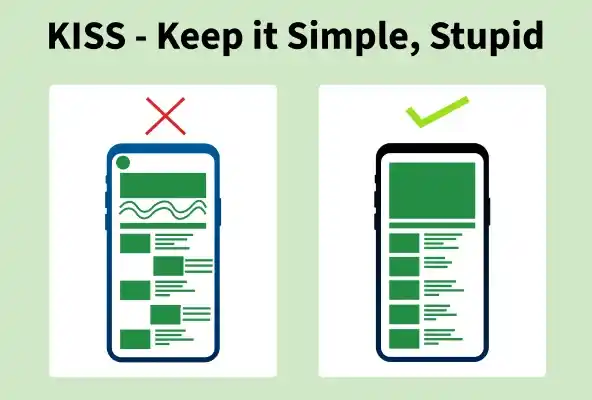
Steps to Apply KISS Principle
Applying the KISS principle involves intentionally simplifying solutions, designs, processes, and decision-making to achieve greater efficiency, clarity, and effectiveness. Here are some practical steps to apply the KISS principle:
1. Identify Core Objectives
Start by understanding what you actually want to achieve before designing a solution.
- Clearly define the problem or objective you're addressing.
- Identify the essential goals and requirements.
2. Focus on Essentials
Once the goal is clear, concentrate only on what is truly necessary.
- Prioritize essential features or components necessary to achieve objectives.
- Avoid unnecessary embellishments or functionalities.
3. Simplify Design and Workflow
Complex designs often create confusion and errors, so simplification is key.
- Streamline processes and workflows to minimize complexity.
- Eliminate redundant steps or unnecessary complications.
4. Prioritize Clarity and Understandability
A simple solution should be easy for everyone to understand and use.
- Ensure that solutions are clear and easy to understand for all stakeholders.
- Use simple and straightforward language in documentation and communication.
5. Iterate and Refine
Simplicity improves over time through continuous review and improvement.
- Continuously review and refine solutions to simplify further.
- Seek feedback and iterate based on insights gained.
6. Use Simple Tools and Techniques
The tools you choose should support simplicity, not add complexity.
- Choose straightforward tools and methodologies that align with the KISS principle.
- Avoid unnecessary complexity in tooling and technology choices.
7. Test for Simplicity
Always evaluate whether your solution is as simple as it can be.
- Evaluate solutions against the KISS principle to ensure simplicity.
- Assess whether each component or feature is truly necessary.
8. Maintain Pragmatism
Simplicity should be balanced with real-world needs and constraints.
- Balance simplicity with other considerations such as functionality and scalability.
- Be pragmatic in decision-making and prioritize simplicity where feasible.
9. Educate and Advocate
Simplicity works best when everyone understands its value.
- Educate team members and stakeholders about the benefits of simplicity.
- Advocate for the adoption of the KISS principle within your organization or team.
10. Lead by Example
People adopt simplicity faster when they see it in action.
- Demonstrate the effectiveness of simple solutions through your actions and decisions.
- Inspire others to embrace simplicity by leading by example.
Examples or Case Studies
Here are a few examples and case studies that demonstrate the application of the KISS principle across various domains:
Google Search Engine
- Google's search engine interface exemplifies simplicity. The homepage consists of a single search bar and minimal text, making it easy for users to understand and use.
- Despite the underlying complexity of the search algorithms, Google's focus on simplicity has made it the most widely used search engine globally.
Apple iPhone
- Apple's iPhone is known for its intuitive and user-friendly design, adhering to the KISS principle. The interface features straightforward navigation, minimalistic icons, and intuitive gestures.
- Apple prioritizes simplicity in its hardware and software design, resulting in a seamless and enjoyable user experience for millions of users worldwide.
Twitter's Character Limit
- Twitter's initial character limit of 140 characters per tweet enforced simplicity in communication. Users were encouraged to convey their message concisely and directly.
- The character limit fostered creativity and forced users to focus on the essence of their message, contributing to Twitter's unique communication style.
Tesla Model S Dashboard
- Tesla's Model S electric car features a minimalist dashboard design with a large touchscreen display. The interface provides essential controls and information while avoiding unnecessary clutter.
- The simplicity of the dashboard enhances usability and reduces distractions for drivers, contributing to a safer and more enjoyable driving experience.
Use of KISS Principles in Software Development
The KISS principle holds significant importance in Software Development Engineering (SDE) across various stages of the software development lifecycle. Here are some key reasons why KISS is essential in SDE:
- Maintainability: Simple code is easier to understand, modify, and maintain, especially in large projects with multiple developers.
- Debugging: Fewer complexities make it easier to identify and fix issues quickly, improving system stability.
- Scalability: Simple designs allow new features to be added more easily as requirements change.
- Performance: Straightforward code avoids unnecessary overhead and often performs better.
- Faster Development and Collaboration: Simple code speeds up development, reduces technical debt, and makes collaboration and code reviews easier.
KISS Vs Over-Engineering
Over-engineering occurs when systems are made more complex than necessary, often by adding features or abstractions too early.
| KISS (Keep It Simple) | Over-Engineering |
|---|---|
| Focuses on building simple and clear solutions that meet current requirements | Adds unnecessary complexity by introducing features or abstractions too early |
| Avoids premature optimization and keeps performance tuning only when needed | Premature optimization increases complexity without providing real benefits |
| Prefers simple architectures instead of splitting systems unnecessarily | Unnecessary microservices increase deployment, communication, and maintenance overhead |
| Uses minimal and clear abstractions for better readability and maintainability | Excessive abstractions create confusion and make debugging more difficult |
Mistakes When Applying KISS
While KISS promotes simplicity, applying it incorrectly can lead to poor design decisions.
- Oversimplifying critical logic and ignoring future requirements.
- Removing necessary abstractions just to reduce code size.
- Confusing simplicity with lack of structure.