Parade’s End (Modern Library #57)

(This is the forty-fourth entry in The Modern Library Reading Challenge, an ambitious project to read the entire Modern Library from #100 to #1. Previous entry: The Age of Innocence.)
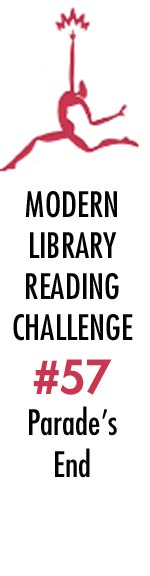
Very few people read Ford Madox Ford (née Ford Madox Hueffer) these days and there are salubrious and soul-preserving reasons why this is so. He’s the rare “great writer” who has as much relevance in the twenty-first century as some huckster trying to sell you an anti-garroting cravat. Parade’s End is ostensibly about the psychological effects of World War I, but, even on my second read of this plodding tetralogy, I found myself revisiting Ernst Jünger’s Storm of Steel, Richard Aldington’s Death of a Hero, Paul Fussell’s The Great War and Modern Memory, and even Rebecca West’s underrated The Return of the Soldier — all far more poignant and perspicacious volumes into how the Great War shaped human history. If anything, Parade’s End is an unwelcome reminder that the crusty white dudes who concocted the Modern Library canon were more motivated by what certain insiders deemed “great literature” rather than bona-fide literary standards.

Of course, I am merely one man on a literary journey — perhaps, more accurately, an asshole on the Internet with an opinion. Even so, when I posted a photo on my Instagram story of me wincing while holding up the Ford omnibus (complete with the unanticipated aesthetic touch of a bandage taped to my forehead, the result of a shaving accident rather than a sustained session in which I repeatedly banged my noggin against a stop sign pole, although my head often felt more like the latter while reading Parade’s End), a friend pointed out that she had indeed suffered with me when she had taken a stab with Ford. Her surprise revelation, delivered in a dramatic “Luke, I am your father” timbre, helped me to feel less alone. Yes, Ford Madox Ford had been dead for a good eighty-seven years and was thus an easy target for a cranky middle-aged bald dude like me who really wanted to write about Kerouac or Faulkner rather than this guy. But our bond of friendship became tighter, cemented in some shared reading agony that we had not hitherto known about. We shook our fists into the air and condemned the dreaded surname “Tietjens.”

You see, only the stodgiest tastemakers imaginable would have the stonecold cruelty to recommend this dull and insufferable perorater to some starry-eyed young reader hoping to secure a foothold in the daunting Modern Library canon. It’s especially aggravating that I have to deal with Ford not once, but twice, on this infernal list. Yes, I am fated to suffer through The Good Soldier when we get to ML 30.  I am not happy about this. But I did take a ridiculous literary oath fifteen years ago and I am a man of my word. This slimmer and more potent novel is admittedly a bit better than Parade’s End — “better” in the way that getting swiftly kicked in the balls is preferable to having a limb sawed off.

But as a graying though exuberant Gen Xer, I am duty-bound to tell any enthusiastic Zoomer or tap-dancing millennial that they would be better off watching Sam Levinson’s exploitative television series Euphoria than reading Ford Madox Ford. It can be sufficiently argued that the only reason that the 2012 BBC television adaptation of Parade’s End was memorable at all is because the brilliant Tom Stoppard (may he rest in peace) rearranged the events and added new scenes and dialogue — most tellingly taking on an “unfaithfully faithful” approach.

Who reads this man today? Perhaps a few superannuated Ford stans can be found whispering “Tietjens” as they slap their fading chits onto lonely numbers in moribund bingo hall parlors swarming with smoke. But I cannot in good conscience join this gloomy coterie of literary losers. These Ford boosters have so deluded themselves into blinkered advocacy that even Julian Barnes had the startling temerity to declare that Ford made Graham Greene, who rightly called out Last Post as “an afterthought,” look old-fashioned. Seriously bro?

Gentlemen don’t earn money. Gentlemen, as a matter of fact, don’t do anything. They exist. Perfuming the air like Madonna lilies. Money comes into them as air through petals and foliage. Thus the world is made better and brighter.

Compare this with Greene in The Quiet American and you see a significant difference between dowdy bloviating and taut observational precision:

A man open to bribes was to be relied upon below a certain figure, but sentiment might uncoil in the heart at a name, a photograph, even a smell remembered.

Christopher Tietjens — intended to reflect the dying gasps of an Edwardian age only now appreciated by husky buzzards pinching tobacco in glum dens boxed by dowdy leatherbound walls — is surely among the least interesting protagonists in 20th century literature. He is the “last Tory” — a clumsy, blunt, physically gargantuan, and very rude statistician incapable of a jocular remark or a jolly jolt in his gait. Ford banged out pages and pages of leaden dialogue from this insufferable mansplainer. And his observations possess all the pleasure of a two hundred pound steel weight being thrown repeatedly into your solar plexus, presumably with some automated Peloton instructor shrieking into your eardrums with the unsettling tenor of an ICE agent preparing to murder someone in broad daylight. “You betray your non-Anglo-Saxon origin by being so vocal…And by your illuminative exaggerations!” “Little nippers like you don’t stop things….Besides, feel the wind!” The ellipses falsely suggest a free associative genius, but only succeeded in reducing me to unintended laughter. (How else was I supposed to soldier through this book? With a stern and self-immolating chin?) Ford actually presages many of these hokey lines with a breezy “Tietjens said:” in the paragraph before just so he can pad out his pages with the unpersuasive momentum of an undergrad trying to hit the 1,000 word minimum on the essay due the next morning.

Tietjens is often outlined as brilliant, but Ford’s descriptive approach is all tell and no show:

The fly that took them back went with the slow pomp of a procession over the winding marsh road in front of the absurdly picturesque red pyramid of the very old town.

Now even someone with a particularly acute case of ADHD will look to such a sentence and see that it is trying way too hard to sound “literary” when it doesn’t say much of anything at all. What are we supposed to dwell on here? The putter of the prewar Smith Flyer? Well, we don’t actually feel its spurts or its undulations in this sentence. But we do have the sense that the fly here is in “slow pomp,” or on display. Which doesn’t really conjure up a distinct image. Okay. Fine, Ford. You do you. But how does the “winding marsh road” contribute to the imagery? Does it serve in some juxtaposition to the fly? Of course not. The road image is used to get us to “an absurdly picturesque red pyramid” that stands in apparent counterpoint to “the very old town.” But what kind of red pyramid? How is it picturesque? Again, we don’t know. And it’s utterly maddening. Ford never describes this “pyramid” again. This isn’t poetic at all. It’s word salad. Ford delivers elegant variations that aren’t even interesting in the manner by which they fail — such as “an extraordinary Falstaff’s battalion of muddy odd-come shorts.” Ford stitches together random phrases, but he only succeeds in giving us disorienting incongruities that read more like some well-read guy tagging along with you on a drunken night in Vegas, though without the pleasure of slot machine clinks or a comely stranger you accidentally hook up with. (Hey, what happens in Vegas stays in Vegas!)

And there’s more hapless syntax where that came from, folks! Should I mention the shadow “falling across the bar of light that the sunlight threw in at his open door” or how a fellow named McKechnie “swallowed as men are said to swallow who suffer from hydrophobia”?

By contrast, here is P.G. Wodehouse describing a golf course at the beginning of “A Woman is Only a Woman”:

It is a vantage-point peculiarly fitted to the man of philosophic mind: for from it may be seen that varied, never-ending pageant, which men call Golf, in a number of its aspects. To your right, on the first tee, stand the cheery optimists who are about to make their opening drive, happily conscious that even a topped shot will trickle a measurable distance down the steep hill. Away in the valley, directly in front of you, is the lake hole, where these same optimists will be converted to pessimism by the wet splash of a new ball. At your side is the ninth green, with its sinuous undulations which have so often wrecked the returning traveler in sight of home. And at various points within your line of vision are the third tee, the sixth tee, and the sinister bunkers about the eighth green⁠—none of them lacking in food for the reflective mind.

This is infinitely more enjoyable than Ford — and not just because Wodehouse is almost always a delight to read. Wodehouse maps out the territory and the types to be found in his setting and he somehow turns golfing — which I myself have never enjoyed outside of the brilliantly designed miniature courses that you find all throughout Ocean City, Maryland — into a joyfully absurd reverie for optimistic philosophy. Where Ford is muddled and confused, Wodehouse is clear and specific, complete with phrases like “wet splash of a new ball.” It is the difference between being stuck at a party with a bitter and rambling old man who gave up on finding felicity at least two decades earlier and a giddy eccentric who plans to cut the rug well into old age — or, at least, as long as his legs will two-step.

Ford Madox Ford was all influence and overhyped “talent.” It’s certainly no accident that the great Jean Rhys devoted her ferocious (and far more gifted) energies to savaging this bombastic tyrant in Quartet — revenge from Rhys after a protracted carnal entanglement. You see, there’s an undeniably skeeze quality to Ford both on the page and in his life. While serving as editor of The Transatlantic Review, Ford used his outsize literary influence to serve as a “literary mentor” to young writers (ahem, young women) decades younger than him. He would publish their early stories and exact a boudoir form of remuneration. This was a less enlightened time in which literary men in positions of power could not be held accountable. And these poor women had to endure Ford’s selfish clit-ignorant thrusts while lying back and thinking of publication. After Ford was rightfully spurned by Violet Hunt (she spent eight ghastly years with Ford; Ford, meanwhile, was cheating on his wife), Ford ruthlessly caricatured her not once, but twice — as Florence Dowell in The Good Soldier and, with evermore preposterous misogyny, as the philandering Sylvia Tietjens (Christopher’s wife) in Parade’s End. Sadly, this was what passed for eminence grise among writers in the early 20th century.

It’s safe to say that, like many clueless male authors who preceded him, Ford could not write women especially well. And this extends to Valentine Wannop, the young suffragette who Tietjens falls for. At the beginning of A Man Could Stand Up–, the third book of Parade’s End, Ford not only has Valentine confused about how to use the telephone, but portrays her dreaming of doing nothing more than eating “pomegranates beside an infinite washtub of Recklitt’s blue.” Recklitt’s Blue, for those of you who aren’t familiar with 19th century household items, was a laundry whitener that helped brighten the hues of your clothes. Despite the fact that we are introduced to Valentine as a free-spirited suffragette in the first volume (unsurprisingly, her best moments in the tetralogy), she not only longs to perform domestic duties, but she complains that she is so alone and lives a “nunlike” existence (“And no one had ever wanted to marry her….No one even had ever tried to seduce her.”).

Now anybody even remotely familiar with the suffragettes knows that they were hardly reticent when it came to passion and sex, either with the men who dated them, with each other, or, quite frequently, as they learned to “control their passions” through the power of theoretical abstinence. (You’d honestly be better off hearing about the suffragettes from Diane Atkinson’s Rise Up, Women than from Ford Madox Ford the chronic mansplainer.) But in reading Parade’s End, we don’t get any real sense of the richer life that Ford was perhaps too incurious or incompetent to draw from. James Longenbach has observed that Ford “took pleasure in feeling more qualified to diagnose the problems with women than women themselves.” (And for anyone who wants to do a deep dive, Reconstructionary Tales, a blog run by Paul Skinner, has a great overview of Ford’s conflicted feelings about the suffragettes.)

My eyes winced with incredulity as Tietjens berated Valentine Wannop for being slightly inaccurate quoting a passage. My soul plummeted into a protective crouch as I realized that Tietjens’s knowledge of the world was largely gleaned from memorizing passages in books with lifeless exactitude and even by reading the encyclopedia in alphabetical order. Almost every time a man showed up in a scene dominated by women, he would flap his lips and I felt very much like Fiona Apple trapped in a bar with the coked out and garrulous egotist Quentin Tarantino.

And here’s the thing. Valentine sees very clearly what a fool Tietjens is:

She knew that his poor mind was empty of facts and of names; but her mother said she was of great help to her. Once provided with facts his mind worked out sound Tory conclusions — of quite startling and attractive theories — with extreme rapidity. This Mrs. Wannop found of the greatest use to her whenever — though it wasn’t now very often — she had an article to write for an excitable newspaper. She still, however, contributed to her failing organ of opinion, though it paid her nothing.

Since I’ve been lambasting the man at length, I’ll give Ford a few modest props for this more clear-eyed passage, but this still circles back to one of my primary gripes about Parade’s End. Obviously, Ford possessed enough cognizance to understand how “modern” women of that era were juggling love and career. But Ford, like many mediocre men before him, is largely incurious about the latter and vitiates what talent he possessed by saturating himself in the former. Hell, even Samuel Richardson’s Clarissa — a massive masterpiece that happily occupied weeks of my reading time last year — showed far more curiosity about the inner life of a young woman than Ford did in Parade’s End. And that’s also accounting for the 18th century’s comparatively more atavistic genuflection to the patriarchy.

Furthermore, activists are fiercely loyal to their causes, particularly if they protest (as Valentine does) on a daily basis. Near the end of Some Do Not…, there is a lengthy section in which Valentine agrees to become Tietjens’s “mistress” — although nothing is consummated — and we are beholden to what is arguably the most pathetic male fantasy on the Modern Library list: namely, Valentine’s fawning admiration for the “poor mind” of this hopeless dullard.

* * *

The first of the Parade’s End books was published two years after Ulysses and T.S. Eliot’s The Waste Land, a year before Virginia Woolf’s Mrs. Dalloway, and while Proust was five books into In Search of Lost Time. These modernist geniuses served up poetic passages about consciousness. They used abstract prose in thrilling and experimental ways to unpack the crags and nuances of human existence. Ford, by contrast, has merely given us clunky prose in which the reader is randomly deposited into a new time and location. Upon solving any “riddle” that Ford presents us, the answer itself proves to be disappointingly pedestrian. It really doesn’t help that Ford is fond of having his characters repeat the title of his novel. “No more parades” obviously means that the pomp and circumstance of established social routines derived from the old social order aren’t exactly going to be practiced after machine guns, mustard gas, and trench warfare demonstrated the truly monstrous possibilities of humankind. And the Groby Great Tree cut down at Tietjens’s estate is more of a blunt and obvious metaphor of the old order collapsing rather than anything especially profound. Ford then commits the grave sin of not only believing himself to be much more clever than he really is, but in giving us a clunky journey in which we increasingly do not care about the destination.

Those who have praised Ford have done so on the basis of what I would deem “consciousness presented through continuous partial attention.” Yet they hold their tongues at the extremely contrived setups throughout the work. Mr. Duchemin, for example, goes insane without any specific reason. There is one particularly awful scene in Some Do Not… in which the “brilliant” Tietjens dukes it out with a banker over a series of overdraft charges.

Oh, but all the confusion and contradiction! The stuff of true literature! It’s why Parade’s End is on this list! Well, I see these more as significant liabilities rather than virtues. I simply cannot believe that Parade’s End was carefully designed as an invaluable modernist contribution — in large part because Ford, at times, doesn’t seem to know Tietjens. We learn, for example, that Christopher has two brothers (one that appears on page) in Some Do Not…. By the time we get to No More Parades, Christopher conveniently has a sister, who has previously been unmentioned. If this is the “inner life” meant to hammer home the conflict between the old and the new social orders, then I’d rather soak in a season of Bridgerton. But, hey, at least I’m now free of this dreadful opus. Don’t worry. I’m quite fond of the next few titles and I’ll behave myself slightly better in future installments!

Next Up! Dashiell Hammett’s The Maltese Falcon!
The Moviegoer (Modern Library #60)

(This is the forty-first entry in The Modern Library Reading Challenge, an ambitious project to read the entire Modern Library from #100 to #1. Previous entry: Death Comes for the Archbishop.)

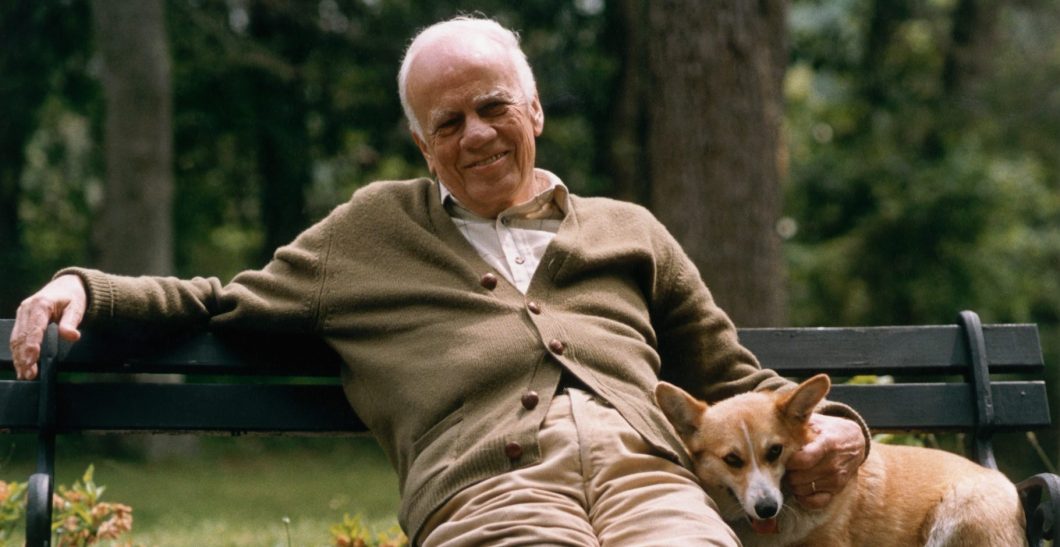
There are many go-nowhere men like Walker Percy’s Jack “Binx” Bolling in American life: the type who creates nothing and who lives like some vaguely seedy salesman overly concerned with easy comities and sartorial aesthetics, the quasi-urbane man who, at his worst, is so terrified of even remotely staining his choppers that he slurps nothing but colorless sugar-free smoothies for breakfast, lunch, and dinner. I can’t say that I’ve wanted to spend a day (much less a life) like this. I am too much of a creative, feverishly curious, and pro-active man with a formidable work ethic and a great brio for life (and all of its attendant messes) to do so, but I do have my moments when I feel the draw to lie in bed for hours and listen to the beautiful rap of rain against my window pane, which is certainly a more human pastime than sucking on the cheap glass teats of television and being extremely online. Then I come to my senses and realize that I do need to make something that day, with the fulsome freedom of not needing approbation, so that I can sleep better at night and feel some self-respect — a drive for independence and authenticity that is decreasingly shared by my fellow Americans as the apocalyptic headlines lull many formidable workhorses into permanent or partial fatigue. I don’t blame anyone for slumming it. This is an exhausting asceticism for anyone to practice and the prolificity that results from my febrile commitment is probably one reason why some people fear me.

But poor Binx Bolling has nothing like that, which is why I find him so interesting and why I find Walker Percy’s The Moviegoer to be more weirdly meaningful with each fresh reeread. Absent of any real purpose, Bolling spends much of this plotless novel trying to shoehorn his rudderless life into something, particularly a “search,” which is not really a search for anything. He seems unwilling to ride or die with unconscious instinct, with the sheer enjoyment of being alive. (Typical of Bolling, he has no allegiance. At one point, he even declares himself “Jewish by instinct.”) He recognizes that instinct is something that people possess, but that doesn’t seem enough for him:

At the great moments of life — success, failure, marriage, death— our kind of folks have always possessed a native instinct for behavior, a natural piety or grace, I don’t mind calling it. Whatever else we did or failed to do, we always had that. I’ll make you a little confession. I am not ashamed to use the word class. I will also plead guilty to another charge. The charge is that people belonging to my class think they’re better than other people. You’re damn right we’re better. We’re better because we do not shirk our obligations either to ourselves or to others. We do not whine. We do not organize a minority group and blackmail the government. We do not prize mediocrity for mediocrity’s sake…Our civilization has achieved a distinction of sorts. It will be remembered not for its technology nor even its wars but for its novel ethos. Ours is the only civilization in history which has enshrined mediocrity as its national ideal.

But is this really so “better”? This is fairly similar to Holden Caulfield’s insufferable kvetching, except that it is far more fascinating because Bolling, unlike Caulfield, is more actively self-aware and constantly observant of others. He chooses to think and feel this way. It is what I call the “fuck my life” look that you see on people’s faces after they have given up on any dreams after the age of forty.

While the Binx Bollings of our world are capable of a few spontaneous decisions and may possess some cultural tastes and perhaps a soupçon of passion, they differ from the “slacker” types that Richard Linklater rightfully celebrated in his wonderful 1991 film in that exuberance is often absent and there isn’t an unusual nobility or even an ethos to their indolence. (And I would contend that Bollling’s “novel ethos” is a false one. For he says this when he has nothing in particular he is striving for. And those who strive for something rarely have a mediocre ideal in mind.)

The Binx Bollings simply live and that’s about it. They are, in short, working stiffs and the burden of surviving is often too much to do much more than that. You’ll find them represented in varying shades within Richard Yates’s Revolutionary Road, Richard Ford’s Frank Bascombe books, John Kennedy Toole’s A Confederacy of Dunces, Frederick Exley’s A Fan’s Notes, John P. Marquand’s The Late George Apley, Sam Lipsyte’s Homeland, Richard Russo’s Nobody’s Fool, Stewart O’Nan’s Last Night at the Lobster, and John Williams’s Stoner. And while I have no desire to leave out women in my literary consideration, yes, the fear of becoming “mediocre” or “detached” like this — the natural “evolution” of Dostoevsky’s “Underground Man” or what Colin Wilson unpacked in The Outsider — does seem to be an overwhelmingly male concern. Contemporary novelists as brilliant as Adelle Waldman, Kate Christensen, and Lauren Groff (you should very much read their work too) have also tackled this to great effect, although they are usually more interested in effect rather than cause or state and the vicarious first-person experience is of less importance. Think of the way that the characters in Edith Wharton, Muriel Spark, and Iris Murdoch (all literary queens who I will enthuse about to my dying day!) are so much more alive than the Binx Bolling type. I also can’t help but think of the way Ross McElwee (also a man of the South) brilliantly and vulnerably put himself front and center in such a way with his fascinating series of personal documentaries. Updike, in particular, was one of the foremost literary Johns drawn to these men and he nimbly spoke to American readers who recognized the telltale cadences of Durkheimian anomie.

Which is not to negate the quotidian struggles of the Binx Bollings. The miracle of Percy’s novel is that we’re still with him on his journey despite all this. Still, it often never occurs to these types to pay attention to the “beloved father” or “husband of X” found so ubiquitously on tombstones, which matters so much more than the roll of a Taylorist scroll memorializing an endless concatenation of checked off tasks. The worst of these aimless men possess no sense of humor and somehow transform into a homely insectoid creature worse than anything that ever bolted upward from Kafka’s imagination, a listless monstrosity commonly referred to as a “critic.” The critic, who is often a cretin, is a pitiful and unsmiling quadraped incapable of expressing joy, much less stridulating his legs together to make a pleasant sound in springtime.

And while we’re on the subject of bugs, as it so happens, there is a cameo appearance from a coterie of creepy-crawlies in Walker Percy’s The Moviegoer that saunter right past our malaise-fueled man Binx: “They dive and utter their thrumming skonk-skonk and go sculling up into the bright upper air.” Percy’s emphasis on sounds and gerunds here really says it all. That same whirlydirsh language is often beyond poor Binx.

* * *

The source for Boiling — as well as Williston Barrett, a Percy protagonist who would be explored in two stages of life (youthful folly and middle age) in, respectively, The Last Gentleman and The Second Coming) — was Percy’s essay “The Man on the Train” (collected in The Message in the Bottle) — in which Percy firmly established the type of protagonist he was interested in writing about:

There is no such thing, strictly speaking, as a literature of alienation. In the re-presenting of alienation the category is reserved and becomes something entirely different. There is a great deal of difference between an alienated commuter riding a train and this same commuter reading a book about an alienated commuter riding a train….The nonreading commuter exists in true alienation, which is unspeakable; the reading commuter rejoices in the speakability of his alienation and in the new triple alliance of himself, the alienated character, and the author. His mood is affirmatory and glad: Yes! that is how it is! — which is an aesthetic reversal of alienation.

In other words, Percy could not bring himself to write about a character in unbearable despair (it is not an artistic focus for the faint of heart) — largely because his natural writing voice is driven by a fine comedic impetus, with the Catholic novelist’s concern for philosophy planting one foot in the wings and the other on stage. (Look no further than Antonia White, Gene Wolfe, and Graham Greene for similarly intriguing juxtapositions.) Much like Richard Linklater’s “slacker” archetype, Percy seeks to pursue the bare minimum of alienation, although, as can be seen with Dr. Thomas More in Love in the Ruins, Percy’s characters are more eggs-in-one-basket types (in More’s case, the Ontological Lapsometer that he sees as a decaying society’s cure-all) and less committed to the free-floating spontaneity of hitching a ride with strangers, taking the entire day to assemble an elaborate rock structure to represent femininity, or being interviewed for a film student’s documentary.

At this point, the gusto-driven reader may rightfully ask, “So why read about this?” For the same reason that we read about any “unlikable” character. This is a form of living, albeit while clutching the bottom of one’s hemp, that is part of the human experience. The eccentric film journalist Jeffrey Wells has recently suggested that the criteria of art (specifically movies) involves being put into “a kind of alternate-reality mescaline dream state.” And while escapism is certainly a dopamine-fueled pastime practiced by a population increasingly hostile to pleasurable cerebration, requiring little of the mind but an uncritical blank slate and a sybarite’s zeal for incessant orgasm, what of the wisdom picked up from raw human experience? Art gives us the advantage of having access to the interior thoughts and feelings of those we may be disinclined to meet in the here and now. Wells’s limited definition therefore nullifies Jonathan Glazer’s excellent film adaptation of Martin Amis’s novel, The Zone of Interest, which is nothing less than a vital and deeply horrifying atmospheric experience warning us of the shockingly pedestrian character of fascism, which is dangerously close to permanently destroying the very fabric of this bountiful nation should the Orange Menace emerge victorious in November.

Likewise, Walker Percy’s masterpiece is a similar (if less baleful) cautionary tale of what it means to coast and how commitment to something (or, in Bolling’s case, someone) represents the inevitable reckoning that anyone is fated to face at one point or another. It is a sneaky warning to anyone with true fuck-it-all drive that even the dreamer faces the risk of slipping into adamantine complacency and is ill-equipped to gently pluck a rose from the carefully maintained bush planted atop a Sisyphean alp.

The New Yorker‘s Paul Elie has smartly observed that The Moviegoer is curiously ahistorical: less taken with unpacking the neverending residue of the Civil War, racial tension, or other hallmarks found prodigiously within typical Southern fiction. The novel is also, by its own prefatory admission, an inexact version of New Orleans: far from meticulously recreated like Joyce’s Dublin, though not entirely fabulist.

But I do think Elie is a tad too dismissive of Southern inventiveness to suggest that Percy mined exclusively from the European existentialists to summon his vision of the unlived and shakily examined life — even though the debt to Kierkegaard is obvious in The Moviegoer (and in “The Man on the Train”), not just because of the opening epigraph:

As for my search, I have not the inclination to say much on the subject. For one thing, I have not the authority, as the great Danish philosopher declared, to speak of such matters in any way other than the edifying. For another thing, it is not open to me even to be edifying, since the time is later than his, much too late to edify or do much of anything except plant a foot in the right place as opportunity presents itself – if indeed asskicking is properly distinguished from edification.

But what is this search? I strongly recommend Rose Engler’s smart unpacking, which eloquently outlines the religious component that was dear to Percy, but there is something intriguingly postmodern about it. One of Percy’s early reviewers — Edwin Kennebeck in Commonweal — believed that The Moviegoer entailed a search not merely for meaning, but for something beyond despair. And there is something to this, given how Bolling categorizes the search early on as “what anyone would undertake if he were not sunk in the everydayness of his own life.” The movies that Bolling regularly watches do not present a true search. And, for Bolling, it can be argued that his search involves doing everything possible to avoid that search, even though he knows inherently that he must search. Denied definitive time and space by Percy, Bolling splits up his search into horizontal and vertical ones, framed without any proper construct from Eddington’s The Expanding Universe. He complains of his family not understanding his search. He searches for a starting point by scribbling in a notebook and, after all this “effort,” tells us, “The search has spoiled the pleasure of my tidy and ingenious life in Gentilly.”

Kenneback pinpointed, quite rightly, that Bolling’s decision to marry Kate represented “a search ended and an ordeal begun.” Belonging then, which most of us crave for and which Bolling is not especially good at, represents the cruel gauntlet thrown down by the universe. Bolling tells us, “Show me a nice Jose cheering up an old lady and I’ll show you two people existing in despair.” He believes that Kate sustains a look of being serious, “which is not seriousness at all but despair masquerading as seriousness.”

Perhaps we’re all pretending in one way or another as we saunter about this mortal coil. But the tragedy of Binx Bolling is that, even with his apparent religious conversion, he cannot seem to accept life at face value. But he is not the only one suffering. Kate has this to say:

“Have you ever noticed that only in time of illness or disaster or death are people real? I remember at the time of the wreck — people were so kind and helpful and solid. Everyone pretended that our lives until that moment had been every bit as real as the moment itself and that the future must be real too, when the truth was that our reality had been purchased only by Lyell’s death. In another hour or so we had all faded out again and gone our dim ways.”

If our presence here is indeed ephemeral, should this not provide greater motive to connect and to find joy? The Catholic mind, and thus the Catholic novel, is not without its involutions and contradictions.

Next Up: Max Beerbohm’s Zuleika Dobson!

James Joyce (Modern Library Nonfiction #73)

(This is the twenty-eighth entry in The Modern Library Nonfiction Challenge, an ambitious project to read and write about the Modern Library Nonfiction books from #100 to #1. There is also The Modern Library Reading Challenge, a fiction-based counterpart to this list. Previous entry: Florence Nightingale.)

“Mr. Joyce, first of all, is a little bourgeois Irishman of provincial tastes who has spent a lifetime on the continent of Europe in a completely fruitless attempt to overcome the Jesuit bigotry, prejudice, and narrowness of his childhood training. Mr. Joyce began his literary career as a fifth-rate poet, from there proceeded to become a seventh-rate short-story writer, graduated from his mastery in this field into a ninth-rate dramatist, from this developed into a thirteenth-rate practitioner of literary Mumbo-Jumboism which is now held in high esteem by the Cultured Few and I believe is now engaged in the concoction of a piece of twenty-seventh-rate incoherency, as if the possibilities in this field had not already been exhausted by the master’s preceding opus.” — Thomas Wolfe, The Web and the Rock

James Joyce was probably the greatest writer of the 20th century, although opinions vary. (Many of today’s young whipper-snappers sound astonishingly similar to a dead-inside academic like Thomas Wolfe’s Mr. Malone when dispensing their rectal-tight rectitude and uncomprehending pooh-poohs on social media.) But as a wildly ambitious literary athlete nearing fifty (353 books read so far this year, with a little more than a week left), I cannot think of any other writer whom I have returned to with such regularity and gusto. Even the dreaded “Oxen of the Sun” chapter in Ulysses, which caused at least six hundred grad students to faint from fatigue in the last year (and a good dozen young scholars to permanently lose their minds), demands that you peruse it anew to appreciate its multitudinous parodies.

Only a handful of living writers can summon a similar obsession in me through the power of their words. But even when these hypergraphic bards descend from the Mount with their thick portentous volumes, they are hopelessly outmatched by the Dublin bard’s mighty polyglot yardstick. (Certainly Anthony Burgess spent his prolific literary career forever lost in Joyce’s formidable fug and forever resented the fact that his best known work, A Clockwork Orange, with its captivating NADSAT, caught on, perhaps because it represented some attempt to mimic Joyce’s word-soaked playfulness.)

When I visited the Martello Tower at Sandycove Point not long before the pandemic, it was the closest thing that an atheist like me has ever had to a religious experience. It had never occurred to me — a relentlessly abused white trash kid who fought off bullies (and still has to do so in his forties) when not filling his voracious noggin with too many books, a reader from the age of two, an accidental provocateur who still manages to piss off PhDs and varying mediocre literary types whenever I quote long passages from memory culled from books they claim to have read but have somehow forgotten — that I would ever have the divine privilege of standing at the very location where “Telemachus” begins. My first walk alongside the Mississippi River last summer in deference to another literary hero of mine was close, but Joyce was the clear winner when it came to summoning such heartfelt psychogeographical wonder. As I sauntered along the swerve of shore to bend of Scotsman’s Bay back to the Dublin train, I trembled with tears of joy, feeling great shudders push me into a state of awe that I did not know was writhing within me. I simply could not believe it. I had already been impressed by the social code of the great Irish people, who would always give you at least five minutes of banter and who were never shy in expressing their opinions and who immediately unlocked the key to further appreciating “Ivy Day in the Committee Room” through their innate conversational finesse. But was I actually standing in the same room in which Samuel Trench (the basis for Haines) had shot at an imaginary panther that had plagued him in his sleep? And was that truly Joyce’s guitar? The good people who run this landmark were incredibly kind to this wildly voluble and incredibly excited Brooklynite. I flooded their robust Irish souls with endless questions and an irrepressible giddiness. A kind woman, who did her best to suppress laughter over my ostentatious literary exuberance, remarked that they had not seen such a visitor display such bountiful passion in months.

But I am and always will be a Joyce stan. I own five Joyce T-shirts, including an artsy one in which the opening words of Finnegans Wake are arranged in a pattern matching one of Joyce’s most iconic photographs. Before I deleted all of my TikTok accounts, my handles were various riffs on Joyce’s most difficult volume. There has rarely been a week in which I have not thought about Ulysses or “The Dead” or, on a whim or in need of a dependable method to restore my soul, picked up my well-thumbed copy of Finnegans Wake and recited pages and laughed my head off. When I went through the roughest patches of my life nine years ago, it was James Joyce who helped save me. I reread Ulysses while living in a homeless shelter. And had I not had that vital volume on me to renew my fortitude and passion, it is quite likely that I would be dead in a ditch somewhere and that the words I am presently writing would not exist.

So I’m obviously already in the tank for Joyce and deeply grateful to him. He has proven more reliable and loyal to me than my toxic sociopathic family. These moments I have chronicled would be enough. But Richard Ellmann hath made my cup runneth over. He somehow achieved the unthinkable, writing what is probably the best literary biography of all time. Other biographers have combed through archives and badgered aging sources, hoping to stitch their tawdry bits with dubious “scholarship.” Small wonder that Joyce himself referred to these highfalutin ransackers, who have more in common with TMZ reporters than academics, as “biografiends.”

But one cannot lay such a mildewed wreath at Ellmann’s feet. There are very few details in Ellmann’s book that do not relate directly to the work. We learn just how invaluable Stanislaus Joyce was to his brother. Stanislaus — an adept peacemaker who documented his fractious fraternal relationship in his own book, My Brother’s Keeper — is liberally excerpted. If Stanislaus hadn’t pushed back hard on the alleged “Russian” feel of Joyce’s great short story “Counterparts,” would we have had “The Dead”? (“The Dead” was written three years after the other fourteen tales contained in Dubliners.) To cite just one of many Ellmann’s cogent connections between Joyce’s life and work, we learn that Edy Boardman — Gertie McDowell’s friend in the “Nausicaa” chapter of Ulysses — represented faithful recreations of neighbors that the Joyce family knew on North Richmond Street and that “the boy that had the bicycle always riding up and down in front of her window” was, in fact, a callout to one Eddie Boardman, who had the first pneumatic-tired bike in the hood. Joyce’s crazed jealousy towards any man whom he suspected had designs on Nora Barnacle — with his insecure interrogations of Nora by letter and in person — are duly chronicled. The boy that Nora had dated before Joyce came along was Sonny Bodkin (who died tragically young of tuberculosis) and she was initially attracted to Joyce because of their close physical resemblance. And while Joyce was forward-thinking when it came to presenting Jewish life in Dublin (and arguably creating one of the most fully realized Jewish heroes in literature with Leopold Bloom), his regressive masculinity could not stand the notion that his great love’s heart had stirred long before he came along. And yet, even with his nasty and unfair and unreasonable accusations, he was able to find a way to broach this in fiction with Gretta Conroy recalling her dead lover Michael Furrey in “The Dead.” It is often the darkest personal moments that fuel the best of fiction.

And let’s talk about that ugly side of Joyce. The great Dublin exile was also an unapologetic leech, a shrewd manipulator, and a master of dodging creditors. He fantasized about pimping his wife Nora out to other men while also being naive enough to believe Vincent Cosgrave’s claim that Cosgrave was sleeping with Nora before him in the fateful summer of 1904, nearly sabotaging his relationship with a series of angsty transcontinental missives. For better or worse, Joyce refused to see the full extent of his poor daughter Lucia’s troubles. He treated many who helped him very poorly. And, of course, he despised explaining his work. He wanted to keep the scholars busy for centuries. And he succeeded. Here we are still discussing him, still mesmerized by him. Even when his life and work are often infuriating.

If there is any weakness to Ellmann’s formidable scholarship, it is with the women who were vital to Joyce’s life. Ellmann was so focused on finding precise parallels between Joyce’s life and work — but usually only including Jim and his brother Stanislaus at the center — that he often portrays these invaluable lieutenants in superficial terms — that is, if he even mentions them at all. Let us not forget that Joyce was a man terrified of dogs, violence, and thunderstorms. The women in his life empathized with the effete qualities of this indisputable genius and provided financial and scholarly resources for Joyce to continue his work, even when they found Finnegans Wake baffling and not to their taste. Perhaps most criminally, there is no mention in Ellmann’s book of Myrsine Moschos (who was Lucia Joyce’s lover at one point), the dutiful woman who toiled at the famous bookstore Shakespeare & Company and spent long days in the dank chambers of Parisian libraries, sifting through decaying volumes that often crumbled to dust in search of obscure words and other arcane lexical associations that Joyce included in Finnegans Wake. Moschos often returned from these scholarly journeys so exhausted that Sylvia Beach — arguably the greatest bookseller in all of human history and the woman who took significant risks to get Ulysses published — had stern words for Joyce about Moschos’s health.

In 2011, Gordon Bowker published a biography — something of a quixotic project, given the long imposing shadow cast by Ellmann — that was more inclusive of Nora Barnacle, Sylvia Beach, and Harriet Shaw Weaver. But I do recommend Brenda Maddox’s Nora, Carol Loeb Schloss’s Lucia Joyce: To Dance in the Wake (with significant reservations), and Noel Riley Fitch’s Sylvia Beach and the Lost Generation as volumes that fill in these significant gaps that Ellmann, in his efforts to portray Joyce as his own master, often failed to address. (Even Jo Davidson, the sculptor who was instrumental in making the New York theatrical run of Joyce’s play Exiles happen, is merely afforded a footnote by Ellmann.)

Can one literary biography be the all-encompassing volume that captures a life? Even one that was as complicated as Joyce’s? Perhaps not. But Ellmann has certainly come closest. Now that Joyce’s famously hostile grandson Stephen has passed away and the copyright for much of Joyce’s work has at long last been released into the public domain, it’s possible that another biographer will be better situated to come closer to revealing the Joyce mystique without being strangled by the bitter hands of some unremarkable apple twice removed from the great tree. But I doubt that any future scholar will match Ellmann. For all of his modest limitations, he was the right man at the right time to capture a seminal literary life in perspicacious and tremendously helpful form.

(Next Up: Elaine Pagels’s The Gnostic Gospels!)

Of Human Bondage (Modern Library #66)

(This is the thirty-fifth entry in the The Modern Library Reading Challenge, an ambitious project to read the entire Modern Library from #100 to #1. Previous entry: Heart of Darkness.)

William Somerset Maugham was a largely gloomy man who just wanted to be loved. And because Maugaham was constitutionally incapable of behaving in the manner of Sally Field accepting her Oscar (and was frequently self-deprecatory), he often wasn’t. It certainly did not help that he was closeted, emo as fuck, fiercely protective of his private life, tight-lipped about his inexorable agony, and reported by many of his acquaintances and admirers as emotionally detached (although he did commit many quiet acts of generosity, including building up a library at The King’s School in Canterbury, where the ashes of Ashenden’s creator were eventually scattered). He frequently quipped that he stood in the first row of second-rate writers, almost to steel himself against the effusive and well-deserved reception he received for his considerable literary accomplishments. The Moon and Sixpence, Cakes and Ale, and The Painted Veil remain remarkably vivacious and salacious for their time and are still eminently readable today.
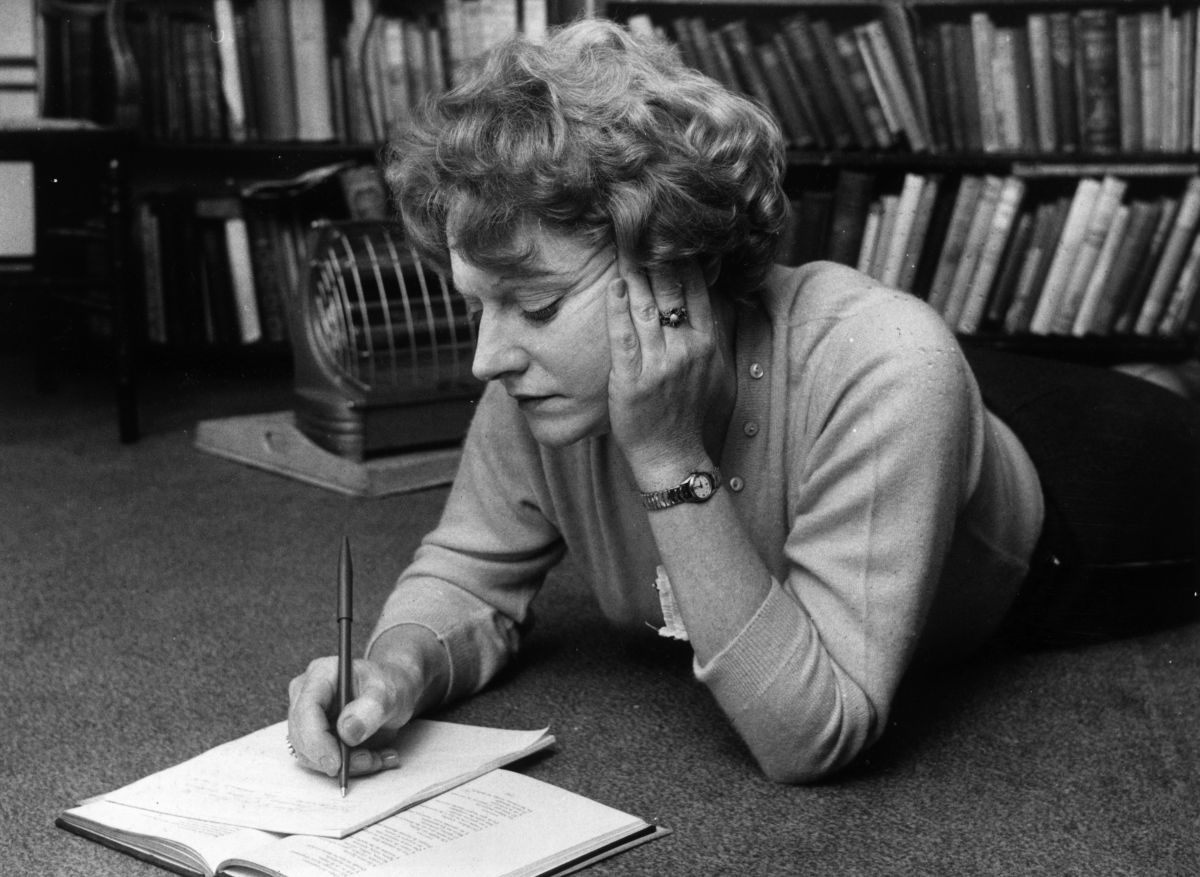
Maugham’s ardent commitment to the “fuck my life” bit, which one often sees today with glum cube slaves over forty, is best evinced by how difficult it is to find a photograph of Maugham smiling. This man hated himself so much that it’s safe to say that he probably would not have been the right man to ask for a selfie. Maugham’s knack for misery is seen in the themes and the grim humor that often punctuate his lurid fiction: the fixation on death and depression, the sense that all love affairs are fated to suffer an abominable heartbreaking end (often with a protagonist too steeped in butterfingers myopia to recognize what’s right in front of him), and a heartless world that is permanently at odds with the joys of human existence. I don’t think it’s an accident that Bill Murray decided on Maugham as his source material when he attempted to turn to dramatic acting in the mid-1980s. Numerous biographers have made noble attempts to ascertain why Maugham was so hopelessly dolorous, but even with “newly discovered papers,” Maugham’s pitch-black penumbra has stubbornly summoned more enigmatic angles. Despite his affluence, he lived quite modestly and, perhaps due to the publicity of his theatrical work, he perfected the art of suffering in plain sight. Given that he made it all the way to the age of 91, one wonders just what it was that kept this tortured depressive living. His storytelling is often so spellbinding that you just want to give the poor man a hug.

But Maugham was also one of the most successful writers of the early twentieth century. With fame came the relentless hail of stonecold critics who refused to budge from their gilded dogpens and throw Willie a bone. Despite his position on the Modern Library list, Maugham has been unfairly neglected in the 21st century. He is not taught, not stocked in most bookstores, and certainly not mentioned by the bratty hordes who are too busy dropping their knickers over such blinking babies as Colleen Hoover and R.F. Kuang. In 1908, Maugham had four wildly successful plays running simultaneously in London. And by the middle of the 20th century, Maugham was so wealthy, such a seemingly permanent mainstream pasha, that even the iconoclastic Simon Raven singled him out as a member of the protected class to be caviled with. And there was Edmund Wilson’s notorious drive-by on Maugham in the New Yorker (contained in Classics and Commercials): “He is for our day, I suppose, what Bulwer-Lytton was for Dickens’s: a half-trashy novelist, who writes badly, but is patronized by half-serious readers, who do not care much about writing.”

Well, I care very much about writing. And while I will concede that Maugham sometimes resorted to pat imagery, melodrama, and telltale tropes (“If only you knew how heartily I despise myself for loving you!” is one cringey line from Of Human Bondage), he could summon striking imagery when he wanted to. In Of Human Bondage, Maugahm beautifully evokes the hope limning the world’s roughness: “The delicate iridescence of the London air gave the softness of a pastel to the gray stone of the buildings; and in the wharfs and storehouses there was the severity of grace of a Japanese print.” Maugham compares a bottle of Chianti with “a slim fair Circassian guarded by four corpulent eunuchs.” And while such imagery probably did not occur frequently enough for a stodgy stooge like Wilson, Maugham’s fixation on surfaces is also vital to what Of Human Bondage is about: namely, the power of imagination and perception to alter one’s life for the better and to make something of one’s existence even when the chips are down.

In condemning Maugham, Wilson had only read two of Maugham’s novels: Then and Now, a truly mediocre historical novel which even we Maugham stans have to discount, and East is West, which even Wilson had to confess was “quite entertaining.” So why the adamantine hate? Why didn’t Wilson bother to tackle Of Human Bondage, which confidently debunks many of Wilson’s beefs with a writer who generations of readers have rightly loved?) I suspect that Wilson’s reckless irresponsibility here as a critic had more to do with the fact that he was an alcoholic who burned through four wives and who made it his lifelong mission to asphyxiate joy whenever he saw it. (And it’s worth pointing out that Wilson is much uglier and somehow more tormented than Maugham is in photographs, resembling nothing less than the living answer to Harold Skimpole: a rage-filled parasite with a permanent scowl.) Moreover, Wilson’s casus belli seems more motivated by Maugham’s dodgy stances on three of Wilson’s literary heroes: Henry James (whom I also despise), James Joyce (whom I am a perfervid acolyte of), and Yeats (yeah, okay, but I prefer Blake and Berryman). Which essentially makes Edmund Wilson’s position no different from those Comic-Con dweebs duking it out on Twitter (sorry, but I can’t will myself to call it X). Wilson engaged with the man and his views, not the work. His criticism is thus nullified.

Even so, I feel an aching need to defend Of Human Bondage against the likes of Wilson and his hamfisted acolytes — that is, if any of them are even still alive. This brilliant novel is far more than a picaresque Bildungsroman, although Dickens is mentioned multiple times and there are many colorful characters that are clearly inspired by Henri Murger’s Scenes of Bohemian Life, which is also name-checked by Maugham. It is, in short, a novel that adeptly portrays the behavioral patterns established in early life and reckoned with in the next two decades. (To cite one of many repetitive phrases throughout Of Human Bondage, the words “I don’t mind” factor in heavily among Philip’s romances.) Yes, Maugham’s grasp of working-class vernacular is not the greatest, confined largely to elided aitches in the manner of Shaw. But who cares? None of Maugham’s modest failings detract from the feel of the novel or the book’s quirky philosophical asides, which include the claim that suicide is better framed through the loss of money rather than the loss of love. Of Human Bondage is a book for the people. That it still remains remarkably absorbing more than a century after its publication and that its subtle lessons about life are still applicable in the 21st century should count for something.

It’s also a mistake to read this massive novel as transposable autobiography, which Wilson was content to do with Dickens in The Wound and the Bow: “If one approaches his first novel, Pickwick Papers, with these facts of Dickens’ biography in mind, one is struck by certain features of the book which one may not have noticed before.” Of Human Bondage‘s hero, Philip Carey, who we follow from the age of eight (after his parents die and he is adopted by his penurious and religious uncle) to early middle age, has a club foot. Maugham had a lifelong stutter. But the panoramic canvases that Maugham paints of London, Paris, and Heidelberg (to say nothing of Philip’s oppressive early life under his vicar uncle’s thumb, the art world, the medical world, and even the down-and-out Athelnys who show up near the book’s end) clearly tells us that there is something larger and more worldly at stake here.

And while Ruth Franklin suggested thirteen years ago that the doomed affair between Philip and Mildred is what makes this novel “original,” I think Mildred — as enthrallingly malicious as she is — is one of the least interesting aspects of this book, particularly when you consider Maugham’s vast scope. All of us meet a Mildred along the way. All of us make the mistake of rejecting people who are good for us — as Philip does with Norah Nesbitt, a woman estranged from her husband and saddled with a kid who is impressively writing penny dreadfuls to support her family and who, even when listening to Philip, is seen knitting so as not to waste a precious moment. All of us, like Philip, meet certain types over the course of our amorous journey. While my 21st century progressive spirit quibbles with Maugham’s portraits of accomplished women as spinsters, Maugham is nevertheless accurate when it comes to Miss Wilkinson (his first love, ten years older than Philip and treated abominably by the tormented young man) and Norah fill in the hole of his absent mother. (Over the course of the novel, Philip sadly loses the photographs and trinkets that are left of his mother, thus having little more than faint memories mimicked by the women he gets involved with in adulthood.) What counts is how we react to all this and how we become nimbler in this tricky business called living.

Of Human Bondage takes its title from the third section of Spinoza’s Ethics. And for the Wilson-friendly snobs who would decry Maugham’s lifting, claiming this to be as graceless as the way old Star Trek episodes were named after Shakespeare lines, this is hardly a casual reference. Rather interestingly, Philip comes to resent and reject religion over the course of the book. And anyone familiar with Spinoza knows that the famous philosopher was careful to establish the existence of God in the first part of Ethics. (Which causes, uh, issues for a staunch atheist and Spinoza fan like yours truly. But I’ve always found ways to look for spiritual sublimity outside of fictitious deities.) So the rejection of religion is, in some sense, a rejection of life. And one of the great thrills of reading Of Human Bondage is watching Philip gradually come to terms with negotiating existence. There is also a concern for Goethe’s notion of living resolutely in “the whole, the good, and the beautiful” — as mentioned by Hayward, the young man who Philip meets in Germany and who proceeds to make cameo appearances throughout the novel. But Maugham is equally suspect of philosophy when he has Cronshaw, a friend of Philip’s, who has this to say about life’s mysteries:

Have you ever been to the Cluny, the museum? There you will see Persian carpets of the most exquisite hue and of a pattern the beautiful intricacy of which delights and amazes the eye. In them you will see the mystery and the sensual beauty of the East, the roses of Hafiz and the wine-cup of Omar; but presently you will see more. You were asking just now what was the meaning of life. Go and look at those Persian carpets, and one of these days the answer will come to you.

Philip does indeed get his hands on a Persian carpet and hopes that, one day, the carpet will yield the mighty answer. But the carpet is destroyed during a particularly crushing moment. Much like Douglas Adams summoning the number 42 as the answer to life, the universe, and everything, so too is the carpet something of a Macguffin. At a certain point, one has to live instinctively rather than relentlessly ponder what life means. And when Philip loses the carpet (along with most of his fortune due to a foolish investment decision), it is only then when Philip begins to find true happiness, with Maugham telegraphing this hard by concluding Chapter CVI with the one sentence paragraph, “Philip was happy.”

And while Of Human Bondage‘s ending may feel a little too tidy, we do get a sense that Philip has thrown off the shackles that marred his efforts to grow as he bounced around many nations and all sorts of people. We have followed his adventures through the first half of his life. And in the end, he has conquered Spinoza’s “lack of power to moderate and restrain the affects” through the strange hope and humility that often comes with middle age. That Philip has done so after considerable misfortune is a testament to the happiness that poor Maugham himself tried so unsuccessfully to chase throughout his life. But then fiction is very often a prayer sent out into the universe, often entailing what the writer himself cannot possibly find in his life. At one point in the novel when Philip faces significant despair, the young man finds a sense of awe and within El Greco’s View of Toledo. El Greco’s raw colors are not easily found in the everyday, but the painting gives Philip the impetus he needs to find something close to heaven in humility. So too do we in revisiting this enormous and scrappy classic. Philip’s character transformation allows us to forgive him of his terrible treatment of the women who gently entered his life. And, in so doing, this novel allows us to forgive ourselves for our own inevitable transgressions.

Next Up: Anthony Burgess’s A Clockwork Orange!

The Prime of Miss Jean Brodie (Modern Library #76)

(This is the twenty-fifth entry in the The Modern Library Reading Challenge, an ambitious project to read the entire Modern Library from #100 to #1. Previous entry: Finnegans Wake.)

We are two days away from the great Muriel Spark’s 100th birthday. Yet, despite New Directions’s valiant reissue of her remarkable work only a few years ago (along with a quiet event planned on Thursday at the 92nd Street Y, which stands incommensurately like a shaking child in the vast shadow of Edinburgh’s impressive celebratory blowout), we are no closer to literary people universally singing her praises on this side of the Atlantic than we are in stopping men from wearing black socks to bed. And that’s a shame. Because Muriel Spark was truly one of the most innovative writers of the 20th century. She was a bold and an economical stylist who packed far more attentive detail and character speculation into one paragraph than most contemporary writers wrangle into a chapter, and she did so with high style, grace, and ferocious wit. The Prime of Miss Jean Brodie, her most enduring and popular novel (and, through a magical twist of fate, the next volume in the Modern Library Reading Challenge), certainly sees Spark’s great gifts on full display, but it is also a book that demands constant and even obsessive study.

I have read Brodie four times within the last two years. It is very possible I will read it four more times within the next two. I am inclined to press this richly entertaining book, no more than a hundred pages, into the hands of anyone who purports to take literature seriously, but who has somehow ignored Spark to hold up some bland offering from one of those “Most Anticipated” lists published at The Millions that nobody will remember or quote from in a decade.

Brodie is both a portrait of an exuberant teacher determined to educate a carefully selected group of girls so that they may be better equipped when “in their prime” and an incredible tableau of 1930s Edinburgh, such as the “wind-swept hockey fields which lay like the graves of the martyrs exposed to the weather in an outer suburb.” Miss Brodie may or may not be a tyrant. (She is fond of Mussolini and Italian culture.) One can read the book anew and come away with an entirely different opinion of the title character. The novel tantalizes us with flash-forwards (which can also be found in many of Spark’s later novels, such as The Driver’s Seat and Territorial Rights, which are also well worth your time) revealing the fates of the schoolgirls in adult life, leaving us with impressions of how formative life and education influences unknowingly in later years. One reads little snippets of the six girls under Miss Brodie’s tutelage from the present and the future– Rose “pulling threads from the girdle of her gym tunic” in class or Jenny not experiencing any sexual awe “until suddenly one day when she was nearly forty, an actress of moderate reputation married to a theatrical manager” — and asks how much Miss Brodie is responsible for corrupting fate, with Spark slyly implicating us as we become more curious.

Muriel Spark wrote this masterpiece in less than a month. This is especially amazing because, much like the magnetic properties contained within the glowing amber necklace Miss Brodie wears when off-screen romance inspires a new step in her exacting stride, this short novel reads as if an exquisite jeweler had painstakingly ensured that not a single element could ever fall out of alignment. And Spark sculpts many glistening carats along the way: the fictitious letters that two girls write after imagining Miss Spark’s love life, the creepy, one-armed artist Teddy Lloyd who also teaches at the school and disguises his true pedophilc nature through the sham panacea of Catholicism and family life, and the lingering question of which schoolgirl betrays Miss Brodie and causes her to lose her job. The novel presents us with many hints and details that hide in plain sight, but that all contribute to an atmosphere in which the girls end up coming up with explanations (often fictitious and sometimes apostate) for what is both seen and not seen. Miss Brodie’s careful lessons, which include a field trip into a rougher part of Edingburgh and often involve knowing the roots of words to better understand them, are perhaps being applied in dangerous ways. And in an age where people judge people who they haven’t met based on what they think they know from a social media profile, The Prime of Miss Jean Brodie remains potent and necessary reading.

Spark’s lecture “The Desegregation of Art,” delivered before a crowd of New York literati on May 26, 1970, offers useful insights into the ambitious gauntlet she felt obliged to throw down as an artist and gives us a sense of what is very much at stake in Brodie. She firmly believed that literature existed to infiltrate and fertilize the mind and denounced any fiction that stood in the way of this lofty artistic goal. If that meant tossing out socially conscious art that was not “achieving its end or illuminating our lives any more,” then this was the price to pay for better art that reflected the depths and thorny hurdles of life. She insisted that “ridicule is the only honourable weapon we have left” and believed that addressing wrongs emerged not so much from instant outrage, but through “a more deliberate cunning, a more derisive undermining of what is wrong. I would like to see less emotion and more intelligence in these efforts to impress our minds and hearts.” Much as Spark detested being a victim in her life, she believed that art reveling in victimhood turned readers into oppressors.

So we are left with Brodie as a remarkable volume that fertilizes our minds even as it challenges our own interpretations. Spark’s honorable ridicule in Brodie may very well lie with the way she shrewdly sends up how people are perceived for their failings based on superficial shorthand. And this extends even to the hypnotic allure of Miss Brodie’s own teaching. At one point, Miss Brodie observes that “John Stuart Mill used to rise at dawn to learn Greek at the age of five” and that the teacher herself learned from this lesson. Mill is a particularly funny choice, given that this philosopher was known for utilitarianism and that we are seemingly experiencing a short “utilitarian” novel when we read Brodie. But, of course, we aren’t. For one wants to reread it yet again.

The intrepid literary adventurer plunging forward on a bold bender for real-life inspiration is often viewed with contempt by any practitioner transforming bits of his life into analeptic artistic truth withstanding the test of time. The adventurer shakily balances the author’s complete works like vertiginous trays stacked tall enough to scrape plaster flakes off the ceiling as the letters and the collected marginalia and the autobiographical tidbits are swirled into a overflowing flute by a jittery finger serving as a makeshift cocktail straw. If not written off as a slightly smarter TMZ reporter who has somehow retained the ability to read despite being barraged daily by Harvey Levin’s soul-destroying smile, such an apparent gossipmonger, even if she is cogent enough to know that fictional characters rarely spring from a singular source, is still tarnished as that rakish yenta who reads fiction for the wrong reasons.

As I have ventured further into this years-long Modern Library project, I’ve come around to the daring idea that, for certain sui generis authors (and Muriel Spark is certainly one of them), one may indeed find deeper appreciation in the way they forge art from the people surrounding them. It isn’t so much the schema of who matches up with whom that should concern us, but rather the fascinating way in which characters defy an easily identifiable origin, turning into a form of fictionalized life that feels just as real on the page as any spellbinding life experience. There is a fundamental difference between the novelist who runs out of raw biographical material mid-career, her limited inventive faculties and inherent disconnection with humanity dishearteningly revealed with mediocre and unconvincing and blandly repetitive offerings in late career (see, for example, the wildly overrated Joyce Carol Oates, surely one of the great living literary embarrassments in the early 21st century), and the novelist who seizes the reins of an indefatigable spirit that runs quite giddily to the very end.

For someone like Muriel Spark, who was fiercely protective of her privacy and her public image, this is not necessarily a slam-dunk proposition even when many of the real life details match up. The formidable literary biographer Martin Stannard secured Spark’s reluctant blessing to get his hands dirty on details occluded in Spark’s remarkably opaque autobiography, Curriculum Vitae. Stannard, like many before him, pegged Christina Kay, the schoolteacher who taught Spark at the age of twelve, as the predominant inspiration for “the real Miss Jean Brodie.” Both Kay and Brodie insisted that their girls were the “crème de la crème.” Miss Kay also took Spark and her fellow students on great cultural adventures into Edinburgh. Both were keen on Italy and shared a rather clueless interest in Mussolini. (As late as 1979, Spark would insist that Miss Brodie was not a fascist and that Brodie’s admiration for Il Duce had more to do with Benito’s powerful masculinity, as it was perceived in 1930, which leads one to ponder the 53 percent of white women voted for Trump in 2016. Some weaknesses in human perception regrettably endure, despite the best history lessons.)

But much as the great Iris Murdoch regularly transcended reality to achieve jaw-droppingly marvelous art, which she defined as that which “invigorates without consoling,” one finds a similarly spellbinding spirit within Spark’s equally incredible novels. Once you read The Girls of Slender Means, The Prime of Miss Jean Brodie, Memento Mori, The Driver’s Seat, or A Far Cry from Kensington, if you have even the faintest desire of wanting to know how art works, you may find yourself obsessing over just how she was able to put so much into her novels. Ian Rankin, writer of the rightfully well-regarded Rebus novels, found himself precisely in this very position, reading The Prime of Miss Jean Brodie over and over again over the course of thirty years and always finding new details, even wondering if the titular character was the hero or the villain. (Some of Rankin’s work on Spark when he was pursuing a Ph.D is available online behind a paywall.)

And if you read Brodie, you may very well join us on this pleasantly fanatical quest. We are told at the end, with one of the characters hiding from the truth of how her life has been altered, “There was a Miss Jean Brodie in her prime.” And that seemingly innocent notion, in Spark’s nimble hands, is the white whale that turns any reader into Ahab.

Next Up: Evelyn Waugh’s Scoop!