The Plant Humanities Lab
The Plant Humanities Lab, which launched in beta form on March 9, 2021, is an innovative digital space that supports the interdisciplinary study of plants from the perspectives of the arts, sciences, and humanities, in order to explore their extraordinary significance to human culture. It was developed by Dumbarton Oaks and JSTOR Labs in the context of the Plant Humanities Initiative, with support from the Andrew W. Mellon Foundation.


People and Research News and Events Educational Resources
About the Initiative
In September 2018 Dumbarton Oaks received a three-year grant from the Andrew W. Mellon Foundation, with a sister grant to JSTOR Labs, to advance Plant Humanities. This new, interdisciplinary field explores and communicates the unparalleled significance of plants to human culture. Plants offer remarkable scope for research and interpretation due to their global mobility and historical significance to human cultures. Their travels offer intriguing roadmaps to cross-cultural exchange and the movement of people, while the importance of plants to fields as diverse as medicine, the history of science, environmental studies, art, and art history renders them a compelling focus for interdisciplinary conversations. Climate change and environmental degradation add to the urgency of researching plant-human interactions and combating the inability to recognize and acknowledge the diversity and importance of plants that has become known as plant blindness.
The Plant Humanities Initiative integrates digital humanities with scholarly programming, building on the strengths of the two partner organizations, Dumbarton Oaks and JSTOR Labs. A product of this collaboration is a digital platform that will highlight rare and unique materials in the Dumbarton Oaks rare book collection and connect these materials to Global Plants and other primary and secondary digitized sources through interactive and visually engaging storytelling. Our hope is that by bringing together different resources related to plants, this endeavor will generate new research questions. To develop the content for the digital platform, Dumbarton Oaks offers new research and professional development opportunities for early-career humanists through an array of scholarly programs.
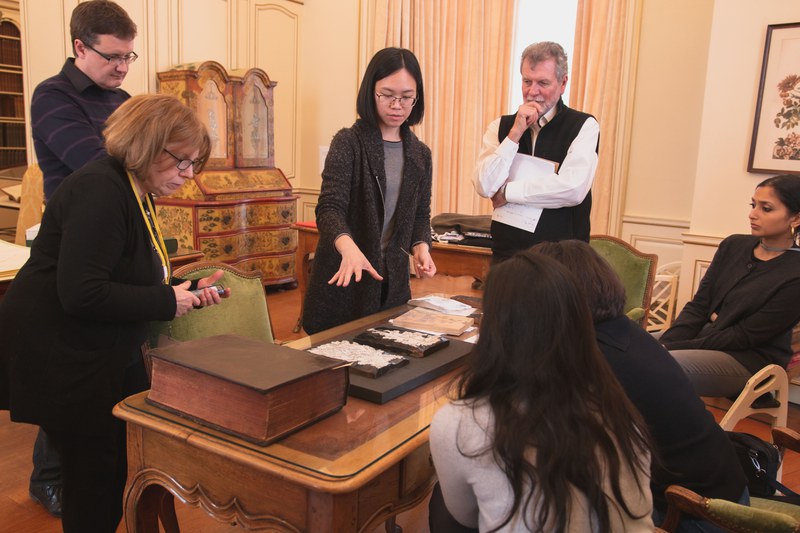
Following a model that is also being applied to other Dumbarton Oaks projects, the project team includes graduate students, post-doctoral researchers and staff. These scholars and digital humanists draw on the riches of the research library, the historic garden, and a rare book collection that is particularly strong in garden history, landscape architecture, botanical illustration, and plant history.
People
Staff

Yota Batsaki

Anatole Tchikine
Fellows

Emile Levesque-Jalbert

Erick Torres-Gonzalez

Kari Traylor
Past Fellows
- Nina Foster, Post-Baccalaureate Fellow, 2024–2025
- Genie Yoo, Post-Doctoral Fellow, 2024–2025
- Nina Ellkadi, Post-Baccalaureate Fellow, 2023–2024
- Lucas Mertehikian, Post-Doctoral Fellow, 2022–2023
- Julia Fine, Post-Baccalaureate Fellow, 2021–2022
- Kristan M. Hanson, 2020–2021 (Consulting Managing Editor, 2022–2023)
- Wouter Klein, 2020–2021
- Ashley Buchanan, 2019–2022
- Leib Celnik, Postgraduate Fellow in Botanical Art, 2019–2021
- Rebecca Friedel, 2019–2020
- Victoria Pickering, 2019–2020