


Request Quote
| Product | Product Code | SAFETY DATA | Technical data | |
|---|---|---|---|---|
(2N) 99% Tantalum Aluminide |
TA3-ALI-02 | SDS > | Data Sheet > | |
(3N) 99.9% Tantalum Aluminide |
TA3-ALI-03 | SDS > | Data Sheet > | |
(4N) 99.99% Tantalum Aluminide |
TA3-ALI-04 | SDS > | Data Sheet > | |
(5N) 99.999% Tantalum Aluminide |
TA3-ALI-05 | SDS > | Data Sheet > |
 Tantalum Aluminide is generally immediately available in most volumes. High purity, submicron and nanopowder forms may be considered. Aluminide compounds contain aluminum and one or more electropositive elements. Since aluminum is adjactent to the nonmetals on the periodic table, it forms compounds with properties intermediate between those of a metallic alloy and an ionic compound. Aluminides have found applications in hydrogen storage technology, industrial manufacturing, and in coatings for furnaces and other high temperature applications. In a recent series of hypergravity experiments, the European Space Agency (ESA) created a unique alloy of titanium aluminide whose light weight and durability may prove critical to the aeronautical industry. American Elements produces to many standard grades when applicable, including Mil Spec (military grade); ACS, Reagent and Technical Grade; Food, Agricultural and Pharmaceutical Grade; Optical Grade, USP and EP/BP (European Pharmacopoeia/British Pharmacopoeia) and follows applicable ASTM testing standards. Typical and custom packaging is available. Additional technical, research and safety (MSDS) information is available as is a Reference Calculator for converting relevant units of measurement.
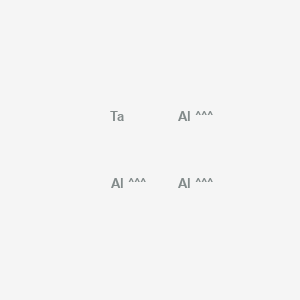
 | Compound Formula | Al3Ta |
|---|---|
| Molecular Weight | 261.892514 |
| Appearance | solid |
| Melting Point | N/A |
| Boiling Point | N/A |
| Density | N/A |
| Solubility in H2O | N/A |
| Exact Mass | 261.892611 |
| Monoisotopic Mass | 261.893005371094 Da |
| Signal Word | N/A |
|---|---|
| Hazard Statements | N/A |
| Hazard Codes | N/A |
| Risk Codes | N/A |
| Safety Statements | N/A |
| Transport Information | N/A |
| Linear Formula | Ta3Al |
|---|---|
| Pubchem CID | 6336851 |
| MDL Number | N/A |
| EC No. | 234-460-0 |
| IUPAC Name | aluminum; tantalum |
| Beilstein/Reaxys No. | N/A |
| SMILES | [AlH3].[AlH3].[AlH3].[Ta] |
| InchI Identifier | InChI=1S/3Al.Ta |
| InchI Key | LJVJDEGCVHBSKZ-UHFFFAOYSA-N |
| Chemical Formula | |
| Molecular Weight | |
| Standard InchI | |
| Appearance | |
| Melting Point | |
| Boiling Point | |
| Density |
Customer Reviews
Customers For Tantalum Aluminide Ta3Al Have Also Viewed
Related Applications, Forms & Industries for Tantalum Aluminide Ta3Al

Each business day American Elements' scientists & engineers post their choice for the most exciting materials science news of the day
See more Tantalum products. Tantalum (atomic symbol: Ta, atomic number: 73) is a Block D, Group 5, Period 6 element with an atomic weight of 180.94788.  The number of electrons in each of tantalum's shells is [2, 8, 18, 32, 11, 2] and its electron configuration is [Xe] 4f14 5d3 6s2. The tantalum atom has a radius of 146 pm and a Van der Waals radius of 217 pm.
  Tantalum was first discovered by Anders G. Ekeberg in 1802 in Uppsala, Sweden however, it was not until 1844 when Heinrich Rose first recognized it as a distinct element. In its elemental form, tantalum has a grayish blue appearance. Tantalum is found in the minerals tantalite, microlite, wodginite, euxenite, and polycrase. Due to the close relation of tantalum to niobium in the periodic table, Tantalum's name originates from the Greek word Tantalos meaning Father of Niobe in Greek mythology.
See more Aluminum products. Aluminum (or Aluminium) (atomic symbol: Al, atomic number: 13) is a Block P, Group 13, Period 3 element with an atomic weight of 26.9815386. It is the third most abundant element in the earth's crust and the most abundant metallic element.  Aluminum's name is derived from alumina, the mineral from which Sir Humphrey Davy attempted to refine it from in 1812. Aluminum was first predicted by Antoine Lavoisier 1787 and first isolated by Hans Christian Øersted in 1825. Aluminum is a silvery gray metal that possesses many desirable characteristics. It is light, nonmagnetic and non-sparking. It stands second among metals in the scale of malleability, and sixth in ductility. It is extensively used in many industrial applications where a strong, light, easily constructed material is needed.
  Although it has only 60% of the electrical conductivity of copper, it is used in electrical transmission lines because of its light weight. Pure aluminum is soft and lacks strength, but alloyed with small amounts of copper, magnesium, silicon, manganese, or other elements, it imparts a variety of useful properties.