
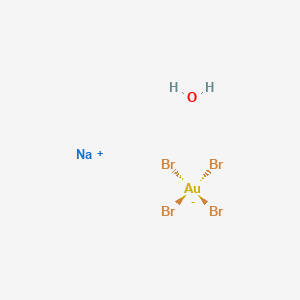


Sodium Tetrabromoaurate(III) Hydrate
Request Quote
| Product | Product Code | SAFETY DATA | Technical data | |
|---|---|---|---|---|
(2N) 99% Sodium Tetrabromoaurate(III) Hydrate |
NA-BRAU4-02-C.XHYD | SDS > | Data Sheet > | |
(2N5) 99.5% Sodium Tetrabromoaurate(III) Hydrate |
NA-BRAU4-025-C.XHYD | SDS > | Data Sheet > | |
(3N) 99.9% Sodium Tetrabromoaurate(III) Hydrate |
NA-BRAU4-03-C.XHYD | SDS > | Data Sheet > | |
(3N5) 99.95% Sodium Tetrabromoaurate(III) Hydrate |
NA-BRAU4-035-C.XHYD | SDS > | Data Sheet > | |
(4N) 99.99% Sodium Tetrabromoaurate(III) Hydrate |
NA-BRAU4-04-C.XHYD | SDS > | Data Sheet > | |
(5N) 99.999% Sodium Tetrabromoaurate(III) Hydrate |
NA-BRAU4-05-C.XHYD | SDS > | Data Sheet > |
| Compound Formula | H2AuBr4NaO |
|---|---|
| Molecular Weight | 557.59 |
| Appearance | Red to black crystals or powder |
| Melting Point | N/A |
| Boiling Point | N/A |
| Density | N/A |
| Solubility in H2O | Insoluble |
| Exact Mass | 557.636158 |
| Monoisotopic Mass | 553.640251 |
| Signal Word | Warning |
|---|---|
| Hazard Statements | H315-H319-H335 |
| Hazard Codes | Xi |
| Precautionary Statements | P261-P280-P305+P351+P338-P304+P340-P405-P501 |
| Risk Codes | 36/37/38 |
| Safety Statements | 26-36 |
| RTECS Number | N/A |
| Transport Information | NONH for all modes of transport |
| WGK Germany | 3 |
| GHS Pictogram |
Image

|
| Linear Formula | NaAuBr4 • xH2O |
|---|---|
| Pubchem CID | 71310037 |
| MDL Number | MFCD00274624 |
| EC No. | 257-962-1 |
| IUPAC Name | sodium; tetrabromogold(1-); hydrate |
| Beilstein/Reaxys No. | N/A |
| SMILES | O.[Na+].Br[Au-](Br)(Br)Br |
| InchI Identifier | InChI=1S/Au.4BrH.Na.H2O/h;4*1H;;1H2/q+3;;;;;+1;/p-4 |
| InchI Key | DCARRTFPXWVHEC-UHFFFAOYSA-J |
| Chemical Formula | |
| Molecular Weight | |
| Standard InchI | |
| Appearance | |
| Melting Point | |
| Boiling Point | |
| Density |
Customer Reviews
Customers For Sodium Tetrabromoaurate(III) Hydrate Have Also Viewed
Related Applications, Forms & Industries for Sodium Tetrabromoaurate(III) Hydrate

Each business day American Elements' scientists & engineers post their choice for the most exciting materials science news of the day
See more Bromine products. Bromine (atomic symbol: Br, atomic number: 35) is a Block P, Group 17, Period 4 element. Its electron configuration is [Ar]4s23d104p5. The bromine atom has a radius of 102 pm and its Van der Waals radius is 183 pm. In its elemental form, bromine  has a red-brown appearance. Bromine does not occur by itself in nature; it is found as colorless soluble crystalline mineral halide salts. Bromine was discovered and first isolated by Antoine Jérôme Balard and Leopold Gmelin in 1825-1826.
See more Gold products. Gold (atomic symbol: Au, atomic number: 79) is a Block D, Group 11, Period 6 element with an atomic weight of 196.966569. The number of electrons in each of Gold's shells is 2, 8, 18, 32, 18, 1 and its electron configuration is [Xe]4f142 5d10 6s1.  The gold atom has a radius of 144 pm and a Van der Waals radius of 217 pm. Gold was first discovered by Early Man prior to 6000 B.C. In its elemental form, gold has a metallic yellow appearance. Gold is a soft metal and is usually alloyed to give it more strength.
 It is a good conductor of heat and electricity, and is unaffected by air and most reagents. It is one of the least reactive chemical elements. Gold is often found as a free element and with silver as a gold-silver alloy. Less commonly, it is found in minerals as gold compounds, usually with tellurium.
 See more Sodium products. Sodium (atomic symbol: Na, atomic number: 11) is a Block D, Group 5, Period 4 element with an atomic weight of 22.989769. The number of electrons in each of Sodium's shells is [2, 8, 1] and its electron configuration is [Ne] 3s1. The sodium atom has a radius of 185.8 pm and a Van der Waals radius of 227 pm. Sodium was discovered and first isolated by Sir Humphrey Davy in 1807. In its elemental form, sodium has a silvery-white metallic appearance. It is the sixth most abundant element, making up 2.6 % of the earth's crust. Sodium does not occur in nature as a free element and must be extracted from its compounds (e.g., feldspars, sodalite, and rock salt). The name Sodium is thought to come from the Arabic word suda, meaning "headache" (due to sodium carbonate's headache-alleviating properties), and its elemental symbol Na comes from natrium, its Latin name.