


Molybdenum Oxide Nanoparticle Dispersion
Request Quote
| Product | Product Code | SAFETY DATA | Technical data | |
|---|---|---|---|---|
Molybdenum Oxide Nanoparticle Dispersion |
MO-OX-01-NPD | SDS > | Data Sheet > |
| Compound Formula | MoO3 |
|---|---|
| Molecular Weight | 143.94 |
| Appearance | Liquid |
| Melting Point | Varies by solvent |
| Boiling Point | Varies by solvent |
| Density | Varies by solvent |
| Solubility in H2O | N/A |
| Exact Mass | 145.89 |
| Monoisotopic Mass | 145.89 |
| Signal Word | Warning |
|---|---|
| Hazard Statements | H319-H335-H351 |
| Hazard Codes | Xn |
| Precautionary Statements | P261-P281-P305 + P351 + P338 |
| Flash Point | Not applicable |
| Risk Codes | 36/37-48/20/22 |
| Safety Statements | 22-23 |
| RTECS Number | QA4725000 |
| Transport Information | NONH |
| WGK Germany | 1 |
| GHS Pictogram |
Image

Image

|
| Linear Formula | MoO3 |
|---|---|
| Pubchem CID | 14802 |
| MDL Number | MFCD00003469 |
| EC No. | 215-204-7 |
| IUPAC Name | trioxomolybdenum |
| Beilstein/Reaxys No. | N/A |
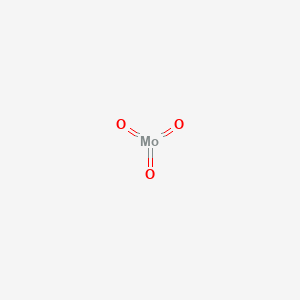
| SMILES | O=[Mo](=O)=O |
| InchI Identifier | InChI=1S/Mo.3O |
| InchI Key | JKQOBWVOAYFWKG-UHFFFAOYSA-N |
| Chemical Formula | |
| Molecular Weight | |
| Standard InchI | |
| Appearance | |
| Melting Point | |
| Boiling Point | |
| Density |
Customer Reviews
Customers For Molybdenum Oxide Nanoparticle Dispersion Have Also Viewed
Related Applications, Forms & Industries for Molybdenum Oxide Nanoparticle Dispersion

Each business day American Elements' scientists & engineers post their choice for the most exciting materials science news of the day
See more Molybdenum products. Molybdenum (atomic symbol: Mo, atomic number: 42) is a Block D, Group 6, Period 5 element with an atomic weight of 95.96.  The number of electrons in each of molybdenum's shells is [2, 8, 18, 13, 1] and its electron configuration is [Kr] 4d5 5s1. The molybdenum atom has a radius of 139 pm and a Van der Waals radius of 209 pm. In its elemental form, molybdenum has a gray metallic appearance. Molybdenum was discovered by Carl Wilhelm in 1778 and first isolated by Peter Jacob Hjelm in 1781. Molybdenum is the 54th most abundant element in the earth's crust.
  It has the third highest melting point of any element, exceeded only by tungsten and tantalum. Molybdenum does not occur naturally as a free metal, it is found in various oxidation states in minerals. The primary commercial source of molybdenum is molybdenite, although it is also recovered as a byproduct of copper and tungsten mining. The origin of the name Molybdenum comes from the Greek word molubdos meaning lead.