


Magnesium Iron Oxide Nanoparticles / Nanopowder
Request Quote
| Product | Product Code | SAFETY DATA | Technical data | |
|---|---|---|---|---|
(2N) 99% Magnesium Iron Oxide Nanopowder |
MG-FEO-02-NP | SDS > | Data Sheet > | |
(3N) 99.9% Magnesium Iron Oxide Nanopowder |
MG-FEO-03-NP | SDS > | Data Sheet > | |
(4N) 99.99% Magnesium Iron Oxide Nanopowder |
MG-FEO-04-NP | SDS > | Data Sheet > | |
(5N) 99.999% Magnesium Iron Oxide Nanopowder |
MG-FEO-05-NP | SDS > | Data Sheet > |
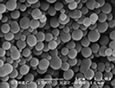 Magnesium Iron Oxide Nanoparticles nanodots or nanopowder are spinel, high surface area particles. Nanoscale Magnesium Iron Oxide Nanoparticles or Magnesia Particles are typically 5 - 100 nanometers (nm) with specific surface area (SSA) in the 25 - 50 m2/g range. Nano Magnesium Iron Oxide Particles are also available in Ultra high purity and high purity and coated and dispersed forms. They are also available as a dispersion through the AE Nanofluid production group. Nanofluids are generally defined as suspended nanoparticles in solution either using surfactant or surface charge technology. Nanofluid dispersion and coating selection technical guidance is also available. Other nanostructures include nanorods, nanowhiskers, nanohorns, nanopyramids and other nanocomposites. Surface functionalized nanoparticles allow for the particles to be preferentially adsorbed at the surface interface using chemically bound polymers.
 | Compound Formula | Fe2MgO4 |
|---|---|
| Molecular Weight | 199.99 |
| Appearance | Powder |
| Melting Point | N/A |
| Boiling Point | N/A |
| Density | N/A |
| Solubility in H2O | N/A |
| Exact Mass | 199.834575 |
| Monoisotopic Mass | 199.834575 |
| Signal Word | N/A |
|---|---|
| Hazard Statements | N/A |
| Hazard Codes | N/A |
| Risk Codes | N/A |
| Safety Statements | N/A |
| Transport Information | N/A |
| Linear Formula | MgFe2O4 |
|---|---|
| Pubchem CID | 61548 |
| MDL Number | N/A |
| EC No. | 235-107-3 |
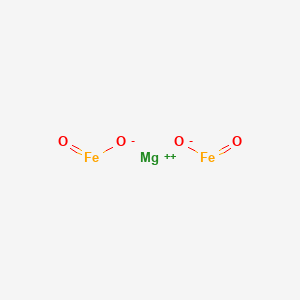
| IUPAC Name | magnesium; oxido(oxo)iron |
| Beilstein/Reaxys No. | N/A |
| SMILES | [O-][Fe]=O.[O-][Fe]=O.[Mg+2] |
| InchI Identifier | InChI=1S/2Fe.Mg.4O/q;;+2;;;2*-1 |
| InchI Key | WJUZJQANVVSKHX-UHFFFAOYSA-N |
| Chemical Formula | |
| Molecular Weight | |
| Standard InchI | |
| Appearance | |
| Melting Point | |
| Boiling Point | |
| Density |
Customer Reviews
Customers For Magnesium Iron Oxide Nanoparticles / Nanopowder Have Also Viewed
Related Applications, Forms & Industries for Magnesium Iron Oxide Nanoparticles / Nanopowder

Each business day American Elements' scientists & engineers post their choice for the most exciting materials science news of the day
See more Iron products. Iron (atomic symbol: Fe, atomic number: 26) is a Block D, Group 8, Period 4 element with an atomic weight of 55.845. The number of electrons in each of Iron's shells is 2, 8, 14, 2 and its electron configuration is [Ar] 3d6 4s2.  The iron atom has a radius of 126 pm and a Van der Waals radius of 194 pm. Iron was discovered by humans before 5000 BC. In its elemental form, iron has a lustrous grayish metallic appearance. Iron is the fourth most common element in the Earth's crust and the most common element by mass forming the earth as a whole. Iron is rarely found as a free element, since it tends to oxidize easily; it is usually found in minerals such as magnetite, hematite, goethite, limonite, or siderite.
 Though pure iron is typically soft, the addition of carbon creates the alloy known as steel, which is significantly stronger.
 See more Magnesium products. Magnesium (atomic symbol: Mg, atomic number: 12) is a Block S, Group 2, Period 3 element with an atomic mass of 24.3050. The number of electrons in each of Magnesium's shells is [2, 8, 2] and its electron configuration is [Ne] 3s2. The magnesium atom has a radius of 160 pm and a Van der Waals radius of 173 pm. Magnesium was discovered by Joseph Black in 1775 and first isolated by Sir Humphrey Davy in 1808. Magnesium is the eighth most abundant element in the earth's crust and the fourth most common element in the earth as a whole.
  In its elemental form, magnesium has a shiny grey metallic appearance and is an extremely reactive. It is can be found in minerals such as brucite, carnallite, dolomite, magnesite, olivine and talc. Commercially, magnesium is primarily used in the creation of strong and lightweight aluminum-magnesium alloys, which have numerous advantages in industrial applications. The name "Magnesium" originates from a Greek district in Thessaly called Magnesia.