
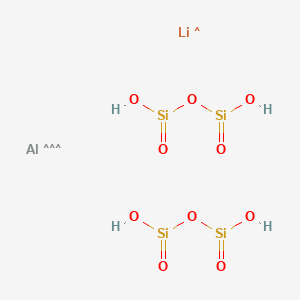


Lithium Aluminum Silicate (Petalite)
Request Quote
| Product | Product Code | SAFETY DATA | Technical data | |
|---|---|---|---|---|
Lithium Aluminum Silicate (Petalite) |
LI-ALSIAT-01-C | SDS > | Data Sheet > |
| Compound Formula | AlLiO10Si4 |
|---|---|
| Molecular Weight | 306.26 |
| Appearance | Solid |
| Melting Point | N/A |
| Boiling Point | N/A |
| Density | N/A |
| Solubility in H2O | N/A |
| Exact Mass | 309.885696 g/mol |
| Monoisotopic Mass | 309.885696 g/mol |
| Signal Word | N/A |
|---|---|
| Hazard Statements | N/A |
| Hazard Codes | N/A |
| Risk Codes | N/A |
| Safety Statements | N/A |
| Transport Information | NONH for all modes of transport |
| Linear Formula | LiAl(Si2O5)2 |
|---|---|
| Pubchem CID | 6338030 |
| EC No. | 215-104-3 |
| IUPAC Name | aluminum; hydroxy-[hydroxy(oxo)silyl]oxy-oxosilane; lithium |
| Beilstein/Reaxys No. | |
| SMILES | [Li].O[Si](=O)O[Si](=O)O.O[Si](=O)O[Si](=O)O.[Al] |
| InchI Identifier | InChI=1S/Al.Li.2H2O5Si2/c;;2*1-6(2)5-7(3)4/h;;2*1,3H |
| InchI Key | HEHRHMRHPUNLIR-UHFFFAOYSA-N |
| Chemical Formula | |
| Molecular Weight | |
| Standard InchI | |
| Appearance | |
| Melting Point | |
| Boiling Point | |
| Density |
Customer Reviews
Customers For Lithium Aluminum Silicate (Petalite) Have Also Viewed
Related Applications, Forms & Industries for Lithium Aluminum Silicate (Petalite)

Each business day American Elements' scientists & engineers post their choice for the most exciting materials science news of the day
See more Aluminum products. Aluminum (or Aluminium) (atomic symbol: Al, atomic number: 13) is a Block P, Group 13, Period 3 element with an atomic weight of 26.9815386. It is the third most abundant element in the earth's crust and the most abundant metallic element.  Aluminum's name is derived from alumina, the mineral from which Sir Humphrey Davy attempted to refine it from in 1812. Aluminum was first predicted by Antoine Lavoisier 1787 and first isolated by Hans Christian Øersted in 1825. Aluminum is a silvery gray metal that possesses many desirable characteristics. It is light, nonmagnetic and non-sparking. It stands second among metals in the scale of malleability, and sixth in ductility. It is extensively used in many industrial applications where a strong, light, easily constructed material is needed.
  Although it has only 60% of the electrical conductivity of copper, it is used in electrical transmission lines because of its light weight. Pure aluminum is soft and lacks strength, but alloyed with small amounts of copper, magnesium, silicon, manganese, or other elements, it imparts a variety of useful properties.
 See more Lithium products. Lithium (atomic symbol: Li, atomic number: 3) is a Block S, Group 1, Period 2 element with an atomic weight of 6.94. The number of electrons in each of Lithium's shells is [2, 1] and its electron configuration is [He] 2s1. The lithium atom has a radius of 152 pm and a Van der Waals radius of 181 pm. Lithium was discovered by Johann Arvedson in 1817 and first isolated by William Thomas Brande in 1821. The origin of the name Lithium comes from the Greek wordlithose which means "stone." Lithium is a member of the alkali group of metals. It has the highest specific heat and electrochemical potential of any element on the period table and the lowest density of any elements that are solid at room temperature.
  Compared to other metals, it has one of the lowest boiling points. In its elemental form, lithium is soft enough to cut with a knife its silvery white appearance quickly darkens when exposed to air. Because of its high reactivity, elemental lithium does not occur in nature. Lithium is the key component of lithium-ion battery technology, which is becoming increasingly more prevalent in electronics.
See more Silicon products. Silicon (atomic symbol: Si, atomic number: 14) is a Block P, Group 14, Period 3 element with an atomic weight of 28.085.  The number of electrons in each of Silicon's shells is 2, 8, 4 and its electron configuration is [Ne] 3s2 3p2. The silicon atom has a radius of 111 pm and a Van der Waals radius of 210 pm. Silicon was discovered and first isolated by Jöns Jacob Berzelius in 1823. Silicon makes up 25.7% of the earth's crust, by weight, and is the second most abundant element, exceeded only by oxygen. The metalloid is rarely found in pure crystal form and is usually produced from the iron-silicon alloy ferrosilicon.
  Silica (or silicon dioxide), as sand, is a principal ingredient of glass, one of the most inexpensive of materials with excellent mechanical, optical, thermal, and electrical properties. Ultra high purity silicon can be doped with boron, gallium, phosphorus, or arsenic to produce silicon for use in transistors, solar cells, rectifiers, and other solid-state devices which are used extensively in the electronics industry.The name Silicon originates from the Latin word silex which means flint or hard stone.