
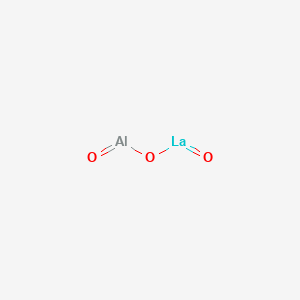


Lanthanum Aluminum Oxide Sputtering Target
Request Quote
| Product | Product Code | SAFETY DATA | Technical data | |
|---|---|---|---|---|
(2N) 99% LaAlO3 Sputtering Target |
LA-ALO-02-ST-LaAl03ST | SDS > | Data Sheet > | |
(3N) 99.9% LaAlO3 Sputtering Target |
LA-ALO-03-ST-LaAl03ST | SDS > | Data Sheet > | |
(4N) 99.99% LaAlO3 Sputtering Target |
LA-ALO-04-ST-LaAl03ST | SDS > | Data Sheet > | |
(5N) 99.999% LaAlO3 Sputtering Target |
LA-ALO-05-ST-LaAl03ST | SDS > | Data Sheet > |
 American Elements specializes in producing high purity Lanthanum Aluminum Oxide Sputtering Targets with the highest possible density
  and smallest possible average grain sizes for use in semiconductor, chemical vapor deposition (CVD) and physical vapor deposition (PVD) display and optical applications. Our standard Sputtering Targets for thin film are available monoblock or bonded with planar target dimensions and configurations up to 820 mm with hole drill locations and threading, beveling, grooves and backing designed to work with both older sputtering devices as well as the latest process equipment, such as large area coating for solar energy or fuel cells and flip-chip applications. We offer all shapes and configurations of targets compatible with all standard guns including circular, rectangular, annular, oval, "dog-bone," rotatable (rotary), multi-tiled and others in standard, custom, and research sized dimensions. All targets are analyzed using best demonstrated techniques including X-Ray Fluorescence (XRF), Glow Discharge Mass Spectrometry (GDMS), and Inductively Coupled Plasma (ICP). "Sputtering" allows for thin film deposition of an ultra high purity sputtering metallic or oxide material onto another solid substrate by the controlled removal and conversion of the target material into a directed gaseous/plasma phase through ionic bombardment. Materials are produced using crystallization, solid state and other ultra high purification processes such as sublimation. American Elements specializes in producing custom compositions for commercial and research applications and for new proprietary technologies. American Elements also casts any of the rare earth metals and most other advanced materials into rod, bar, or plate form, as well as other machined shapes and through other processes such as nanoparticles and in the form of solutions and organometallics.
 | Compound Formula | LaAlO3 |
|---|---|
| Molecular Weight | 213.89 |
| Appearance | solid |
| Melting Point | N/A |
| Boiling Point | N/A |
| Density | 6.52 g/cm3 |
| Solubility in H2O | N/A |
| Exact Mass | 213.87263 |
| Monoisotopic Mass | 213.87263 |
| Signal Word | N/A |
|---|---|
| Hazard Statements | N/A |
| Hazard Codes | N/A |
| Risk Codes | N/A |
| Safety Statements | N/A |
| Transport Information | N/A |
| Linear Formula | LaAlO3 |
|---|---|
| Pubchem CID | 16217677 |
| MDL Number | MFCD00144550 |
| EC No. | 234-433-3 |
| IUPAC Name | oxo-oxoalumanyl oxylanthanum |
| Beilstein/Reaxys No. | N/A |
| SMILES | O=[Al]O[La]=O |
| InchI Identifier | InChI=1S/Al.La.3O |
| InchI Key | KJXBRHIPHIVJCS-UHFFFAOYSA-N |
| Chemical Formula | |
| Molecular Weight | |
| Standard InchI | |
| Appearance | |
| Melting Point | |
| Boiling Point | |
| Density |
Customer Reviews
Customers For Lanthanum Aluminum Oxide Sputtering Target Have Also Viewed
Related Applications, Forms & Industries for Lanthanum Aluminum Oxide Sputtering Target

Each business day American Elements' scientists & engineers post their choice for the most exciting materials science news of the day
See more Aluminum products. Aluminum (or Aluminium) (atomic symbol: Al, atomic number: 13) is a Block P, Group 13, Period 3 element with an atomic weight of 26.9815386. It is the third most abundant element in the earth's crust and the most abundant metallic element.  Aluminum's name is derived from alumina, the mineral from which Sir Humphrey Davy attempted to refine it from in 1812. Aluminum was first predicted by Antoine Lavoisier 1787 and first isolated by Hans Christian Øersted in 1825. Aluminum is a silvery gray metal that possesses many desirable characteristics. It is light, nonmagnetic and non-sparking. It stands second among metals in the scale of malleability, and sixth in ductility. It is extensively used in many industrial applications where a strong, light, easily constructed material is needed.
  Although it has only 60% of the electrical conductivity of copper, it is used in electrical transmission lines because of its light weight. Pure aluminum is soft and lacks strength, but alloyed with small amounts of copper, magnesium, silicon, manganese, or other elements, it imparts a variety of useful properties.
See more Lanthanum products. Lanthanum (atomic symbol: La, atomic number: 57) is a Block F, Group 3, Period 6 element with an atomic weight of 138.90547.  The number of electrons in each of lanthanum's shells is [2, 8, 18, 18, 9, 2] and its electron configuration is [Xe] 5d1 6s2. The lanthanum atom has a radius of 187 pm and a Van der Waals radius of 240 pm. Lanthanum was first discovered by Carl Mosander in 1838. In its elemental form, lanthanum has a silvery white appearance.
 It is a soft, malleable, and ductile metal that oxidizes easily in air. Lanthanum is the first element in the rare earth or lanthanide series. It is the model for all the other trivalent rare earths and it is the second most abundant of the rare earths after cerium. Lanthanum is found in minerals such as monazite and bastnasite. The name lanthanum originates from the Greek word Lanthaneia, which means 'to lie hidden'.