
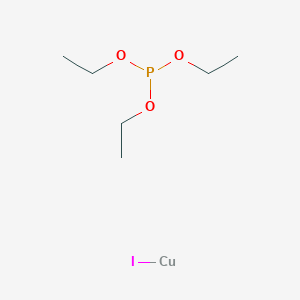


Iodo(triethyl phosphite)copper(I)
Request Quote
| Product | Product Code | SAFETY DATA | Technical data | |
|---|---|---|---|---|
97% Iodo(triethyl phosphite)copper(I) |
CUI-TPL-01 | SDS > | Data Sheet > |
| Compound Formula | C6H16CuIO3P |
|---|---|
| Molecular Weight | 356.6 |
| Appearance | solid |
| Melting Point | 110-116 °C |
| Boiling Point | N/A |
| Density | N/A |
| Solubility in H2O | N/A |
| Exact Mass | 355.909951 g/mol |
| Monoisotopic Mass | 355.909951 g/mol |
| Charge | 0 |
| Signal Word | Warning |
|---|---|
| Hazard Statements | H315-H319-H335 |
| Hazard Codes | N/A |
| Risk Codes | N/A |
| Safety Statements | N/A |
| Transport Information | N/A |
| WGK Germany | 3 |
| Linear Formula | C6H16CuIO3P |
|---|---|
| Pubchem CID | 11783241 |
| MDL Number | MFCD00074947 |
| EC No. | N/A |
| IUPAC Name | iodocopper; triethyl phosphite |
| Beilstein/Reaxys No. | |
| SMILES | CCOP(OCC)OCC.[Cu]I |
| InchI Identifier | InChI=1S/C6H15O3P.Cu.HI/c1-4-7-10(8-5-2)9-6-3;;/h4-6H2,1-3H3;;1H/q;+1;/p-1 |
| InchI Key | IVPQRWLSGJFSTC-UHFFFAOYSA-M |
| Chemical Formula | |
| Molecular Weight | |
| Standard InchI | |
| Appearance | |
| Melting Point | |
| Boiling Point | |
| Density |
Customer Reviews
Customers For Iodo(triethyl phosphite)copper(I) Have Also Viewed
Related Applications, Forms & Industries for Iodo(triethyl phosphite)copper(I)

Each business day American Elements' scientists & engineers post their choice for the most exciting materials science news of the day
See more Copper products.  Copper (atomic symbol: Cu, atomic number: 29) is a Block D, Group 11, Period 4 element with an atomic weight of 63.546. The number of electrons in each of copper's shells is 2, 8, 18, 1 and its electron configuration is [Ar]3d10 4s1. The copper atom has a radius of 128 pm and a Van der Waals radius of 186 pm. Copper was first discovered by Early Man prior to 9000 BC. In its elemental form, copper has a reddish-orange metallic and lustrous appearance. Of all pure metals, only silver
  has a higher electrical conductivity. The origin of the word copper comes from the Latin word 'cuprium' which translates as "metal of Cyprus," as the Mediterranean island of Cyprus was known as an ancient source of mined copper.
See more Iodine products. Iodine (atomic symbol: I, atomic number: 53) is a Block P, Group 17, Period 5 element with an atomic radius of 126.90447. The number of electrons in each of Iodine's shells is 2, 8, 18, 18, 7 and its electron configuration is [Kr] 4d10 5s2 5p5. The iodine atom has a radius of 140 pm and a Van der Waals radius of 198 pm. In its elemental form, iodine has a lustrous metallic gray appearance as a solid and a violet appearance as a gas or liquid solution.  Iodine forms compounds with many elements, but is less active than the other halogens. It dissolves readily in chloroform, carbon tetrachloride, or carbon disulfide. Iodine compounds are important in organic chemistry and very useful in the field of medicine. Iodine was discovered and first isolated by Bernard Courtois in 1811. The name Iodine is derived from the Greek word "iodes" meaning violet.
 See more Phosphorus products. Phosphorus (atomic symbol: P, atomic number: 15) is a Block P, Group 15, Period 3 element. The number of electrons in each of Phosphorus's shells is 2, 8, 5 and its electronic configuration is [Ne] 3s2 3p3. The phosphorus atom has a radius of 110.5.pm and its Van der Waals radius is 180.pm. Phosphorus is a highly-reactive non-metallic element (sometimes considered a metalloid) with two primary allotropes, white phosphorus and red phosphorus its black flaky appearance is similar to graphitic carbon. Compound forms of phosphorus include phosphates and phosphides. Phosphorous was first recognized as an element by Hennig Brand in 1669 its name (phosphorus mirabilis, or "bearer of light") was inspired from the brilliant glow emitted by its distillation.