


Germanium(IV) Selenide Sputtering Target
Request Quote
| Product | Product Code | SAFETY DATA | Technical data | |
|---|---|---|---|---|
(2N) 99% Germanium(IV) Selenide Sputtering Target |
GE4-SE-02-ST | SDS > | Data Sheet > | |
(3N) 99.9% Germanium(IV) Selenide Sputtering Target |
GE4-SE-03-ST | SDS > | Data Sheet > | |
(4N) 99.99% Germanium(IV) Selenide Sputtering Target |
GE4-SE-04-ST | SDS > | Data Sheet > | |
(5N) 99.999% Germanium(IV) Selenide Sputtering Target |
GE4-SE-05-ST | SDS > | Data Sheet > |
| Compound Formula | GeSe2 |
|---|---|
| Molecular Weight | 230.6 |
| Appearance | Solid |
| Melting Point | N/A |
| Boiling Point | N/A |
| Density | 4.56 g/cm3 |
| Solubility in H2O | N/A |
| Exact Mass | 233.754222 |
| Monoisotopic Mass | 233.754227 Da |
| Signal Word | N/A |
|---|---|
| Hazard Statements | N/A |
| Hazard Codes | N/A |
| Risk Codes | N/A |
| Safety Statements | N/A |
| Transport Information | N/A |
| GHS Pictogram |
Image

Image

Image

|
| Linear Formula | GeSe2 |
|---|---|
| Pubchem CID | 82903 |
| MDL Number | MFCD00016116 |
| EC No. | 235-063-5 |
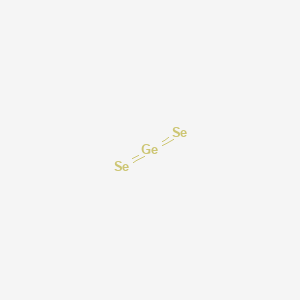
| IUPAC Name | bis(selanylidene)germane |
| Beilstein/Reaxys No. | N/A |
| SMILES | [Se]=[Ge]=[Se] |
| InchI Identifier | InChI=1S/GeSe2/c2-1-3 |
| InchI Key | WYDSCDJEAVCHQJ-UHFFFAOYSA-N |
| Chemical Formula | |
| Molecular Weight | |
| Standard InchI | |
| Appearance | |
| Melting Point | |
| Boiling Point | |
| Density |
Customer Reviews
Customers For Germanium(IV) Selenide Sputtering Target Have Also Viewed
Related Applications, Forms & Industries for Germanium(IV) Selenide Sputtering Target

Each business day American Elements' scientists & engineers post their choice for the most exciting materials science news of the day
See more Germanium products. Germanium (atomic symbol: Ge, atomic number: 32) is a Block P, Group 14, Period 4 element with an atomic weight of 72.63.  The number of electrons in each of germanium's shells is 2, 8, 18, 4 and its electron configuration is [Ar] 3d10 4s2 4p2. The germanium atom has a radius of 122.5 pm and a Van der Waals radius of 211 pm. Germanium was first discovered by Clemens Winkler in 1886. In its elemental form, germanium is a brittle grayish white semi-metallic element. Germanium is too reactive to be found naturally on Earth in its native state.
  It is commercially obtained from zinc ores and certain coals. It is also found in argyrodite and germanite. It is used extensively as a semiconductor in transitors, solar cells, and optical materials. Other applications include acting an alloying agent, as a phosphor in fluorescent lamps, and as a catalyst. The name Germanium originates from the Latin word "Germania" meaning "Germany."
 See more Selenium products. Selenium (atomic symbol: Se, atomic number: 34) is a Block P, Group 16, Period 4 element with an atomic radius of 78.96. The number of electrons in each of Selenium's shells is 2, 8, 18, 6 and its electron configuration is [Ar] 3d10 4s2 4p4. The selenium atom has a radius of 120 pm and a Van der Waals radius of 190 pm. Selenium is a non-metal with several allotropes: a black, vitreous form with an irregular crystal structure three red-colored forms with monoclinic crystal structures and a gray form with a hexagonal crystal structure, the most stable and dense form of the element.
  One of the most common uses for selenium is in glass production the red tint that it lends to glass neutralizes green or yellow tints from impurities in the glass materials. Selenium was discovered and first isolated by Jöns Jakob Berzelius and Johann Gottlieb Gahn in 1817. The origin of the name Selenium comes from the Greek word "Selênê," meaning moon.