
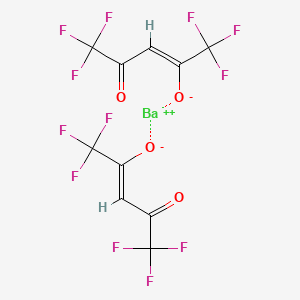


Barium Hexafluoroacetylacetonate
Request Quote
| Product | Product Code | SAFETY DATA | Technical data | |
|---|---|---|---|---|
Barium Hexafluoroacetylacetonate |
BA-FACA-01-C | SDS > | Data Sheet > |
| Compound Formula | C10H2F12O4Ba |
|---|---|
| Molecular Weight | 551.44 |
| Appearance | White powder |
| Melting Point | 220-250 °C |
| Boiling Point | N/A |
| Density | N/A |
| Solubility in H2O | Insoluble |
| Exact Mass | 551.881394 g/mol |
| Monoisotopic Mass | 551.881394 g/mol |
| Charge | 0 |
| Signal Word | Warning |
|---|---|
| Hazard Statements | H302 |
| Hazard Codes | Xi |
| Risk Codes | N/A |
| Safety Statements | N/A |
| Transport Information | UN1564 6.1/PG III |
| WGK Germany | 1 |
| Linear Formula | (C5HO2F6)2Ba |
|---|---|
| Pubchem CID | 6260720 |
| MDL Number | MFCD00075633 |
| IUPAC Name | barium(2+); (Z)-1,1,1,5,5,5-hexafluoro-4-oxopent-2-en-2-olate |
| Beilstein/Reaxys No. | |
| SMILES | C(=C(C(F)(F)F)[O-])C(=O)C(F)(F)F.C(=C(C(F)(F)F)[O-])C(=O)C(F)(F)F.[Ba+2] |
| InchI Identifier | InChI=1S/2C5H2F6O2.Ba/c2*6-4(7,8)2(12)1-3(13)5(9,10)11;/h2*1,12H;/q;;+2/p-2/b2*2-1-; |
| InchI Key | WUXISMDFUAVWSS-PAMPIZDHSA-L |
| Chemical Formula | |
| Molecular Weight | |
| Standard InchI | |
| Appearance | |
| Melting Point | |
| Boiling Point | |
| Density |
Customer Reviews
Customers For Barium Hexafluoroacetylacetonate Have Also Viewed
Related Applications, Forms & Industries for Barium Hexafluoroacetylacetonate

Each business day American Elements' scientists & engineers post their choice for the most exciting materials science news of the day
See more Barium products. Barium (atomic symbol: Ba, atomic number: 56) is a Block S, Group 2, Period 6 element with an atomic weight of 137.27. The number of electrons in each of barium's shells is [2, 8, 18, 18, 8, 2] and its electron configuration is [Xe] 6s2.  Barium is a member of the alkaline-earth metals. The barium atom has a radius of 222 pm and a Van der Waals radius of 268 pm. Barium was discovered by Carl Wilhelm Scheele in 1772 and first isolated by Humphry Davy in 1808.
  In its elemental form, barium is a soft, silvery-gray metal. Industrial applications for barium include acting as a "getter," or unwanted gas remover, for vacuum tubes, and as an additive to steel and cast iron. Barium is also alloyed with silicon and aluminum in load-bearing alloys. The main commercial source of barium is the mineral barite (BaSO4); it does not occur naturally as a free element . The name barium is derived from the Greek word "barys," meaning heavy.
Fluorine is a Block P, Group 17, Period 2 element. Its electron configuration is [He]2s22p5. The fluorine atom has a covalent radius of 64 pm and its Van der Waals radius is 135 pm. In its elemental form, CAS 7782-41-4, fluorine gas has a pale yellow appearance. Fluorine was discovered by André-Marie Ampère in 1810. It was first isolated by Henri Moissan in 1886.